On this page
- Why RBI rewrote its recovery agent rules
- Which lenders the directions cover
- When a recovery agent may call or visit
- What recovery agents may say, and to whom
- Recording, call logs and the duties behind each call
- How to complain about a recovery agent
- Can an AI voice agent make recovery calls?
- Key dates
- Sources
Why RBI rewrote its recovery agent rules
RBI has regulated how lenders chase overdue loans for years. A circular of 24 April 2008 set rules for how banks use recovery agents, and a circular of 12 August 2022 barred recovery calls before 8 am and after 7 pm for most types of lender. What RBI had not done was give every lender the same detailed rulebook.
When it proposed the new framework, RBI noted that its detailed instructions on recovery agents had been "issued to Scheduled Commercial Banks (excluding Regional Rural Banks) and Housing Finance Companies" only. Duties such as vetting agencies, training agents and holding them to a code of conduct therefore depended on which kind of lender held the loan. After a review announced in its Statement on Developmental and Regulatory Policies of 6 February 2026, RBI decided to issue comprehensive instructions to every regulated lender (RBI press release, 12 February 2026).
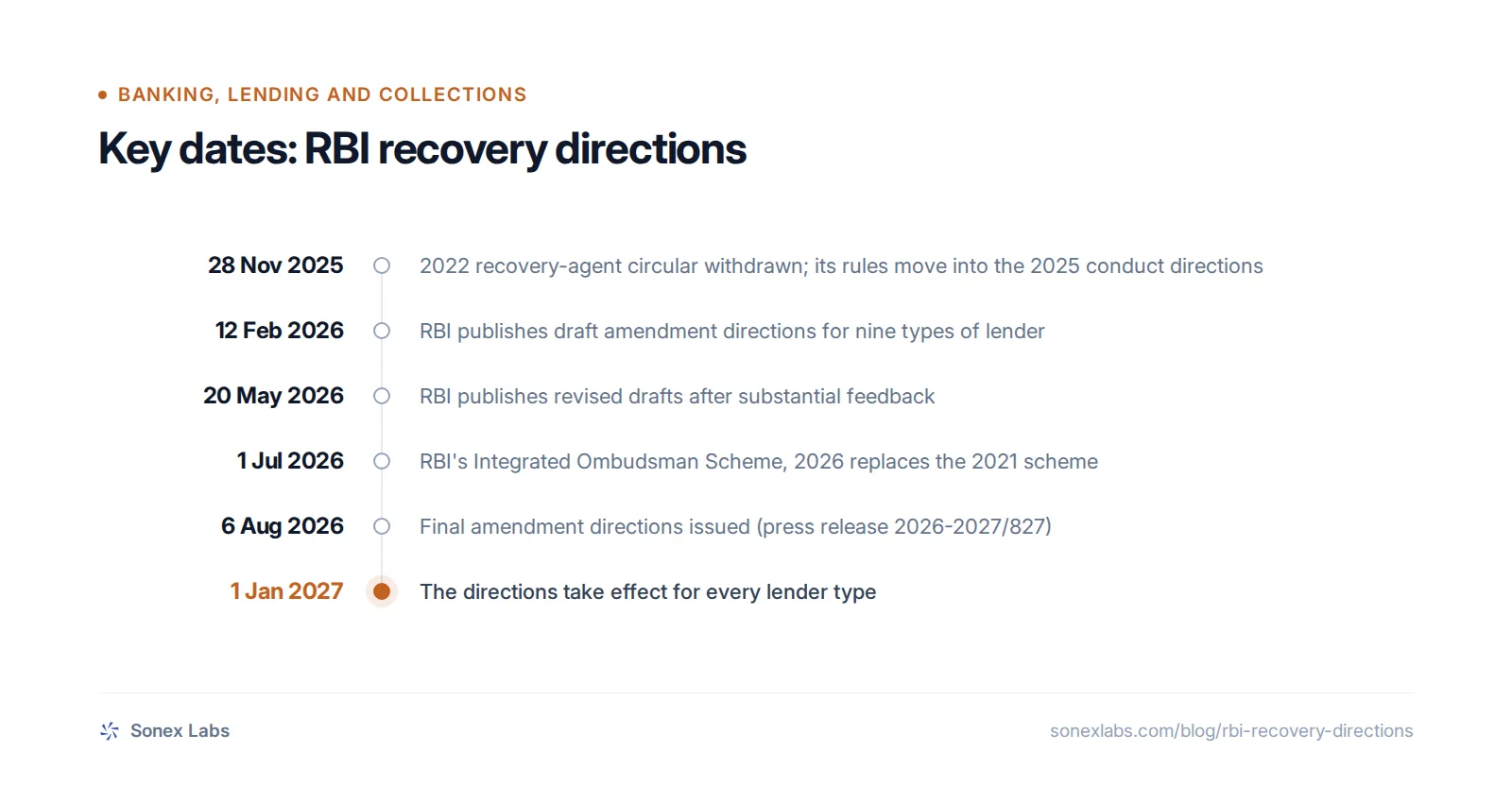
The result is nine amendment directions, published on 6 August 2026 and announced together, all taking effect on 1 January 2027 (RBI press release 2026-2027/827). Each adds a section on recovering loans and engaging recovery agencies to that lender's Responsible Business Conduct (RBC) Directions, 2025, which are RBI's rulebooks on how lenders treat customers. The call rules use the same wording in all nine. The housing finance direction simply applies the NBFC text, and otherwise only the lender's name and the paragraph numbers differ.
Two terms run through the text. A recovery agency is any outside firm or person a lender engages to recover dues from a borrower in default, whatever the contract calls it. A recovery agent is the agency's representative who deals with the borrower. The rules also bind the lender's own employees who work on recovery, so moving collections in-house does not take a lender outside them (para C).
The rules that apply until 1 January 2027
Until the new directions start, the current rules apply, and they already cover much of the same ground. They bar recovery calls before 8 am and after 7 pm, and they ban threats, abuse and persistent calling (NBFC RBC Directions, 2025, para 100; para 445 for commercial banks). These rules began in the 2022 circular, which RBI withdrew on 28 November 2025 when it moved its contents into the 2025 RBC Directions.
Microfinance loans have a narrower window today: no recovery calls before 9 am or after 6 pm (NBFC para 91(2); para 410(2) for commercial banks). The 2026 amendments delete those paragraphs, so from 1 January 2027 microfinance recovery follows the same 08:00 to 19:00 window as every other loan. That gives microfinance collectors two more hours a day, although collection still happens at a central place agreed with the borrower (para Y(7)).
Two drafts, and start dates that never took effect
The final text took two rounds of consultation. RBI published draft directions on 12 February 2026 with a proposed start of 1 July 2026. It then published revised drafts on 20 May 2026, after what it described as substantial feedback, with a proposed start of 1 October 2026.
In August RBI said it had examined the feedback on the revised drafts and built the resulting changes into the final directions. Neither draft date took effect, so pages that still give 1 July or 1 October 2026 as the start date are describing a draft.
Which lenders the directions cover
Because RBI wrote one direction per lender type, the first practical question is which one applies to you. Every main type of RBI-regulated lender is covered except payments banks. They appear in none of the nine directions, and they were not among the lender types in the February 2026 draft either.
Housing finance companies (HFCs) get a short amendment that applies the NBFC (non-banking financial company) paragraphs to them (para 170A). The NBFC direction leaves out mortgage guarantee companies, core investment companies, account aggregators, standalone primary dealers, non-operative financial holding companies and NBFCs with no customer interface. Most of these do not deal with retail borrowers, which is the likely reason they are excluded.
Every direction uses the same paragraph letters, so this guide cites the letter only, such as para Y(4) for the calling window. To find the full reference, put your base number from the table in front of it. Para Y(4) is 100Y(4) for an NBFC, 454Y(4) for a commercial bank and 437Y(4) for a regional rural bank.
| Lender type | Direction | New paragraphs |
|---|---|---|
| Commercial banks (other than small finance, payments, regional rural and local area banks)Source: RBI/2026-27/223; DOR.MCS.REC.No.193/01-01-032/2026-27 | Commercial Banks – RBC Fourth Amendment Directions, 2026 | Section L, paras 454A–454AB |
| Small finance banks (SFBs)Source: RBI/2026-2027/224; DOR.MCS.REC.No.194/01-01-033/2026-27 | Small Finance Banks – RBC Fourth Amendment Directions, 2026 | Section L, paras 454A–454AB |
| Local area banks (LABs)Source: RBI/2026-27/225; DOR.MCS.REC.No.195/01-01-035/2026-27 | Local Area Banks – RBC Fourth Amendment Directions, 2026 | Section H, paras 235A–235AB |
| Regional rural banks (RRBs)Source: RBI/2026-2027/226; DOR.MCS.REC.No.196/01-01-036/2026-27 | Regional Rural Banks – RBC Fourth Amendment Directions, 2026 | Section J, paras 437A–437AB |
| Urban co-operative banks (UCBs)Source: RBI/2026-27/227; DOR.MCS.REC.No.197/01-01-037/2026-27 | Urban Co-operative Banks – RBC Fourth Amendment Directions, 2026 | Section J, paras 325A–325AB |
| Rural co-operative banks (RCBs)Source: RBI/2026-2027/228; DOR.MCS.REC.No.198/01-01-038/2026-27 | Rural Co-operative Banks – RBC Fourth Amendment Directions, 2026 | Section J, paras 378A–378AB |
| All-India financial institutions (AIFIs)Source: RBI/2026-27/229; DOR.MCS.REC.No.200/01-01-040/2026-27 | AIFIs – RBC Third Amendment Directions, 2026 | Section E, paras 32.1A–32.1AB |
| NBFCs (some types excluded, see above)Source: RBI/2026-27/230; DOR.MCS.REC.No.199/01-01-039/2026-27 | NBFC – RBC Third Amendment Directions, 2026 | Section J, paras 100A–100AB |
| Housing finance companies (HFCs)Source: RBI/2026-2027/231; DOR.MCS.REC.No.201/01-01-039/2026-27 | Housing Finance Companies Third Amendment Directions, 2026 | New para 170A: follow NBFC paras 100A–100AB |
| Payments banks (not covered) | None | None |
When a recovery agent may call or visit
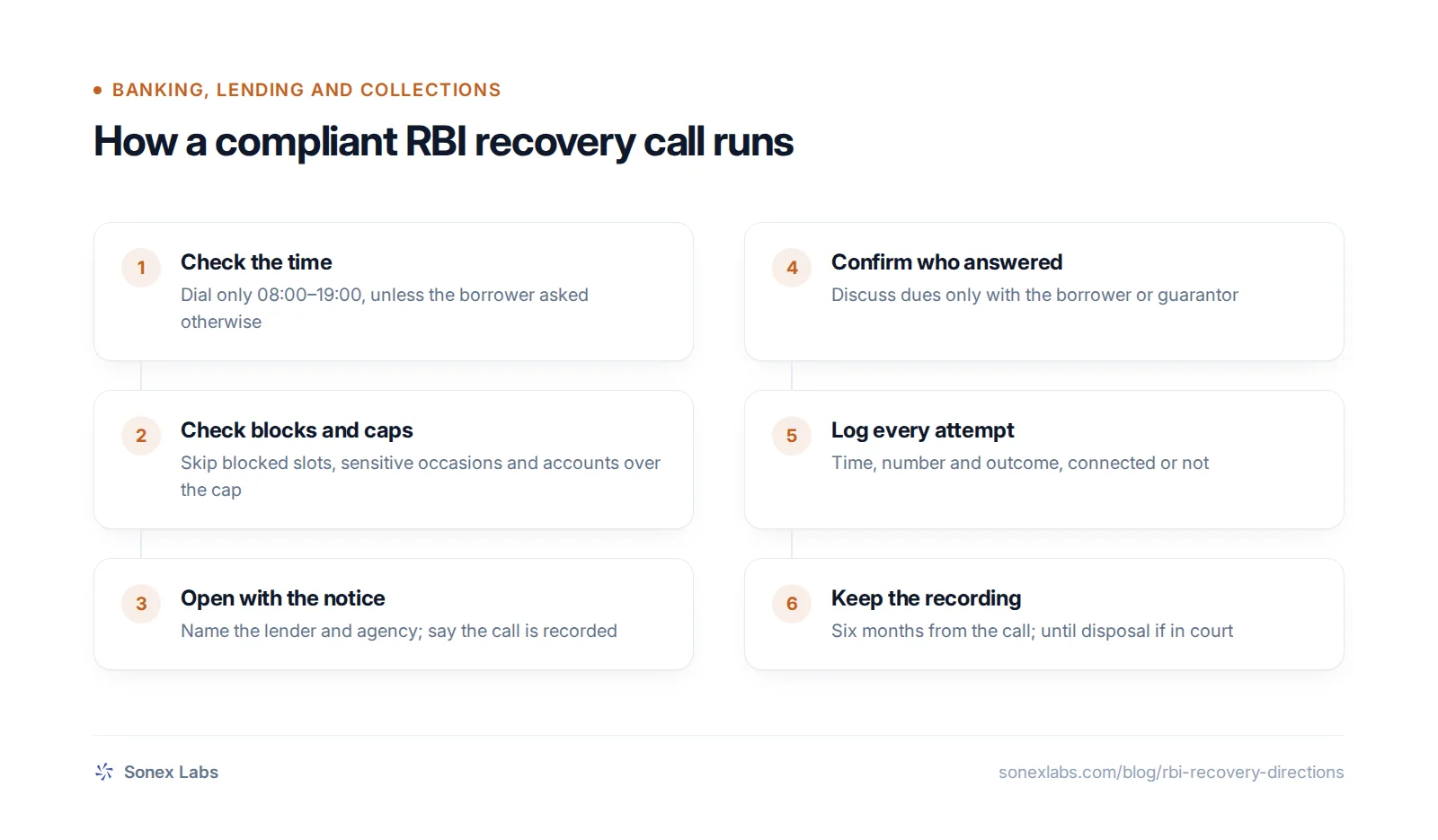
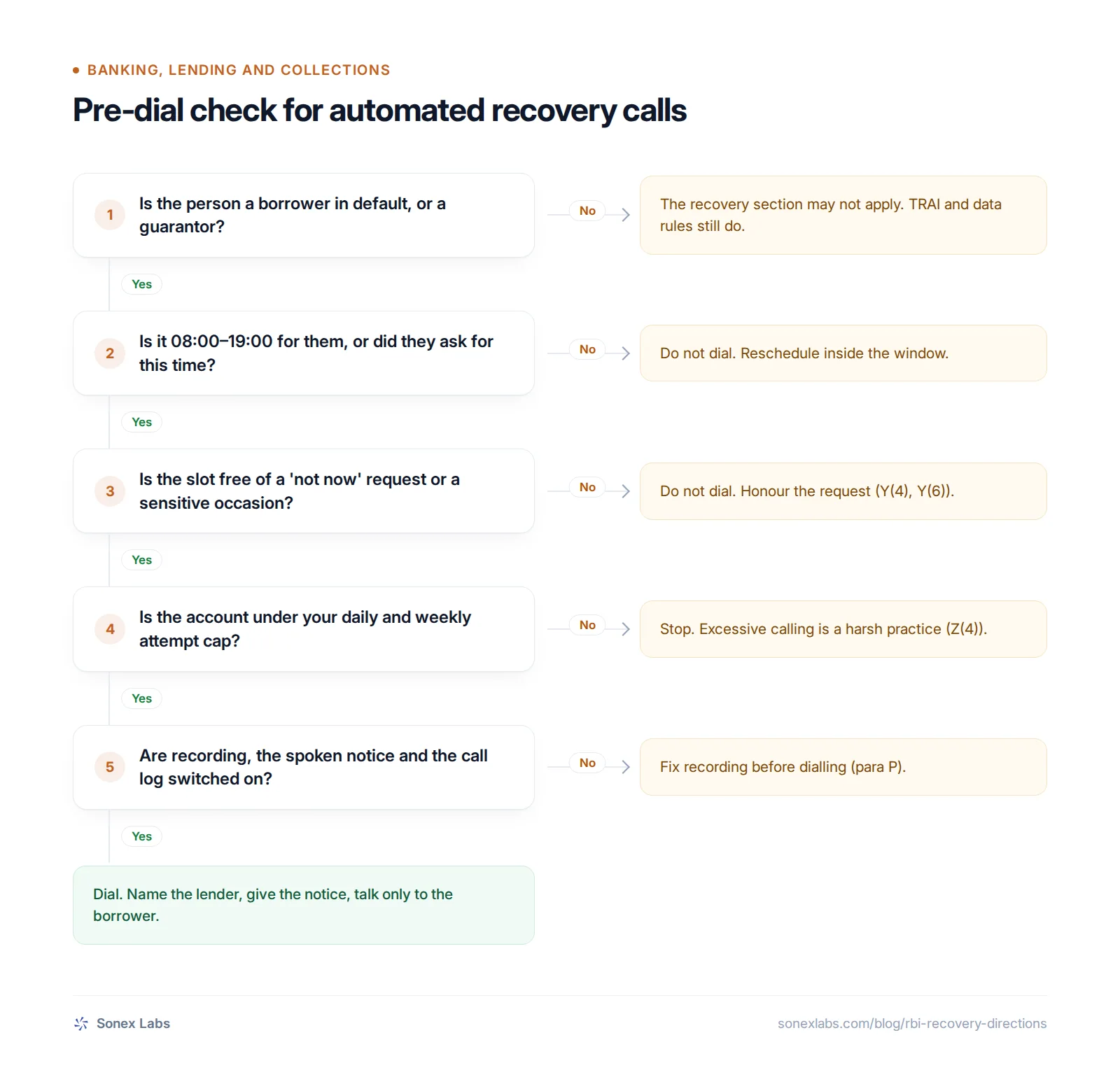
The calling window is the rule lenders will feel first, because it has to be built into every dialler and every field schedule. An employee or recovery agent may contact or visit the borrower or guarantor "only between 08:00 hours and 19:00 hours" (NBFC direction, para Y(4)). The rule covers visits as well as calls, and it applies to every kind of loan.
There is one exception and one limit. Contact outside those hours is allowed only when the borrower or guarantor has expressly asked for it or authorised it. In the other direction, a borrower's request not to be called at a particular time must be honoured in normal circumstances, so a borrower who cannot talk in the evenings can narrow the window further.
The directions do not single out Sundays or public holidays, so calls on those days are allowed within the same window. The text does not settle whether a request to avoid a particular time can cover a whole day, such as every Sunday. Honouring it is the safer course, because refusing would be hard to defend if the borrower later complained.
Timing also depends on what is happening in the borrower's life. Agents must avoid calls and visits during a bereavement in the family, a medical emergency, another calamitous occasion or a marriage function (para Y(6)). Calling outside the window counts as a harsh practice, and so does calling or messaging excessively (para Z(4)). RBI sets no number for excessive, so a lender needs its own written cap per day and per week to show where it drew the line.
Home and workplace visits
Visits carry extra conditions, because an agent at the door is harder to ignore than a phone call. When a lender passes a case to an agency for in-person recovery, it must send the borrower the agency's details at least one day before the first visit (para L). If it changes the agency midway, it must tell the borrower at once (para M).
At the visit, staff and agents must show an identity card. An agent must also carry an authorisation letter and a copy of the advance notice, and both must give the agency's phone number and the grievance officer's details (para X). Only representatives the lender or agency has authorised may visit at all (para Y(3)).
Where the meeting happens is regulated too. An agent should ordinarily meet the borrower at a place the borrower chooses (para Y(5)). Only if the borrower names no place, or fails to turn up there on two or more successive occasions, may the agent go to the borrower's home or place of work.
What recovery agents may say, and to whom
Once a call connects, the rules turn to who the agent may talk to and how. Loan dues may be discussed only with the borrower or the guarantor (para Y(1)), so an agent may not ring relatives or friends to talk about the loan. Intimidating or harassing the borrower's relatives, referees, friends or co-workers, or intruding on their privacy, is a harsh practice in its own right (para Z(6)).
The directions do not say whether a lender may call a relative only to ask where the borrower is. Any such call risks breaching both paragraphs, so the safer course is to treat it as off limits.
Tone and paperwork are covered as well. Every interaction must be civil and decent (para Y(2)). A letter or written message from an agent needs the lender's prior approval and must carry the sender's name and contact details (para Y(8)). Any payment collected must be acknowledged at once with a proper receipt (para Y(9)).
The borrower's phone and personal data
Several rules keep the borrower's personal data out of recovery. A lender may share borrower data with an agency only as far as recovery needs it (para O). Digital lending apps must not access the contact list, call logs, files or media on the borrower's phone (NBFC Credit Facilities Directions, 2025, para 13(1)). The RBI digital lending rules for apps and their partners cover the rest of that regime. A lender that locks a financed phone, and the provider of its locking software, may never use the phone's contacts, SMS, call logs, photos or location history (para U).
Device locking itself is allowed only on a phone, tablet or laptop the loan paid for, and only in stages. After giving notice, the lender may start restricting the device once the loan is 30 days past due and still unpaid. It may not block outgoing calls before 60 days, and it may never block incoming calls, SMS or emergency SOS (paras S(3) and T(2)).
The restriction must be lifted within one hour of the dues being paid (para T(5)). If the lender restricts a device wrongly, or is late to unlock it after payment, it owes the borrower ₹250 for every hour until it is fixed, up to the loan amount disbursed (para T(6)).
What counts as harassment
Harassment by a recovery agent is defined broadly. Any harsh method of collection or recovery is banned, and para Z lists eight practices that always count as harsh. The list is not exhaustive, so conduct that is missing from it can still breach the rule. The eight listed practices are:
- Minatory (threatening) or abusive language.
- Posting the borrower's or guarantor's videos, audio recordings or personal details on social media.
- Sending inappropriate messages by phone or social media.
- Calling or messaging excessively, or outside the prescribed hours.
- Threatening or anonymous calls.
- Intimidating, harassing or publicly humiliating the borrower, guarantor or their relatives, referees, friends or co-workers, or intruding on their privacy.
- Using or threatening violence against them, their family, assets or reputation.
- False or misleading statements, especially about the size of the debt or the consequences of not paying.
Recording, call logs and the duties behind each call
The rules on hours and conduct need evidence behind them, and recording supplies it. From 1 January 2027 the lender must make sure every recovery call its employees or agents make to a borrower or guarantor is recorded (para P). The duty runs both ways. Calls the borrower makes to the phone number the lender gave them must be recorded too, so a recovery helpline or callback number is in scope, not just outbound dialling.
The borrower should know about it. The direction asks lenders to take reasonable precautions, such as telling the borrower or guarantor that the conversation is being recorded, which in practice means saying so at the start of the call.
Each recording must be kept for six months from the date of the call. If the case is sub judice, meaning a court case about it is pending, the recording stays until the case is disposed of. The same paragraph requires a log of the time and number of calls, which is the lender's evidence that its calling was not excessive. For how this period sits beside other retention duties, see how long to keep call recordings in India.
For banks, recording is not new. RBI's circular of 24 April 2008 already asked banks to record recovery agents' calls, but it set no retention period, and RBI withdrew it on 28 November 2025. The 2026 rules add the six-month period and extend the duty to every lender type.
Policy, agencies and incentives
Around the calls, the same section decides who may make them and on what terms. Each lender needs a written recovery policy that covers the triggers for recovery action, an escalation matrix, a code of conduct for staff and agents, and how to treat borrowers in financial distress (para D). Recovery agencies must pass due diligence, including checks on their background, and must undertake to follow the code of conduct (paras H to J).
Agents must hold the debt recovery agent certificate of the Indian Institute of Banking and Finance (IIBF), and agents already engaged on 1 January 2027 have one year to get it (para I). The lender must keep an up-to-date list of its recovery agencies on its website and revise it within seven calendar days of any change (para K).
Two rules aim at the pressures that tend to produce harassment. Recovery targets and incentive schemes, whether for staff or written into agency contracts, must not encourage harsh practices (para Q). The lender must also run a dedicated channel for recovery complaints and put the grievance officer's name, email, phone number and address in every recovery communication (para AA).
How to complain about a recovery agent
For a borrower, the grievance details in every recovery message are the way in. Complain to the lender first, in writing, to the grievance officer named there (para AA), and keep proof of the date, because the next deadline runs from it. A complaint is stronger with the date and time of each call and an early request for the recordings, which the lender has to keep for only six months.
If the lender does not reply within 30 days, or the reply is unsatisfactory, the next step is the Reserve Bank – Integrated Ombudsman Scheme, 2026 (RB-IOS). Where RBI, NPCI (National Payments Corporation of India) or card network rules give the lender longer to reply, that period applies instead. The scheme replaced the 2021 scheme on 1 July 2026. The complaint must be filed within 90 days after the waiting period ends or after the lender's last reply, whichever is later (RBI FAQ, Q17).
Filing is free. The ombudsman can award up to ₹3 lakh for lost time, expenses, harassment or mental anguish, on top of up to ₹30 lakh for consequential loss. Threats or violence can also be reported to the police, which is ordinary criminal law rather than an RBI route. A complaint reaches RBI in these ways:
- Online: cms.rbi.org.in, RBI's complaint portal.
- Email: crpc@rbi.org.in.
- Post: Centralised Receipt and Processing Centre, Reserve Bank of India, Central Vista, Sector 17, Chandigarh 160017.
- Phone help: RBI's contact centre on 14448 gives guidance and complaint status, but it cannot take complaints.
Can an AI voice agent make recovery calls?
RBI has not said. None of the nine directions mentions automated, IVR (interactive voice response) or AI calls. They regulate contact by an employee or recovery agent, and they define a recovery agent as an agency's representative who deals with customers (NBFC para 6(11B)), wording written with people in mind.
Nothing in the text forbids an automated call either. Our reading, which is interpretation and not a rule, is that RBI will judge an automated recovery call by the same duties as a human one. The lender's recovery policy (para D) and its responsibility for recovery conduct do not depend on who or what dials.
Most of the duties translate directly into software settings. On Sonex, for example, each outbound campaign carries its own calling window, time zone and retry limit, and calls are kept as recordings and transcripts. The window and the cap then become configuration rather than reminders to an operator, which is the approach behind AI collections calls for banks and lenders.
EMI reminders before a default
Many automated calls are not recovery calls at all but EMI (equated monthly instalment) reminders before a payment is missed. Whether the rules cover them is unclear. The section applies to recovery from borrowers in default (para A), and it reaches borrowers who are not in default only where a paragraph explicitly says so.
The paragraphs on calling hours and harsh practices (Y and Z) speak of collection or recovery of dues, which can be read as covering routine reminders. The recording paragraph (P) speaks only of recovery. RBI has not clarified the point, so the cautious course is to keep reminder calls inside 08:00 to 19:00 and free of every harsh practice, even if a lender decides not to record them.
TRAI's rules for automated calls
Every direction also requires compliance with the commercial-call rules of the Telecom Regulatory Authority of India (TRAI), including its Telecom Commercial Communications Customer Preference Regulations (TCCCPR), 2018, as amended (para AB). Under TRAI's Third Amendment of 18 September 2026, an A2P (application-to-person) call is one placed by software or an automated platform without a person dialling. That includes calls that use a pre-recorded or artificial voice.
Senders must declare A2P calling to their telecom operator in advance. The duty starts on 27 November 2026, 60 days after the amendment appeared in the Gazette on 28 September 2026 (Gazette of India, Extraordinary, Part III, Section 4, CG-DL-E-28092026-276548). The same regulations decide which number series a lender's calls must come from, and TRAI's 2026 rules for AI and automated calls cover the rest.
Gaps the lender has to fill
Where the text is silent, an automated caller needs decisions the directions do not make. The window should run on the borrower's local time, since the text does not say whose clock counts. The attempt cap needs an actual number, because RBI calls excessive calling harsh but sets none. The agent also needs a rule for sensitive news: if a borrower mentions a death, a medical emergency or a wedding, it should end the call politely and pause the account.
The opening line follows from the ban on anonymous calls (para Z(5)) and the recording notice in para P. A line such as "This is [agent name] from [agency], calling on behalf of [lender] about your loan account, and this call is being recorded" covers both. RBI does not require an AI agent to say it is automated, but saying so makes it much harder to claim later that the borrower was misled. The recording-notice and AI disclosure scripts have versions in several languages.
Certification is the hardest gap. Software cannot hold the IIBF certificate that para I requires, and RBI has not said whether an automated caller counts as a recovery agent. Until it does, the cautious course is to make sure anyone who supervises automated recovery calls, or takes them over from the bot, holds the certificate and follows the code of conduct.
Key dates
Sources
- RBI press release 2026-2027/827: amendment directions on conduct in recovery of loans, 6 Aug 2026Official
- Commercial Banks – RBC Fourth Amendment Directions, 2026 (RBI/2026-27/223)Official
- Small Finance Banks – RBC Fourth Amendment Directions, 2026 (RBI/2026-2027/224)Official
- Local Area Banks – RBC Fourth Amendment Directions, 2026 (RBI/2026-27/225)Official
- Regional Rural Banks – RBC Fourth Amendment Directions, 2026 (RBI/2026-2027/226)Official
- Urban Co-operative Banks – RBC Fourth Amendment Directions, 2026 (RBI/2026-27/227)Official
- Rural Co-operative Banks – RBC Fourth Amendment Directions, 2026 (RBI/2026-2027/228)Official
- AIFIs – RBC Third Amendment Directions, 2026 (RBI/2026-27/229)Official
- NBFC – RBC Third Amendment Directions, 2026 (RBI/2026-27/230), web pageOfficial
- NBFC – RBC Third Amendment Directions, 2026 (RBI/2026-27/230), PDFOfficial
- Housing Finance Companies Third Amendment Directions, 2026 (RBI/2026-2027/231)Official
- RBI press release on the draft directions, 12 Feb 2026Official
- RBI draft amendment directions for commercial banks, Feb 2026 (proposed start 1 Jul 2026)Official
- RBI press release on the revised draft directions, 20 May 2026Official
- RBI revised draft amendment directions for commercial banks, May 2026 (proposed start 1 Oct 2026)Official
- RBI circular on recovery agents, 12 Aug 2022 (withdrawn 28 Nov 2025)Official
- RBI circular to banks on recovery agents, 24 Apr 2008 (withdrawn 28 Nov 2025)Official
- RBI: circulars withdrawn by the Department of Regulation (annex to RBI/2025-26/100)Official
- RBI (NBFC – Responsible Business Conduct) Directions, 2025: current rules, paras 91(2) and 100Official
- RBI (Commercial Banks – Responsible Business Conduct) Directions, 2025: current rules, paras 410(2) and 445Official
- RBI (NBFC – Credit Facilities) Directions, 2025, para 13(1) on lending appsOfficial
- TRAI: TCCCPR (Third Amendment) Regulations, 2026, 18 Sep 2026Official
- Gazette of India: TCCCPR (Third Amendment) Regulations, 2026, published 28 Sep 2026 (CG-DL-E-28092026-276548)Official
- RBI (NBFC – Managing Risks in Outsourcing) Directions, 2025, para 57(4) on complaintsOfficial
- RBI FAQ: Reserve Bank – Integrated Ombudsman Scheme, 2026Official
- RBI Complaint Management SystemOfficial
- Vinod Kothari: RBI proposes uniform recovery norms across all lenders (NBFC types excluded), Jun 2026Secondary
Change log: 23 Oct 2026, First published. Same day: added lender-by-lender table, call-duty table and automated-call section; removed product section · 24 Oct 2026, Corrected who the RBI Ombudsman scheme covers and its waiting period; tightened the TRAI A2P definition and the employee-coverage citation; exact TRAI start dates from the Gazette (published 28 Sep 2026). Later the same day, rewritten as one continuous guide: added why RBI made the change, the rules for home and workplace visits (notice, identity card, authorisation letter, place of meeting), receipts, written messages, incentive limits and the one-hour unlock rule with ₹250-an-hour compensation; the steps, checklist and FAQs were folded into the body