On this page
- Why RBI's outsourcing rules reach an AI voice vendor
- Is an AI calling vendor material outsourcing?
- Due diligence before signing and every year after
- The contract and the six-hour incident clock
- Offshore servers, cloud platforms and foreign AI models
- Complaints and customers stay with the lender
- Board oversight, work that cannot be outsourced, and the FREE-AI report
- Key dates
- Sources
Why RBI's outsourcing rules reach an AI voice vendor
Outsourcing lets a lender buy skills and scale it does not have, but it moves risk to a firm the regulator does not supervise directly. RBI's answer is to leave the risk where the licence is. The lender stays responsible for what it outsources, including the acts of the sales agents and recovery agents who act for it (paras 9 and 17 of the bank directions).
An AI voice vendor fits that picture closely. It speaks to the lender's customers in the lender's name, and it usually stores recordings, transcripts, phone numbers and account details on its own systems. If it misleads a borrower or leaks data, RBI looks to the lender, so the vendor's contract, security and complaint handling become the lender's own compliance work.
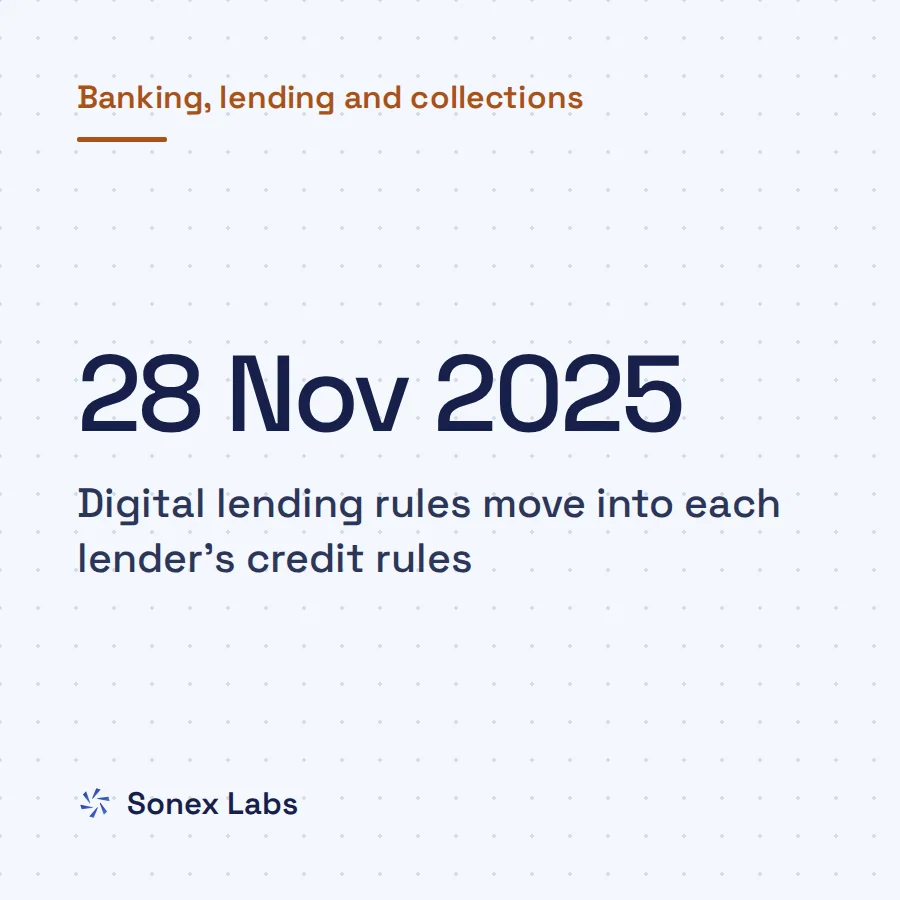
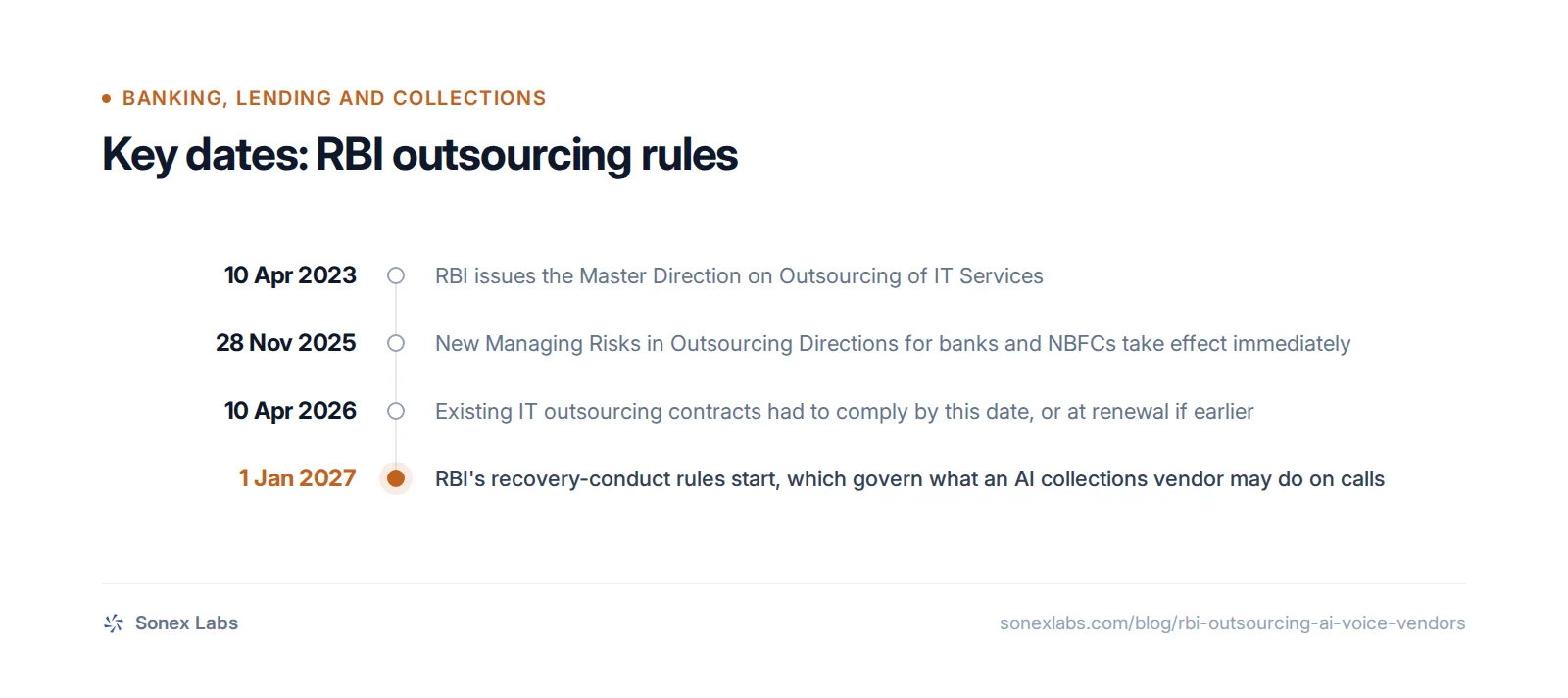
The current rules are the Managing Risks in Outsourcing Directions, 2025, which RBI issued on 28 November 2025 and which came into force immediately (para 2). For commercial banks the instrument is RBI/DOR/2025-26/171, and for NBFCs (non-banking financial companies) it is RBI/DOR/2025-26/363.
Small finance banks, payments banks, local area banks, urban and rural co-operative banks, all-India financial institutions and credit information companies each have their own version of the same date. We found no version for regional rural banks in RBI's Master Directions list (checked 24 October 2026), and the commercial bank directions exclude them (para 3).
Two chapters, and an AI vendor can fall under both
Each direction covers two kinds of outsourcing. Chapter III deals with financial services, such as loan applications, document processing, marketing, loan supervision and back-office work (para 4(1)). Chapter IV deals with IT services, including cloud computing (para 5(1)). A vendor that both makes calls and hosts the data from them can sit under both chapters at once.
NBFCs have two differences. Their Chapter III applies only to material outsourcing (NBFC para 4(1)), and base-layer NBFCs, the smallest tier under RBI's scale-based regulation, do not have to follow Chapter IV (NBFC para 3(2)). Otherwise the NBFC text closely mirrors the bank text, but its paragraph numbers differ from paragraph 45 onwards, including the whole IT chapter, so the table below gives both.
What the 2025 directions replaced
The 2025 directions repeal the earlier outsourcing instructions for financial and IT services (bank para 95, NBFC para 100). The rules from the Master Direction on Outsourcing of IT Services of 10 April 2023 now sit in Chapter IV of each new direction. The 2023 master direction is on RBI's list of withdrawn circulars, annexed to the repeal circular of 28 November 2025 (DOR.RRC.REC.302/33-01-010/2025-26).
Its own page on rbi.org.in still shows the full text with no "repealed" notice, which explains why some vendors and questionnaires still cite it. Contracts and vendor reviews should cite the 2025 directions for the lender's type instead, with their paragraph numbers.
The transition date carried over from the 2023 text. Existing IT outsourcing agreements had to comply "either at the time of renewal or by April 10, 2026, whichever is earlier" (para 2). New agreements must comply from the day they are signed, so any AI voice contract running today should already carry the new clauses.
| Topic | Banks (RBI/DOR/2025-26/171) | NBFCs (RBI/DOR/2025-26/363) |
|---|---|---|
| What counts as outsourcing | Para 6(1) | Para 6(1) |
| Material outsourcing: financial services | Para 14 | Para 14 |
| Material outsourcing: IT services | Para 53(2) | Para 58(2) |
| Functions you may not outsource | Para 15 | Para 15 |
| Contract clauses | Paras 34 and 69 | Paras 34 and 74 |
| Cyber incident to RBI within 6 hours | Para 56 | Para 61 |
| Offshore vendors | Paras 46–48 and 88–89 | Paras 52–53 and 93–94 |
| Cloud services | Paras 91–92 | Paras 96–97 |
| Customer grievances | Paras 49–52 | Paras 54–57 |
| Old instructions repealed | Para 95 | Para 100 |
Is an AI calling vendor material outsourcing?
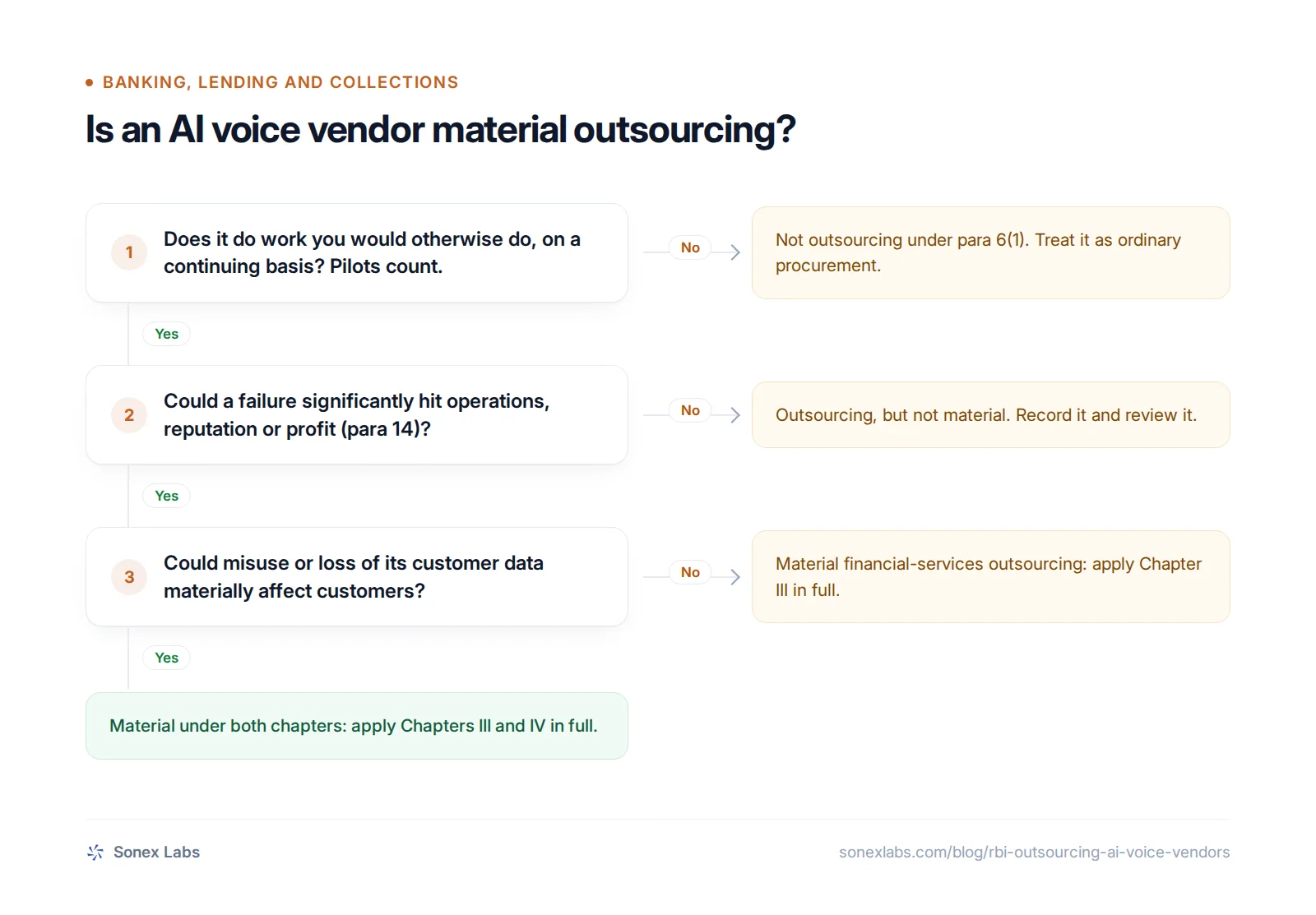
Usually, yes. The first question is whether the arrangement is outsourcing at all. Outsourcing means a third party doing, on a continuing basis, work the lender would normally do itself, and an agreement for a limited period still counts (para 6(1)).
Calling borrowers, sending reminders, selling products and answering customer queries are all work a lender would otherwise do, which is the job of AI voice agents for banks and lenders. A short pilot that calls real customers or holds their data is therefore outsourcing too, and should go through the same materiality test and due diligence as a full contract.
The IT test looks at operations and customer data
Material outsourcing is outsourcing that brings the full set of controls, and for a voice vendor the question usually turns on the IT test. IT outsourcing is material if a disruption or compromise could significantly affect the lender's business operations. It is also material if unauthorised access to, or loss or theft of, customer information the vendor holds could materially affect customers (para 53(2) for banks, para 58(2) for NBFCs).
A voice vendor usually meets the second limb even when calls are a small part of the lender's operations. It records calls, stores transcripts and holds phone numbers and loan details, so a leak would hit customers directly. Retention of those recordings has its own rules, set out in how long to keep call recordings in India.
The financial-services test looks at the lender
Under Chapter III, material means a disruption could significantly affect the lender's operations, reputation or profitability, and for NBFCs customer service too (para 14). The test is a judgement under the lender's board-approved policy rather than a formula. Para 14 asks the lender to weigh:
- how important the outsourced activity is;
- its effect on earnings, solvency, liquidity, funding, capital and risk profile;
- the harm to the lender's reputation, brand and plans if the vendor fails;
- its cost as a share of total operating costs;
- how much the lender already depends on that vendor; and
- for NBFCs, how much the activity matters for customer service and protection.
Due diligence before signing and every year after
Once a vendor is material, the lender must check it properly before signing and again at renewal (paras 29 to 31). Para 30 lists what to weigh, including the vendor's experience and competence, financial strength, reputation and complaint history, and concentration risk. It also covers the checks the vendor runs on its own staff and subcontractors, and its security, internal controls and business continuity.
IT outsourcing adds more factors (para 66 for banks, para 71 for NBFCs). These include the vendor's technology stability, backups and disaster recovery, its ability to keep the lender's data separate from other clients' data, and its information and cyber security risk.
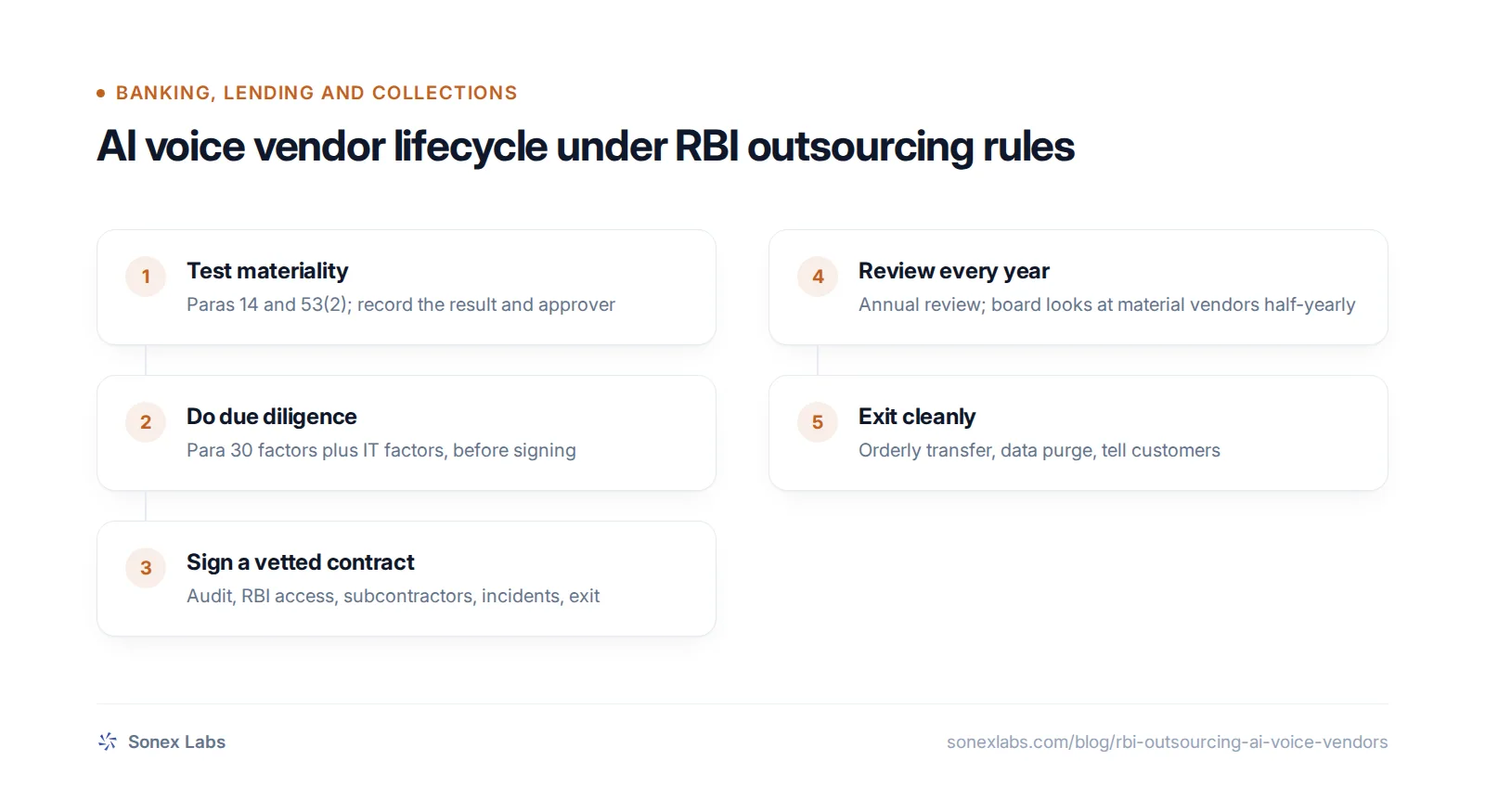
The checks do not stop at signature. The lender must review every vendor's financial and operational condition at least once a year (para 38), and keep a central record of all material outsourcing, which the board reviews every six months (para 36). The diagram below traces the whole arrangement from the materiality test to exit.
For an AI voice vendor, the factors translate into a handful of plain questions. A fuller set is in the AI voice vendor due-diligence questionnaire, and how to evaluate an AI voice vendor covers the quality side. The questions that map most directly to the directions are:
- Who builds and runs the voice agent, and who are its subcontractors, including AI model providers?
- Where are recordings, transcripts and logs stored, and who can access them?
- How is the lender's data kept separate from other clients' data (paras 26–27)?
- What happens to calls if the vendor's platform or its model provider goes down?
- What audit reports and certifications can the vendor share, and how recent are they?
The contract and the six-hour incident clock
What due diligence finds has to be fixed in the contract, which must be in writing and vetted by the lender's legal counsel (para 33). Para 34 lists the clauses every outsourcing contract needs, and para 69 for banks (para 74 for NBFCs) adds more for IT services.
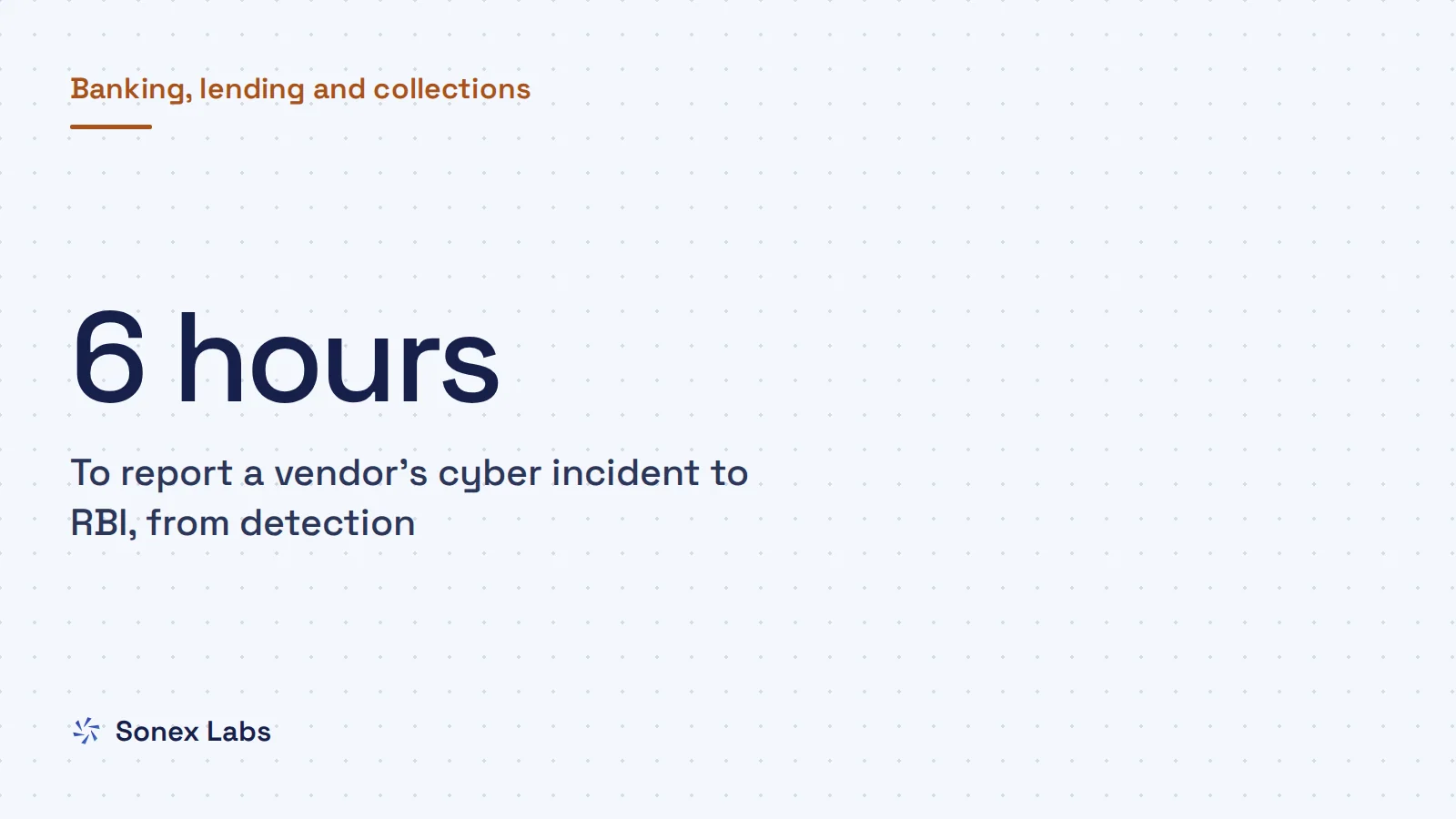
The clause with the tightest timing is incident reporting. The vendor must report cyber incidents to the lender without undue delay, so that the lender can report them to RBI "within six hours of detection by the service provider" (para 56 for banks, para 61 for NBFCs). The clock starts when the vendor spots the incident, not when it tells the lender, so every hour the vendor waits comes out of the lender's time.
Separately, the lender must notify RBI immediately of any security breach or leak of confidential customer information, and it is liable to its customers for any damage (para 28). In practice the contract should set a vendor reporting deadline well under six hours, for example two hours from detection, with a named contact at each end. For an AI voice vendor, these are the clauses that matter most (bank paragraph numbers):
- Audit: the lender's internal or external auditors can audit the vendor (34(vii), 69(i)).
- RBI access: RBI can access records and inspect the vendor and its subcontractors (34(viii)–(ix), 69(xii), 76).
- Confidentiality: controls on customer data that continue after the contract ends (34(v), 34(xi), 69(xix)).
- Subcontractors: the lender's prior approval before the vendor uses one, with the vendor staying liable for them (4(2), 34(iv), 69(i), 69(xiii)).
- Incidents and data location: which adverse events, such as breaches or outages, the vendor must report (69(iii)), and storage in India where the rules require it (69(vi)).
- Continuity: contingency plans that are tested (34(vi), 69(x)).
- Exit and records: a termination clause with a minimum notice period and an orderly transfer (34(x), 69(xv)), and records kept in line with the lender's legal duties (34(xii)).
Offshore servers, cloud platforms and foreign AI models
Most AI voice platforms run in the cloud, and many use components hosted abroad. The directions allow offshore and cloud vendors, but with conditions. For an offshore vendor, the lender must monitor country risk and fix the governing law (paras 88 to 89 for banks). It must also keep records available even if the vendor is liquidated, and keep RBI's right to audit or inspect the vendor. For financial services, all original records must continue to be kept in India (para 47(viii)).
For cloud services, the lender should contract only with providers in jurisdictions that enforce agreements. It must use multi-factor authentication and least-privilege access, and keep encryption keys and hardware security modules under its own control (para 92). Logs should feed into its security operations centre, and it needs a cloud exit plan that ends with a secure purge of its data (para 92(xvi)).
AI models raise a less obvious version of the same issue. A voice platform that sends audio or transcripts to an AI model provider abroad is sending customer data offshore. Our reading is that the lender should treat that model provider as a subcontractor and have it named in the contract, since the subcontractor clauses (4(2), 34(iv), 69(xiii)) do not distinguish model providers from any other. India's data protection law adds duties of its own, covered in the DPDP Act for voice AI.
Complaints and customers stay with the lender
Whatever the vendor does on a call, the lender handles the customer's complaint about it. Outsourcing does not affect customers' rights against the bank (para 49), and responsibility for complaints about outsourced services rests with the bank (para 51). The NBFC directions say the same (paras 54 and 56).
The response time, at most 30 days, must be on the bank's website. A customer whose complaint is rejected, or not answered within 30 days, can go to the RBI Integrated Ombudsman (para 52(3)). That paragraph still names the 2021 scheme, which the Integrated Ombudsman Scheme, 2026 replaced on 1 July 2026. NBFCs outside the ombudsman scheme send such customers to RBI's Consumer Education and Protection Cell instead (NBFC para 57(4)).
Customers must also know that vendors are involved. Banks must say in product literature that service providers may be used, including for sales and marketing (para 50). If a lender ends a customer-facing vendor's contract, it must publicise the end so customers stop dealing with that vendor (para 44). Banks also tell the Indian Banks' Association, which keeps a caution list; NBFCs display a notice in branches, post it online and inform customers.
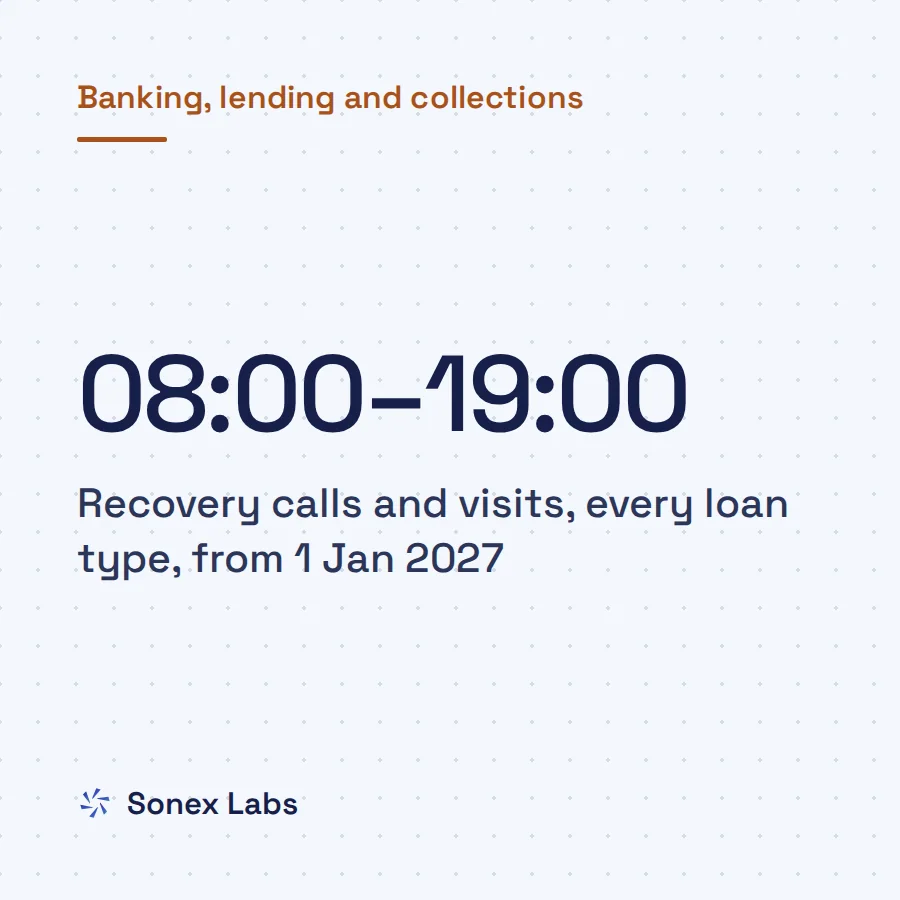
For collections vendors, the conduct on each call is set by separate rules. RBI's recovery agent rules from 1 January 2027 cover calling hours, recording and what agents may say. The digital lending rules for lending service providers add disclosure duties for digital loans.
Board oversight, work that cannot be outsourced, and the FREE-AI report
All of this sits under the board. The directions give it specific approval and review duties, and they put some work beyond the reach of any vendor.
What the board must approve and review
The board must approve a written outsourcing policy (para 10). For financial services the policy must cover how activities and vendors are chosen, what counts as material, who can approve what and how vendors are monitored (para 20). For IT services it must also cover disaster recovery, business continuity, termination and exit (para 57 for banks, para 62 for NBFCs).
The board decides which material activities may be outsourced and reviews the record of material outsourcing every six months (para 12(1)). For banks, the board must also make sure an annual compliance certificate goes to RBI's Department of Supervision, and a material AI voice vendor belongs in both.
Functions a lender cannot hand to a vendor
Lenders cannot outsource core management functions, including internal audit, compliance and decision-making functions such as giving sanction for loans, retail loans included (para 15). An AI agent can explain a loan offer, collect documents or remind a borrower of a due date. The credit decision itself must stay with the lender.
The FREE-AI report is guidance, not a direction
RBI's FREE-AI framework is often cited alongside these rules, but it is a committee report, not a binding direction. On 13 August 2025 RBI published the report of its committee on a Framework for Responsible and Ethical Enablement of Artificial Intelligence (FREE-AI) in the financial sector, with 26 recommendations.
Two of them bear directly on voice agents. Recommendation 14 asks for a board-approved AI policy. The consumer-protection recommendation says customers "must be explicitly informed whenever they are interacting with AI systems" (para 4.4.54), and adds that they should always be able to switch to a human.
Neither point is required by the outsourcing directions. In our view supervisors may still expect lenders to know the report, so building an AI disclosure and a route to a person into voice scripts is the cautious course.
Key dates
Sources
- RBI (Commercial Banks – Managing Risks in Outsourcing) Directions, 2025, RBI/DOR/2025-26/171, 28 Nov 2025Official
- RBI (NBFC – Managing Risks in Outsourcing) Directions, 2025, RBI/DOR/2025-26/363, 28 Nov 2025Official
- RBI Master Directions list: outsourcing directions for SFBs, payments banks, LABs, UCBs, RCBs, AIFIs and CICs, 28 Nov 2025Official
- RBI Master Direction on Outsourcing of IT Services, RBI/2023-24/102, 10 Apr 2023 (withdrawn)Official
- RBI: Consolidation of Regulations – Withdrawal of circulars (RBI/2025-26/100), 28 Nov 2025Official
- RBI: list of circulars withdrawn by the Department of Regulation (annex to RBI/2025-26/100)Official
- RBI press release on the FREE-AI committee report, 13 Aug 2025Official
- RBI FREE-AI committee reportOfficial
- Vinod Kothari: IT outsourcing under the RBI's 2025 directions, 6 Feb 2026Secondary
Change log: 24 Oct 2026, Rewritten as one continuous guide: added why the outsourcing rules reach an AI voice vendor, grouped the materiality tests, board duties and FREE-AI under H3s, and folded the takeaways, steps, checklist and FAQs (NBFC differences, pilots, subscription software, ending a contract) into the body. Para 15 now quoted as RBI words it. Earlier the same day: added the operations limb of the IT materiality test, NBFC paragraph numbers and the ombudsman scheme update; FREE-AI described as a committee report · 23 Oct 2026, First published