On this page
- How long do you have to keep call recordings in India?
- SEBI's rules for brokers and research analysts
- RBI and IRDAI: recovery calls, video KYC and insurance sales
- When the DPDP Act says erase and a regulator says keep
- Keeping recordings in a form a court will accept
- Recordings held by vendors
- Turning the rules into a retention policy
- Key dates
- Sources
How long do you have to keep call recordings in India?
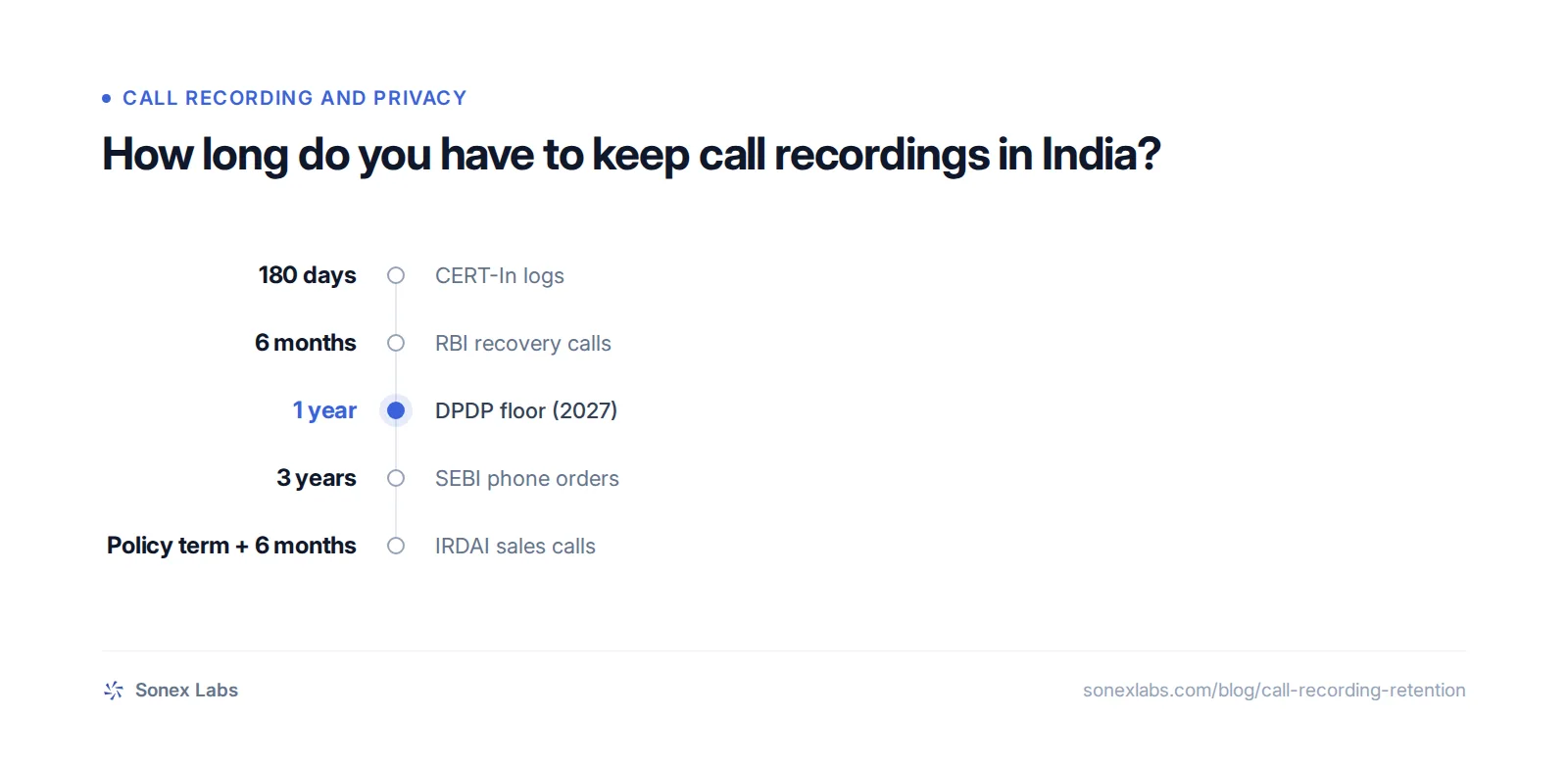
It depends on who you are and why the call was made. We found no general Indian law that fixes one period for all call recordings. Each sector regulator sets its own period for the calls it oversees, and the periods differ widely, from six months for a lender's recovery calls to five years for a research analyst's client calls.
The differences make more sense once you see what each period is for. A recording is evidence, and most regulators tie its period to how long a complaint or dispute about the call can still arise. SEBI links brokers' records to the window in which investors can take a complaint to arbitration, and IRDAI links insurance sales records to the life of the policy and any claim. That is our reading of the pattern, not a principle any regulator states.
From 13 May 2027 the DPDP Rules also add a one-year floor for every Data Fiduciary. A Data Fiduciary is any business that decides why and how personal data is used, so in practice this reaches almost every business that records customer calls. The same law pulls the other way too: the DPDP Act requires erasure once no law or purpose still needs the data, so keeping everything indefinitely is not a safe default.
The working rule follows from that. Where two rules cover the same recording, keep it for the longer period, then delete it. The table lists every rule we found that touches call recordings, and the sections after it explain the ones that need judgement. Whether you may record a call in the first place is a separate question, covered in whether call recording is legal in India.
| Rule and who it applies to | What to keep | Minimum period |
|---|---|---|
| RBI recovery directions (from 1 Jan 2027): all banks (including small finance, local area, regional rural and co-operative banks), NBFCs, housing finance companies and all-India financial institutionsSource: RBI/2026-27/230, para 100P; the matching para P in the seven bank and AIFI notifications; HFCs through para 170A | Recovery call recordings, to and from the borrower or guarantor, plus a log of the time and number of calls | 6 months from the call; if the case is in court, until it is disposed of |
| SEBI, evidence of client orders: stockbrokersSource: Master Circular for Stock Brokers, 17 Jun 2025, paras 35.2–35.6 | Evidence of every order, including recordings of orders taken by phone | While arbitration accepts investor complaints, currently 3 years; until final resolution if disputed; longer if SEBI asks |
| SEBI, records of client interactions: registered research analysts and research entitiesSource: SEBI (Research Analysts) Regulations 2014, reg. 25(1)(vii) and 25(2); Master Circular for Research Analysts, 6 Feb 2026, para 1.13; SEBI circular of 23 Oct 2026 | Records of every conversation about the service with clients and prospective clients, including call recordings; recordings of calls with institutional investors are optional from 8 Nov 2026 | 5 years; until resolved if disputed; longer if SEBI asks |
| IRDAI distance-marketing guidelines (status unclear): insurers, and brokers and telemarketers selling insurance by phoneSource: IRDA/ADMN/GDL/MISC/059/04/2011 of 5 Apr 2011, para 12 | A voice record of the whole process, from first contact to sale | 6 months after the policy term, or until the claim is settled, whichever is later |
| IRDAI verification calls: insurers selling by distance modes such as phoneSource: Same guidelines, para 13(iii) | Records of post-sale verification calls | Non-life: at least 15 months from the policy date or until claim settlement, whichever is later. Life: at least 3 years |
| RBI KYC, video customer identification (V-CIP): commercial banks (similar texts exist for other lenders)Source: RBI (Commercial Banks – KYC) Directions, 2025, paras 27(3)(i) and 50(2) | All V-CIP data and video recordings, stored in India | Record-keeping rules apply; identity records kept at least 5 years after the relationship ends |
| CERT-In cyber security directions: service providers, intermediaries, data centres, companies and government bodiesSource: CERT-In directions of 28 Apr 2022, direction (iv) | Logs of all ICT (information and communication technology) systems, such as telephony platform and server logs | Rolling 180 days |
| DPDP Rules, logs of processing (from 13 May 2027): every Data Fiduciary, including processing done by its vendorsSource: DPDP Rules 2025, rule 8(3) | Personal data, associated traffic data and other logs of the processing | At least 1 year from processing, then erase unless another law needs longer |
| DPDP Rules, security logs (from 13 May 2027): every Data FiduciarySource: DPDP Rules 2025, rule 6(1)(e) | Logs and personal data needed to detect and investigate unauthorised access | 1 year, unless another law says otherwise |
| DPDP Act, storage limitation: every Data FiduciarySource: DPDP Act 2023, s.8(7) | Nothing; this is a duty to delete | Erase when consent is withdrawn or the purpose is served, unless a law requires retention |
| TRAI, proof of a customer inquiry (from 28 Oct 2026, 30 days after the amendment's Gazette publication on 28 Sep 2026): senders of commercial calls and messagesSource: TCCCPR Third Amendment, 18 Sep 2026, reg. 2(bb)(ii); Gazette of India, Extraordinary, Part III, Section 4, CG-DL-E-28092026-276548 | The customer's written or digital inquiry, which lets you contact them for 7 days | No period stated; it must be "maintained in a verifiable form" |
| Bharatiya Sakshya Adhiniyam (BSA), 2023: anyone who wants to use a recording in courtSource: BSA s.63 and the Schedule | The recording and a certificate with its hash value | No period; it decides whether the recording is admissible |
SEBI's rules for brokers and research analysts
The Securities and Exchange Board of India (SEBI) has the two most detailed recording rules, and they work differently. A stockbroker's period moves with the arbitration window, while a research analyst's period is fixed at five years. The guide to SEBI's call-recording rules for brokers covers the wider framework those rules sit in.
Stockbrokers: recordings of phone orders
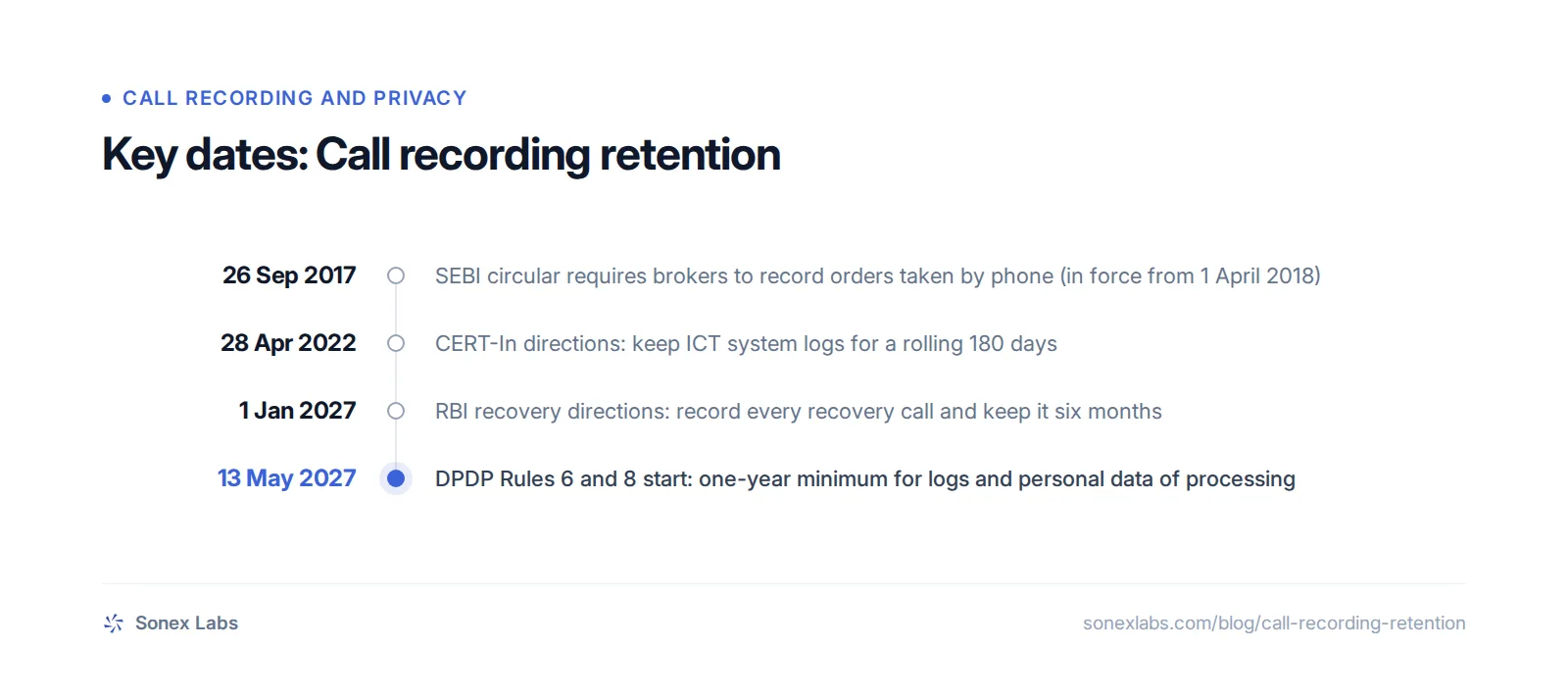
SEBI requires brokers to record every order a client gives by phone and to keep the recordings. It first said so on 26 September 2017 (CIR/HO/MIRSD/MIRSD2/CIR/P/2017/108). Under that circular a broker may execute a client's trade only after keeping evidence of the order, and phone orders need a "telephone recording system".
The text has moved between documents since then, which is why older articles cite different numbers. A clarification of 30 November 2017 set the retention period (CIR/HO/MIRSD/MIRSD2/CIR/P/2017/124). SEBI merged these rules into one circular on 22 March 2018, in force from 1 April 2018 (SEBI/HO/MIRSD/DOP1/CIR/P/2018/54), and that text is now paras 35.2 to 35.6 of the Master Circular for Stock Brokers dated 17 June 2025.
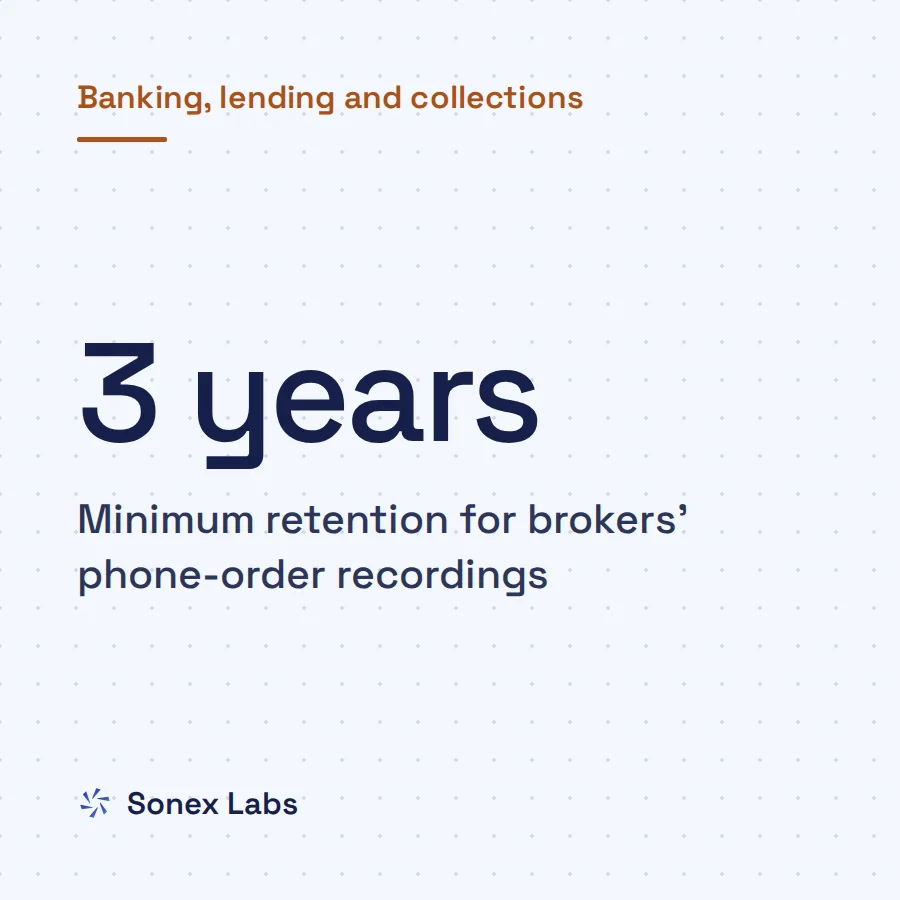
Para 35.5 sets the period. Brokers keep the records "for a minimum period for which the arbitration accepts investors' complaints as notified from time to time currently three years". If a dispute has been raised, they keep them until it is finally resolved, and para 35.6 lets SEBI ask for specific records to be kept until further notice.
Because the period is tied to the arbitration window rather than written as a fixed number, it can change without SEBI amending para 35.5 itself. A broker reviewing its policy should check the current arbitration period, not just the circular.
Research analysts: records of client calls
Research analysts have their own rule with a fixed period. Since a December 2024 amendment, the SEBI (Research Analysts) Regulations require them to keep records of communication with clients and prospective clients, including call recordings, for at least five years (regulation 25(1)(vii) and 25(2)). They keep them longer if a dispute is still open (Master Circular for Research Analysts, para 1.13).
SEBI has since narrowed the duty. After a consultation paper of 18 May 2026, it made recordings of calls with institutional investors optional from 8 November 2026. Calls with all other clients must still be recorded and kept (circular of 23 October 2026).
RBI and IRDAI: recovery calls, video KYC and insurance sales
The Reserve Bank of India (RBI) and the Insurance Regulatory and Development Authority of India (IRDAI) each regulate a few specific kinds of call. Outside those, neither sets a period for ordinary service or sales calls, as far as we found.
Recovery calls
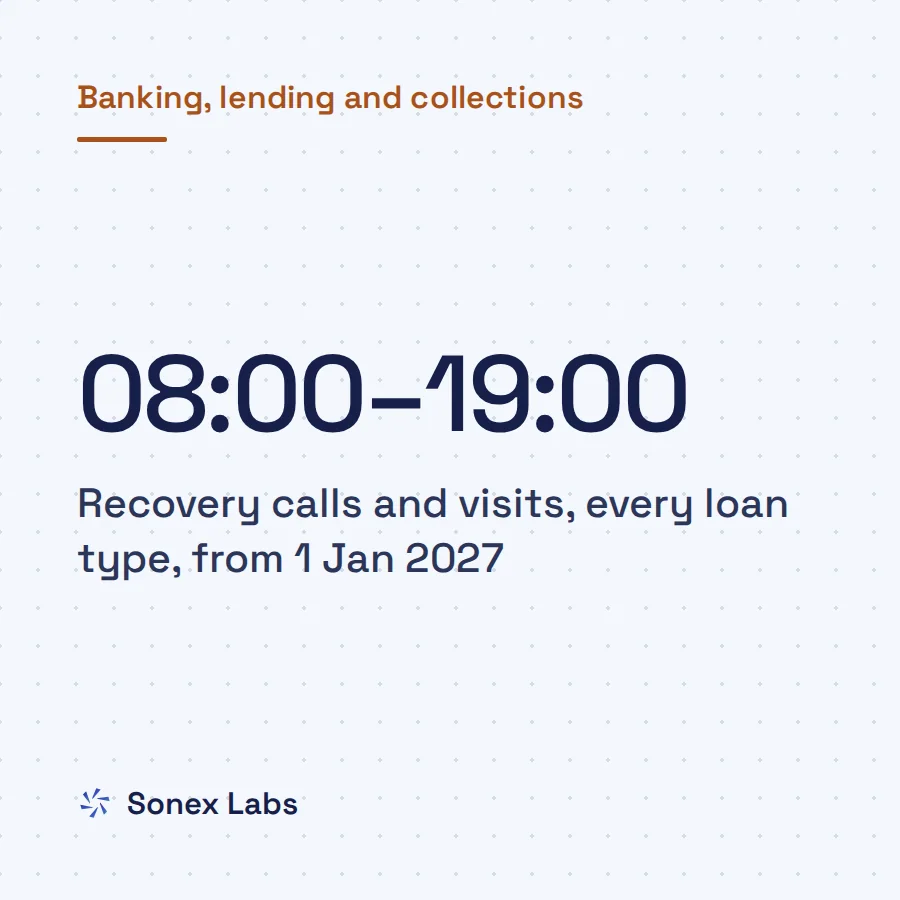
From 1 January 2027, lenders must record recovery calls, including the borrower's calls to the number the lender gave them. RBI issued nine recovery directions on 6 August 2026. Eight carry this rule in a paragraph numbered P, and the one for housing finance companies applies the NBFC text (para 170A).
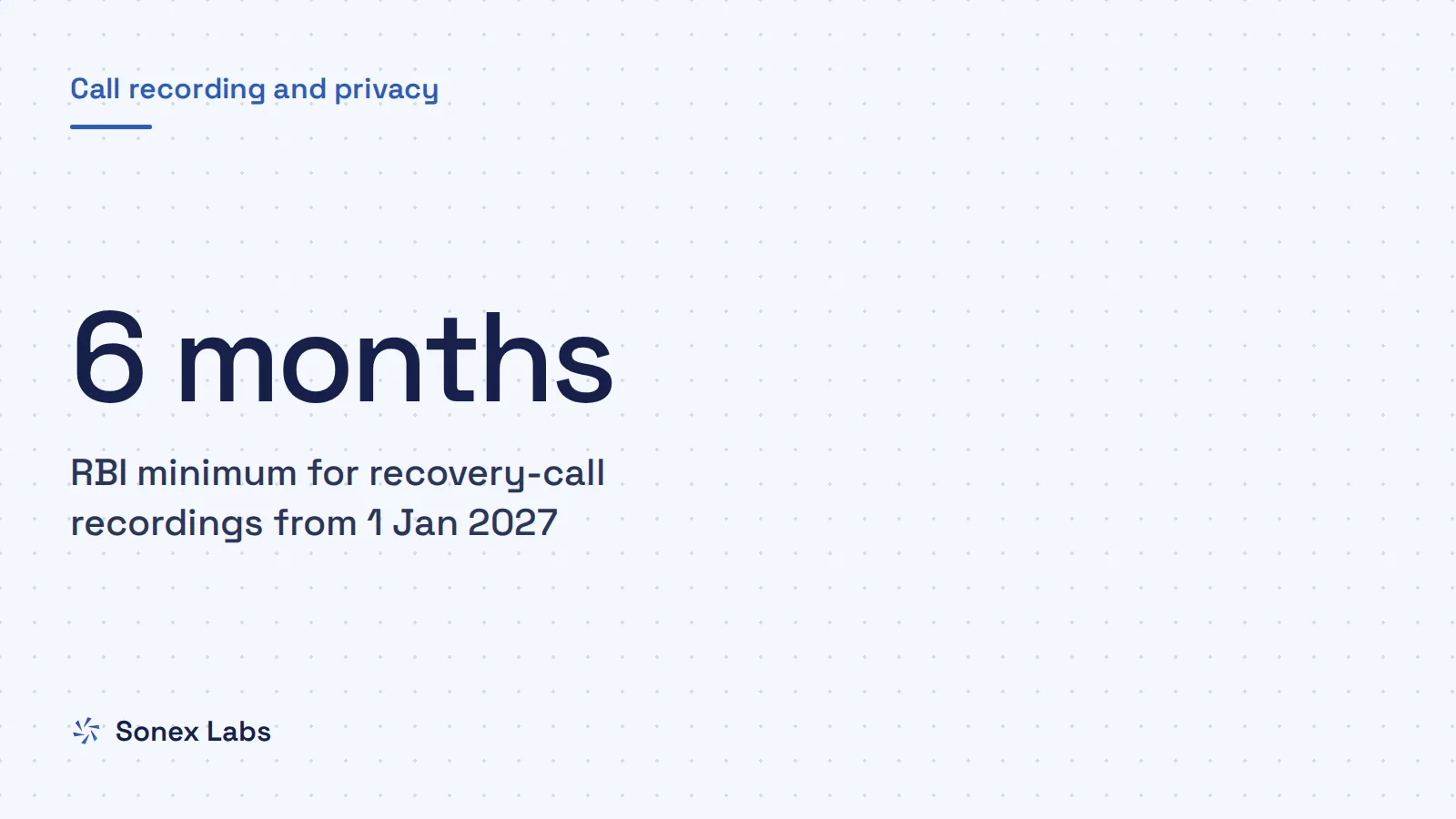
Each recording is kept six months from the call date, or until any court case about it is disposed of, with a log of the time and number of calls. RBI gives "intimating the borrower / guarantor that the conversation is being recorded" as the example of a reasonable precaution (NBFC direction, para 100P). The rest of the regime is explained in RBI's recovery agent rules from 1 January 2027.
Video KYC recordings
Video KYC has its own rule. V-CIP (video-based customer identification process) is RBI's process for verifying a customer's identity over video, and banks must store "the entire data and recordings of V-CIP in a system / systems located in India" (KYC Directions, para 27(3)(i)). Each recording needs a date and time stamp for easy search.
The same paragraph applies the directions' record-keeping rules, which keep identity records for at least five years after the relationship ends (para 50(2)). Applying that five-year period to the video itself is our reading of the cross-reference, not something the text says in so many words.
Insurance sales by phone
IRDAI is the uncertain case. Its 2011 distance-marketing guidelines require insurers' telemarketing calls to be recorded, and tele-callers must tell clients the call is recorded and that they can ask for a voice copy (para 9.3(iv)). The guidelines are still on IRDAI's policyholder website, but we could not confirm whether later IRDAI rules have replaced them.
If they still apply, the voice record of the whole process, from first contact to sale, is kept for six months after the policy term or until the claim is settled, whichever is later (para 12). Records of post-sale verification calls have their own periods: at least 15 months from the policy date for non-life policies, or until claim settlement if later, and at least three years for life policies (para 13(iii)). The guide to IRDAI's pre-issuance verification calls covers the newer verification regime.
When the DPDP Act says erase and a regulator says keep
The rules in the table sometimes point in different directions. When the DPDP Act says erase and a regulator says keep, the regulator wins for as long as its period runs. The DPDP Act requires erasure when consent is withdrawn or the purpose is served, except where "retention is necessary for compliance with any law for the time being in force" (section 8(7)).
So a customer can ask for a recording to be deleted, but a business does not always have to agree at once. A customer who withdraws consent cannot force a broker to delete a disputed phone-order recording, and the broker deletes it once the SEBI period and the dispute have both ended. Disputes extend periods in the same way elsewhere: RBI recovery recordings stay until a court case is disposed of, and SEBI can ask for specific records to be kept until further notice.
The harder question runs the other way, and it is about the one-year floor. From 13 May 2027 every Data Fiduciary must keep "such personal data, associated traffic data and other logs of the processing for a minimum period of one year" (DPDP Rules, rule 8(3)). That is longer than RBI's six months for recovery calls.
Rule 8(3) is written for access by the government and the other purposes listed in the Rules' Seventh Schedule. It does not mention call recordings, so it is unclear whether the audio itself, or only the data about the call, must be kept for a year. The guide to what the DPDP Act means for voice AI covers the rest of the Rules.
For ordinary service and sales calls, this is most of the law. Unless a sector rule covers them, such as IRDAI's for insurance telesales, the DPDP Act's erasure duty and, from 13 May 2027, its one-year floor are the main rules to plan around. Logs are also covered separately. CERT-In's 2022 directions require logs of all ICT (information and communication technology) systems, such as a telephony platform's server logs, to be kept for a rolling 180 days within Indian jurisdiction (CERT-In directions, direction (iv)). CERT-In's FAQ lets them sit abroad if they can be produced in reasonable time.
Keeping recordings in a form a court will accept
Knowing how long to keep a recording is half the job. The other half is keeping it so it cannot be changed without a trace and can be found quickly. IRDAI is the most specific: records must be kept "in an inalterable and easily retrievable form", and voice records "shall be digitized and encrypted" (2011 guidelines, para 12). RBI's video KYC rule asks for a date and time stamp that allows easy search (para 27(3)(i)).
Court use adds its own demands. To use a recording in court you need a certificate under section 63(4) of the Bharatiya Sakshya Adhiniyam, 2023 (BSA), which replaced the certificate under section 65B of the Evidence Act from 1 July 2024. The certificate format is in the Act's Schedule. Part A is filled in by the party producing the record, such as the person in charge of the system, and Part B by an expert, and both parts must state the file's hash value.
A hash is a short code computed from the file, such as a SHA-256 value, which changes if even one byte of the file changes. If you record the hash when the call ends, you can later show the file has not been altered. In practice that means:
- Store the original file, not only a compressed or transcribed copy.
- Compute and store a hash (for example SHA-256) when the call ends.
- Keep the call's metadata with it: numbers, time stamps in IST, campaign, agent or bot version.
- Log every access, export and deletion.
- Know who in your organisation will fill in Part A, and which expert will sign Part B.
Recordings held by vendors
If a call centre or platform records calls for you, the files may never sit on your own systems, but the business that owns the customer relationship stays responsible for them. A Data Processor is a vendor that handles personal data on a business's behalf, such as a call centre or a voice-AI platform. Under the DPDP Act, the Data Fiduciary stays responsible for what its processors do, "irrespective of any agreement to the contrary" (section 8(1)).
RBI took the same line for recovery agents: the ultimate responsibility for outsourced activities "vests with" the lender (circular of 12 August 2022). That circular was withdrawn on 28 November 2025, when RBI moved its recovery rules into the 2025 Responsible Business Conduct Directions.
The rules also say where the files should end up. IRDAI's 2011 guidelines require an insurer's contract with a telemarketer to make it keep recordings until they reach the insurer (para 5(i)). Recordings of calls that end in a sale must reach the insurer within 30 days of the sale (para 10(vii)). For video KYC run on a cloud model, RBI requires all data, including the video, to move to servers the bank exclusively owns or leases right after the session, with the provider keeping no data (para 27(1)(i)).
These duties belong in the vendor contract. The DPDP Rules give an example: a fiduciary must make sure its cloud processor also keeps the data and logs for at least a year (rule 8(3), Case 2). The fiduciary must also make its processor erase data when the fiduciary has to (section 8(7)(b)). AI voice agent platforms, Sonex among them, keep call recordings and transcripts for their customers, so the same terms apply to both files, and the vendor questionnaire has questions to put to any provider. A good contract covers four points:
- Name who stores each recording, where, and for how long.
- Require the vendor to hand over or delete recordings on your instruction, with written confirmation.
- Check data location: V-CIP recordings must be in India; CERT-In's FAQ (Q35) lets logs sit abroad if they can be produced to CERT-In in reasonable time.
- Get access to recordings and hashes for disputes, audits and court certificates.
Turning the rules into a retention policy
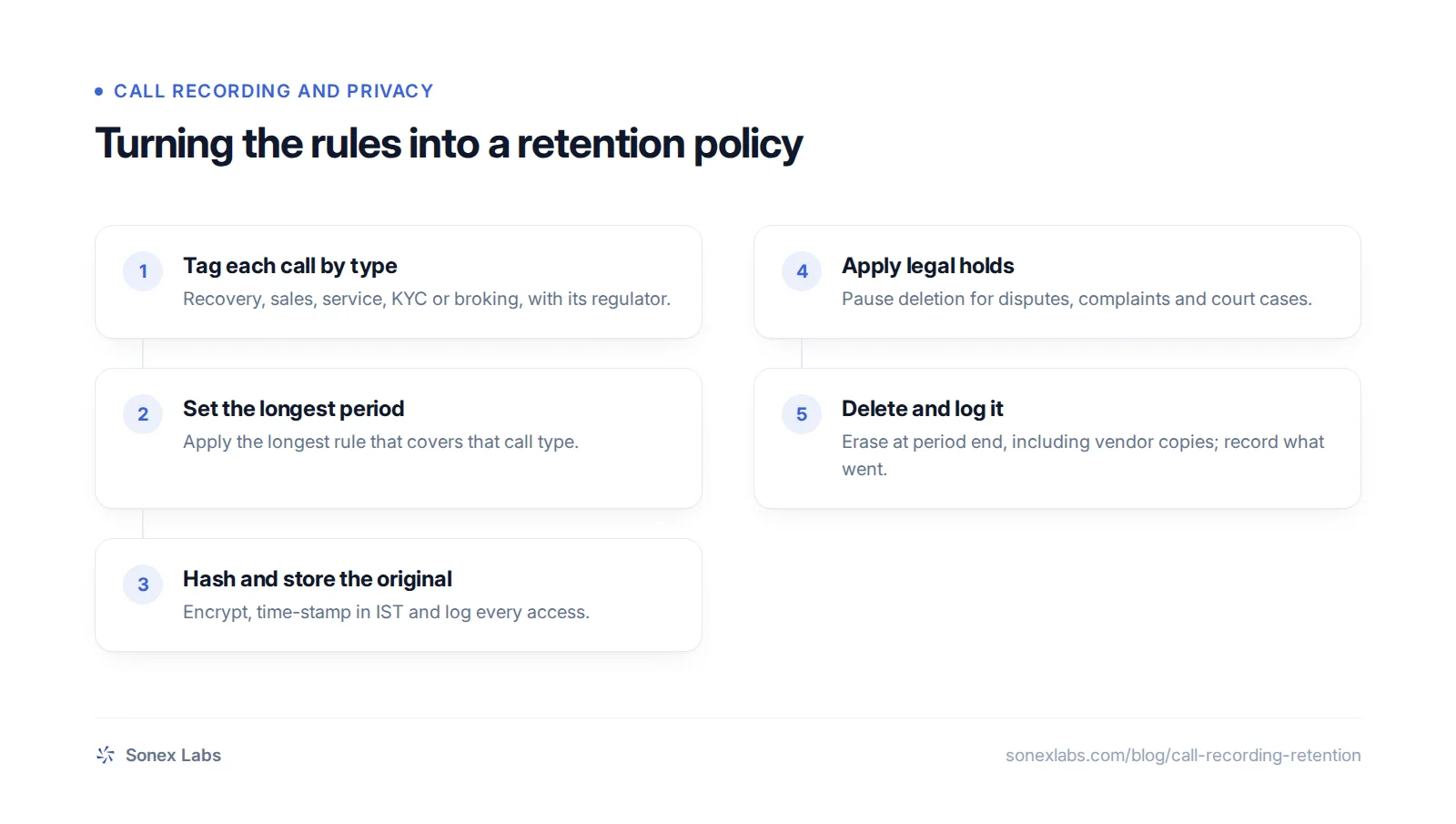
A workable policy starts from call types rather than from regulators. List every kind of call you record, such as recovery, sales, service, video KYC and broking, and note the regulator and rule from the table that covers each. Then give each type one period, the longest that applies: six months for recovery calls, for example, and at least three years for broker phone orders.
Two controls make the periods real. A legal hold pauses deletion for accounts in dispute, open complaints and court cases, and is lifted only when the matter closes. Deletion then runs on schedule, including copies your vendors hold, with a log of what was deleted and when, so you can later show the rule was followed. Telling callers in the opening line that the call is recorded, and why, completes the picture; for insurance sales calls that line should also offer a voice copy.
Key dates
Sources
- RBI NBFC – RBC Third Amendment Directions, 2026 (RBI/2026-27/230), para 100POfficial
- RBI Commercial Banks – RBC Fourth Amendment Directions, 2026 (RBI/2026-27/223), para 454POfficial
- SEBI circular: Prevention of Unauthorised Trading by Stock Brokers, 26 Sep 2017Official
- SEBI clarification to the circular on unauthorised trading, 30 Nov 2017Official
- SEBI circular consolidating the rules on unauthorised trading, 22 Mar 2018 (SEBI/HO/MIRSD/DOP1/CIR/P/2018/54)Official
- SEBI Master Circular for Stock Brokers, 17 Jun 2025 (para 35)Official
- IRDAI Guidelines on Distance Marketing of Insurance Products, 5 Apr 2011Official
- RBI (Commercial Banks – Know Your Customer) Directions, 2025Official
- CERT-In directions under section 70B(6) of the IT Act, 28 Apr 2022Official
- CERT-In FAQs on the cyber security directions, May 2022Official
- Digital Personal Data Protection Rules, 2025 (G.S.R. 846(E))Official
- Digital Personal Data Protection Act, 2023Official
- TRAI TCCCPR (Third Amendment) Regulations, 2026Official
- Gazette of India: TCCCPR (Third Amendment) Regulations, 2026, published 28 Sep 2026 (CG-DL-E-28092026-276548)Official
- Bharatiya Sakshya Adhiniyam, 2023 (as published in the Gazette, PRS copy)Official
- RBI circular on recovery agents, 12 Aug 2022Official
- RBI: Consolidation of Regulations, withdrawal of circulars, 28 Nov 2025 (RBI/2025-26/100)Official
- RBI (Housing Finance Companies) Third Amendment Directions, 2026, para 170AOfficial
- SEBI press release: limitation period for stock exchange arbitration (three years), Jan 2011Official
- SEBI (Research Analysts) Regulations, 2014, last amended 10 Oct 2026 (regulation 25)Official
- SEBI Master Circular for Research Analysts, 6 Feb 2026 (para 1.13)Official
- SEBI consultation paper: relaxing call records for research analysts' institutional clients, 18 May 2026Official
- SEBI circular: maintenance of call records of institutional clients by research analysts, 23 Oct 2026Official
Change log: 24 Oct 2026, Rewritten as one continuous guide: SEBI, RBI and IRDAI rules grouped by regulator with subsections, the pattern behind the periods explained, ordinary calls, CERT-In logs and deletion requests moved into the DPDP section, and a closing section on building a policy. Takeaways, steps, checklist and FAQs were folded into the body · 24 Oct 2026, Added SEBI research analysts; exact TRAI start dates from the Gazette (published 28 Sep 2026) · 24 Oct 2026, Corrected the BSA certificate signatories, the RBI recovery-direction paragraph numbers and the V-CIP cloud rule; dated the TRAI row and hedged the no-general-law claim · 23 Oct 2026, First published