On this page
- Why TRAI brought automated calls under its spam rules
- Is AI calling legal in India?
- Declaring A2P calls and choosing a number series
- Consent after an enquiry, and older consents
- How spam flags and complaints lead to action
- The A2P termination charge, and who pays it
- Getting automated calling ready for 27 November 2026
- Key dates
- Sources
Why TRAI brought automated calls under its spam rules
The Telecom Regulatory Authority of India (TRAI) regulates business calls and messages through the Telecom Commercial Communications Customer Preference Regulations (TCCCPR), 2018. Those rules decide who may send promotional calls and texts, how customers opt out through Do Not Disturb (DND), and how operators deal with spam. Until 2026 they were written mostly around what a call said, not how it was dialled.
Operators' own figures pushed TRAI to look at the dialling. In April 2026, operators disconnected 20,591 connections for spam violations. Of those, 15,736 were SIP or PRI lines, the business trunk connections used for A2P calling, a share TRAI put at about 75% (TRAI Third Amendment, explanatory memorandum). Software can place thousands of calls an hour, which is what makes it useful to legitimate businesses and attractive to spammers.
TRAI published a draft Third Amendment for consultation on 13 March 2026, took comments until 19 April and counter-comments until 4 May, and held an open house discussion on 3 June. It notified the final text on 18 September 2026 (TRAI Press Release 119/2026). The amendment builds on the Second Amendment of 12 February 2025, which created the 140 and 1600 number series and already asked senders to disclose their use of autodiallers and robocalls.
Two older terms run through the rules. UCC (unsolicited commercial communication) is TRAI's word for spam. DLT (distributed ledger technology) is the shared registry where operators record senders, their numbers, their message templates and their customers' consents.
When each change starts
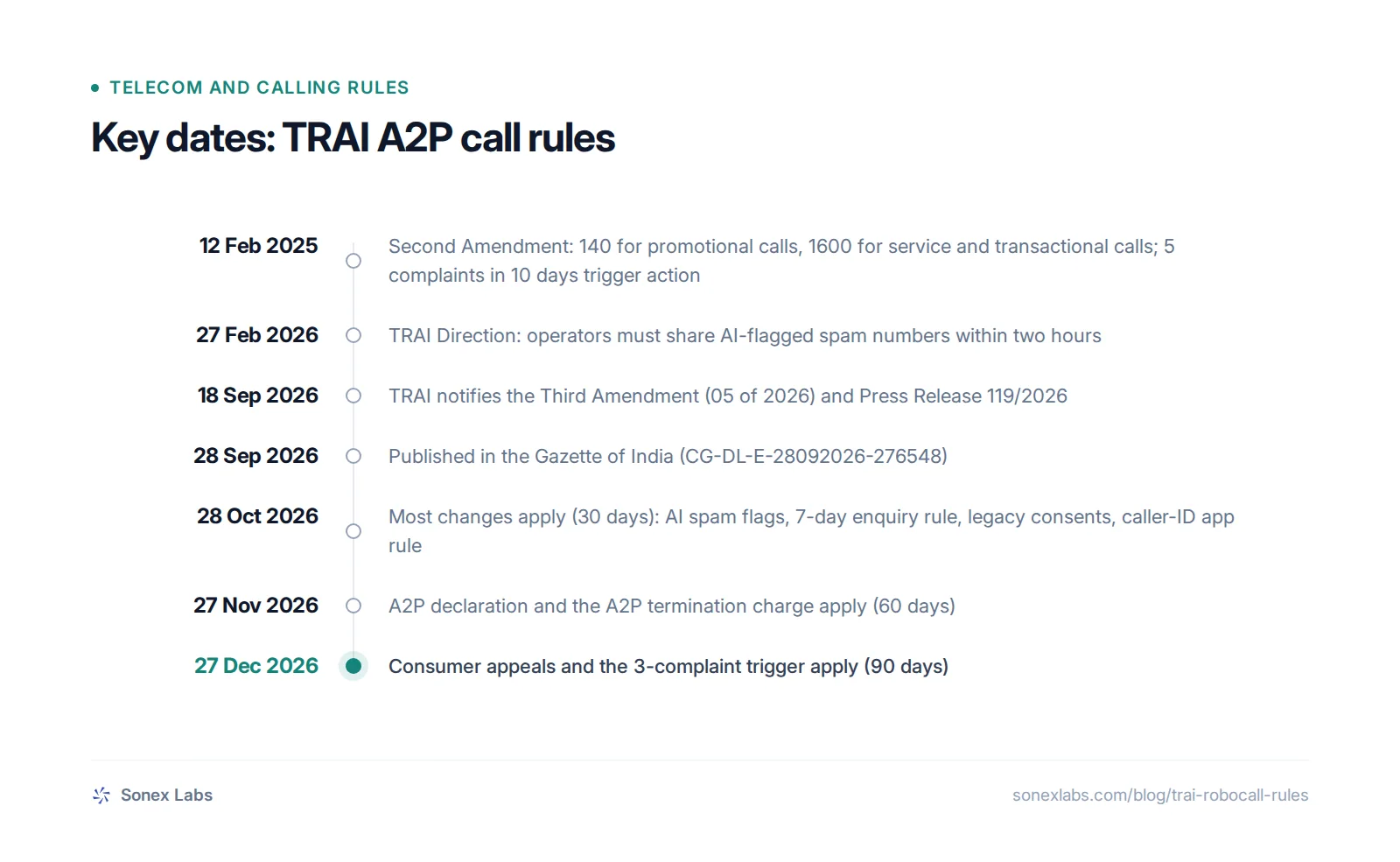
The amendment does not start on one day. Its start dates are counted from publication in the Gazette of India on 28 September 2026 (Gazette of India, Extraordinary, Part III, Section 4, CG-DL-E-28092026-276548), as regulation 1(3) sets out. Most of it applies after 30 days, from 28 October 2026: the AI spam flags, the seven-day enquiry rule, the treatment of older consents and the rewritten rule for caller-ID apps.
After 60 days, from 27 November 2026, come the A2P declaration and the A2P charge, along with a live DLT link for virtual network operators and rules on misused SMS headers and templates. After 90 days, from 27 December 2026, come the consumer appeal route and a lower complaint threshold for AI-flagged senders. The table sets each change against the rule it replaces.
| Topic and start date | Before | After |
|---|---|---|
| Automated calls, from 27 Nov 2026 | Senders had to disclose use of autodiallers and robocalls (2025 amendment) | Every software-dialled call is A2P. Declare A2P use and caller number ranges in advance, or calls count as spam |
| Charge on A2P voice calls, from 27 Nov 2026 | None (a charge applied only to commercial SMS) | Up to ₹0.05 a minute between operators; 140, 1600 and 1601 exempt |
| Operator AI spam flags, from 28 Oct 2026 | Set by a TRAI Direction of 27 February 2026 | Written into the rules. Five flagged numbers in 10 days starts KYC checks, then possible barring |
| Complaint trigger (unregistered telemarketers), from 27 Dec 2026 | 5 complaints from different people in 10 days | Also 3 complaints in 10 days if any sender number is AI-flagged; 5 still trigger action alone |
| Calls after an enquiry, from 28 Oct 2026 | An enquiry or application counted for three months, and need not be in writing | Enquiries count for 7 days and must be written or digital and verifiable. Applications: still 3 months |
| Older (legacy) consents, from 28 Oct 2026 | Counted only if verified with the customer and recorded by the operators' Consent Registrar | Count if obtained through verifiable means, then registered in the Consent Register |
| Consumer appeals, from 27 Dec 2026 | Appeals to the operator's Appellate Authority only by call centre, email, post or in person | Appeal within 15 days to the operator's Appellate Authority, including via the DND app, operator app or 1909 |
| Caller-ID and spam apps, from 28 Oct 2026 | Barred from tagging or blocking designated series (2025 amendment) | Rule rewritten: a "report spam" button is allowed only if reports go to the DLT platform |
Is AI calling legal in India?
Yes. Nothing in the amendment bans AI voice agents, IVR (interactive voice response) campaigns or autodiallers. Cold calling with AI is not banned either: a promotional call is lawful if the customer consented or has not blocked that category through DND, and if it comes from a 140-series number. What the amendment adds is a label, A2P, and a set of duties that follow from it.
TRAI defines an A2P call as a voice call "initiated by an application, software system, or automated platform without direct human dialling" (new regulation 2(ea), TCCCPR Third Amendment). The definition names autodialling, robocalls and pre-recorded or artificial voices. An AI voice agent that places outbound calls fits it squarely.
The test is how a call is dialled, not what it says. TRAI explained that its definition of a commercial communication turns on content, while the A2P definition turns on the technical way a call is generated. A bank's balance alert dialled by software is therefore an A2P call, even though it is a service message rather than a sales pitch.
Calls where a person joins later
Many companies asked TRAI to exclude calls where a live agent takes over, such as ride-hailing bridges, delivery calls and agent diallers. TRAI refused. It said operators have no technical way to tell which software-dialled calls have a human on them. It also pointed out that A2P calls from the designated number series are exempt from the new charge anyway.
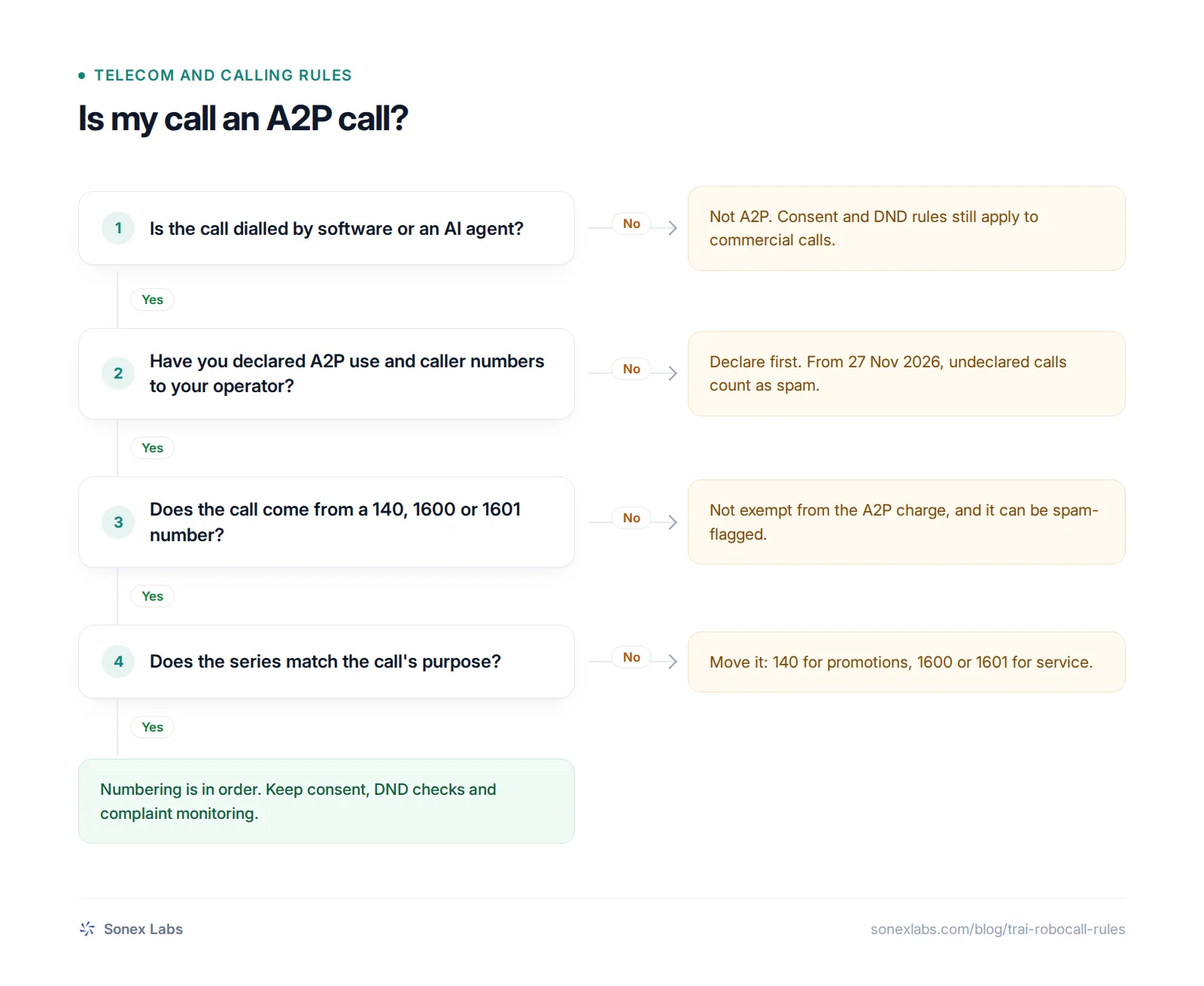
Others asked TRAI to limit the rule to commercial calls. TRAI refused that too. It said the rules apply to all A2P calls, because a narrower rule would let spam be dressed up as transactional or service calling. In practice, then, an AI agent that hands a call to a person is still making an A2P call from the moment software dialled it. The chart walks through the checks for a single call.
Declaring A2P calls and choosing a number series
The declaration is the change most likely to catch businesses out, because it reaches every number that software dials from. A sender tells its originating operator, the one whose network the calls start on, in advance that it makes A2P calls. It also lists the CLI (calling line identification) ranges it will use, meaning the caller numbers people see on their screens (substituted regulation 4).
The operator records the declaration on the DLT platform, together with the number series assigned to the sender. Holding 140, 1600 or 1601 numbers does not excuse a sender from declaring them. From 27 November 2026, a call made without a declaration is treated as UCC, which exposes the numbers behind it to complaints, barring and disconnection however legitimate the call was.
Which number series to call from
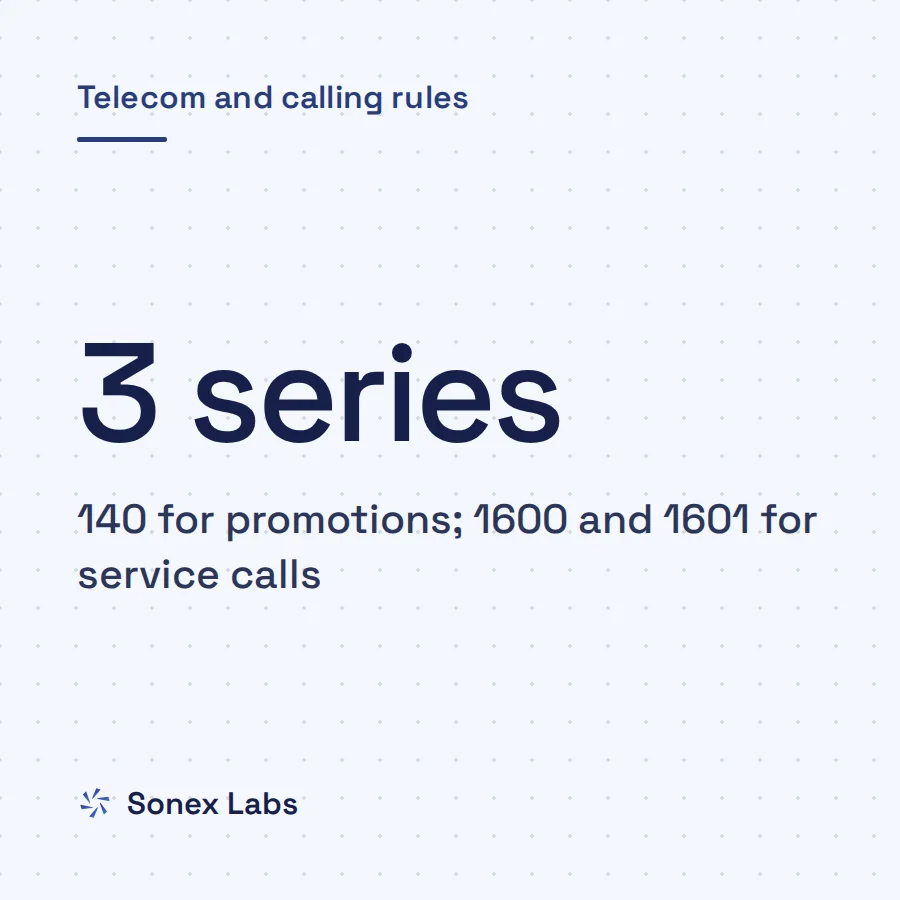
The declaration says which numbers you call from, and the purpose of each call decides which numbers those should be. Promotional calls from any sector use the 140 series. Service and transactional calls use 1600 if you are a bank, NBFC (non-banking financial company), insurer, mutual fund, qualified stock broker, pension body or government body. Utilities, courier and logistics firms are moving their service calls to the new 1601 series.
Other sectors have no series yet, so their service calls still go out on ordinary numbers. Those calls are not exempt from the A2P charge, and operators can flag them as spam. Some businesses asked TRAI to exempt such calls because their numbers are already declared on DLT. TRAI refused, saying designated series are the better approach and that more may follow. The guide to the 140, 1600 and 1601 number series has the sector-by-sector deadlines, and the number series lookup tool shows which series fits a given call.
When a platform places the calls for you
Many businesses do not dial these calls themselves, which raises the question of who is responsible when a platform does it for them. The answer is both. TRAI says registered cloud communication platforms act as aggregators for senders and carry a sender's or aggregator's obligations (explanatory memorandum, para 26). If a business uses numbers owned by an intermediary to send spam, the intermediary must stop the misuse, or operators act against its own telecom resources as well as against the business (para 5).
Because both sides are exposed, the split of work is best written down rather than assumed: who declares which number ranges, who receives flag notices and who answers complaints. Calling software can enforce some of the operational rules. On Sonex, for example, each outbound calling campaign carries its own calling window, time zone and retry limit. None of that replaces the declaration, which is made to the operator that provides the numbers.
Consent after an enquiry, and older consents
Declaring numbers tells the network who is calling. Consent rules still decide whom you may call, and the amendment's sharpest change here concerns calls that follow a customer's enquiry. From 28 October 2026, a business may call on the strength of an enquiry for only seven days after it. The enquiry must have been made in writing or digitally, and kept in a verifiable form.
Before the amendment, an enquiry or an application created a relationship for three months, and the enquiry did not need to be written down. Applications keep the longer window, so a customer who applied for a loan or a policy can still be called about it for three months. TRAI said the enquiry route exists mainly for e-commerce and e-service platforms, and that the written record is there to stop it being used as cover for spam.
Older consents collected outside the operators' consent system also get a route back in. From 28 October 2026 they count if you obtained them through verifiable means and then register them in the Consent Register (new definition 2(y)). Before, only consents verified directly with the customer and recorded by the operators' Consent Registrar counted.
Service calls and reminders
Service calls to your own customers about something they bought, such as balance alerts, delivery updates and OTPs, need no explicit consent. Calls to help a customer through an ongoing transaction do: that consent lasts seven days and can be renewed a week at a time (substituted regulation 2(bh)).
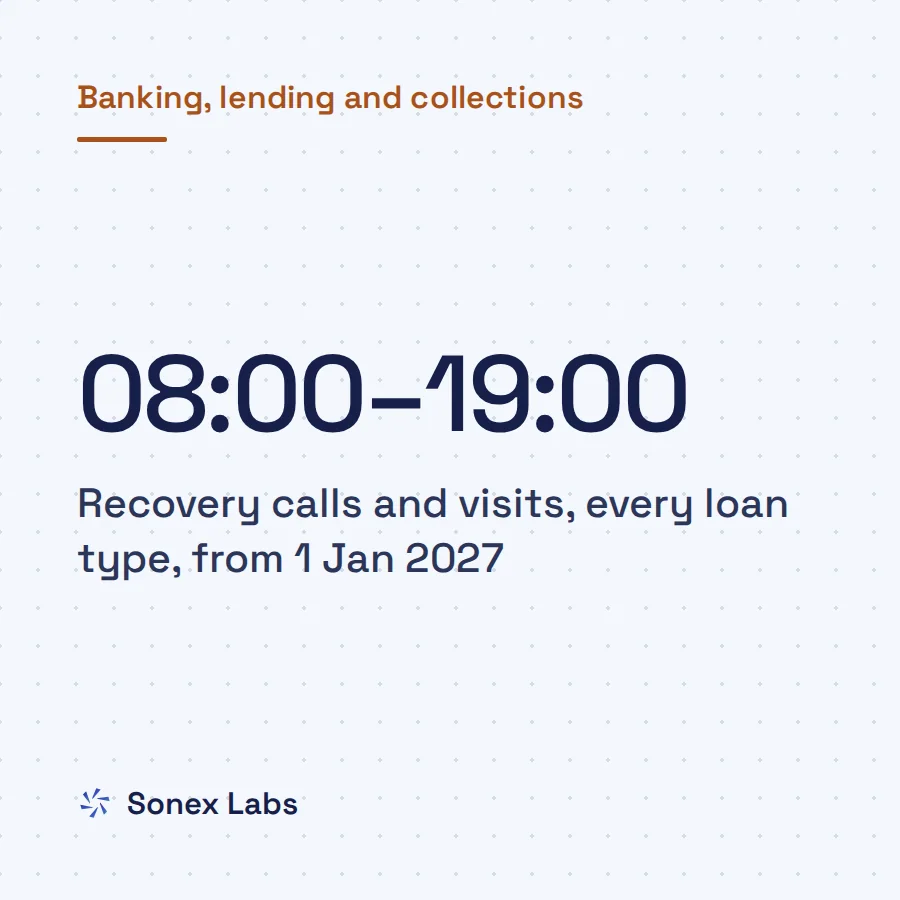
TRAI does not say whether EMI (equated monthly instalment) reminders or collection calls belong in the first group, so check with your operator and counsel before relying on it. Lenders face a second rulebook in any case. The RBI recovery agent rules from 1 January 2027 set calling hours and recording duties for collection calls, and an EMI reminder call script shows the disclosures in practice.
How spam flags and complaints lead to action
From 28 October 2026, mistakes over consent or declarations reach consequences faster, because operators' spam detection is written into the rules. Operators use AI and machine-learning systems to flag caller numbers likely to be spam (new regulation 21A). The operator receiving the calls must share flagged numbers with the sender's operator within two hours, and the sender is told by SMS, email or both. A TRAI Direction of 27 February 2026 first required this, and the amendment moves it into the regulations.
If five or more of one sender's numbers are flagged within 10 days, operators act in steps. The first time, the sender's KYC (know-your-customer) details are re-verified within three business days. The second time, a physical check follows within five business days. If that fails or misuse is found, outgoing calls are barred for 15 days on all operators, and repeat cases can end in a one-year disconnection and blacklisting.
A wrong flag can be challenged. The operator must remove it if the sender's justification holds, so consent records and the A2P declaration are worth keeping where they can be produced quickly.
Complaints from the public run alongside the flags. For unregistered telemarketers, meaning senders not registered with an operator for commercial calls, five complaints from different people in 10 days still trigger action on their own. From 27 December 2026, three are enough if any of the sender's numbers is also AI-flagged. Either way, the operator must suspend the numbers at once and investigate (regulation 25(5)). From the same date, customers unhappy with how a complaint was resolved can appeal within 15 days to the operator's Appellate Authority, through the DND app, the operator's app or 1909.
Protection for designated numbers
Numbers from the 140, 1600 and 1601 series may not be shown as suspected spam to the person receiving the call. TRAI's July 2026 clarification goes further for caller-ID apps: calls from 1600 numbers may not be tagged, blocked or filtered at all. Calls from 140 numbers may not be tagged or filtered except where the customer has blocked that category on the DND registry (TRAI Press Release 91/2026).
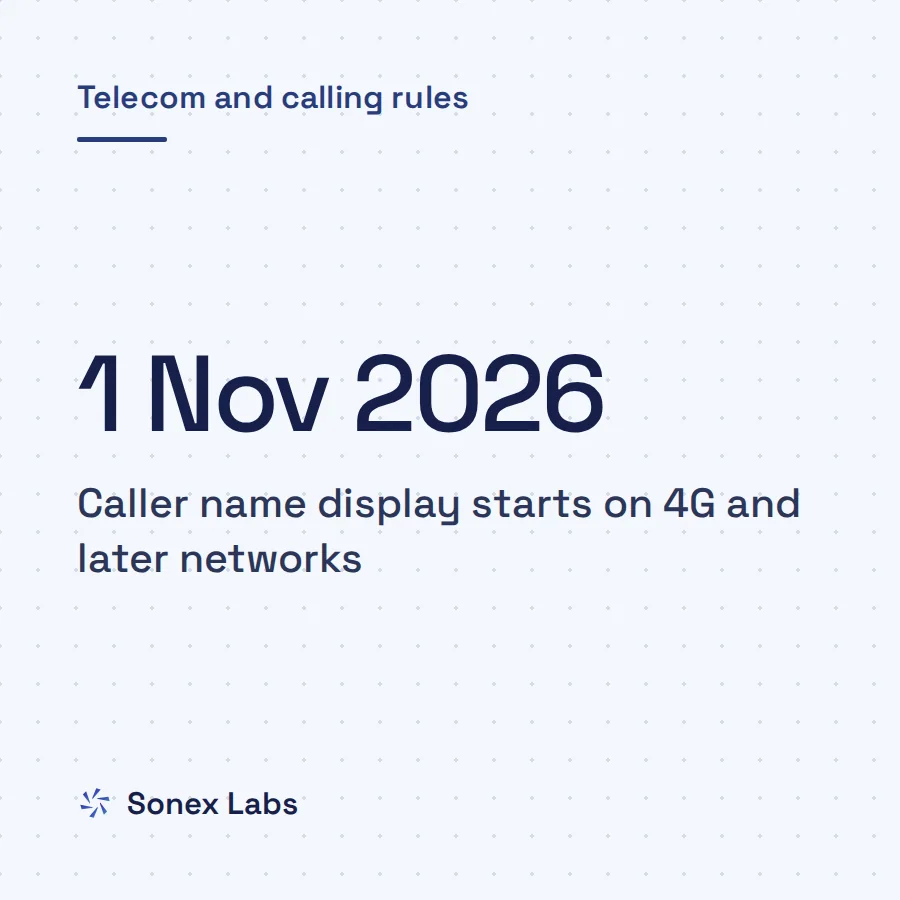
Regulation 34A, first added in 2025 and rewritten in 2026, sets the same limit for caller-ID and spam-blocking apps across all their users. Each person can still block a number on their own phone, and an app may offer a "report spam" button only if the reports go to the operators' DLT platform. Ordinary 10-digit numbers have none of this protection, which is the usual reason a business number shows up as spam. Caller name display (CNAP) is a separate change that puts the registered name on screen.
The court challenge to the complaint rule
The complaint rule is being contested. IndiaMART has asked the Delhi High Court to strike down regulation 25, as amended in 2025, in so far as it applies to business-to-business communication. The court issued notice to TRAI and the Department of Telecommunications in December 2025 (Bar & Bench, 23 December 2025). The petition predates the 2026 amendment, which rewrote regulation 25 again, and as of 24 October 2026 we found no report of a stay or a ruling.
The A2P termination charge, and who pays it
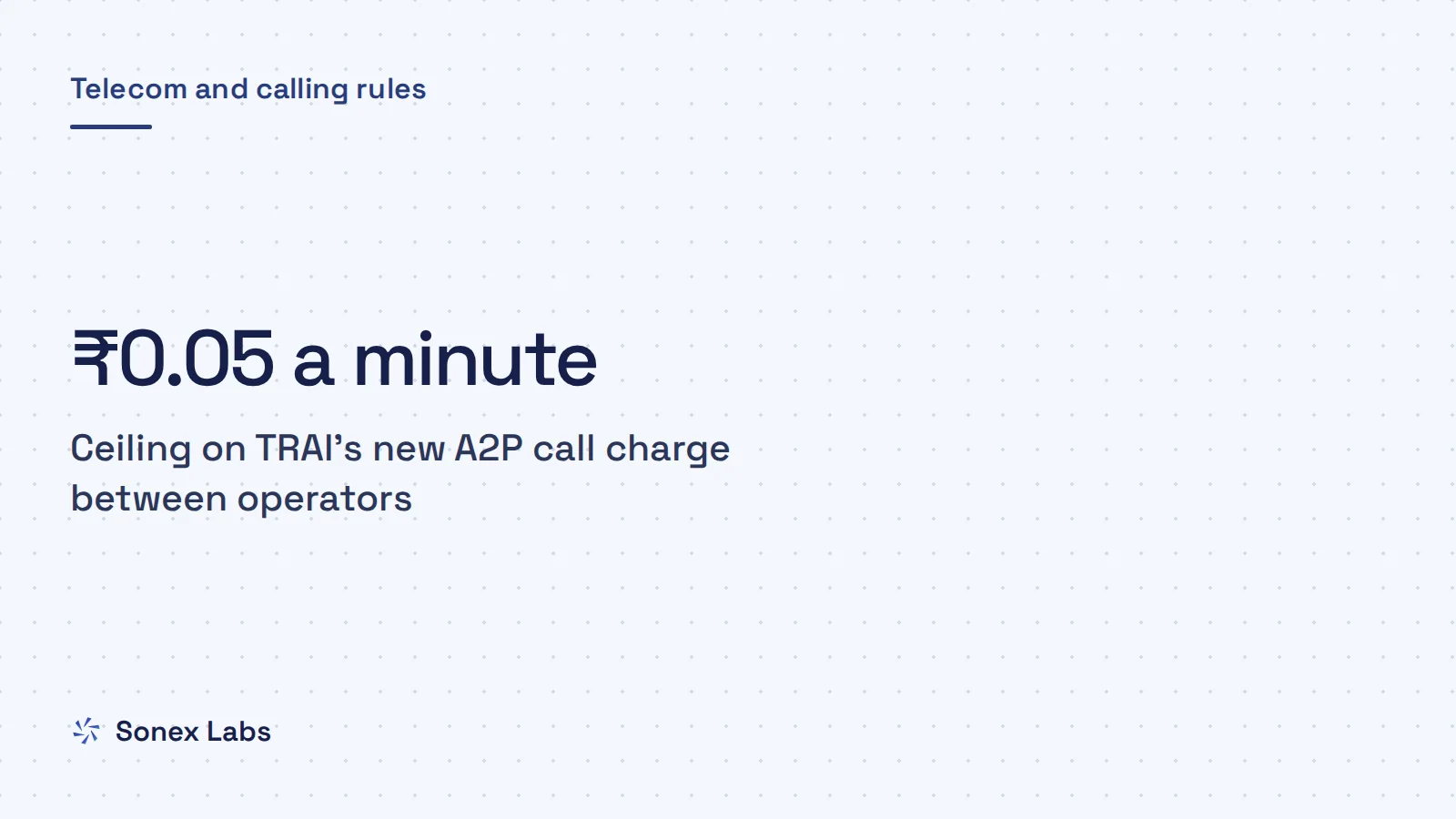
The last major change puts a price on A2P calls made outside the designated series. The A2P termination charge is up to ₹0.05 (five paise) per minute, counted in one-minute pulses (new regulation 35A). The operator delivering the call may bill the operator that sent it, but never more than its own lowest tariff to the senders or telemarketers it serves.
There is no charge on A2P calls from the 140, 1600 and 1601 series, or on calls made by or for TRAI. TRAI describes the charge as a deterrent rather than cost recovery, modelled on the existing five-paise charge on commercial SMS, and it is the first such charge on A2P voice calls. Its effect is to make the designated series the cheaper route as well as the protected one.
Businesses are not billed the charge directly. Whether any of it reaches you depends on your contract with your operator, which is worth asking about before 27 November 2026.
Getting automated calling ready for 27 November 2026
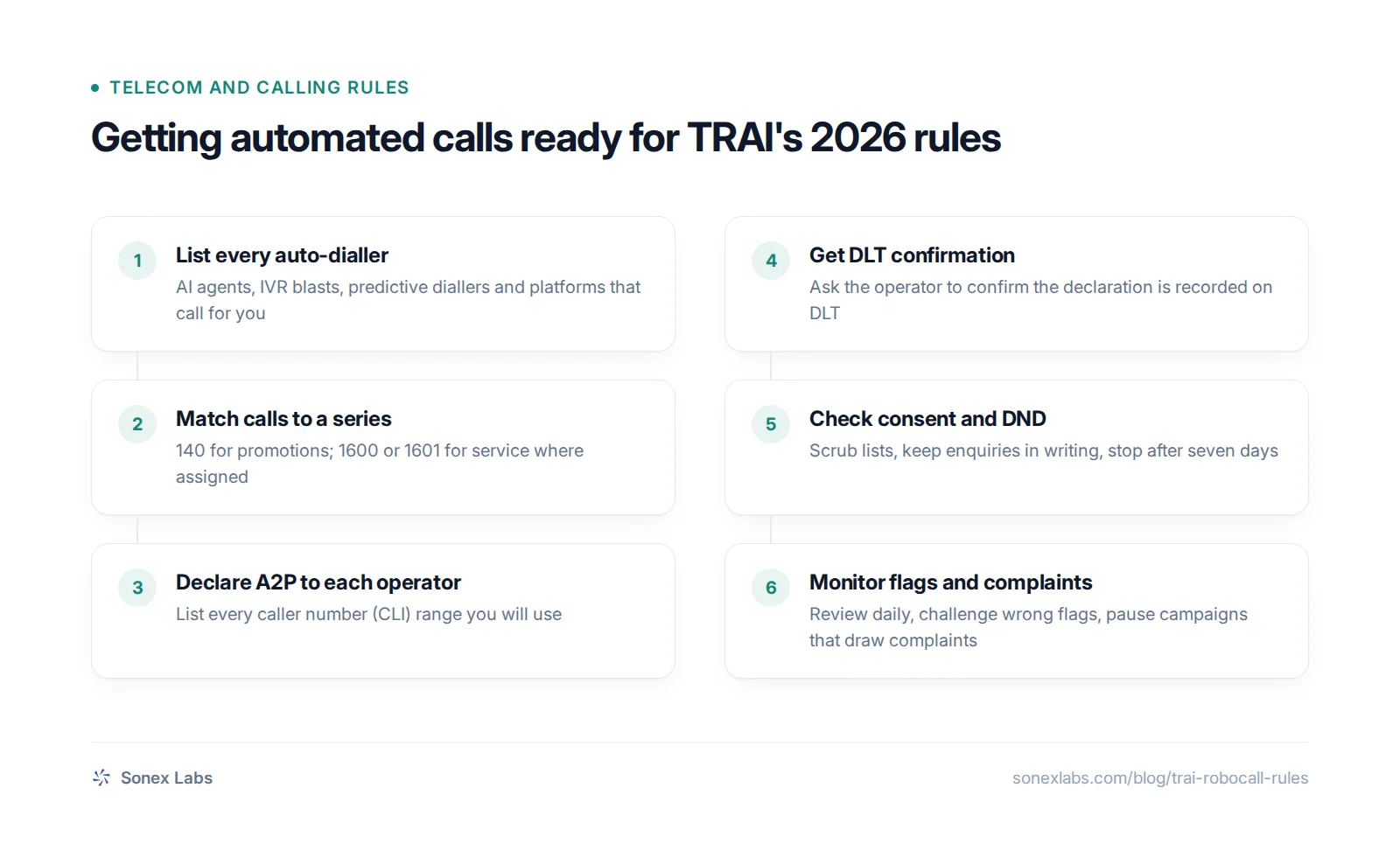
The declaration can only be as complete as a business's list of what dials for it. That list usually runs longer than expected. It covers AI voice agents, IVR blasts and predictive diallers, plus any vendor or platform that places calls on the business's behalf, each with its own numbers and operator.
From there the work follows the order of the rules. Each campaign is matched to a number series by purpose, each operator receives a declaration covering every caller number range, and the operator confirms the entry on DLT. Consent records, written enquiries and daily flag and complaint counts then keep the numbers in good standing once calling starts. The calling rules by country tool summarises the India rules alongside other markets.
Key dates
Sources
- TRAI: TCCCPR (Third Amendment) Regulations, 2026 (05 of 2026), with explanatory memorandumOfficial
- TRAI Press Release 119/2026, 18 September 2026Official
- Gazette of India: TCCCPR (Third Amendment) Regulations, 2026, published 28 Sep 2026 (CG-DL-E-28092026-276548)Official
- TRAI Direction on sharing AI/ML-flagged spam numbers, 27 February 2026Official
- TRAI: TCCCPR (Second Amendment) Regulations, 2025 (including the first regulation 34A)Official
- TRAI Press Release 11/2025 (Second Amendment), 12 February 2025Official
- TRAI Press Release 91/2026: clarification on 1600 and 140 seriesOfficial
- TRAI Direction on the 1600 series, 19 November 2025 (sectors including qualified stock brokers)Official
- Bar & Bench: Delhi High Court seeks Centre's response to IndiaMART's plea against spam call and message regulations, 23 December 2025Secondary
Change log: 23 Oct 2026, First published · 24 Oct 2026, Corrected the template-suspension rule, the earlier appeal route and the 1600 broker wording; added the IndiaMART court challenge; exact TRAI start dates from the Gazette (published 28 Sep 2026). Added TRAI's July 2026 clarification on tagging 1600 and 140 calls. Later the same day, rewritten as one continuous guide: added why TRAI acted (April 2026 disconnection figures, consultation timeline) and TRAI's content-versus-dialling distinction; the takeaways, steps, checklist and FAQs were folded into the body