On this page
- Why TRAI gives business calls their own number series
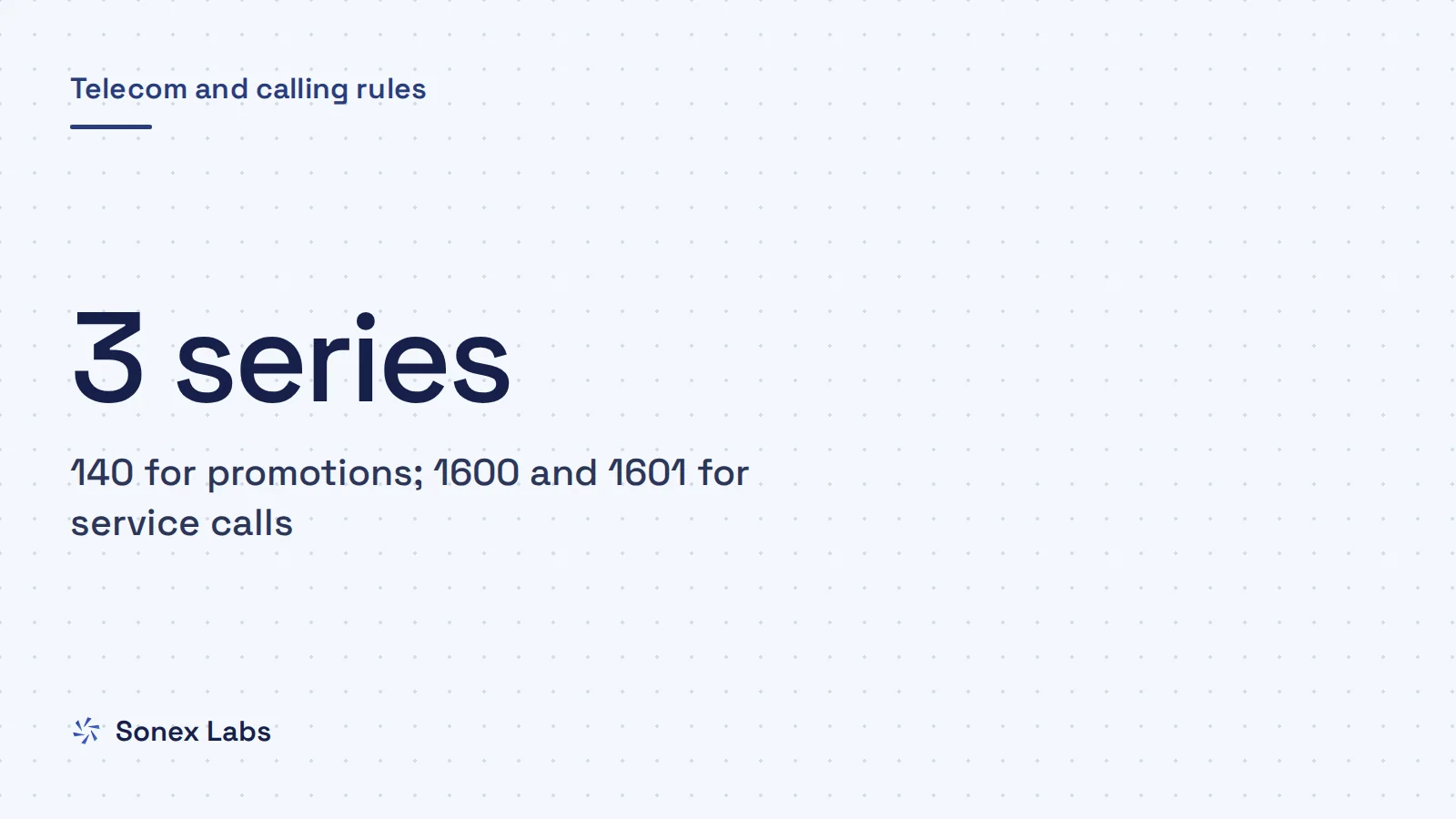
- Promotional calls on the 140 series
- The 1600 series for banks, insurers, funds and brokers
- The 1601 series for utilities, courier and logistics
- Can a business still call from a 10-digit number?
- Why business numbers show as spam, and which numbers the rules protect
- Key dates
- Sources
Why TRAI gives business calls their own number series
For years, a call from a bank, a delivery company and a fraudster could look exactly the same: an unknown 10-digit mobile number. The Telecom Regulatory Authority of India (TRAI) is changing that by tying the purpose of a business call to the range it comes from. A customer who sees a 1600 number should be able to trust that a regulated bank, insurer or government body is calling, while a 140 number marks the call plainly as marketing.
That only works if commercial calls stop arriving from ordinary numbers. So in its Second Amendment of February 2025, TRAI stopped senders from using normal 10-digit numbers for telemarketing (TRAI Press Release 11/2025). The 1600 series, which many people search for as the "160 series", followed for service calls from regulated finance, and in August 2026 TRAI added 1601 for service calls from other sectors.
Two kinds of call run through the rules. A promotional call tries to sell something. A service or transactional call is about something the customer already has, such as an account alert, a policy renewal or a delivery. The table shows which series each kind of caller uses, and by when.
| Who is calling | Series and purpose | Deadline |
|---|---|---|
| Any sector | 140xx: promotional | Already required |
| Commercial banks | 1600xx: service and transactional | 1 Jan 2026 |
| Payments banks, small finance banks, NBFCs with assets above ₹5,000 crore | 1600xx: service and transactional | 1 Feb 2026 |
| Other NBFCs, co-operative banks, regional rural banks and other RBI-regulated entities | 1600xx: service and transactional | 1 Mar 2026 |
| Mutual funds and asset management companies | 1600xx: service and transactional | 15 Feb 2026 |
| Qualified stock brokers | 1600xx: service and transactional | 15 Mar 2026 |
| Pension: central record-keeping agencies and pension fund managers | 1600xx: service and transactional | 15 Feb 2026 |
| Insurers and other IRDAI-regulated entities | 1600xx: service and transactional | 15 Feb 2026 |
| Government bodies | 1600xx: government-to-citizen | None found as of 24 Oct 2026 |
| Utilities, courier and logistics | 1601xx: service and transactional | About 8 Nov 2026 |
| Everyone else (e-commerce, healthcare, education, telecom, real estate and others) | None assigned yet (service and transactional) | None |
Promotional calls on the 140 series
The 140 series is the one every sector shares. A promotional call must come from a 140 number. TRAI says a business that wants those numbers has to register with its telecom operator under the TCCCPR (Telecom Commercial Communications Customer Preference Regulations), TRAI's rules on business calls and messages. In practice that means DLT registration. DLT (distributed ledger technology) is the shared platform where operators record registered senders, their numbers and their customers' consents.
Customers then decide which sectors may reach them. A customer who has blocked a sector on the Do Not Disturb (DND) registry, for example through the TRAI DND app, gets no 140 calls from businesses in that sector. The call either has the customer's consent or respects that choice. The calling rules by country tool sets the India rules beside other markets.
TRAI does not allow apps to tag or filter 140 calls apart from that DND blocking. Its reasoning is that a spam label on a 140 call could mislead a customer who deliberately allowed calls from that sector (TRAI Press Release 91/2026).
The 1600 series for banks, insurers, funds and brokers
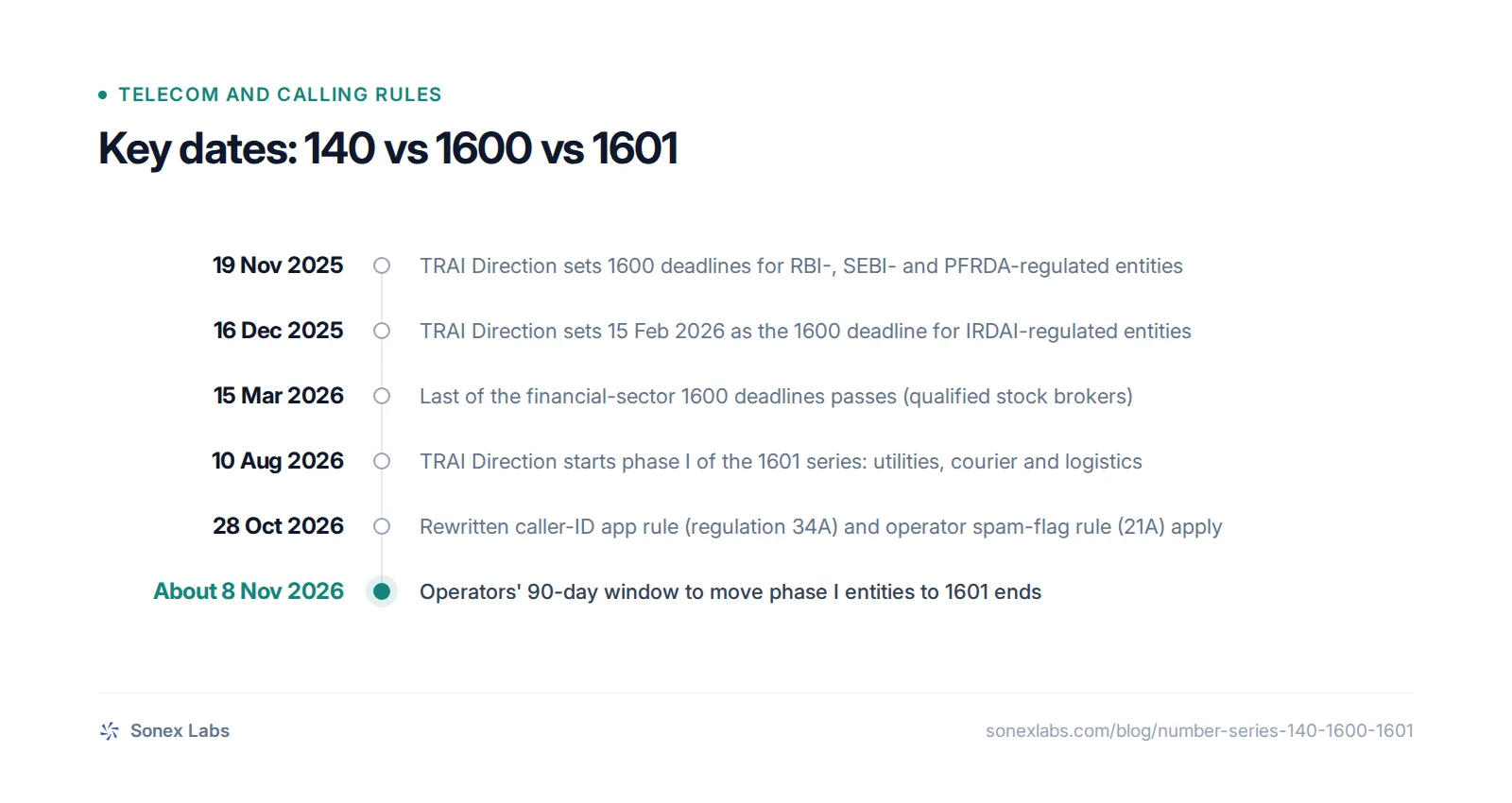
Service and transactional calls from regulated finance are where the 1600 series applies, and all its deadlines for financial firms have passed. TRAI set them in a Direction of 19 November 2025 for entities regulated by the Reserve Bank of India (RBI), the securities regulator SEBI and the pension regulator PFRDA. A Direction of 16 December 2025 added insurers regulated by IRDAI (Press Releases 135/2025 and 151/2025).
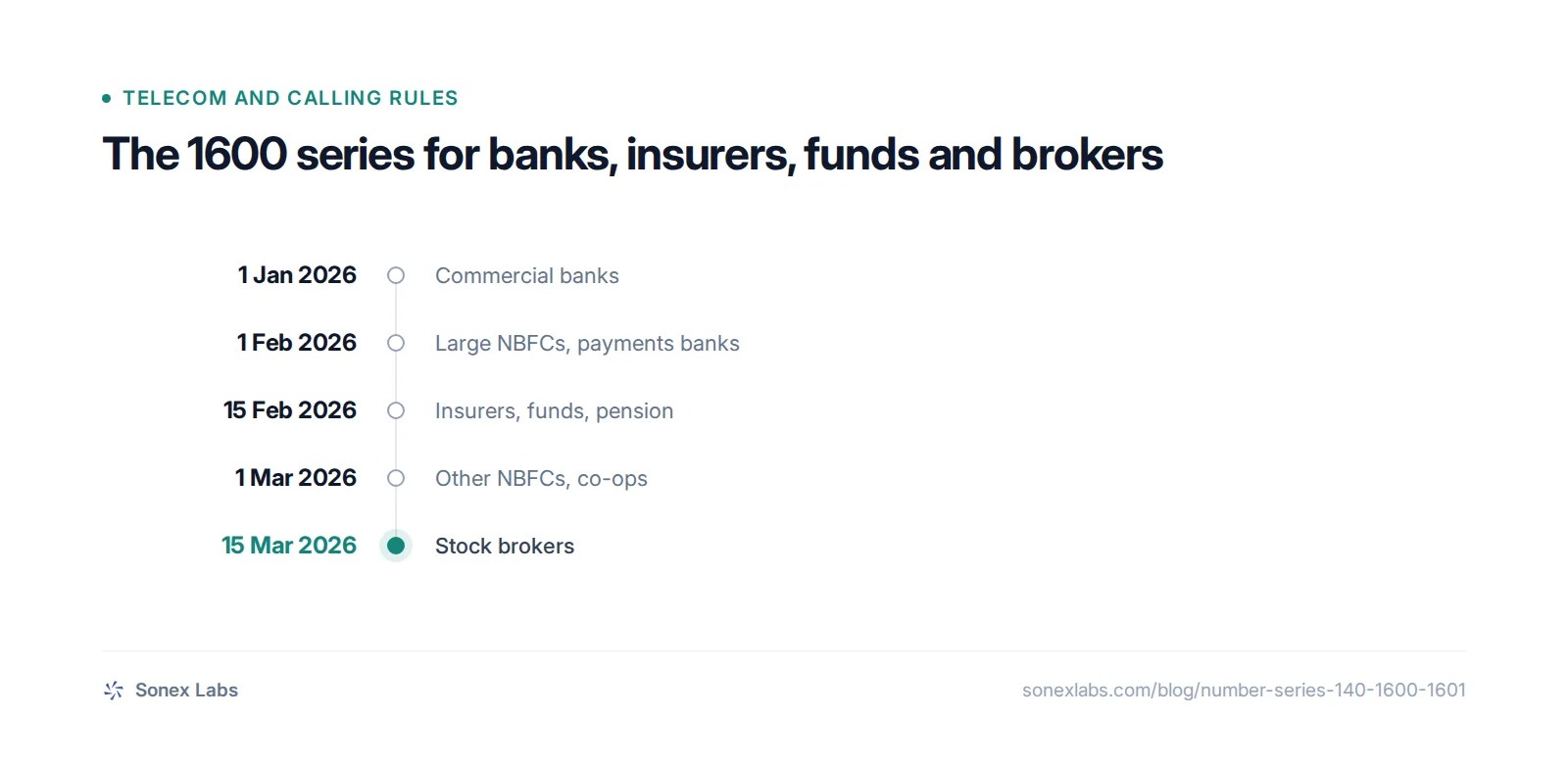
Commercial banks went first, on 1 January 2026. Payments banks, small finance banks and NBFCs (non-banking financial companies) with assets above ₹5,000 crore followed on 1 February. Insurers, mutual funds, asset management companies and pension bodies had until 15 February, smaller NBFCs and other RBI-regulated lenders until 1 March, and qualified stock brokers until 15 March 2026.
Missing a deadline has real consequences. A covered firm may not make service or transactional calls from any other number, "even with the explicit or inferred consent of customers". Spam complaints against it are handled as for an unregistered telemarketer (TRAI Direction of 19 November 2025, para 8). Other SEBI intermediaries may move voluntarily for now.
The series is not a marketing channel. TRAI's July 2026 clarification describes 1600 as mandated for these firms' calls to their existing customers, and for government bodies' calls to citizens (Press Release 91/2026). A bank or insurer selling a new product therefore calls from 140 like anyone else, and the customer's consent or DND choice applies. Lenders' collection calls carry a second set of duties, set out in the RBI recovery agent rules from 1 January 2027.
A possible exemption for small financial firms
In its September 2026 amendment, TRAI noted regulators' suggestion that small financial firms dealing with only a few existing customers could be exempted from 1600, or allowed to use it optionally. It gave itself power to classify senders and set different criteria for each class (TCCCPR Third Amendment, explanatory memorandum). We found no exemption notified as of 24 October 2026, so the deadlines above still apply.
The 1601 series for utilities, courier and logistics
For businesses outside finance and government, TRAI created 1601, a separate series for their service and transactional calls. It kept these calls out of 1600 "to avoid mixing of important financial voice calls" with other sectors' calls. It added that a distinct range would let consumers recognise legitimate service calls (TRAI Press Release 113/2026, 10 August 2026). A 1600 number keeps meaning a financial or government caller, while 1601 marks a service call from another kind of business.
Phase I covers two groups. Utilities means electricity distribution companies, water utilities, city gas and LPG distributors and similar providers. Logistics and courier means courier, express, parcel delivery, freight and logistics companies that deliver consignments.
Operators must finish moving these firms within 90 days of TRAI's Direction of 10 August 2026, which works out to about 8 November 2026. More sectors will follow in later phases after TRAI reviews phase I, but it has not named them or set dates. E-commerce, healthcare, education and other sectors without a series should watch TRAI's press releases. Guides written before August 2026 sometimes describe 1601 differently; the August Direction is the current position.
How 1601 numbers are allotted
The allotment rules are strict. The numbers go directly to the eligible business, not to an aggregator or other intermediary (Press Release 113/2026), so a cloud telephony provider cannot hand them out from its own pool. Before allotting them, the operator checks eligibility and takes an undertaking, in a form set by DoT (the Department of Telecommunications), that the numbers will carry only service and transactional calls.
The numbers are issued only as ten-digit numbers, and "under no circumstances" may they be used for promotional calls (TRAI Direction of 10 August 2026). A courier firm that also runs sales campaigns therefore needs 140 numbers for those. Its 1601 range is for calls like the delivery and failed-delivery checks in a delivery and NDR call script.
Can a business still call from a 10-digit number?
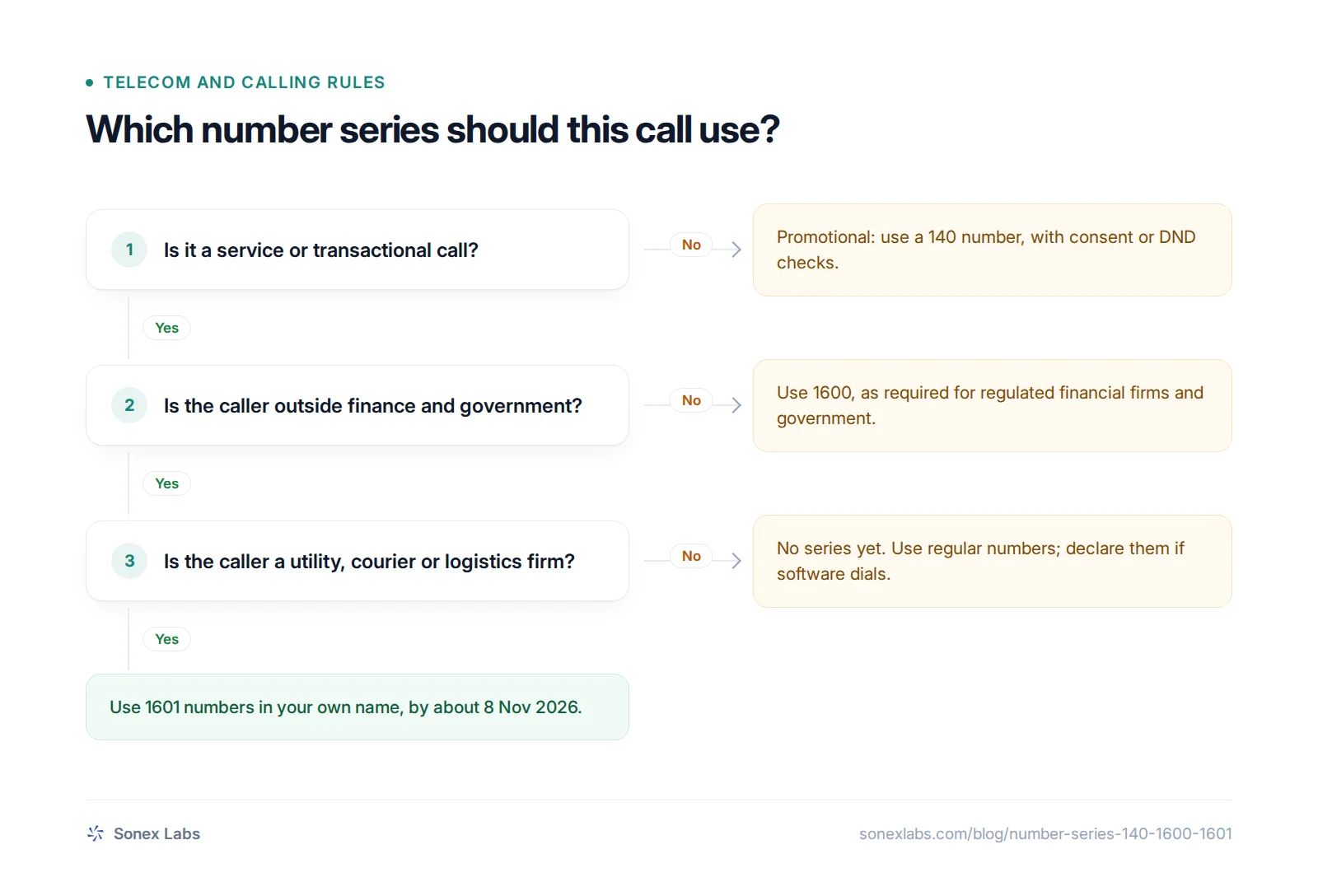
Choosing a series for a call comes down to two questions: what is the call for, and who is calling? Promotional calls always go out on 140, so a 10-digit number is never allowed for them. Service calls go out on 1600 if you are a financial firm or a government body, and on 1601 if you are a utility, courier or logistics firm once your operator has moved you.
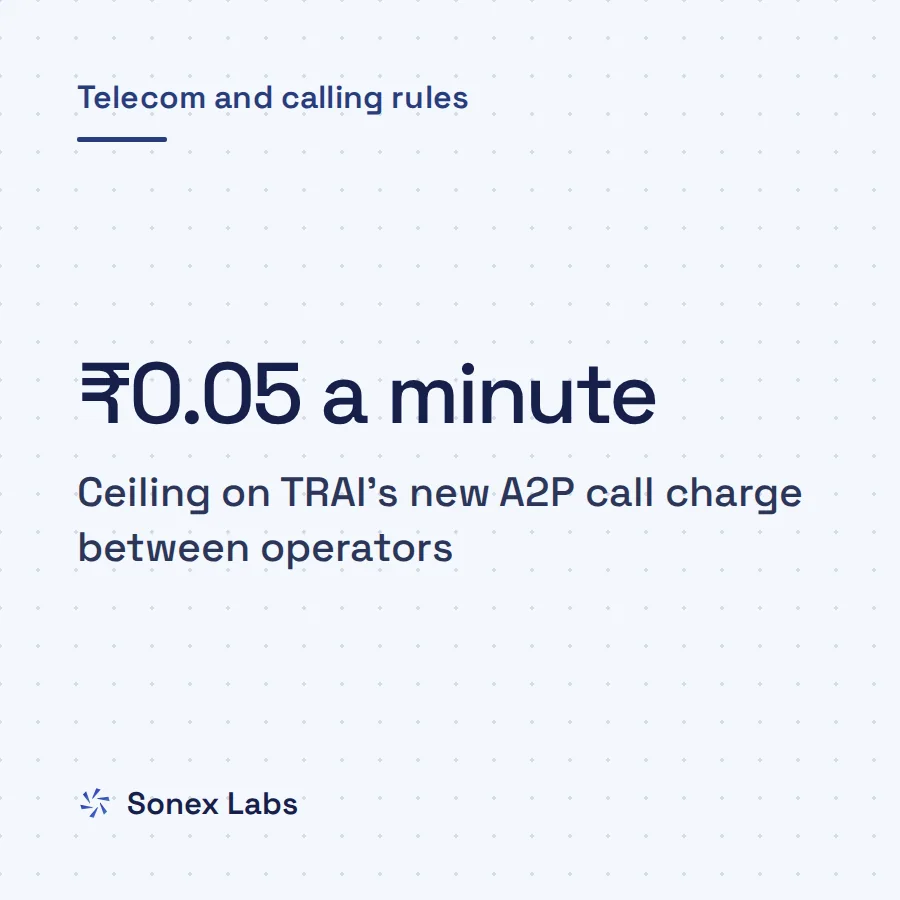
If your sector has no series yet, your service calls still go out on regular numbers, and they lose two protections the designated series enjoy. They are not exempt from TRAI's new A2P charge of up to ₹0.05 per minute between operators, and operators' AI systems can flag them as spam. Some businesses asked TRAI to exempt service calls from numbers already declared on DLT. TRAI refused, saying designated series are the better approach and that it may designate more over time (explanatory memorandum to the 2026 amendment, para 5).
One more duty applies whichever series you use, if software or an AI agent dials the call. TRAI's September 2026 amendment was published in the Gazette on 28 September 2026 (Gazette of India, Extraordinary, Part III, Section 4, CG-DL-E-28092026-276548). From 27 November 2026, 60 days later, a business must declare such A2P (application-to-person) calls to its operator, with the number ranges it will use. The operator records the declaration on DLT alongside your series, so it covers 140, 1600 and 1601 numbers as well as regular ones. TRAI's 2026 rules for AI and automated calls explain the declaration and the charge.
Because 1601 numbers are allotted only to the business itself, an AI calling platform has to be able to dial from numbers you hold. On Sonex, for example, outbound AI calling can run on telephony you bring from your own operator, so the numbers and their series stay in your name. The number series lookup tool gives the right series for a given sector and call type.
Why business numbers show as spam, and which numbers the rules protect
If your business number shows as spam on Truecaller or a similar caller-ID app, the usual reason is that it is an ordinary 10-digit number and enough of the people you called reported it. TRAI describes this as crowd-sourced tagging: some recipients flag a number, and the app then shows the label to everyone who gets a call from it.
TRAI's protection against those labels covers only the designated series. Its July 2026 clarification says no tagging, blocking or filtering of 1600 calls is permitted, and no tagging or filtering of 140 calls except through the DND registry (Press Release 91/2026). The rule behind this is regulation 34A, added in 2025, which barred caller-ID apps from tagging or blocking designated number series.
The September 2026 amendment rewrites regulation 34A from 28 October 2026, 30 days after its Gazette publication. Apps may not tag, block or filter calls from any series designated for commercial or government calls, or treat them differently from genuine calls. An app may keep a "report spam" button only if it sends those reports to the operators' DLT platform.
TRAI also gave itself a route to enforce this against apps. Under the new regulation 34A(3), it may act against a non-compliant app under the applicable laws, after giving it a chance to respond. The explanatory memorandum points to the IT Act. An intermediary that breaks a law, including TRAI's regulations, can lose the safe-harbour protection of section 79 of the IT Act, under rule 7 of the IT Rules, 2021.
Operator flags and ordinary numbers
Operators face the same limit. Their AI spam systems flag numbers that behave like spam callers (regulation 21A), but no 140, 1600 or 1601 number may be shown as suspected spam to the person called. Ordinary numbers get none of this. From 28 October 2026 the spam reports app users make go to the operators' DLT platform, and TRAI says operators will treat them as reports, not complaints, and use them to spot suspected spammers.
So a number many people report can now be flagged by the network as well as by the app. If an operator has flagged your number, ask it to unflag the number and give your reasons. Regulation 21A requires operators to offer senders a way to object and to remove the flag if the justification holds. That process covers operator flags only. A caller-ID app's own label is handled by the app, or by TRAI under regulation 34A if the number is from a designated series.
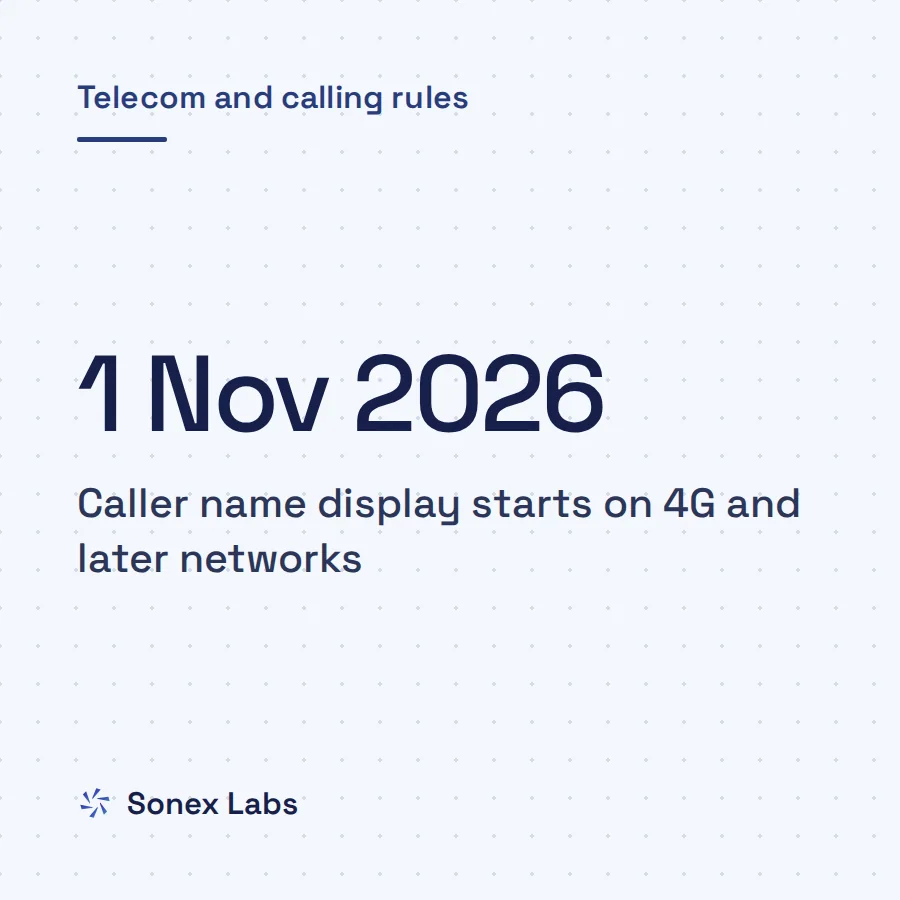
The lasting fix is the series itself: promotional calls on 140, and service calls on 1600 or 1601 where your sector has one. Caller name display (CNAP), which shows the caller's registered name on screen, is a separate change that also helps customers recognise a genuine business.
Customers can still block you
None of this stops an individual customer from refusing your calls. A customer can block a whole sector's promotional 140 calls on the DND registry, and anyone can block a single number on their own phone. Regulation 34A only stops apps from labelling or blocking designated numbers for everyone, so a personal block must not change what other users see.
Key dates
Sources
- TRAI Press Release 91/2026: clarification on 1600 and 140 series, 10 July 2026Official
- TRAI Press Release 113/2026: 1601 series phase I, 10 August 2026Official
- TRAI Direction on 1601 series phase I, 10 August 2026Official
- TRAI Press Release 135/2025: 1600 deadlines for RBI, SEBI and PFRDA entities, 19 November 2025Official
- TRAI Direction on 1600 series for RBI, SEBI and PFRDA entities, 19 November 2025Official
- TRAI Press Release 151/2025: 1600 deadline for IRDAI entities, 17 December 2025Official
- TRAI Direction on 1600 series for IRDAI entities, 16 December 2025Official
- TRAI Press Release 11/2025: Second Amendment to TCCCPR, 12 February 2025Official
- TRAI: TCCCPR (Third Amendment) Regulations, 2026, with explanatory memorandumOfficial
- Gazette of India: TCCCPR (Third Amendment) Regulations, 2026, published 28 Sep 2026 (CG-DL-E-28092026-276548)Official
- TRAI: TCCCPR (Second Amendment) Regulations, 2025 (the first regulation 34A)Official
- All India Radio News: 1601 series for transactional and service calls other than banks, financial and government entities, 10 August 2026Secondary
Change log: 23 Oct 2026, First published · 24 Oct 2026, Corrected the source for the 1601 no-aggregator rule and tightened the spam-flag and broker wording; exact TRAI start dates from the Gazette (published 28 Sep 2026). Added a section on why business numbers show as spam on caller-ID apps such as Truecaller, the July 2026 clarification and the rewritten regulation 34A. Later the same day, rewritten as one continuous guide: added why TRAI ties calls to number ranges and TRAI's stated reason for 1601; the takeaways, steps, checklist and FAQs were folded into the body