On this page
Why COD returns cost Indian sellers so much
RTO (return to origin) is the courier's term for a parcel that goes back to the seller undelivered. It happens on prepaid orders too, but it is far more common on COD orders, because a buyer who has paid nothing has nothing to lose by refusing the parcel. On a COD order the seller usually pays both the outbound and the return shipping, and the stock is tied up in transit for days.
How big the problem is depends on whose numbers you read. Razorpay, citing ET Prime Research from 2024, says 60 to 65% of Indian e-commerce orders are placed via COD, and that "25 to 30% of COD orders result in RTO" against 2 to 3% for prepaid (Razorpay). A narrower snapshot, Fynd's report on the 2025 Black Friday sales, put COD at 45.2% of orders, down from 49.9% a year earlier. In that report COD RTO was 8.65% and prepaid RTO 2.08% (Indian Retailer, December 2025).
The two sources measure different things, one a broad estimate and the other a single sale on large platforms, so neither is a forecast for your store. Both point the same way, though: COD orders come back several times as often as prepaid ones. That gap is what confirmation calls, prepaid discounts and COD limits all try to close.
What a confirmation call can and cannot fix
A confirmation call works on one kind of loss: orders that would have been refused at the door because the buyer ordered on impulse, ordered twice or forgot. Asking "shall I confirm the order?" before dispatch lets those buyers say no while it still costs you nothing to ship. The same call can catch a duplicate order, ask for a landmark when an address is vague, and move a delivery to a day the buyer will be home.
An AI agent does this at any hour, within minutes of the order, and in the buyer's language, which is hard for a small human team to match. Speed matters because an impulse buyer is easiest to reach, and cheapest to cancel, while the order is fresh. So trigger the call from the new-order event rather than in a batch at the end of the day.
What the call cannot do is check whether the buyer is honest. A prankster or a rival placing fake orders can simply say yes. An address typed wrong at checkout stays wrong unless the buyer notices, and a buyer who confirms happily today can still refuse the parcel on Friday. These limits are why the benefit varies so much between stores, and why the vendor percentages later in this article are not a forecast for yours.
Problems to fix before the order exists
Several causes of RTO sit upstream of any call, and they are usually cheaper to fix there. A checkout that accepts a six-digit pincode with no house number, or a phone field that takes nine digits, produces orders no call can rescue. Blocking known fake numbers, flagging repeat refusers and checking pincode serviceability before offering COD all cut losses before the order is placed.
Failed deliveries are a different call
Delivery-day failures are a separate problem. When a courier marks an order undelivered because the buyer was out or unreachable, a follow-up call about the failed attempt, called an NDR (non-delivery report) call, can rescue it. That is a different script, asked at a different moment, and the delivery NDR call script covers it.
What a confirmation call costs per order
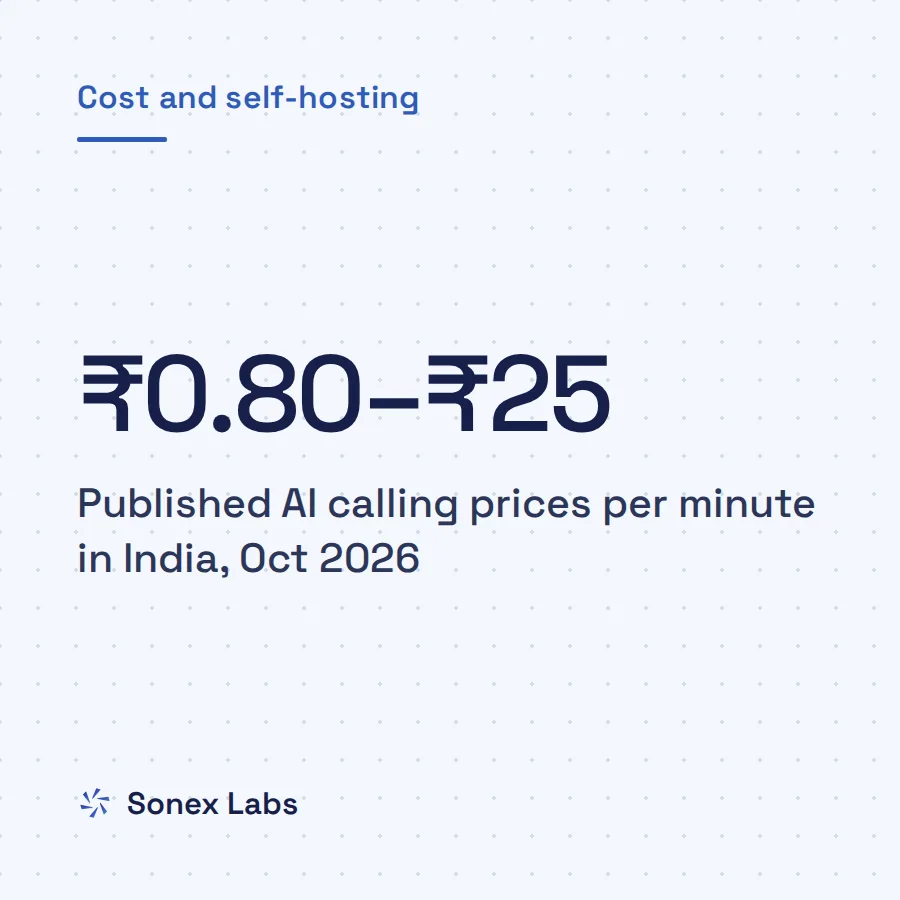
A confirmation call is short, so its cost depends as much on how part-minutes are billed as on the rate. Sonex Labs publishes a voice-agent price of $0.055 per minute, which is ₹5.23 a minute at ₹95.04 to the dollar (open.er-api.com, 24 October 2026). The table works through four call lengths both ways: billed by the second, and rounded up to the next whole minute.
The difference is large at the lengths that matter. The COD confirmation call script aims for under 30 seconds, because a yes or no is all you need, and at that length rounding to a whole minute doubles the cost. When you compare quotes, ask every vendor, including us, which increment applies on the telephony route you will use. The breakdown of what an AI calling agent costs per minute in India explains each line of the bill.
Other vendors' figures sit in the same range. One Indian vendor's COD page puts AI verification at ₹3 to ₹8 per confirmed call including telephony, against ₹25 to ₹50 for a manual calling agent, though both are its own estimates (caller.digital). A Shopify COD-verification app sells bundles of minutes: its $9, $29 and $79 monthly plans include 100, 600 and 2,000 minutes (Shopify App Store). That works out to about ₹8.55, ₹4.59 and ₹3.75 per included minute if you use them all.
The language model is often billed on top of the minute rate, so ask about it. On Sonex, telephony on a Sonex number and the model's tokens are billed on top of the $0.055. For scale, Vyas, the Sonex Labs language model, is priced at $0.30 per million input tokens and $0.60 per million output tokens. A short call that sends 6,000 input tokens and gets back 150 output tokens would cost about $0.0019 at those rates, or roughly 18 paise. Use your own call logs for real token counts.
Cost per call is not cost per order
Some orders need two or three attempts before anyone answers, and some are never reached. On outbound campaign calls made by customer agents on Sonex in August and September 2026, 53% of 256 calls were picked up. That is a small sample from a few agents, not a market figure, but it shows why a per-call price understates the cost.
Work out cost per order as total calling spend divided by COD orders placed, and ask the vendor whether unanswered and ringing-only attempts are billed. Decide in advance how many attempts to make and what happens if nobody answers: ship anyway, hold for a day, or cancel. Our look at whether people hang up on AI calls in India has more on pick-up and early hang-ups.
| Call length | Billed per second | Rounded up to whole minutes |
|---|---|---|
| 30 seconds | ₹2.61 | ₹5.23 |
| 45 seconds | ₹3.92 | ₹5.23 |
| 60 seconds | ₹5.23 | ₹5.23 |
| 75 seconds | ₹6.53 | ₹10.45 |
Why vendor RTO claims prove less than they seem
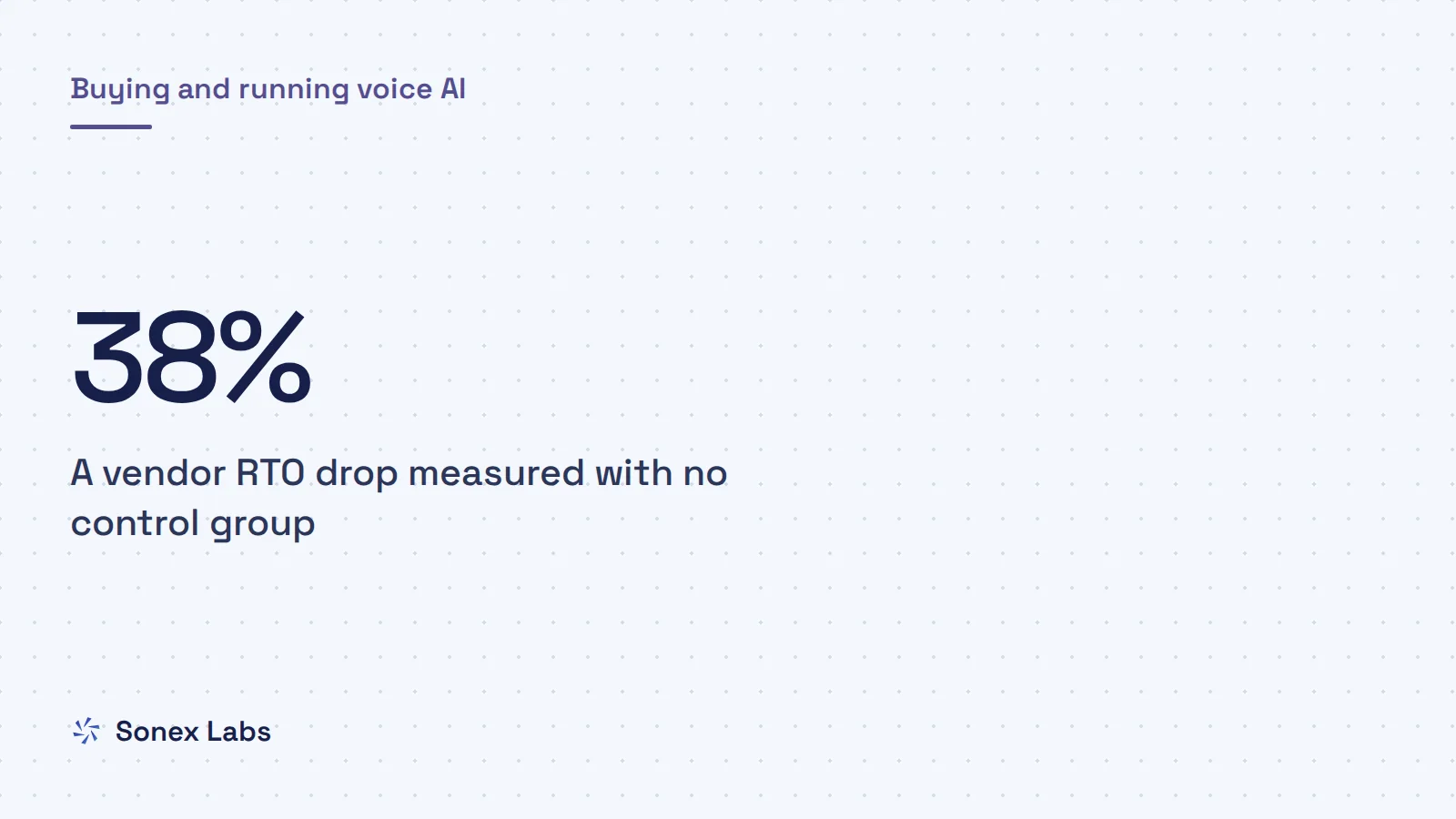
Vendors selling COD calls publish large RTO reductions, but none of the claims we checked was measured against a control group. One vendor's page says D2C brands cut RTO by 30 to 45% and calls that an industry benchmark, while the same site also says "up to 35%" and "40%". Another headlines a 38% drop for a fashion brand whose RTO fell from 34% to under 21% within 45 days. A third promises 35 to 40% on average, and none says how many orders were measured or what else changed at the time.
A before-and-after comparison on one store mixes the call's effect with everything else that moved. Festive sales, a new courier, a prepaid discount, a change in ad targeting or a cleaner customer list can all shift RTO by several points in a few weeks. The fall in COD RTO between the 2024 and 2025 Black Friday sales in Fynd's figures is the kind of background change a before-and-after study would wrongly credit to the calls.
There is a subtler trap too. A confirmation call cancels some orders before they ship. If you measure RTO only on shipped orders, the rate falls even if no buyer behaves differently, because the doubtful orders were removed from the count rather than turned into deliveries. The fair measure is what happens to every order placed: how many were delivered and paid for, cancelled on the call or returned, and what each cost.
How to run a fair holdout test
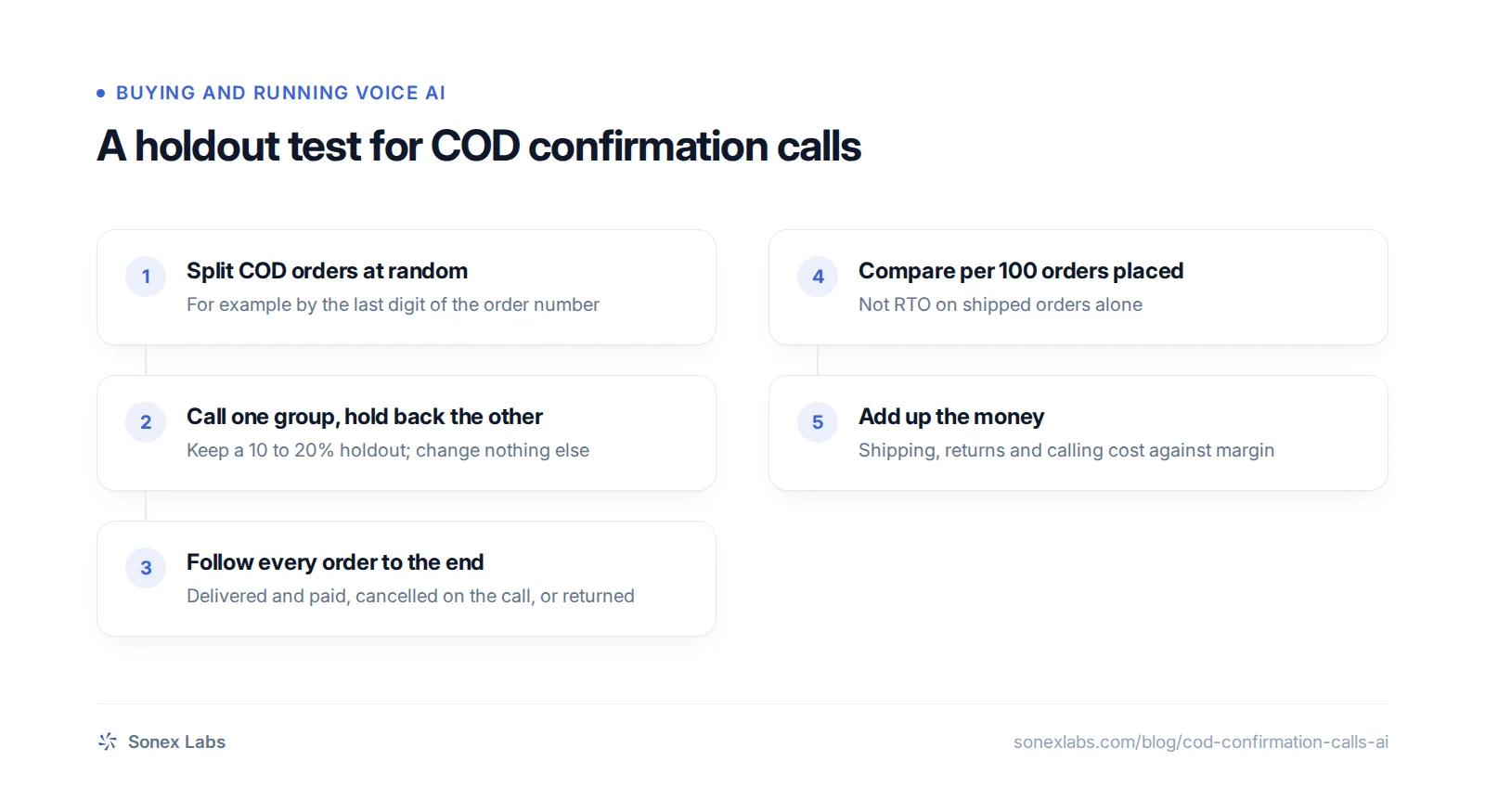
A holdout test splits COD orders at random into a group that gets the call and a group that does not, and changes nothing else. Assign by something unrelated to the buyer, such as the last digit of the order number, so neither group is easier than the other. A holdout of 10 to 20% of orders is usually enough without giving up much of the benefit if the calls work. Apply the same no-answer policy to both groups, or the comparison stops being fair.
Follow every order to its final status, not just to dispatch, and compare the groups per 100 orders placed. The numbers that matter are delivered and paid orders, cancellations before dispatch, RTO parcels, and net margin after shipping, return and calling costs. If the called group delivers more paid orders per 100, or the same number at lower total cost, the calls are earning their keep.
Plan for enough orders to see a difference. With the usual formula for comparing two rates, at 95% confidence and 80% power, telling an RTO of 25% from one of 20% needs about 1,100 orders in each group. With a 15% holdout, that means roughly 7,300 COD orders in total. Smaller differences need far more, so a store with a few hundred COD orders a month should run the test for longer rather than stop at the first good week.
Testing who to call, and how
Start by calling every COD order inside the test, so you learn where calls help. Once you have results, compare segments such as first-time buyers, high-value orders and pincodes with high return rates. If the benefit is concentrated in a few segments, calling only those cuts cost without losing much.
The same design settles whether a WhatsApp confirmation message would do. A message is cheaper and less intrusive, but fewer buyers may reply, and an unanswered message tells you little. Test it against the same holdout, alone or as a first step with a call only for buyers who do not reply within a set time.
Keeping it a service call: script, language and TRAI rules
The call works best when it is short and identical every time: who is calling, the product and amount, and one yes-or-no question. Asking the same way makes answers easy to classify and compare across the test groups. The COD confirmation call script has these lines in Hindi, English and four other Indian languages.
Use the buyer's own language, which you can often infer from the delivery state or from the language they used on your site. A call in Hindi to a buyer in Tamil Nadu is more likely to be ignored. Keep the wording identical across languages so answers can still be compared.
Keep the call about the order. E-commerce has no service number series yet, so these calls go out on regular numbers, as the guide to TRAI's 140, 1600 and 1601 number series explains. Adding an offer, such as a prepaid discount, can make it a promotional call, which needs a 140-series number and consent or DND checks. Many sellers send the prepaid offer by message instead.
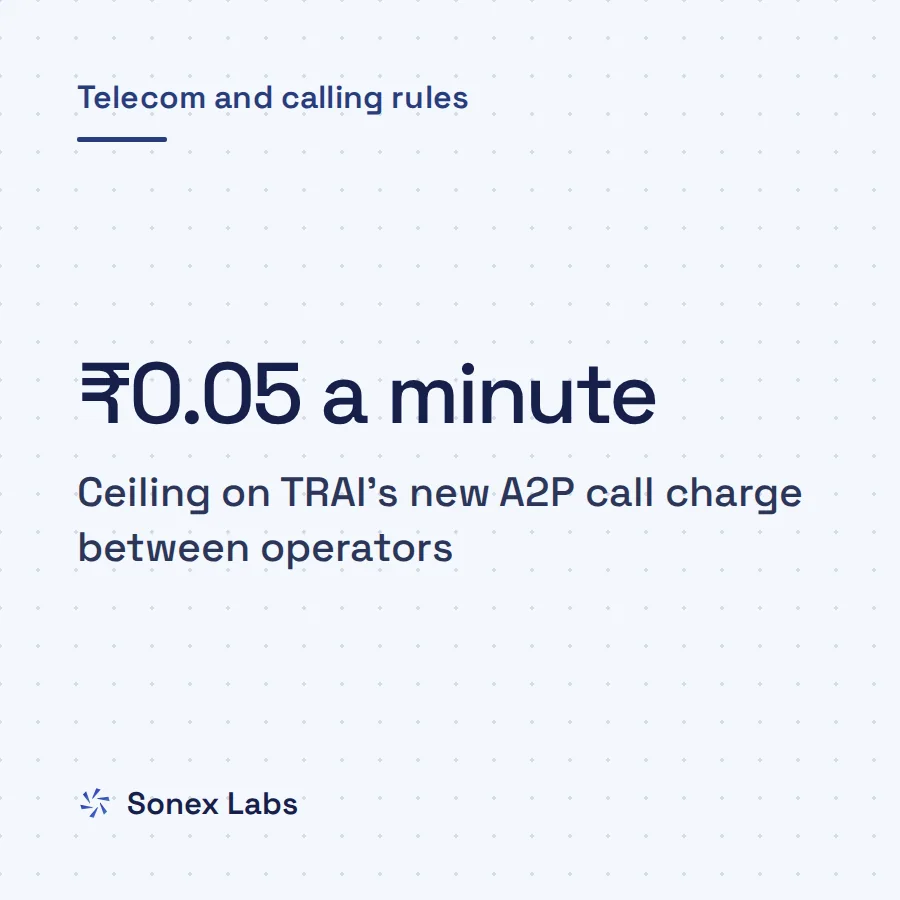
If software or an AI agent dials the call, declare A2P (application-to-person) calling and your caller numbers to your telecom operator before 27 November 2026. The guide to TRAI's 2026 rules for AI and automated calls covers the details. For how a store runs these calls alongside delivery and support calls, see AI calling for e-commerce and retail.
Sources
- Razorpay: Cash on delivery (citing ET Prime Research 2024: 60 to 65% of orders COD; 25 to 30% COD RTO), updated 10 June 2026Secondary
- Indian Retailer: Fynd Black Friday 2025 report (COD 45.2% of orders; COD RTO 8.65%, prepaid 2.08%), 4 December 2025Secondary
- caller.digital: COD order confirmation use case (₹3 to ₹8 per confirmed call; 30 to 45% RTO claim)Secondary
- Rootle: Voice AI for COD order confirmation (38% case study)Secondary
- Hillteck: Voice AI for COD (35 to 40% RTO claim)Secondary
- Shopify App Store: COD voice verification app plansSecondary
- open.er-api.com: USD exchange rates, 24 October 2026 (₹95.04 per $1)Official
Change log: 24 Oct 2026, First published. Rewritten the same day as one continuous guide: added why COD returns are costly, with COD share and RTO figures from Razorpay (ET Prime Research) and Fynd; added the outbound pick-up rate on Sonex customer agents; said that telephony and LLM tokens are billed on top of the published per-minute price; folded the steps, checklist, takeaways and FAQs into the body