On this page
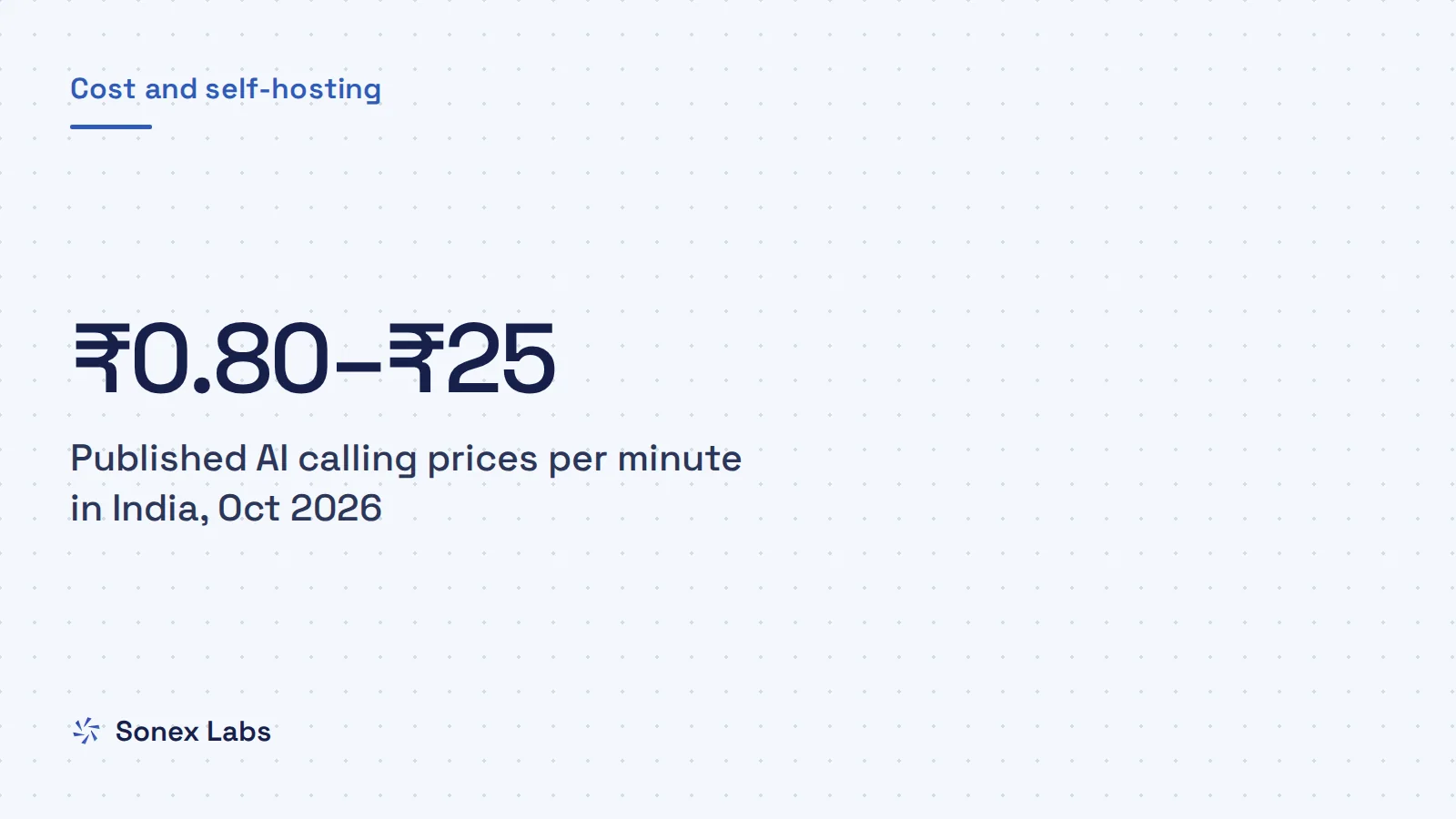
Why published prices range from ₹0.80 to ₹25 a minute
The public figures for India disagree by a factor of thirty because they are not prices for the same thing. A call has to be carried by a phone network, heard by speech to text (STT), answered by a large language model (LLM) and spoken by text to speech (TTS). A vendor can quote any combination of those, and a few convert dollar prices at old exchange rates. Read each figure for what it includes before comparing it with anything else.
At the low end, Acefone puts AI voice bot calls at ₹0.80 to ₹3 a minute, depending on provider, volume and call type (Acefone, updated 24 August 2026). Caller Digital gives ₹2 to ₹12 as the headline range, and ₹6 to ₹25 "once you include platform fees, telephony markup and connect-rate losses" (Caller Digital). Connect-rate losses mean the cost of dialling numbers that never answer, spread over the calls that do.
Sarvam publishes one of the clearest rate cards. Its voice agents cost ₹3.50 a minute pay as you go, which it describes as end to end, covering the platform and its speech and language models, with ₹3.15 on its Growth plan (Sarvam pricing). Telephony is metered separately at ₹0.20 per 30-second pulse, a number costs ₹59 every 30 days, simulated test runs cost ₹2 each, and all prices exclude GST.
Other platforms show how one product can be quoted three ways. One comparison site lists Bolna at ₹5.52 a minute base rate plus infrastructure costs, another at "$0.07/min all-in", and Inc42 reported about ₹5.5 a minute for self-serve customers and ₹1.75 to ₹2 for large committed volumes. Vapi's $0.05 a minute covers its platform only; one review estimates $0.22 to $0.34 a minute all in, once STT, the LLM, TTS and telephony are added.
The lines that make up a per-minute price
Voice AI prices come in a dozen units because each part of the call is bought from a different kind of supplier, and each supplier bills the way its own costs work. A vendor that bundles some of them into one per-minute rate is turning several meters into one, and the details of each meter still decide what you pay. These are the lines to look for in any quote:
- Speech to text: usually per second the stream is open, not per second of speech, so silence and idle connections count. Why a silent STT stream still costs money explains how vendors meter it.
- Language model: per token, and the whole prompt and conversation so far are resent on every turn, so a 5-minute call pays for its instructions dozens of times over.
- Text to speech: per character spoken, so longer replies cost more; Sonex's Pāṇini TTS on its own is $0.03125 per 1,000 characters, the same in every language.
- Telephony: per minute or per pulse, rounded up per call. Plivo and Sarvam use 30-second pulses in India; Sonex rounds each call on its own numbers up to the next full minute. Exotel, Plivo, Ozonetel and Vobiz compared covers what Indian carriers publish about price and how they hand call audio to an agent.
- Phone numbers: a monthly rental per number, such as Plivo's ₹200 a month or Sarvam's ₹59 every 30 days.
- Concurrency: some platforms cap simultaneous calls and sell extra slots. Vapi includes 10 and charges $10 a month for each extra one, per one review; Retell includes 20 and charges $8 a line, per another.
- Dead air: on any per-minute plan you pay for silence, slow replies and needless confirmation questions, which is why call length matters as much as the rate.
One platform worked line by line
To see how the lines add up, here is Sonex Labs, which publishes each line separately. The agent minute is $0.055 for each minute of call time, the published price. Telephony on a Sonex Indian number is $0.008 a minute, billed on top, with each call rounded up to the next full minute. The language model, Vyas LLM, is billed per token at $0.30 per million input tokens and $0.60 per million output tokens.
The table uses the example in the AI calling cost calculator: 20,000 call minutes a month in calls of 3 minutes each, about 6,667 calls. The LLM line assumes 12,000 input tokens and 240 output tokens per minute of conversation. That is four agent turns a minute, each resending about 3,000 tokens of instructions and history, with a 60-token reply. These are starting values, not measurements of anyone's calls. Rupee figures use ₹95.04 to the dollar (open.er-api.com, 24 October 2026) and are before taxes.
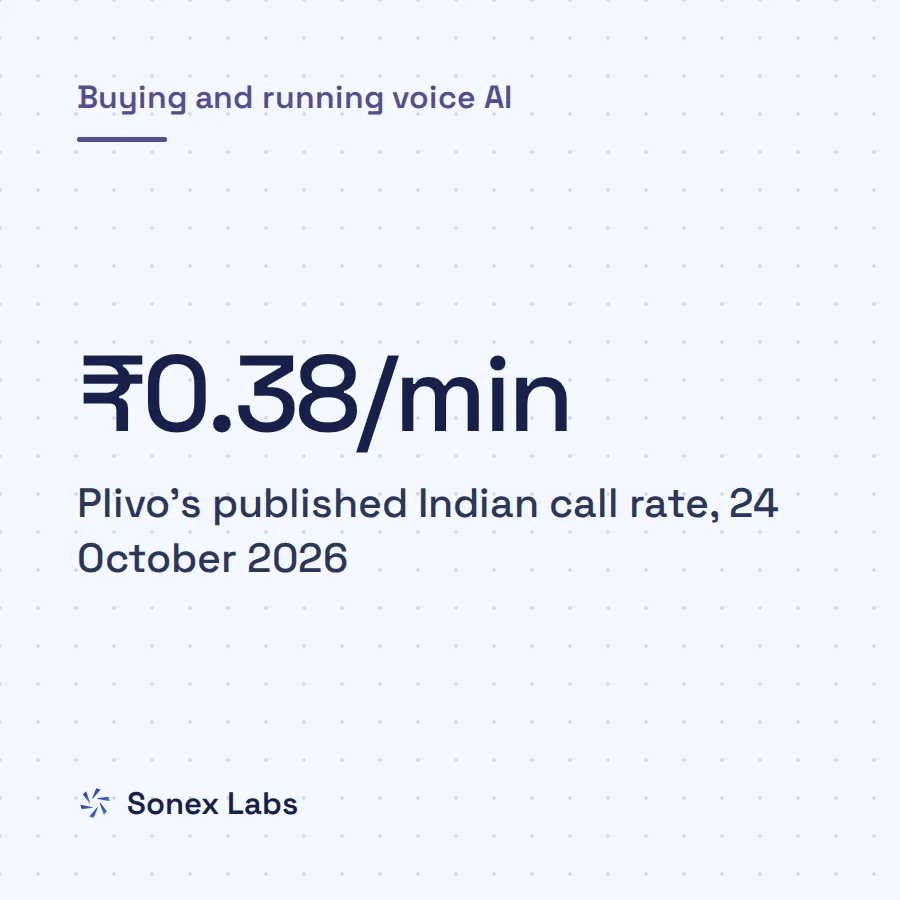
With your own carrier instead of a Sonex number, the telephony line leaves the Sonex bill and appears on your carrier's. Plivo's public India page lists domestic calls at ₹0.38 a minute in 30-second pulses and ₹200 a month for a number (Plivo India pricing, checked 24 October 2026). The Sonex part then drops to about ₹5.58 a minute, about ₹5.96 with Plivo's minute rate added. Sonex's own Indian numbers are ordinary 080 landlines, and the agent minute is the same price in Hindi, Tamil, English or any other language.
For comparison, adding Sarvam's published lines the same way gives ₹3.50 plus two pulses at ₹0.20, about ₹3.90 a minute on its own telephony, before GST and number rental. The two totals are not like for like: Sarvam's minute includes its models, while the Sonex figure carries an LLM line that grows with your prompt. That difference is the point of adding up lines rather than comparing headlines.
| Line | Per minute | Per month |
|---|---|---|
| Agent minutes, published price | $0.055 (₹5.23) | $1,100 (₹1,04,544) |
| Telephony on a Sonex Indian number, billed on top | $0.008 (₹0.76) | $160 (₹15,206) |
| Vyas LLM tokens, 12,000 in and 240 out a minute (assumed) | $0.0037 (₹0.36) | $74.88 (₹7,117) |
| All in | $0.0667 (₹6.34) | $1,334.88 (₹1,26,867) |
Prompt size and call length move the total most
The language model is the line most likely to be wrong in an estimate, because it depends on your prompt, not on the vendor's rate card. Every turn resends the system prompt, any tool results and the conversation so far. The calculator's default of 3,000 tokens a turn suits a short, focused prompt. On Sonex's own production and pilot phone agents running Vyas, the median prompt per reply was 7,502 to 12,778 tokens across the three main reply languages (measured on Sonex calls, 24 September to 24 October 2026, 2,066 replies).
Here is what that does to the bill, as our arithmetic. At 10,000 input tokens a turn and four turns a minute, Vyas costs $0.0121 a minute (₹1.15) instead of $0.0037 (₹0.36), and the all-in figure rises from ₹6.34 to ₹7.14 a minute. Long booking flows, product catalogues pasted into the prompt and verbose tool results all push the number up. Trimming the prompt and summarising old turns bring it down.
Call length matters through rounding. A 40-second call on a Sonex number is billed one full minute of telephony, so short outbound calls pay more per minute of actual talk than the table shows. Carriers with 30-second pulses round less, but every carrier rounds something. If your campaign is mostly short calls, such as reminders or confirmations, model the telephony line per call, not per minute. Teams at millions of minutes a month sometimes ask whether running the models themselves would be cheaper; the self-hosting cost model works through when it is.
AI agent or telecaller: how the cost per call compares
On salary alone, a telecaller in India is cheaper per 3-minute call than an AI agent at these default assumptions, so the case for AI rests on capacity, hours and consistency rather than price per minute. An Indian calling-business operator wrote in April 2026 that a telecaller costs about ₹20,000 a month for about 80 calls a day, with 80 to 100 calls a day the practical ceiling. Older Quora answers put entry-level metro support pay at ₹10,000 to ₹13,000 a month. The comparison here uses ₹15,000 to ₹25,000.
The example's 6,667 calls a month need 3 to 4 telecallers at 80 to 100 calls a day over 26 working days, which is ₹45,000 to ₹1,00,000 a month in salary. That works out to ₹5.77 to ₹12.02 a call, against about ₹19.03 for a 3-minute AI call on a Sonex number. The salary figure leaves out seats, phones, calling minutes, supervision, training and attrition. And the ceiling of 80 to 100 calls a day assumes short calls: 80 calls of 3 minutes is already 4 hours of talk.
What the AI line buys is different. It answers at 2 a.m. and on Sundays, takes a spike of campaign calls without hiring, and reads the same script the same way on the ten-thousandth call. The same operator said they moved to AI because people were capped at 80 to 100 calls a day against 30,000 leads a month. If your calls are few, long and complex, people may well cost less. If they are many, short and repetitive, or spread across the clock, an AI voice agent usually wins on capacity even where it loses on salary per call.
How to get a quote you can compare
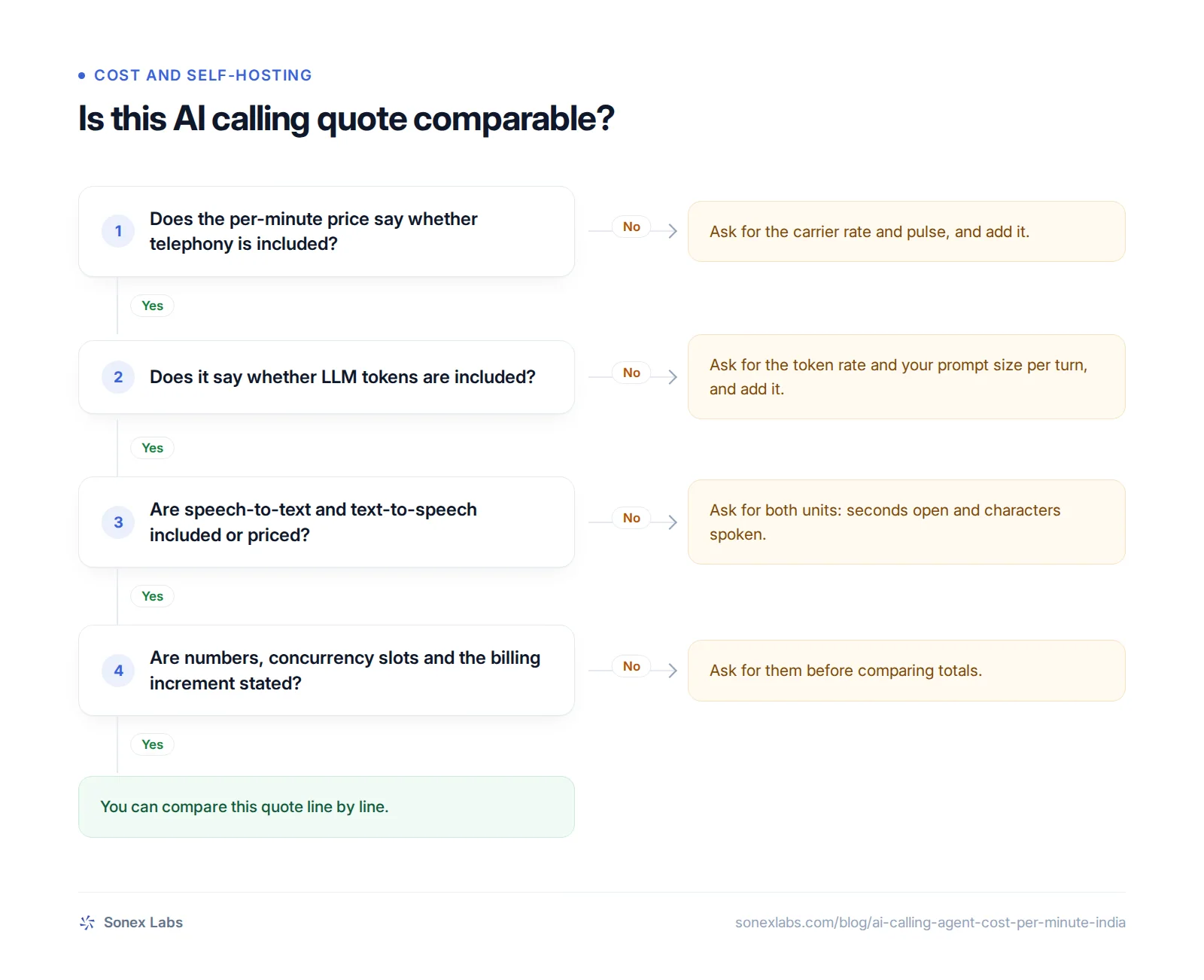
A comparable quote names every line, its unit and its rounding, and states what is excluded. Ask each vendor the same questions, write the answers into one sheet, and price your own call length and prompt size rather than the vendor's example.
At minimum, ask whether telephony is included or billed on top, and at what pulse. Ask whether the LLM is included and how many tokens a minute the quote assumes, and how speech to text is metered. Ask whether numbers, extra concurrent calls or recordings cost extra, whether the price is in rupees or converted from dollars and at what rate, and whether GST is included. Ask too about minimum balances, setup fees or monthly commitments. A low rate with a large commitment can cost more than a higher rate without one.
If a bill later comes in above the quote, compare your billed minutes with your talk time, and your token counts with the vendor's assumption. The gap usually sits in a line the headline left out.
Sources
- Sonex Labs AI calling cost calculator: defaults and sources (24 October 2026)Official
- Sarvam voice agents pricing (checked 24 October 2026)Official
- Plivo India voice pricing (checked 24 October 2026)Official
- Acefone: voice bot pricing in India (updated 24 August 2026, checked 24 October 2026)Secondary
- Caller Digital: voice AI pricing in India, headline vs effective (checked 24 October 2026)Secondary
- AssemblyAI pricing: streaming billed on session durationOfficial
- Vapi support: LLM token consumption, prompt and history resent each turnOfficial
- Vyora: AI voice agents in India, Bolna base rate (October 2026)Secondary
- AI Architect GK: voice agent cost comparison India (6 May 2026)Secondary
- Inc42: the unit economics of India's voice AI boom (15 July 2026)Secondary
- AIToolPick: Vapi pricing 2026 (25 August 2026)Secondary
- Rezora: Retell vs Vapi, concurrency add-ons (August 2026)Secondary
- X post by an Indian calling-business operator on telecaller cost and AI calling (April 2026)Secondary
- Quora: How much do call centre employees in India earn on an average?Secondary
- ExchangeRate-API open access rates (USD to INR, 24 October 2026)Official
Change log: 24 Oct 2026, First published. Later the same day, rewritten as one continuous article that opens on the market range rather than a Sonex price: added Sarvam's telephony, number and test-run charges and a like-for-like warning, Caller Digital's definition of effective cost, the GST question and what to do when a bill exceeds the quote; corrected the measured prompt-size sample to 2,066 Vyas phone replies; the cover fact is now the market range; FAQs folded into the body