On this page
Why Indian callers hang up fast
The habit of hanging up quickly was formed long before AI agents. In a LocalCircles survey of 2024, 95% of mobile subscribers who answered said they get unwanted commercial calls every day, and 77% said they get three or more a day (LocalCircles, September 2024). An unknown number, a pause before anyone speaks, or a voice that sounds recorded is easy to mistake for one of those calls. Many calls therefore end before the person has heard what they are about.
What people say they will do is also gloomier than what they do. AnswerConnect, which sells human answering services, cites a OnePoll survey of 6,000 adults in which one in three said they would hang up on AI (AnswerConnect). An Indian calling-business operator wrote in April 2026 that they expected 30 to 40% of people to hang up on their AI calls and saw 6% (X post). That figure comes from one company's campaign, measured its own way, and is not comparable with the call-length figures below.
The largest public analysis of real calls is from the US. Upfirst studied 450,702 inbound calls to 503 AI receptionists and found that many hang-ups happen in the first few seconds, before the caller interacts with the AI. AI settings such as the greeting, voice and training explained only about 13% of the difference in hang-up rates between businesses. The rest came from things outside the AI's control (ANI via LatestLY, July 2026). Hang-ups, in other words, are mostly decided by who is calling whom, and why, before the agent's quality comes into it.
How we measured hang-ups on Sonex calls
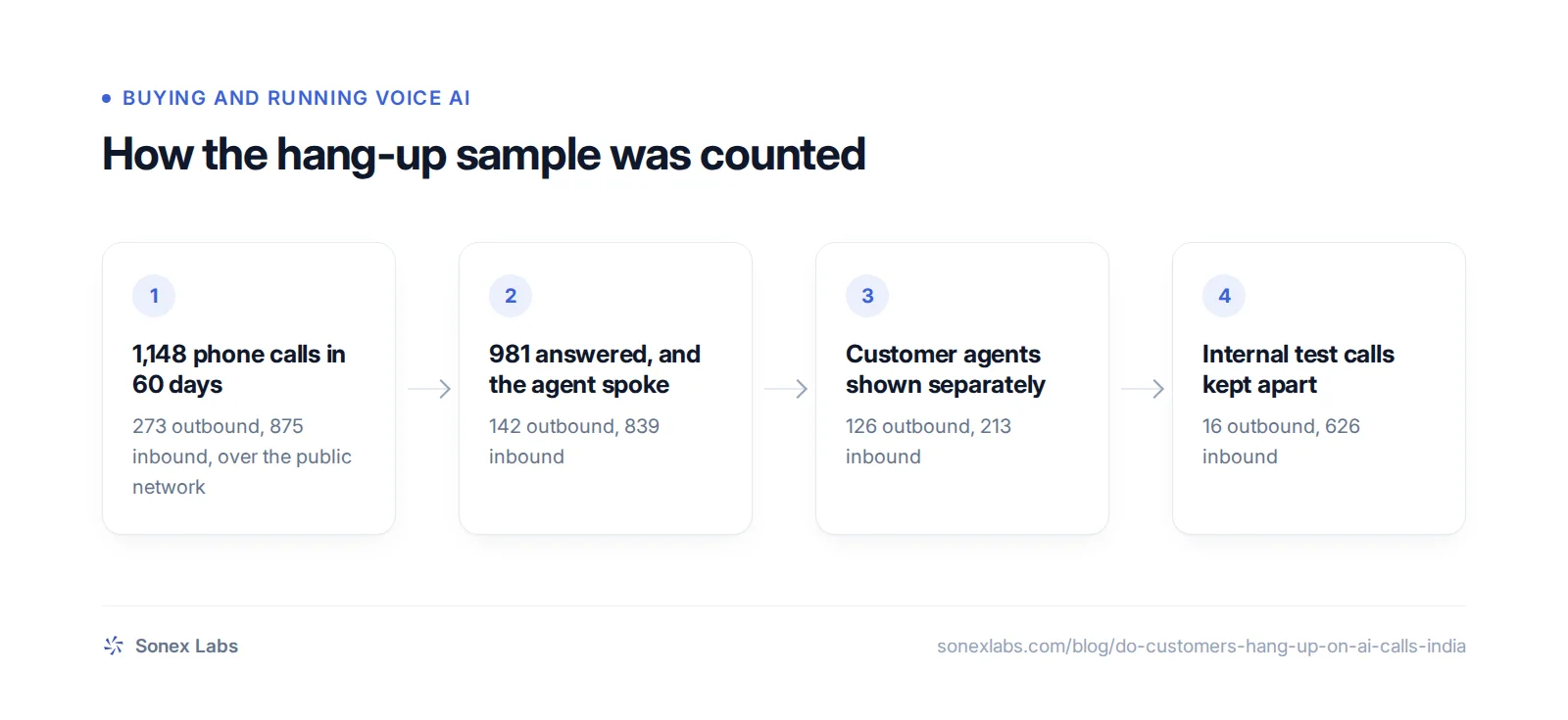
To add Indian data, we looked at every phone call on Sonex Labs agents over 60 days, from 25 August to 24 October 2026. That was 1,148 calls over the public phone network, 273 outbound and 875 inbound, carried by Plivo, Vobiz and, once, Exotel. Time to hang-up is the call's recorded duration from answer to end. For it we used the 981 answered calls in which the agent spoke at least once: 142 outbound and 839 inbound.
Two things shape how to read the results. Most inbound calls in the period were our own team testing agents, so we show customer agents separately and quote those. And the counting script prints only totals: no workspace, agent, phone number or transcript left it, and we did not listen to calls. Language is inferred from the script of what the agent said, Telugu, Kannada, Devanagari or Latin, where Latin includes romanised Hinglish.
Outbound AI calls are answered about half the time, and most are short
When the AI makes the call, the first few seconds decide most outcomes. Customer agents placed 256 outbound calls to 205 different numbers in August and September 2026, almost all as part of campaigns, and 135 were picked up, a pick-up rate of 53%. There is no public Indian benchmark to set that against. Pick-up depends far more on the list, the number shown, the time of day and whether people expect the call than on the AI.
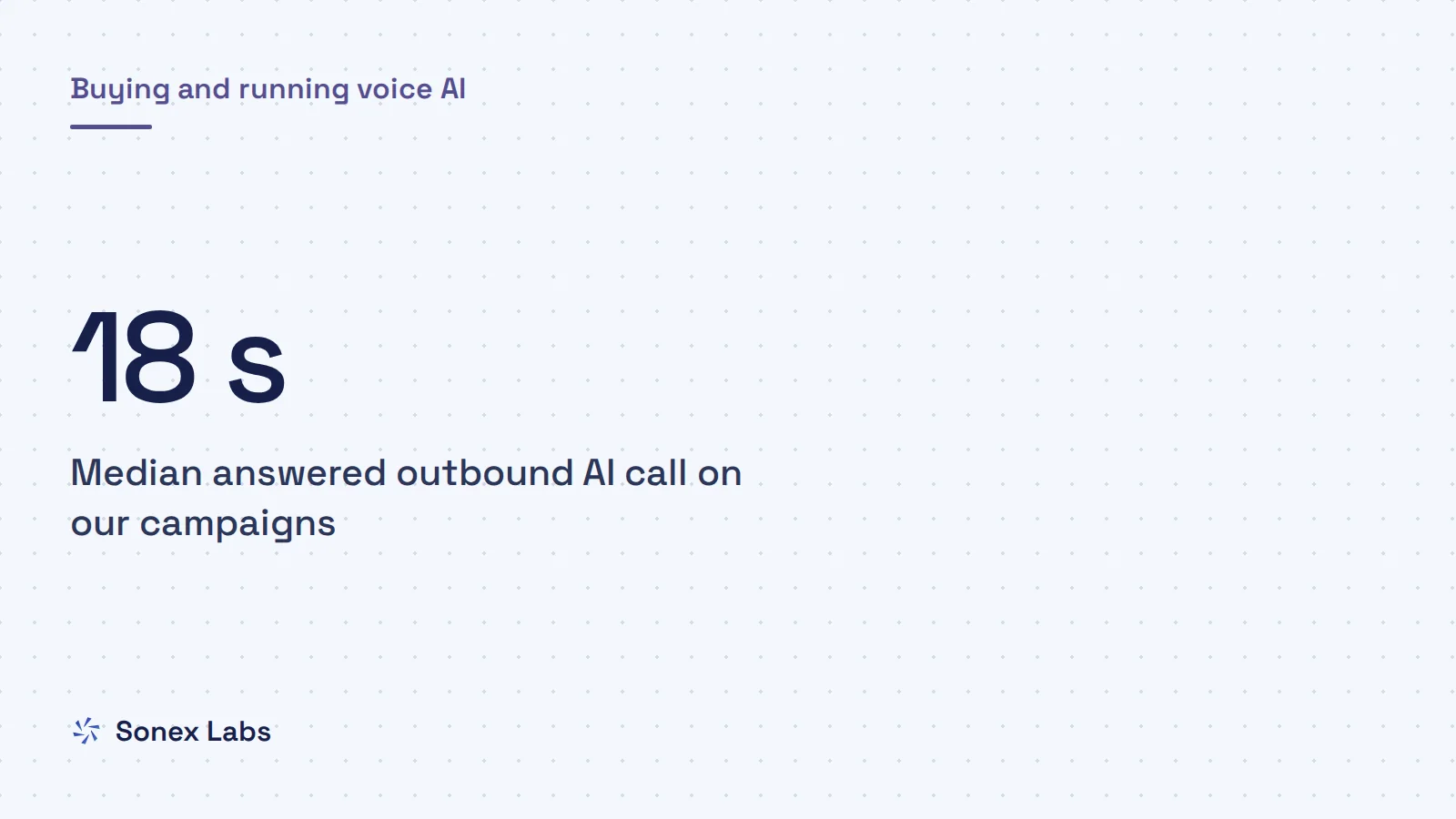
On the 126 answered calls where the agent spoke, a quarter ended within 12 seconds, half within 18 seconds and three quarters within 33 seconds; one in ten ran past 75 seconds. In all, 13% ended within 10 seconds and 72% within 30. That early cluster fits the shape Upfirst found in the US.
Short does not mean failed. We do not know each campaign's purpose from these numbers, and "yes, I'll come, thanks" takes 15 seconds. On 29% of answered outbound calls the person never said anything the agent transcribed. That covers people who listened and hung up, and also speech recognition missing a very short or quiet reply. A dropped line looks exactly like a hang-up in call records.
Almost all of these calls were in English or romanised Hinglish. There were too few outbound calls in Telugu (7) or Hindi (5) to say whether the language of a call changes how fast people hang up.
| Group (answered calls) | Median call length | Ended within 10 s |
|---|---|---|
| Outbound, customer agents (126) | 18 s | 13% |
| Inbound, customer agents (213) | 69 s | 5% |
| Inbound, customer agents, Telugu (200) | 64 s | 4% |
| Inbound, internal test agents (626) | 62 s | 12% |
Inbound calls to an AI agent last about a minute
People who call an AI agent themselves mostly stay on the line. On customer agents, the 213 answered inbound calls had a median of 69 seconds, only 5% ended within 10 seconds, and on 13% the caller never said anything the agent transcribed. The largest group, 200 Telugu calls from about 66 numbers, had a median of 64 seconds and 4% ending within 10 seconds, though those callers had chosen to call. Across all 839 inbound calls, including our own testing, the median was 63 seconds.
It was callers, not agents, who ended the calls. Only 1 of the 981 answered calls ended with the agent's own end-call tool. Our call logs for the last 30 days agree: on phone calls, the media stream was closed from the caller's side on 599 calls. On inbound calls, then, the agent's job is to answer well and let the caller go, not to hold them. For a clinic front desk, that is what the guide to an AI receptionist for clinics in India is built around.
Does saying it is an AI make people hang up?
We wanted to compare calls where the agent says it is an AI with calls where it does not, and could not. No setting or log records whether an agent discloses. As a stand-in, we searched each call's first agent line for disclosure words in English, Hindi, Telugu, Kannada and Tamil, such as AI, virtual assistant, automated and bot. Only 1 of the 981 greetings matched, which is far too few to compare.
The question is genuinely open. On Quora, some argue that an agent that identifies itself upfront makes most people hang up; others say honesty keeps people from hanging up angry later. Upfirst's co-founder said disclosing "is associated with about 20 per cent lower hang-ups", which is an association across businesses, not a controlled test, and the one-in-three survey above points the other way.
The way to settle it for your own calls is an A/B test. Split the same campaign's list at random, give one half a greeting with disclosure and the other one without, and compare time to hang-up and outcomes. The two openings below show what that test would compare. Both say who is calling and why in the first sentence, which is the part every source agrees on. The AI disclosure and recording-notice scripts have ready-made lines, and the guide to AI voice labelling rules in India covers what the law says.
नमस्ते, मैं सिटी केयर क्लिनिक की AI असिस्टेंट बोल रही हूँ। कल सुबह साढ़े दस बजे आपकी अपॉइंटमेंट है, बस वही कन्फ़र्म करना था।
नमस्ते, सिटी केयर क्लिनिक से बोल रही हूँ। कल सुबह साढ़े दस बजे आपकी अपॉइंटमेंट है, बस वही कन्फ़र्म करना था।
Measuring and reducing hang-ups on your own calls
Because hang-ups depend so much on the list and the purpose, one figure for a whole account says little. Record, per campaign, how many calls were answered, the time from answer to hang-up, who ended the call and whether the person spoke. Report the median and the share ending within 10 and 30 seconds, keep test calls out, and read a sample of short calls before calling them failures.
The levers that matter sit mostly in the first seconds. Make sure audio starts the moment the call connects, so the person does not hear a silent pause, and open with who is calling and why in one short sentence. What the person sees matters too: from 1 November 2026 Indian mobile operators must show the caller's registered name on calls over 4G and later networks. The guide to CNAP caller name display explains how to make it your brand.
The voice itself plays a smaller part than most buyers expect, but it is not nothing. A voice that sounds like a recorded notice is easy to dismiss, which is why the guide on why a too-perfect Hindi AI voice hurts conversion argues for everyday wording. For outbound work, AI voice agents on Sonex run campaigns with calling windows, time zones and retry limits, so pick-up can be compared across times of day rather than guessed.
Sources
- LocalCircles: pesky calls survey (2 September 2024)Secondary
- AnswerConnect: OnePoll survey of 6,000 adults on AI customer service (undated)Secondary
- X post by an Indian calling-business operator on AI call hang-ups (April 2026)Secondary
- LatestLY (ANI): Upfirst analysis of 450,702 calls to 503 AI receptionists (31 July 2026)Secondary
- Quora: Should AI voice agents always disclose that they're not human?Secondary
Change log: 24 Oct 2026, First published. Rewritten the same day as one continuous article: opened on why Indian callers hang up fast (LocalCircles, Upfirst, a OnePoll survey cited by AnswerConnect); added a section on measuring and reducing hang-ups, with CNAP; the takeaways and FAQs were folded into the body