On this page
What an AI receptionist does on a clinic's phone line
An AI receptionist handles the calls a front desk handles: booking, moving and cancelling appointments, confirming the next day's list, and answering fixed questions such as timings and directions. Under the hood it is a chain of three systems. Speech-to-text turns the caller's words into text, a language model decides what to say and when to check the calendar, and text-to-speech speaks the reply. Anything it is not set up for goes to a person.
The strongest case for one is the calls nobody answers today. On the dental forum Dentaltown, the founder of a healthcare voice company replied to a sceptical column. He argued that after-hours answering and overflow are the best fit for now, ahead of replacing the front desk (Dentaltown, April 2025). That matches our view. A call answered at 9 pm, or while the receptionist is with a patient, is a booking that would otherwise go to voicemail or another clinic.
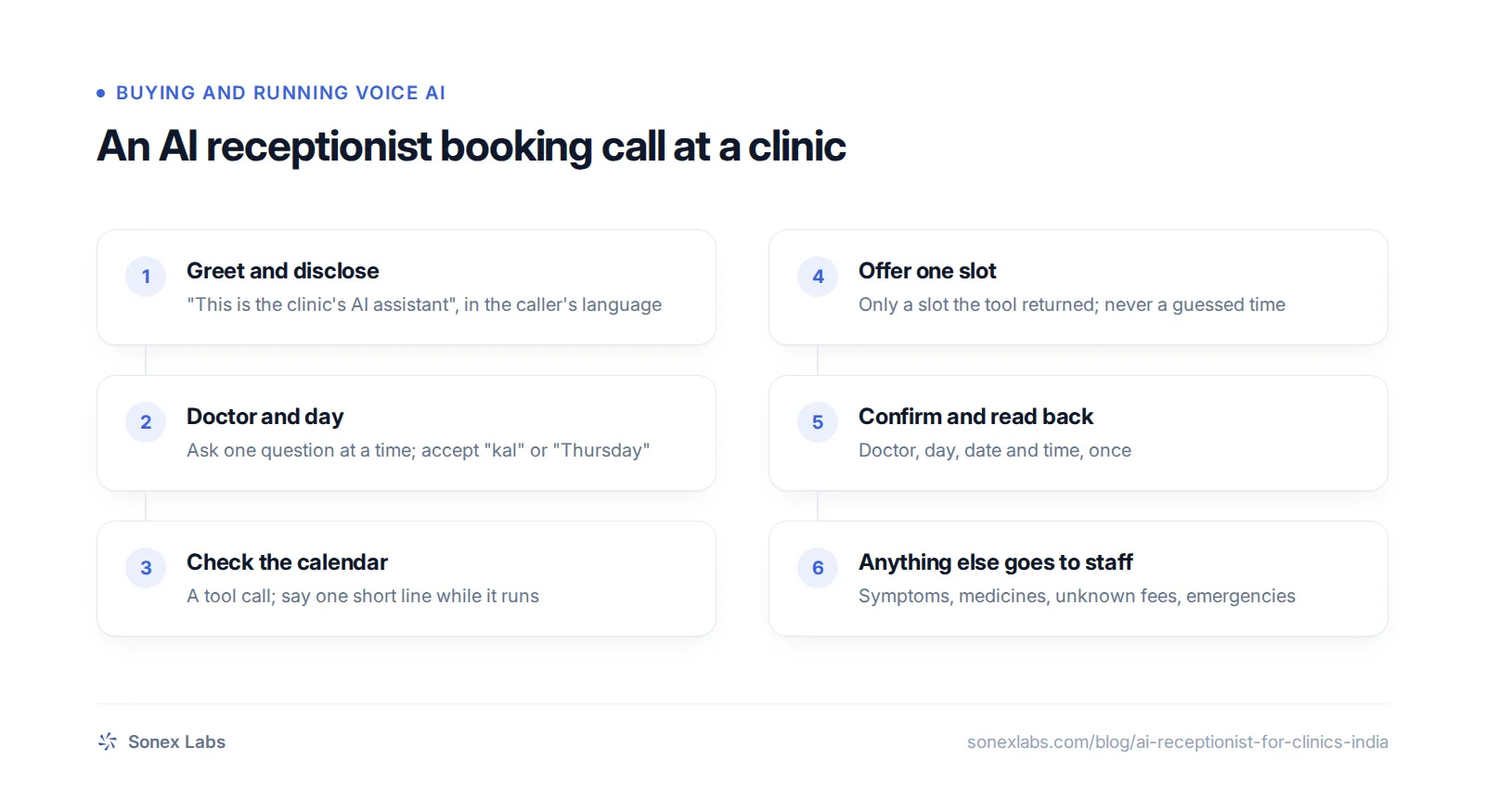
A good booking call is short and predictable. The agent says it is an AI and who it works for, asks which doctor and which day, checks the calendar, offers one slot, and reads the confirmed booking back once. The appointment booking call script has these lines in Hindi, English and four regional languages, and the AI receptionist for clinics and hospitals page shows how the same flow runs on Sonex.
Connecting it to the clinic's calendar
The agent can only book what it can see. During the call it checks free slots and writes the booking through a tool, which in practice means an API (a way for software to talk to the booking system). If your clinic software has no API, the agent cannot use it, which is why many clinics start with a shared online calendar. Ask your software vendor about an API before choosing a voice agent.
On Sonex, agents support MCP and tool calling during a call, with connectors for HubSpot, Salesforce, n8n, Zapier and Make. A clinic calendar can usually be reached through one of those. Whatever the platform, the tool should return a plain outcome, such as a slot, "no slot that day" or "calendar unavailable". The agent should then act on that outcome word, not on its own reading of the clinic's hours; why this matters is explained in why a voice agent ignores a tool result.
Reminder calls the day before
The same agent can call patients the day before an appointment, in the same voice and language, to confirm, move or cancel. Outbound calls need their own limits: a calling window that suits patients, a time zone, and a cap on unanswered attempts. Sonex campaigns carry all three settings.
Keep these calls to existing patients and to the appointment itself. India's medical conduct code treats soliciting patients as unethical, so a reminder should never turn into an offer. The guide to what a clinic's AI receptionist may and may not say explains why.
How dates and times should sound in Hindi and Telugu
Dates and times are where clinic calls most often go wrong, so decide how the agent says them before anything else. A patient who hears a time in an unfamiliar form has to work it out, and a misheard time becomes a missed appointment. The fix is to write every date and time in the text the agent speaks in the exact words a receptionist would use.
In Hindi, patients say "साढ़े दस बजे" (half past ten), "सवा चार" (quarter past four) and "पंद्रह तारीख" (the 15th), with "सुबह" or "शाम" rather than AM or PM. A raw "10:30" sent to text-to-speech may come out as digits, so the agent's reply should carry the time in words.
Telugu gives a clinic a real choice. A Telugu agent can say clock times in English words, such as "eleven thirty AM", or in Telugu, while saying the day and date in Telugu. Both work, and the choice is set per agent. Pick the form your patients use: ask the front desk how callers say times today, and listen to test calls in both before going live. Then make every calendar answer use the same form, so a patient never hears the time two ways on one call.
Read the booking back once, at the end, in that same form. A misheard "चार" (four) and "चौदह" (fourteen) is caught by a read-back, and a caller who hears the day, date and time together can correct any one of them. Do not read back every step, which doubles the length of the call. The samples below are single lines rendered by Pāṇini TTS to show the wording, not recordings of patient calls; the Telugu lines use English words for the time.
डॉक्टर मेहता गुरुवार को सुबह साढ़े दस बजे खाली हैं। ये टाइम चलेगा?
ठीक है, आपकी अपॉइंटमेंट गुरुवार, छब्बीस तारीख, सुबह साढ़े दस बजे डॉक्टर मेहता के साथ बुक हो गई है।
డాక్టర్ వాణి గురువారం eleven thirty AM కి ఖాళీగా ఉన్నారు. ఆ టైమ్ మీకు ఓకేనా?
సరే అండి, మీ అపాయింట్మెంట్ గురువారం, ఇరవై ఆరో తేదీ, eleven thirty AM కి డాక్టర్ వాణితో బుక్ అయింది.
What the agent must not do, and how fast it hands over
Write the limits before the greeting. The agent does not assess symptoms, suggest medicines or explain reports, because India's Telemedicine Practice Guidelines bar AI platforms from counselling patients or prescribing. It does not quote a fee, a package price or an insurance answer the clinic has not written down for it. The rules for what a clinic's AI receptionist can say set out the full line, topic by topic.
Emergencies go first, above greetings and booking rules in the agent's instructions. The agent tells the caller to call 112 or go to the nearest emergency department, then transfers the call to staff. Test this with the phrases callers actually use, such as "chest pain", "saans nahi aa rahi" and "bahut khoon". An agent that books a slot for someone describing an emergency is the one failure a clinic cannot afford.
A handover is only useful if it is fast. The agent should say one short sentence in the caller's language, such as that it is connecting them to the reception, and transfer in the same turn without first asking more questions. If nobody picks up, it should take a callback number and say when the clinic will call back, rather than leave the caller on hold in silence. After hours, telling callers when a person will ring back matters even more.
What an AI receptionist costs a clinic each month
There are two ways vendors charge. A per-minute price charges for the time the agent spends on calls, so the cost is calls a month times average minutes times the rate. A monthly plan charges a flat fee that includes some minutes or calls and charges extra above them. Either way, start from your own call log, because the number of calls and their length decide the bill.
Sonex's published agent price is $0.055 a minute of call time, which is ₹5.23 at ₹95.04 to the dollar (open.er-api.com, 24 October 2026). Telephony on a Sonex number and the language model's tokens are billed on top of that figure, so add them before comparing with a plan that includes them.
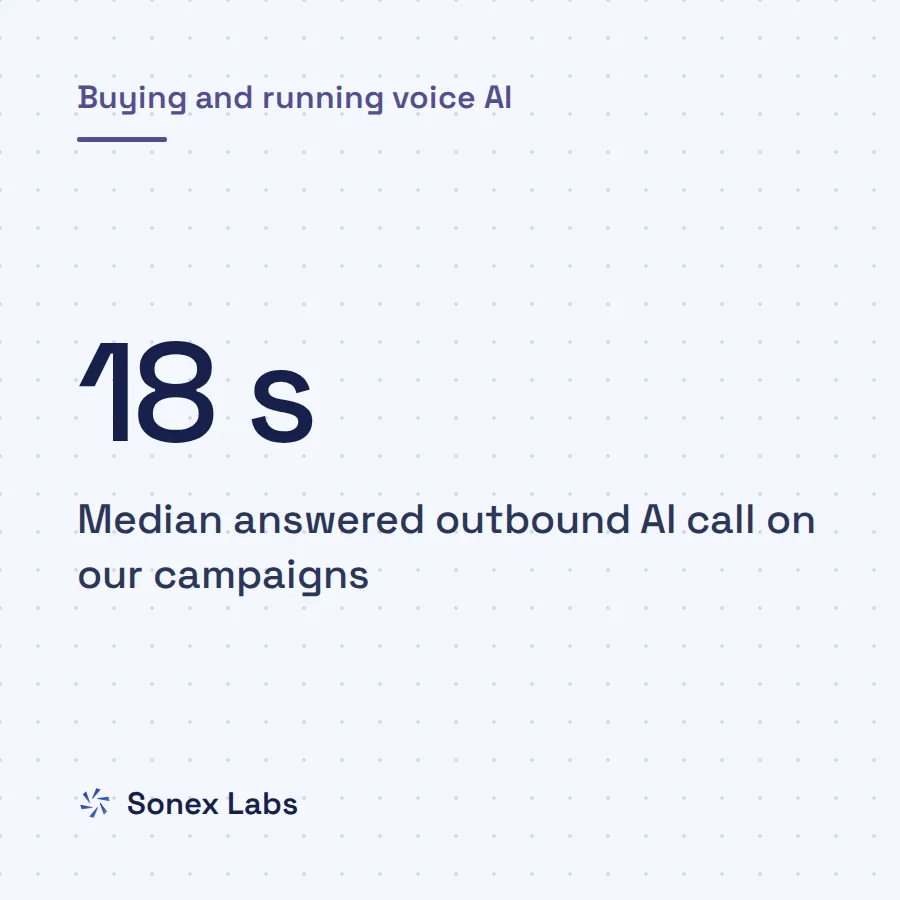
The table works the agent minutes for three clinic sizes. It assumes 69 seconds a call, the median length of answered inbound calls on customer agents on Sonex in the 60 days to 24 October 2026 (213 calls, not only clinics). Your calls may be shorter if the agent only books, or longer if callers ask about doctors and fees.
Clinic receptionist products in India mostly sell monthly plans. Hellodesk advertises "from ₹1,999/month" for clinics, and Voxerra "starting at ₹4,999/month", with calls above the plan charged from ₹15 each on its Premium plan. Neither page we read says how many minutes the plan includes. Edesy does: its Pro plan is ₹1,499 a month with 300 minutes included and ₹5 a minute after that, and its pay-as-you-go rate is ₹6 a minute plus telephony. We sell per-minute pricing, so weigh our framing accordingly. Use the AI calling cost calculator or the breakdown of what an AI calling agent costs per minute in India to compare like with like.
| Calls answered a month | Minutes at 69 s a call | Agent minutes cost |
|---|---|---|
| 300 (about 10 a day) | 345 | $18.98 (₹1,803) |
| 600 (about 20 a day) | 690 | $37.95 (₹3,607) |
| 1,200 (about 40 a day) | 1,380 | $75.90 (₹7,214) |
Answering the sceptics: slow replies, made-up answers, repeated names
The sharpest public criticism is a Dentaltown column titled "AI Dental Receptionists – The Latest Grift" (March 2025, about 1,700 views). Its author estimated that a long instruction manual would make the agent take 5 to 10 seconds to reply and cost perhaps 50 US cents a session. He said his own test build confidently made things up, and quoted a dentist whose patients were tired of repeating names and birthdates. On Hacker News, a 320-point thread about an AI receptionist for a mechanic shop added that there is "no way to ensure that the AI doesn't guess" (Hacker News).
Speed and cost are the easier objections to test. Sonex states that its voice agents answer in about 300 ms end to end, from when the caller stops speaking to when the agent starts. A long instruction manual is still worth trimming to what a booking call needs. On cost, a 69-second call at $0.055 a minute is about $0.06 of agent minutes, before telephony and the model. The fairest test of any vendor's claim is your own: call its demo line from an ordinary mobile phone and time the pauses.
The guessing criticism is fair, and the honest answer is that nobody can guarantee a language model never guesses. You can shrink what it is allowed to guess about. Slots come only from the calendar tool, fees only from a written list, everything else goes to staff, and the booking is read back. Then you check, by listening to calls in the dashboard's recordings and transcripts, rather than trusting the setup. Repeated names have a simpler fix: collect only what the booking needs, and do not ask for a date of birth on a call that only books a slot.
For a small clinic with few missed calls, the alternatives raised in the Hacker News thread deserve a serious look: a shared human answering service, or voicemail with a fast callback. An AI receptionist earns its place where calls are missed often, after hours and at peak times, and where most calls are routine bookings. Our guides on how to evaluate an AI voice vendor and whether callers hang up on AI calls in India cover what to test before signing.
Sources
- Dentaltown (RevUp Dental): AI Dental Receptionists – The Latest Grift, 7 March 2025Secondary
- Dentaltown (iSapien): AI Dental Receptionists – Why the Real Story Is More Complex, 10 April 2025Secondary
- Hacker News: I built an AI receptionist for a mechanic shopSecondary
- Hellodesk: AI voice receptionist for clinicsSecondary
- Voxerra: AI voice receptionist for IndiaSecondary
- Edesy: AI receptionist pricing (Pay As You Go, Pro, Max, Ultra), read 24 October 2026Secondary
- ExchangeRate-API (open.er-api.com): USD rates, 24 October 2026Secondary
Change log: 24 Oct 2026, First published. Rewritten the same day before publication: the call-length assumption changed from 63 s (all inbound calls, mostly internal tests) to 69 s (customer agents only) and the cost table recalculated; Edesy's plan with included minutes added; Telugu time wording described as a per-agent choice; calendar connection and reminder calls added; latency stated as the published figure; FAQs and takeaways folded into the body