On this page
- Why a demo tells you so little about a voice vendor
- Test calls that expose what a demo hides
- The all-in price per minute, and what is left out of it
- Contract terms: cancellation, countries, numbers and white-label
- Support and reliability you can check before signing
- How to read review sites without being misled
- Checklist
- Sources
Why a demo tells you so little about a voice vendor
A demo is short, scripted and usually played over clean browser audio, so it shows the best case. Your customers call from noisy streets on phone lines, interrupt, give half an address and ask things the script never planned for. The gap between the two is where buyers get hurt, because most voice-agent failures only appear under those conditions.
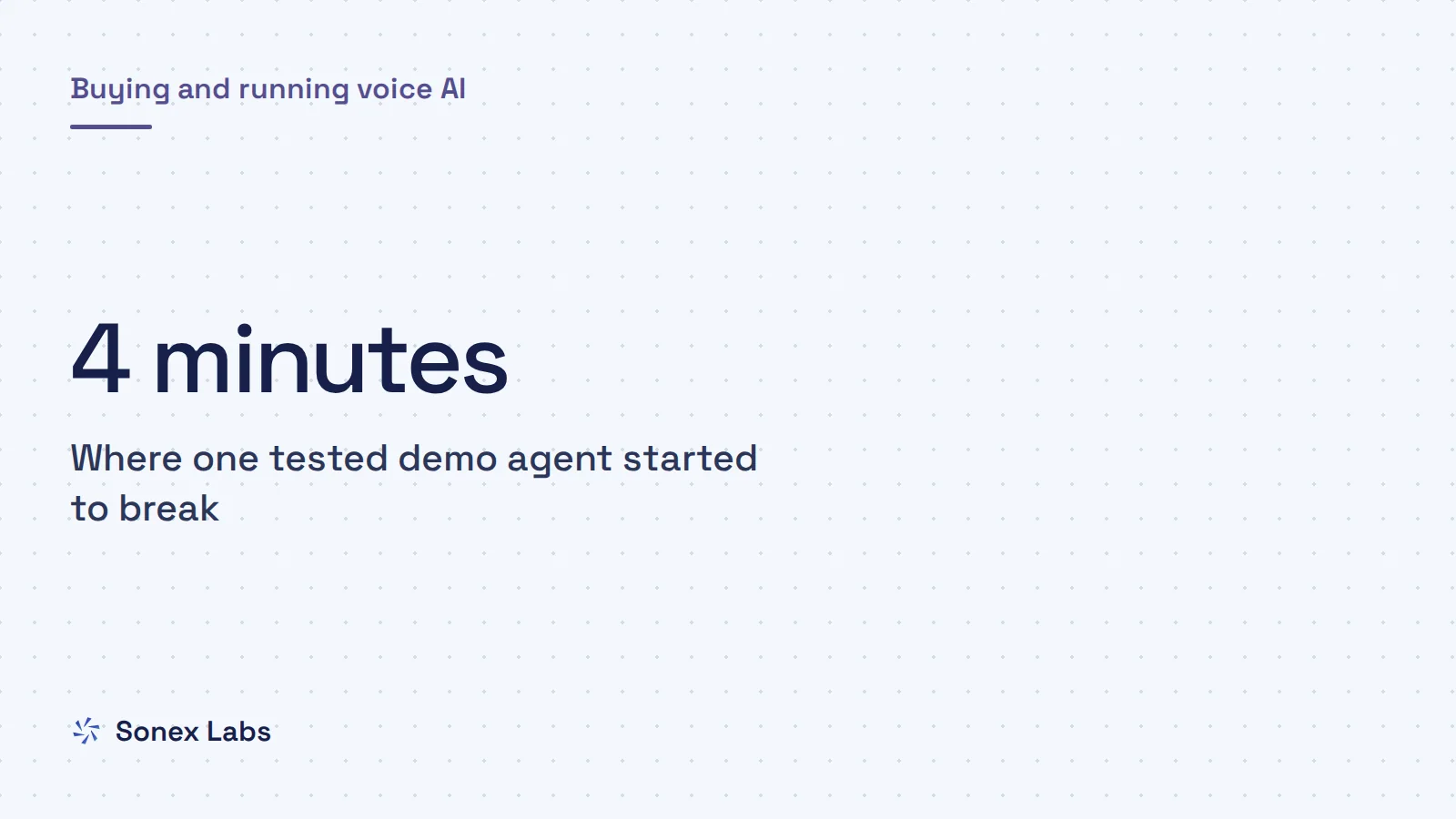
One builder who reviewed seven platforms on Indie Hackers wrote that the agent they first chose was, three weeks into production, breaking on calls longer than 4 minutes, losing context and inventing booking slots that did not exist (Indie Hackers). That post ranks one platform first while saying it has no sponsored placements, so treat its rankings with care. The failure it describes is still a common one, and a demo would never have shown it.
Independent advice is also hard to find. A question on Quora asking which AI voice calling agent is best in India had no useful answer when we looked in October 2026. The search results for it are almost all vendor pages ranking themselves. This article does not rank anyone. Each part of it maps to a complaint real buyers have posted, so you can apply it to any vendor.
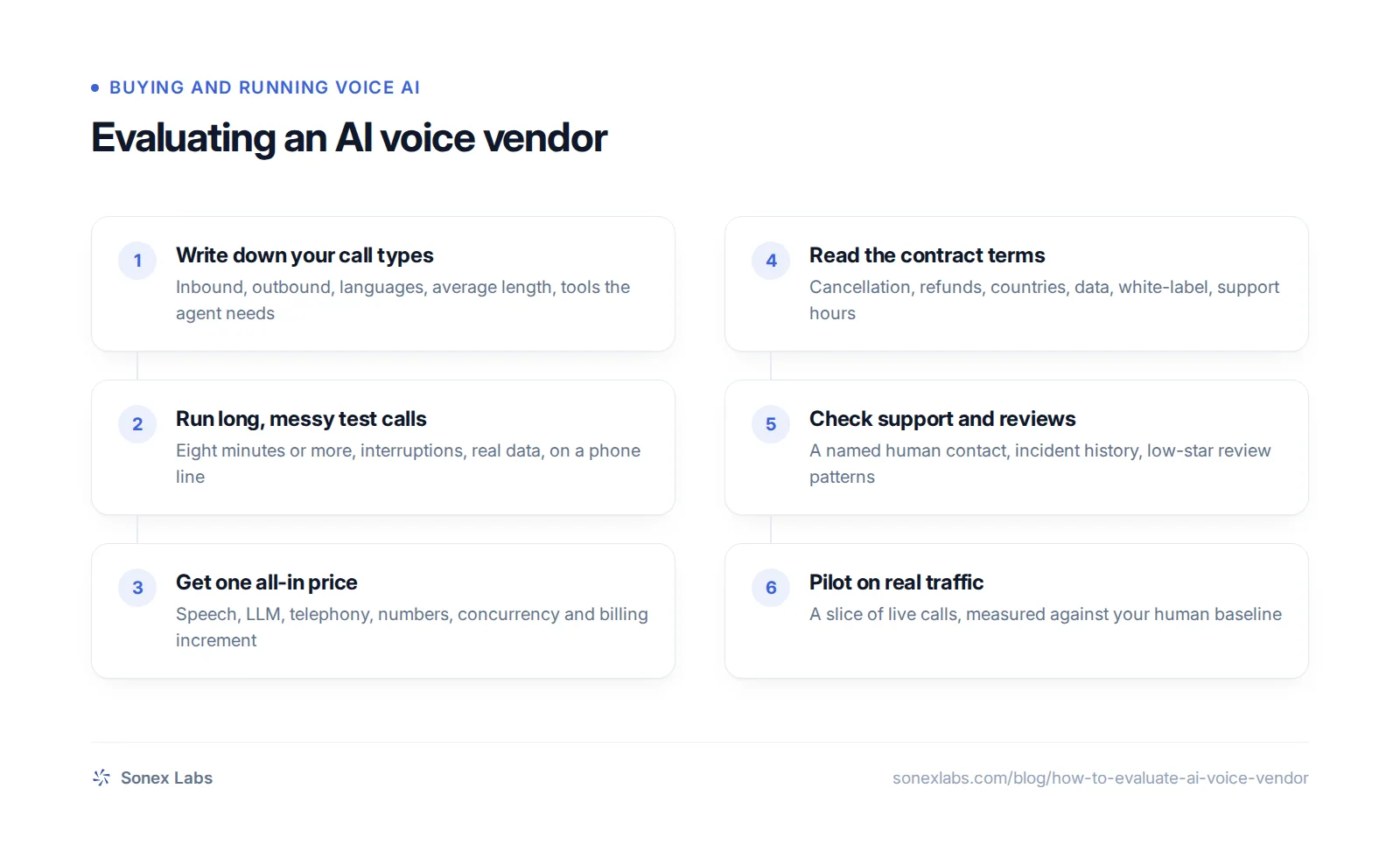
We have a stake here, because Sonex Labs sells AI voice agents. Apply every question below to us too, and expect the same written answers you would ask of anyone else. The flowchart shows the order we suggest: write down your call types, test, price, read the contract, check support, then pilot on live traffic.
Test calls that expose what a demo hides
Start by writing down what the agent must handle: inbound or outbound, languages, typical call length and the tools it needs, such as a calendar or CRM. Then make test calls that are longer and messier than any demo. Failures that matter tend to show up after a few minutes, when the conversation holds enough detail for the model to lose track, or when the caller changes their mind. Make some test calls run past eight minutes, twice the length at which the agent in the Indie Hackers post started to break.
Make them on a real phone line, not in the browser. A phone call carries 8 kHz audio, half the sample rate many speech models are trained on, and that alone changes how well names and numbers are heard. The guide to how 8 kHz phone audio breaks 16 kHz speech models explains why. Use your real data too: your product names, branch addresses, customers' surnames, and the dates and amounts your callers actually say.
Interrupt the agent mid-sentence, cough, say "hmm" while it talks, and go quiet for a few seconds. Each tests a different part of turn-taking, the system that decides when the caller has finished and when the agent should stop talking. Then time the gap between the moment you stop speaking and the moment the agent starts. Vendors measure latency in different ways, so measure it yourself; even a five-star review of one large platform mentions delays of 1.5 to 2.5 seconds with one model choice.
If the agent must work in several languages, test each one against the same list of moments. The guide to testing a multilingual voice agent sets out that matrix. Record and transcribe every test call, and note each wrong fact, cut-off and talk-over, so you can compare vendors on the same evidence. The table lists the tests worth running on every vendor.
Piloting on live calls
Test calls show whether an agent can do the job; a pilot shows whether it does it on your traffic. Run it on a slice of real calls long enough to cover every call type and the busy and quiet parts of your week. For most businesses that means at least two to four weeks. Note your human numbers for the same calls before you start, such as completed tasks, average handling time, transfers and complaints, so the pilot has something to beat.
Compare the agent on those measures, not on how the calls sound. A paid setup or custom demo can be fair when the vendor builds integrations or prompts for you. Agree first what you get: a working agent on your data, test calls you can run yourself, and the right to walk away if the pilot misses agreed targets.
| Test | How to run it | What a failure looks like |
|---|---|---|
| Long call | Talk for eight minutes or more, then ask about something said in the first minute | The agent forgets, contradicts itself or invents details |
| Interruptions | Cut in mid-sentence; say "hmm" or "okay" while it talks | It talks over you, or stops for every small sound |
| Real data | Your names, addresses, amounts, dates and phone numbers | Wrong numbers read back, names mangled, dates off by a day |
| Phone line | Call from a mobile on a busy road | Words missed that it caught in the browser demo |
| Tool calls | Book, reschedule and cancel against a real calendar | It says it booked a slot that is not in the calendar |
| Languages | Switch language mid-call, or mix English into Hindi | It replies in the wrong language or garbles the mix |
| Hand-off | Ask for a human, angrily, twice | No transfer, or a transfer with no context passed on |
The all-in price per minute, and what is left out of it
The price that matters is the total you pay for one minute of a real call, and a headline rate often covers only part of it. A voice agent has several cost lines. Speech-to-text (STT) turns the caller's audio into text, the language model (LLM) decides what to say, and text-to-speech (TTS) speaks the reply. Telephony is the phone call itself, and the phone number has its own rental. Some platforms also charge for concurrency, the number of calls you can run at once.
Reviewers on one platform's Trustpilot page complain that its listed price covered only the platform, with the language model and the phone provider billed on top (Trustpilot). That is the most common pricing complaint we found. Ask every vendor to write down which of those lines its per-minute price includes, and what each excluded line costs at your expected volume.
Then ask for the billing increment, meaning how a part-minute is rounded. Take a 45-second call at $0.10 a minute: billed per second it costs $0.075, but rounded up to a whole minute it costs $0.10, a third more. On short calls such as reminders and confirmations, the increment can matter more than the rate.
The cleanest check is a sample invoice. A vendor that is confident in its pricing can show an itemised invoice or usage export for a real month, with names removed. If it cannot, ask it to price your exact call mix in writing: number of calls, average length, languages, and the share of calls that need tools or a transfer.
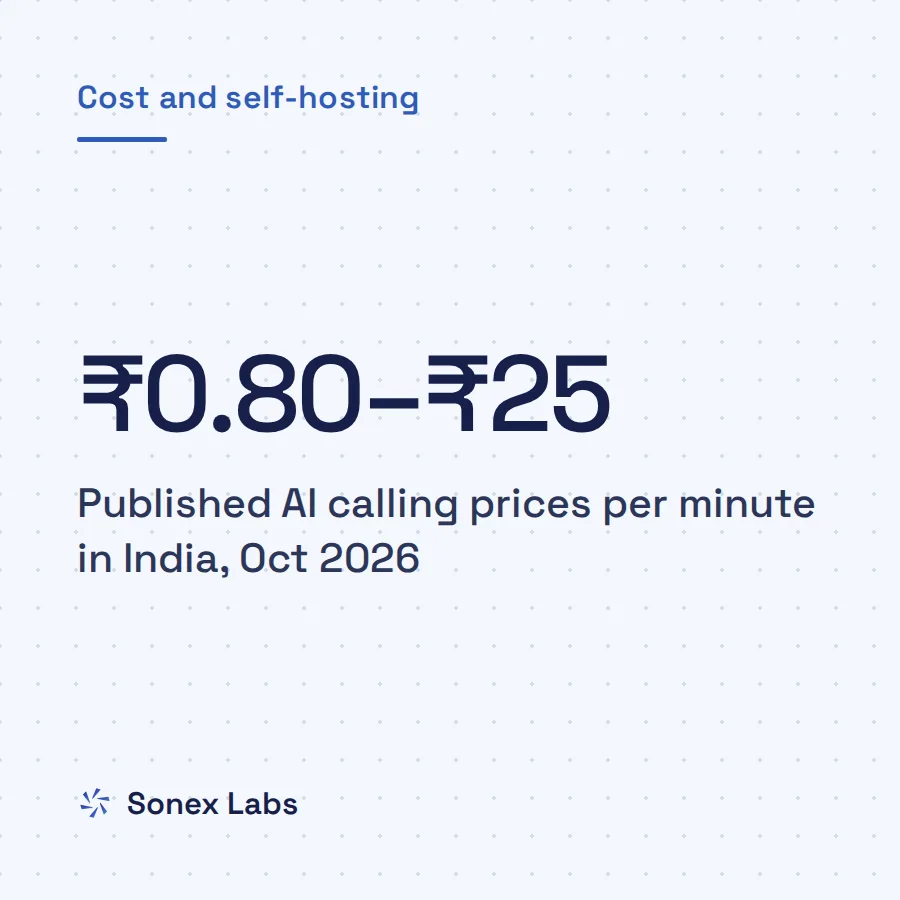
For comparison, and as our disclosure, Sonex Labs publishes a voice-agent price of $0.055 per minute, with telephony on Sonex numbers and the language model's tokens billed on top. Ask us the same questions you would ask anyone else, including how part-minutes are rounded. The breakdown of what an AI calling agent costs per minute in India goes through every line with rupee figures.
Contract terms: cancellation, countries, numbers and white-label
Read how you leave before you decide to join. Billing after cancellation is one of the loudest complaints on review sites. On one platform's Trustpilot page, a reviewer said they cancelled more than five months earlier and still "continue to get billed each month", and others reported being charged after cancelling or on a free plan. Ask how to cancel, whether it can be done in the dashboard without a support ticket, whether plans auto-renew, what happens to unused balance and what written confirmation you get.
Next, ask which countries and number types each plan can call. A one-star review of a large platform reported that every outbound call to Turkey failed with a SIP 403 error, a refusal from the telephony network. The reviewer described it as "a country-level block that cannot be changed from the dashboard" (Trustpilot). The reviewer's real complaint was that nothing said which countries were restricted, so get the list in writing for every country you need.
Who owns the phone numbers
Numbers rented through a voice platform usually belong to the platform or its carrier, and porting them out may not be possible. If keeping your numbers matters, rent them from a carrier in your own name and connect them to the platform, so a vendor change does not change what customers see on their screens. Ask about this before customers have saved the number.
Indian calling and data rules
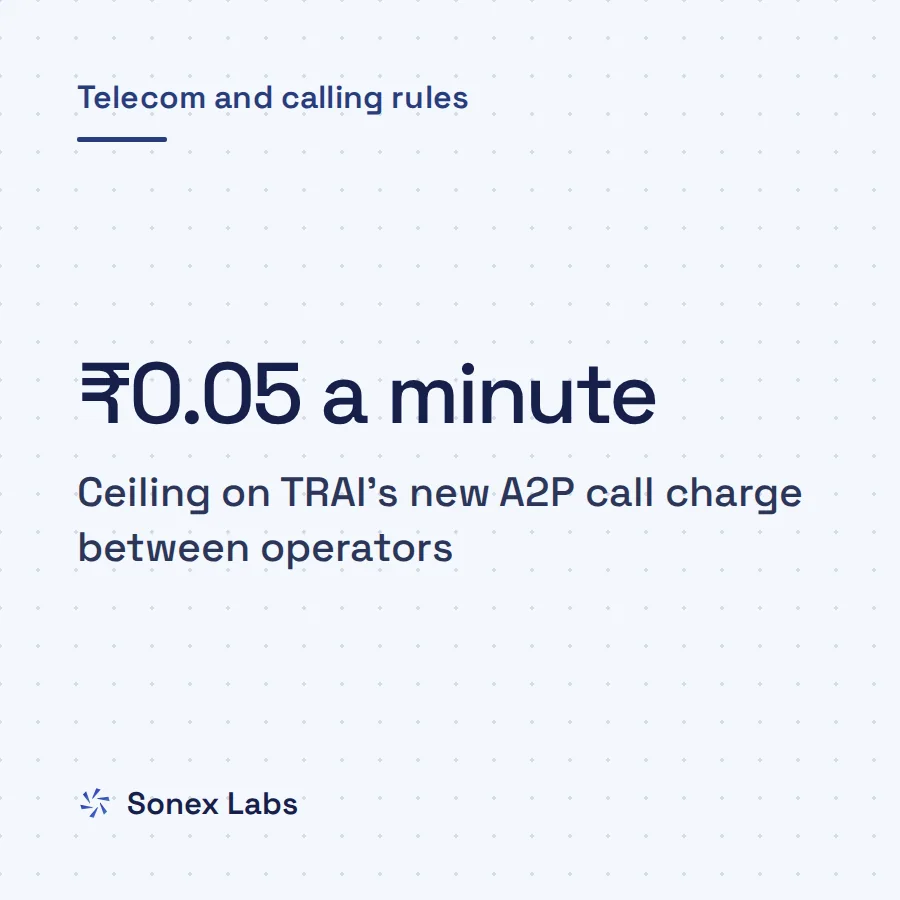
A vendor does not need to be based in India to serve Indian customers, but it does need to handle Indian requirements. From 27 November 2026, every call dialled by software must be declared to your telecom operator as A2P (application-to-person) calling, along with the caller numbers you use. Ask the vendor who makes that declaration, on whose numbers, and how spam flags on those numbers are reported to you. The guide to TRAI's 2026 rules for AI and automated calls explains what the declaration involves.
Ask too where call recordings and transcripts are stored and for how long, because India's data protection law will govern them. The guide to the DPDP Rules 2025 and call recordings sets out the dates and duties. Support during Indian business hours, and Indian languages tested on 8 kHz phone audio, belong on the same list.
Reselling under your own brand
If you are an agency reselling a platform under your own brand, test the white-label setup as your client would see it. One agency reviewer said the vendor's logos stayed visible in client-facing screens, and that clients who raised tickets were sent to the vendor's own support.
Ask whether usage and cost can be split per client or per agent, because reconciling one shared bill across many clients by hand eats into a reseller's margin. As a disclosure, in our own dashboard call history can be filtered by agent and each call shows its cost broken down by part, but there is no running spend total per agent yet.
Support and reliability you can check before signing
Find out who answers when something breaks, before it breaks. On one platform's review page, a customer wrote that after going live you should "expect to be waiting a week" for issues to be looked at properly, and two others said they could only reach a bot. On another, one reviewer said their agents had gone down more than a week earlier with no reply, and another said calls were suddenly disconnecting.
None of this is unusual for a young category, and a single bad review proves little. What you can check is how a vendor handles failure. Ask for a named support contact, response times written into the contract, a public status page with past incidents and an example of a post-incident report. Ask what happens to live calls if one of its speech or model providers goes down: is there a fallback, and is it billed differently?
Ask for two references in your own industry and, if possible, your own language. A reference running Hindi collections calls tells you far more about a Hindi collections deployment than a US dental clinic does. Regulated buyers have a longer list. For banks, NBFCs, insurers and brokers, the due-diligence questionnaire for AI voice vendors maps each question to the rule behind it, and the guide to RBI's outsourcing rules for AI voice vendors explains the checks a bank must run.
How to read review sites without being misled
Review scores are only comparable when the profiles behind them are similar, and for voice-agent platforms they rarely are. On Trustpilot in October 2026, one large platform had 805 reviews and a TrustScore of 4.9. Another had 13 reviews and a score of 2.5, on an unclaimed profile whose company had not invited customers to review (Trustpilot). A third had 215 reviews and a score of 4.1, but only six of those reviews were from the past year (Trustpilot).
A profile with 13 reviews mostly collects people who were angry enough to look for it. A profile with hundreds of five-star reviews may reflect a review-request email after every successful setup. Neither tells you much about the calls you will run. Read the one- to three-star reviews for patterns that repeat across different people and dates, such as billing, outages or support, and check whether the company replies.
Watch for planted reviews, too. One recent review on a voice platform's page said only "Try Alternative Keevora", which promotes another product rather than describing any experience. The same applies to comparison posts: many "we tested every platform" articles are written by a vendor or carry affiliate links, so check who wrote them before you trust the ranking. The checklist below collects what to get from every vendor before you sign.
AI voice vendor checklist
- Call types, languages and current human baseline written down
- Test calls of 8+ minutes, with interruptions and real data, on a phone line
- One all-in per-minute price, with billing increment and exclusions, or a sample invoice
- Cancellation, refund and renewal terms in writing
- Countries, number ownership and A2P declaration responsibility confirmed
- Where recordings and transcripts are stored, and for how long
- Named support contact, status history and two references
- A pilot on live calls with agreed targets and the right to walk away
Sources
- Indie Hackers: I tested 7 AI voice agent platforms so you don't waste $3,000Secondary
- Quora: Which is the best AI voice calling agent in India?Secondary
- Trustpilot: Retell AI reviews (805 reviews, 4.9, October 2026)Secondary
- Trustpilot: Vapi reviews (13 reviews, 2.5, unclaimed profile, October 2026)Secondary
- Trustpilot: Synthflow reviews (215 reviews, 4.1, October 2026)Secondary
Change log: 24 Oct 2026, First published. Rewritten the same day as one continuous guide: the steps and FAQs (pilot length, number ownership, setup fees, India requirements) were folded into the sections they belong to; the checklist was kept as a printable list and gained data storage and pilot items; said that telephony and LLM tokens are billed on top of the published per-minute price; the Vapi Trustpilot profile is now described as unclaimed, as the page shows