On this page
Why rules written for doctors reach a clinic's phone line
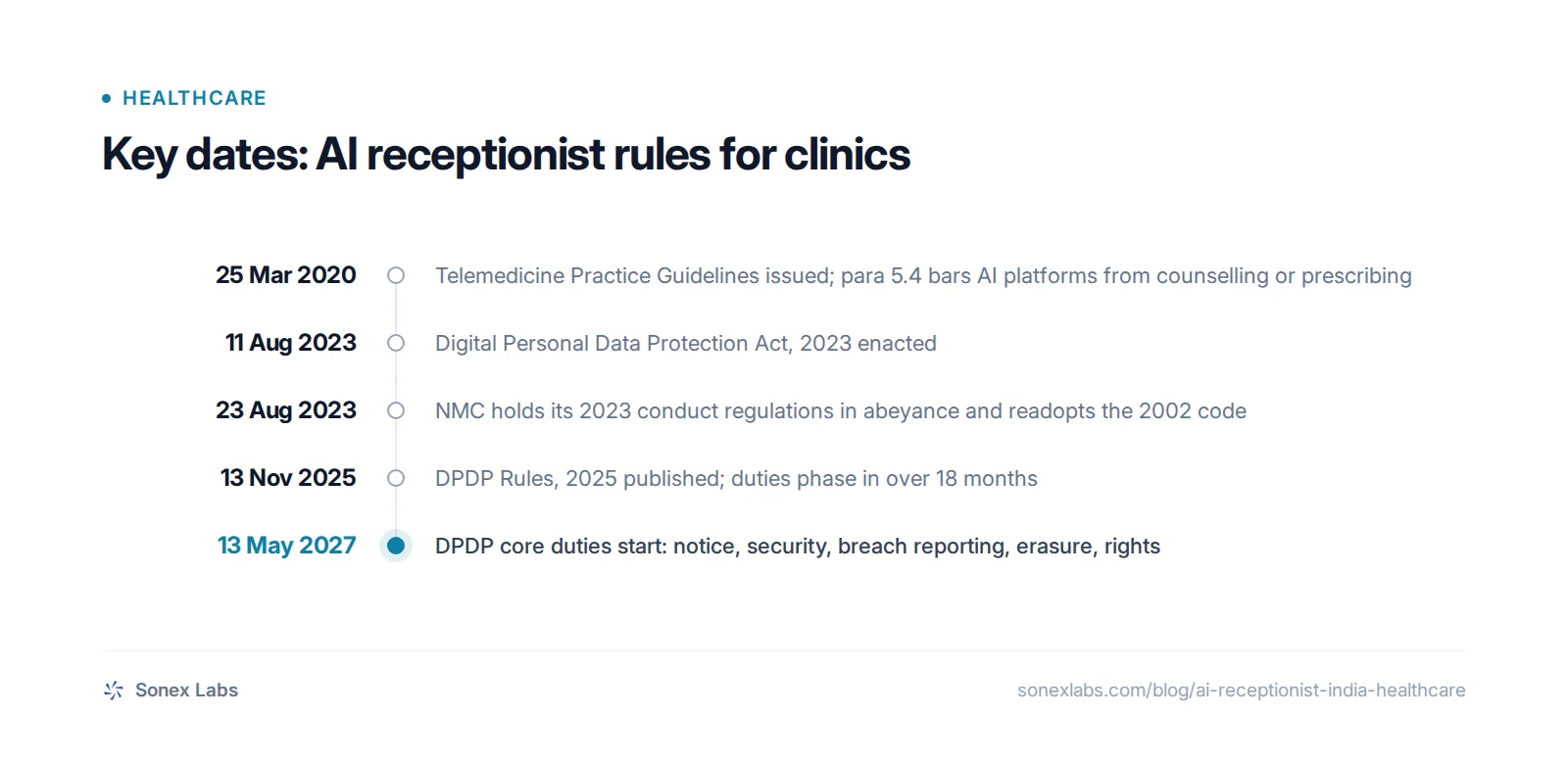
India has no law written for AI receptionists. What it has is a set of professional rules for doctors, and one of them speaks directly to AI. The Telemedicine Practice Guidelines were issued on 25 March 2020, early in the Covid-19 pandemic, to let doctors consult and prescribe remotely. They came from the Board of Governors in supersession of the Medical Council of India, meaning the board that had taken over the MCI's powers, and were prepared with NITI Aayog.
In a section on technology platforms, the guidelines say AI and machine-learning platforms "are not allowed to counsel the patients or prescribe any medicines to a patient" (Telemedicine Practice Guidelines, para 5.4). Only a registered medical practitioner (RMP), meaning a doctor on a medical register, may counsel or prescribe, and the doctor must communicate with the patient directly. The same paragraph leaves room for AI behind the scenes: it can "assist and support" a doctor with evaluation, diagnosis or management, as long as the final advice comes from the doctor.
That settles two questions people often ask. AI cannot give medical advice to a patient in India, and AI cannot prescribe medicine, because both are reserved for a registered doctor. Prescribing by telemedicine also carries the same professional accountability as an in-person visit (para 3.7.4).
Why the guidelines bind doctors, and which code is in force
The guidelines form Appendix 5 of the Indian Medical Council (Professional Conduct, Etiquette and Ethics) Regulations, 2002. That placement matters, because it makes them professional-conduct rules that bind doctors, not loose advice. A doctor who breaks them answers to the medical regulator.
It also means the status of the 2002 code matters. The National Medical Commission (NMC) notified new conduct regulations in August 2023. On 23 August 2023 it held them in abeyance, meaning suspended, and readopted the 2002 code until a further Gazette notification (NMC notification). We found no later notification lifting this. NMC's own advertising guidelines of 6 October 2026 are still to be read with the 2002 code (para 4.2). As of 24 October 2026, the 2002 code and its telemedicine appendix are therefore the working rules.
Does para 5.4 cover a receptionist bot?
Not in so many words. Para 5 covers platforms that connect patients with doctors, and the guidelines as a whole are addressed to doctors. A clinic's front-desk agent that books appointments is not a telemedicine consultation, and no regulator has said how para 5.4 applies to one.
The risk still lands on the doctor. A doctor whose clinic's agent gives medical advice is exposed under the same conduct rules, whether or not the agent counts as a platform. Our reading, which is interpretation and not a ruling, is that the safe course is to treat para 5.4 as applying in full: the agent never counsels and never prescribes.
Where the front desk ends: what the agent can and cannot say
If the agent must never counsel or prescribe, the practical question is where the front desk's job ends. The line runs between running the clinic and advising the patient. The guidelines define counselling as "specific advice given to patients" about their condition (para 3.7.3), and prescribing is the doctor's call (para 3.7.4). Admin and logistics, which depend on facts the clinic controls, sit on the safe side.
The table applies that line to the questions a clinic front desk hears most often. Where a row says the agent can speak, it is passing on facts such as slots, fees and written instructions. Where it must not, the answer would depend on the patient's own condition, and the agent should give one fixed reply and offer a doctor or staff member instead.
Medicine questions need the most care, because the ban on prescribing goes further than not writing prescriptions. Telling a caller to take a painkiller, or to keep taking a tablet, is a medicine instruction, even when it sounds like ordinary helpfulness. General wellness tips carry the same risk: the guidelines' own examples of counselling include food restrictions and do's and don'ts for a patient on anticancer drugs (para 3.7.3). A diet tip given in reply to a patient's description of their condition is counselling.
Reading out the clinic's own instructions
Reading out preparation instructions, such as fasting times before a blood test, can look like counselling at first sight. It is not, as long as the agent only repeats what a doctor approved. In the section on consultations through a health worker, the guidelines describe the health worker "reinforcing the health education and counseling provided by the RMP". Passing on a doctor's advice is different from giving your own.
That distinction holds only if the words stay the doctor's. Store the instructions as fixed, clinic-approved text, and do not let the agent rephrase them, expand on them or apply them to a patient's situation. If the caller asks "does this apply to me?", hand over to staff.
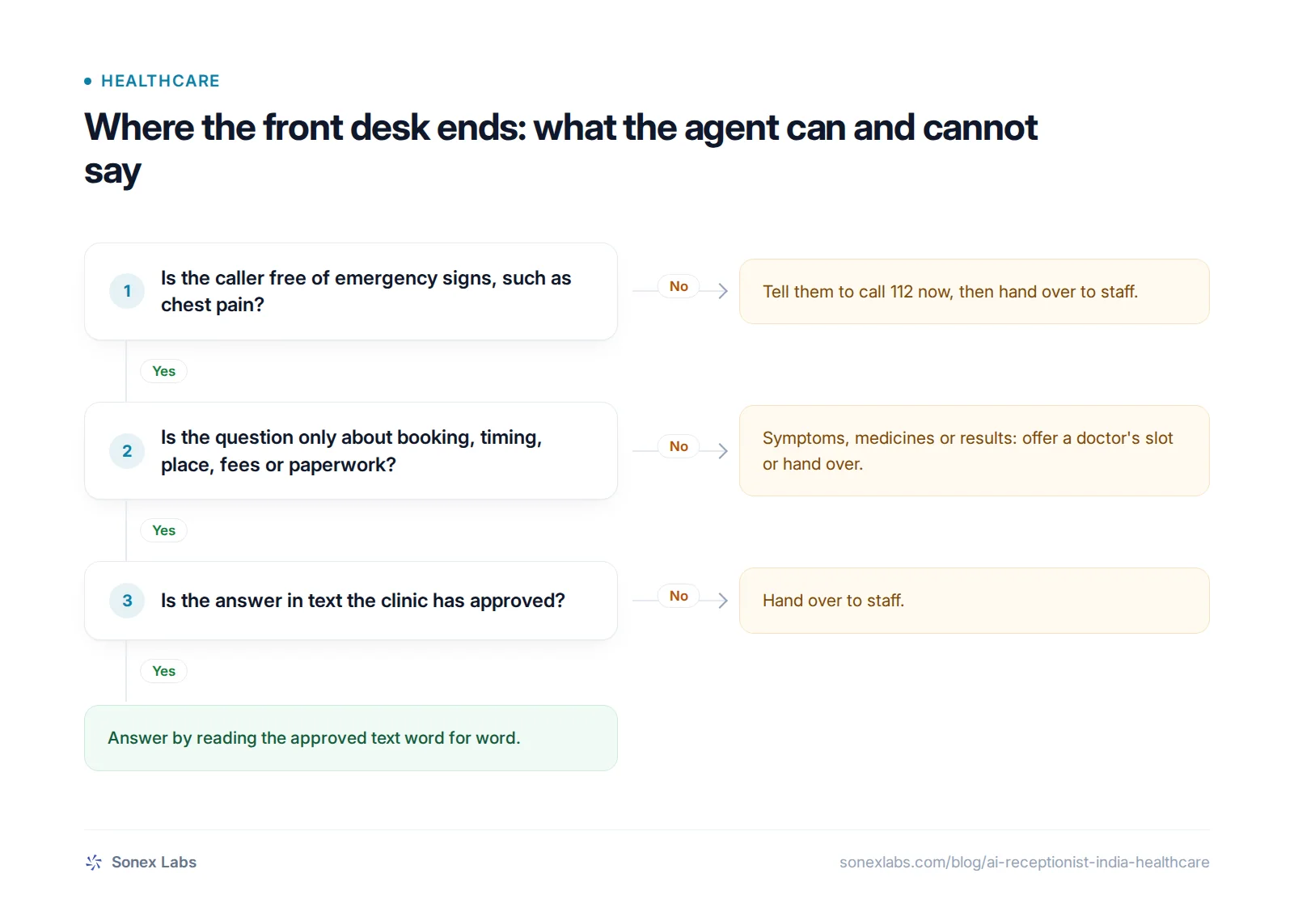
A written list of allowed topics, a fixed refusal line and approved text are only as good as the agent's behaviour on real calls. Reviewing a sample of calls each week for any answer that crosses into advice, and fixing the instructions when one does, is how a clinic finds out. Every patient question then goes through the same three checks, shown in the chart: rule out an emergency, send health questions to a person, and let the agent answer only admin questions it has approved text for.
| Topic | The agent can say | The agent must not say |
|---|---|---|
| Booking | Free slots, the doctor's name and specialty, how long a visit takes, and a booking confirmation. | Which doctor the patient "needs" from their symptoms, beyond routing to a department the clinic has listed. |
| Rescheduling and cancelling | New times, the clinic's cancellation policy, and a confirmation. | That it is fine to skip or delay a follow-up the doctor asked for. |
| Reminders | Date, time, place, and what to bring (reports, ID, previous prescriptions). | Changes to medicine timing or dose, even as a "reminder", unless the doctor wrote those exact words for this patient. |
| Directions, hours and fees | Address, parking, opening hours, consultation fees and accepted payment methods. | Price comparisons or promises about outcomes. |
| Preparation instructions | The clinic's written instructions for a test or procedure, read word for word (for example, fasting times the lab set). | Its own version of the instructions, or advice on whether this patient should follow them. |
| Symptoms | "I can't advise on symptoms. I can book you with a doctor today, or connect you to the clinic." | Any guess at what the symptom means, how serious it is, or home remedies. |
| Medicines | That the doctor or pharmacist will answer, and an offer to book or pass on a message. | Whether to start, stop, double or swap a medicine, or what a medicine is for. |
| Test results | That the report is ready, and how to collect it or book a review. | What the result shows, whether it is normal, or any reading of the numbers. |
| Emergencies | "Please call 112 now, or go to the nearest emergency department." Then hand over to staff. | Anything that delays the caller: questions, booking steps or reassurance. |
Handling a medical emergency on the line
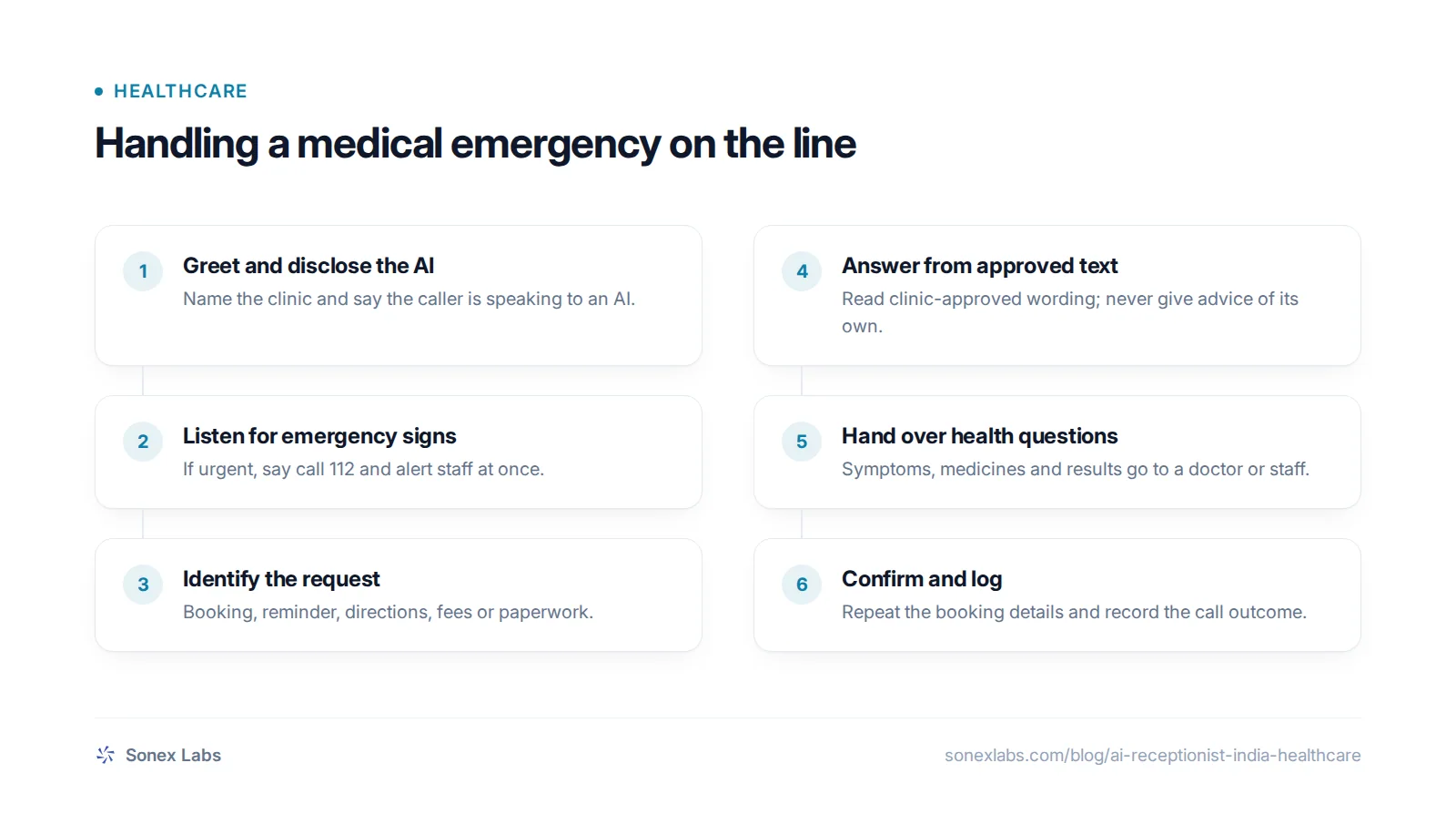
The emergency check comes first because a caller in danger needs help, not a booking. Even for doctors consulting remotely, the guidelines say that in all cases of emergency the patient "MUST be advised for an in-person interaction" with a doctor at the earliest (para 4.5). A doctor may also advise first aid in that moment. An agent is not a doctor, so it should not try to assess the emergency or give first-aid advice. It should tell the caller to get emergency help at once, then hand over to a person without asking more questions first.
112 is India's single emergency number, and in many states 108 is the ambulance number. Many clinics also have their own emergency line, so the agent's script should say plainly which number to use. The instruction belongs at the top of the agent's script, and it should be tested with the phrases callers actually use, in every language the clinic serves.
Data protection law does not stand in the way. Under India's Digital Personal Data Protection Act, 2023 (DPDP Act), no consent is needed to respond to a medical emergency that threatens someone's life or immediately threatens their health (DPDP Act, section 7(f)). Passing the caller's details to staff or emergency services in that moment is covered. The flow shows where the emergency check sits in a full call, right after the agent introduces itself.
Telling patients they are speaking to an AI
Indian law does not clearly require a clinic's voice agent to say it is an AI, but the country's ethical guidance for AI in healthcare expects it. The Indian Council of Medical Research (ICMR) published Ethical Guidelines for Application of Artificial Intelligence in Biomedical Research and Healthcare in 2023. They are ethical guidance, not a statute, written for clinicians, institutions, ethics committees and AI developers, and they name clinic management, including appointment scheduling, as a use of AI.
The guidelines set ten principles, starting with autonomy, safety and risk minimisation, trustworthiness, data privacy, and accountability and liability. Under autonomy, "patients should be fully informed about the use of AI technologies" and "must have complete autonomy to choose or reject AI technologies" (ICMR guidelines, para 1.1). The same paragraph backs a "Human in The Loop" model, and para 1.2 says unsupervised models carry more risk.
For a voice agent, the practical reading is an opening line that names the clinic, says the caller is speaking to an AI assistant and offers a person. Something like "Hello, you've reached [Clinic]. I'm an AI assistant. I can book or change appointments, or connect you to the team" does all three. A human then stays responsible for anything clinical. The AI disclosure and recording-notice scripts have versions in several Indian languages. The guide to AI voice labelling rules in India explains why the IT Rules' labelling duty for synthetic audio may or may not reach phone calls.
Outbound calls: reminders yes, promotion no
The 2002 code also shapes how a clinic may use an agent that calls out. Soliciting patients "directly or indirectly", by a doctor or by an institution, is unethical (para 6.1.1). NMC's Guidelines on Ethical Advertising and Public Communication of 6 October 2026 go further for AI: they treat AI-generated or AI-assisted promotional communication as advertising (NMC public notice, para 3.2).
A clinic using an AI agent to call out should therefore keep to reminders and follow-ups for existing patients, such as confirming tomorrow's appointment or a review the doctor asked for. Cold calls offering a health check or a discount on a procedure look like solicitation by an institution, whatever voice delivers them.
Health claims carry a separate risk under a different law. The Drugs and Magic Remedies (Objectionable Advertisements) Act, 1954 restricts advertisements suggesting a drug can treat or cure listed diseases (section 3). Its definition of advertisement covers "any announcement made orally" (1954 Act, section 2(a)). In our reading that can reach a spoken call script, though we found no case applying it to automated calls, so keep cure claims out of every script.
Patient call data under the DPDP Act
Every call the agent handles creates a record, and that brings in India's data protection law. Call recordings and transcripts that identify a patient are digital personal data under the DPDP Act. The Act has no separate "sensitive" category, so health details get the same protections as other personal data. The EU's GDPR, by contrast, treats health data as a special category with extra conditions.
The main duties, including notice, security, breach reporting, erasure and patients' rights, start on 13 May 2027, under the Act's commencement notification (G.S.R. 843(E)) and the matching DPDP Rules, 2025 (rule 1(4)). Until that date the Information Technology Act, 2000 still applies. Its 2011 rules list a person's health condition and medical records as sensitive personal data, and a company that negligently fails to protect such data must compensate the person harmed (section 43A). The DPDP Act deletes section 43A on 13 May 2027 (section 44(2)(a)). Either way, a clinic needs to decide where recordings and transcripts are kept, who can hear them and when they are deleted. The guide to the DPDP Act for voice AI sets out each duty, and how long to keep call recordings in India covers retention.
Children's data has its own rule. For children, the Act normally needs verifiable consent from a parent, but clinical establishments, mental health establishments and healthcare professionals are exempt (rule 12 and the Fourth Schedule). The exemption covers only health services to the child "to the extent necessary for the protection of her health".
Clinics that connect to the Ayushman Bharat Digital Mission (ABDM), the government's digital health programme, also have to follow its Health Data Management Policy, which is built around the patient's consent before health records are shared. We could not load the ABDM site to confirm the current version on 24 October 2026, so check it there before relying on it.
Putting the rules into a working agent
These rules decide what the agent may say; they do not decide how well it books. Choosing languages, saying dates and times the way patients do, handing over fast and pricing the agent are covered in our guide to setting up an AI receptionist for a clinic in India. Clinics that also serve US patients face a different regime, explained in HIPAA rules for voice agents, and the AI receptionist for clinics and hospitals page shows how Sonex handles patient calls.
Key dates
Sources
- Telemedicine Practice Guidelines, 25 Mar 2020 (MoHFW eSanjeevani copy)Official
- NMC: Indian Medical Council (Professional Conduct, Etiquette and Ethics) Regulations, 2002Official
- NMC: notification R-12013/01/2022/Ethics, 23 Aug 2023, holding the 2023 conduct regulations in abeyanceOfficial
- NMC: Guidelines on Ethical Advertising and Public Communication, public notice R-13014/01/2024-Ethics, 6 Oct 2026Official
- ICMR: Ethical Guidelines for Application of AI in Biomedical Research and Healthcare, 2023Official
- Drugs and Magic Remedies (Objectionable Advertisements) Act, 1954 (CBFC copy)Official
- PIB (Ministry of Home Affairs): ERSS-Dial 112, the pan-India single emergency number, 3 Dec 2019Official
- Digital Personal Data Protection Act, 2023Official
- Digital Personal Data Protection Rules, 2025 (G.S.R. 846(E))Official
- IT Act 2000, section 43A (Indian Kanoon)Secondary
- TeamLease RegTech: MeitY notification G.S.R. 843(E) on commencement of the DPDP Act, 13 Nov 2025Secondary
Change log: 23 Oct 2026, First published · 24 Oct 2026, Fact-check: para 4.5 emergency reading corrected, issuing body named as on the guidelines, NMC 6 Oct 2026 advertising guidelines and DPDP commencement notification added, hedges labelled. Later the same day, rewritten as one continuous guide focused on the rules: the conduct-code status moved next to the guidelines it governs, AI disclosure and outbound calls given their own sections, and the takeaways, steps, checklist and FAQs folded into the body. Setup, languages and cost moved to the companion guide on AI receptionists for clinics