On this page
- What SEBI's call recording rule requires
- Where the rule comes from, and the 2017 circular today
- When an AI voice agent takes the order
- How CSCRF came in, and which category your firm is in
- What CSCRF expects from calling and AI voice vendors
- Keeping recordings and AI processing in India
- Which numbers brokers and mutual funds must call from
- Key dates
- Sources
What SEBI's call recording rule requires
If a client can place an order with you by phone, you must record that call. The rule comes from SEBI's work on preventing unauthorised trading, where a broker trades in a client's account without the client's instruction. Its starting point is simple: a broker may execute a client's trade only after keeping evidence that the client placed the order (para 35.2 of the Master Circular for Stock Brokers).
For phone orders, that evidence must be a recording. Where the order comes by phone, the broker "shall mandatorily use telephone recording system to record the instructions and maintain telephone recordings as part of its records" (Master Circular for Stock Brokers, para 35.4). Orders that arrive another way can be evidenced in other forms. SEBI lists six examples, "inter alia" (para 35.2): a physical record written and signed by the client, a telephone recording, an email from the client's authorised email ID, a log for internet transactions, a record of SMS messages, or any other legally verifiable record.
How long to keep phone-order recordings
The recordings must be kept for at least three years. Brokers keep order evidence for at least the period in which arbitration accepts investor complaints, which the master circular says is "currently three years" (para 35.5). Because the period is tied to the arbitration window rather than fixed in the text, it would move if that window changed.
Two situations extend it. If a dispute is raised, the records stay until it is finally resolved, and if SEBI asks for specific records to be preserved, they stay until SEBI says otherwise (para 35.6). The guide to how long to keep call recordings in India sets this period beside those of RBI, IRDAI and the DPDP Rules.
What happens in a dispute
The records earn their keep when something goes wrong. In a dispute, the broker must produce them for the disputed trades (para 35.3). If it cannot, for example after a technical failure, it must explain why, and other evidence, such as the client's post-trade confirmation or payment records, may then be considered.
Getting this wrong is expensive in ways that go beyond the dispute itself. In August 2025, Moneylife reported that SEBI had fined a broker, Integrated Master Securities, ₹1 lakh during an insider-trading probe in Mastek shares. According to the report, the broker had not kept the original recordings of client orders and instead submitted calls recreated in December 2024 for trades made in July 2023 (Moneylife, 20 August 2025).
Where the rule comes from, and the 2017 circular today
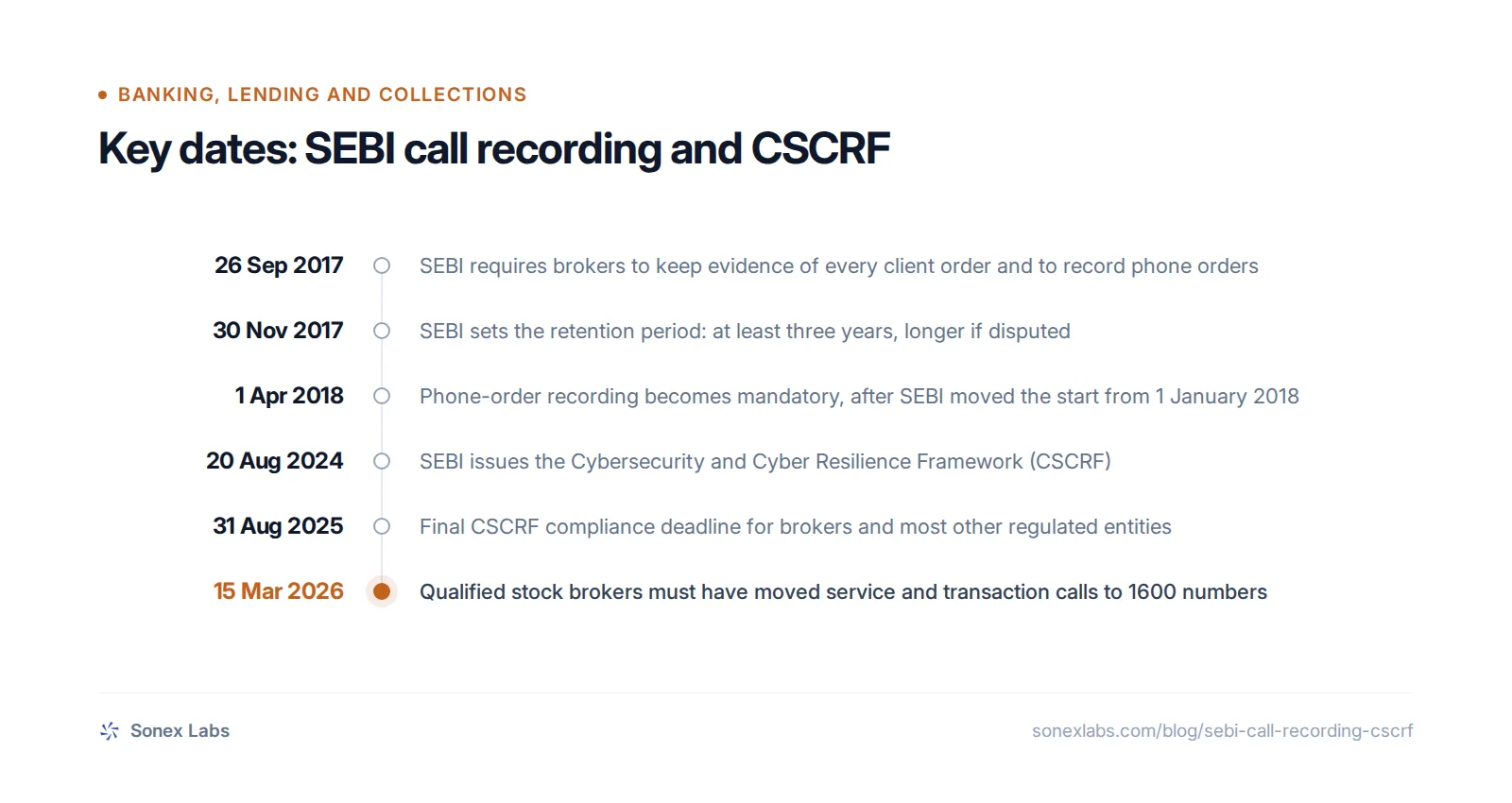
The "SEBI call recording circular" that many pages cite is the circular of 26 September 2017 on preventing unauthorised trading by stock brokers (CIR/HO/MIRSD/MIRSD2/CIR/P/2017/108). It was due to start on 1 January 2018, but SEBI moved the start to 1 April 2018 after brokers asked for more time (circular of 11 January 2018).
In between, SEBI's clarification of 30 November 2017 (CIR/HO/MIRSD/MIRSD2/CIR/P/2017/124) set the three-year retention period. A circular of 22 March 2018 (SEBI/HO/MIRSD/DOP1/CIR/P/2018/54) then consolidated the rules and rescinded the earlier circulars. That text, retention period included, now forms para 35 of the Master Circular for Stock Brokers (SEBI/HO/MIRSD/MIRSD-PoD/P/CIR/2025/90), dated 17 June 2025.
The 2017 circular is no longer the text to cite. In March 2026 SEBI confirmed, in an informal guidance letter, that it is superseded by the master circular, so policies and vendor contracts should cite the master circular. One detail to watch: the letter dates the master circular 17 July 2025, but SEBI's own page and the circular itself say 17 June 2025.
The SEBI (Stock Brokers) Regulations, 2026, published on 7 January 2026, replaced the 1992 regulations. They do not cancel the master circular. Any reference to the 1992 regulations in a SEBI circular is now read as a reference to the 2026 regulations (regulation 51(3)), and SEBI's March 2026 letter still cites para 35 as the rule.
When an AI voice agent takes the order
SEBI has not said anything about AI agents taking orders. The rule applies "wherever the order instructions are received from clients through the telephone", whoever or whatever answers. So if an AI agent accepts a buy or sell instruction, the safe reading is that the call must be recorded and kept like any other phone order.
The recording must also hold up as evidence. In its March 2026 informal guidance on WhatsApp orders, SEBI said records must be "retrievable and legally verifiable" for any investigation or legal proceedings. In a dispute, the broker must prove this under the law on electronic evidence. That is where an AI setup can fall short. A transcript alone, or a recording that cannot be tied to the client's registered number and the time of the order, may not be enough.
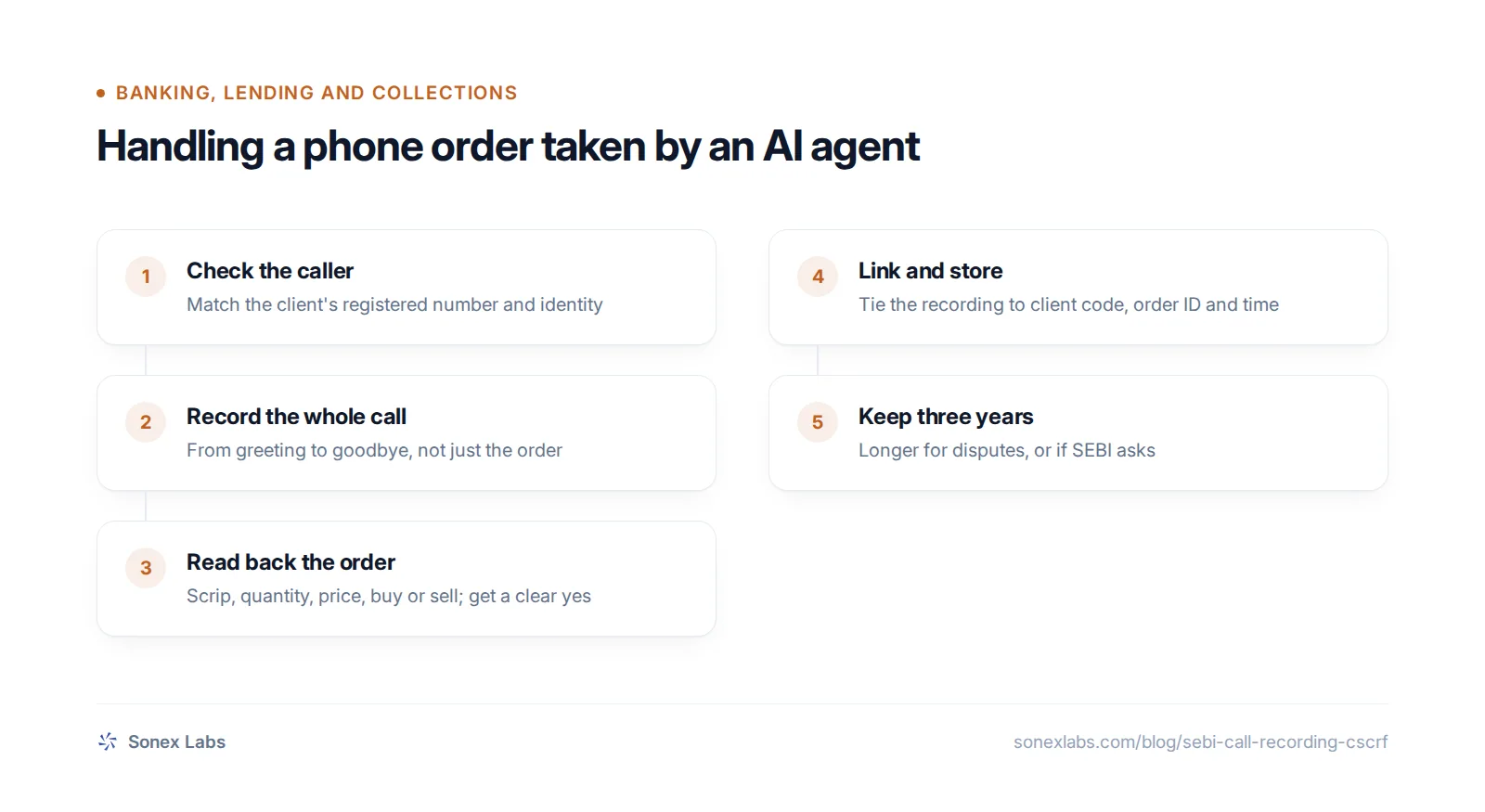
Three habits make the record easier to defend, although none is itself a SEBI rule. The first is recording the whole call rather than the moment of confirmation, because a client often gives the instruction early and the agent confirms it later, and partial clips are harder to defend in arbitration. The second is having the agent read back the scrip, quantity, price and buy or sell, and wait for a clear yes before placing the order. The third is linking each recording to the client code, registered number, order ID and confirmation time, and testing that any one of them can be found quickly.
Platforms that run AI voice agents, Sonex among them, keep both a call recording and a transcript. For SEBI's purposes the audio is the record, and the transcript is a search aid. SEBI's provisions covered here require the recording itself, and we did not find a requirement in them to announce it, but telling the client costs one sentence, such as "This call is recorded for your order records". Exchange rules and the client agreement may say more.
How CSCRF came in, and which category your firm is in
The recording rule tells you what to keep. CSCRF decides what you must demand from the vendor that records, stores or transcribes those calls. It is SEBI's Cybersecurity and Cyber Resilience Framework for SEBI Regulated Entities, issued on 20 August 2024 (circular SEBI/HO/ITD-1/ITD_CSC_EXT/P/CIR/2024/113), and it replaces SEBI's earlier cybersecurity circulars, including the 2018 framework for stock brokers and depository participants.
Oddly, the June 2025 Master Circular for Stock Brokers still reproduces that 2018 framework (para 62) without saying how it fits with CSCRF. We treat CSCRF as the text that applies, since it says it supersedes the 2018 circulars, but that is our reading. CSCRF applies to brokers, depository participants, mutual funds, portfolio managers and other regulated entities. Investment advisers and research analysts registered only in that capacity were exempted in April 2025 (circular SEBI/HO/ITD-1/ITD_CSC_EXT/P/CIR/2025/60, paras 2.3 and 2.4).
Deadlines that slipped to 31 August 2025
The first deadline was 1 January 2025 for the six kinds of entity that already had a cyber framework, including brokers. Everyone else had until 1 April 2025 (para 17). The dates then slipped: SEBI gave regulatory forbearance until 31 March 2025, extended the deadline to 30 June 2025, and finally extended it to 31 August 2025.
Market infrastructure institutions, KYC registration agencies and qualified registrars and transfer agents got neither extension. For brokers, the framework has applied since 31 August 2025, apart from the data localisation standard, which is on hold.
Size categories for stock brokers
How much of CSCRF applies to a broker depends on its size, measured two ways: total registered clients and yearly clientele trading volume. Each measure is applied on its own, and if they point to different categories, the higher one applies (circular of 30 April 2025, para 2.1.1). Brokers with fewer than 1,000 registered clients and less than ₹1,000 crore of yearly clientele trading volume are exempt (para 2.1.2).
The category is fixed at the start of each financial year on the previous year's data, and the reporting authority checks it when the broker submits compliance. These thresholds replaced the original 2024 table, which sorted brokers by active clients and by whether they offered internet-based or algorithmic trading. That table also put every qualified stock broker (QSB) in the top tier, a point the 2025 revision does not mention, so a QSB should check with its exchange.
| Category | Total registered clients | Yearly clientele trading volume |
|---|---|---|
| Qualified | More than 10 lakh | More than ₹10,00,000 crore |
| Mid-size | More than 1 lakh, up to 10 lakh | More than ₹1,00,000 crore, up to ₹10,00,000 crore |
| Small-size | More than 10,000, up to 1 lakh | More than ₹10,000 crore, up to ₹1,00,000 crore |
| Self-certification | More than 1,000, up to 10,000 | More than ₹1,000 crore, up to ₹10,000 crore |
| Exempt | Fewer than 1,000 | Less than ₹1,000 crore (both must apply) |
What CSCRF expects from calling and AI voice vendors
Once CSCRF applies, the vendor question follows quickly, because outsourcing a task does not outsource the responsibility for it. CSCRF says "the responsibility, accountability and ownership of outsourced activities lies primarily with REs", meaning regulated entities. The broker must monitor vendors against the framework and certify this in its periodic reports to SEBI (standard GV.SC.S4, guideline 3).
Incidents show what that means in practice. Incidents covered by the cybersecurity directions of CERT-In, India's national computer emergency response team, must be reported to SEBI and CERT-In within six hours of noticing them. Brokers must also tell the stock exchanges within the same six hours (RS.CO guideline 1). Full details go on SEBI's incident reporting portal within 24 hours, and other cybersecurity incidents must be reported within 24 hours.
A breach at your calling vendor is your incident, and the six hours start when you notice it, so the contract should require the vendor to tell you well inside that window, for example within two hours. The vendor questionnaire has questions to put to a provider, and the guide to RBI's outsourcing rules for AI voice vendors covers the banking equivalent. More generally, a vendor that hosts call recordings or speaks to clients should expect to be held to the same controls as the broker:
- Background checks, a non-disclosure agreement and cybersecurity compliance for every third-party service provider (GV.SC.S4, guideline 4).
- A confidentiality and integrity agreement with third-party service providers, and due diligence on every provider that accesses the broker's IT systems (GV.RR.S5 and GV.RR.S6, guideline 2).
- A software bill of materials (SBOM), meaning a list of the components inside the software, for any new critical software or SaaS application at procurement (GV.SC.S5).
- Audits and inspections of vendors' IT resources, and SEBI's right to search and seize data that third-party service providers hold for the broker (GV.OC.S2).
- A check on concentration risk where many brokers rely on one vendor, for all but small-size and self-certification brokers (GV.SC.S7).
- At qualified brokers: source code or a source code escrow for critical applications, and SLA deadlines for fixing vulnerabilities (PR.DS.S6).
Keeping recordings and AI processing in India
The question vendors are asked most is where the data sits. Call recordings stored or processed in the cloud have to stay in India: SEBI's cloud framework of 6 March 2023 says data, including logs, "should reside/be processed within the legal boundaries of India" (circular SEBI/HO/ITD/ITD_VAPT/P/CIR/2023/033).
The same framework allows cloud services only from providers empanelled by MeitY, the Ministry of Electronics and Information Technology. A SaaS (software as a service) provider must run on that empanelled infrastructure. It must also host and process the broker's data only in MeitY-empanelled data centres that hold a valid STQC audit, STQC being the government's testing and certification body.
CSCRF's own data localisation standard (PR.DS.S2) is on hold. SEBI put it in abeyance on 31 December 2024 pending further consultation, and its August 2025 clarification still calls it "currently in abeyance" (circulars 2024/184 and 2025/119). As written, it kept Regulatory Data in India and exempted only IT and cybersecurity data sent to a global security operations centre or a SaaS security tool.
CSCRF still asks brokers to classify data. Its "Regulatory Data" includes communication between investors and the entity through applications, and any data SEBI or government rules require to be kept. Phone-order recordings fit the second group, so expect them to be treated as Regulatory Data if the localisation standard returns; that is our reading, not SEBI's statement.
Which numbers brokers and mutual funds must call from
The last set of rules governs the outgoing call itself rather than the record it leaves. The Telecom Regulatory Authority of India (TRAI) set deadlines on 19 November 2025 to move service and transaction calls to the 1600 number series (TRAI press release 135/2025). Mutual funds and asset management companies (AMCs) had to finish by 15 February 2026, and qualified stock brokers by 15 March 2026. TRAI's direction let other SEBI-registered intermediaries move voluntarily "for the time being", so check whether TRAI has since set a date for your type of firm.
Promotional calls from any sector use the 140 series, and the guide to the 140, 1600 and 1601 number series explains which calls belong where. TRAI's Third Amendment of 18 September 2026 defines an A2P (application-to-person) call as one started by software without a person dialling, including calls using pre-recorded or artificial voice. An AI voice agent that places calls is therefore likely to be an A2P caller, which the sender must declare to its operator in advance.
That declaration rule starts on 27 November 2026, 60 days after the amendment was published in the Gazette on 28 September 2026 (Gazette of India, Extraordinary, Part III, Section 4, CG-DL-E-28092026-276548). TRAI's 2026 rules for AI and automated calls cover the declaration in detail.
Key dates
Sources
- SEBI circular CIR/HO/MIRSD/MIRSD2/CIR/P/2017/108, Prevention of Unauthorised Trading by Stock Brokers, 26 Sep 2017Official
- SEBI clarification CIR/HO/MIRSD/MIRSD2/CIR/P/2017/124, 30 Nov 2017 (three-year retention)Official
- SEBI circular CIR/HO/MIRSD/MIRSD2/CIR/P/2018/09, 11 Jan 2018 (start moved to 1 Apr 2018)Official
- SEBI circular SEBI/HO/MIRSD/DOP1/CIR/P/2018/54, 22 Mar 2018 (consolidation)Official
- SEBI Master Circular for Stock Brokers, SEBI/HO/MIRSD/MIRSD-PoD/P/CIR/2025/90, 17 Jun 2025Official
- SEBI informal guidance letter to FRR Shares and Securities, 20 Mar 2026 (2017 circular superseded by SB Master Circular)Official
- SEBI CSCRF circular SEBI/HO/ITD-1/ITD_CSC_EXT/P/CIR/2024/113, 20 Aug 2024Official
- SEBI clarifications to CSCRF, SEBI/HO/ITD-1/ITD_CSC_EXT/P/CIR/2024/184, 31 Dec 2024 (forbearance; data localisation in abeyance)Official
- SEBI CSCRF extension to 30 Jun 2025, SEBI/HO/ITD-1/ITD_CSC_EXT/P/CIR/2025/45, 28 Mar 2025Official
- SEBI clarifications to CSCRF, SEBI/HO/ITD-1/ITD_CSC_EXT/P/CIR/2025/60, 30 Apr 2025 (revised categories)Official
- SEBI CSCRF extension to 31 Aug 2025, SEBI/HO/ITD-1/ITD_CSC_EXT/P/CIR/2025/96, 30 Jun 2025Official
- SEBI technical clarifications to CSCRF, SEBI/HO/ITD-1/ITD_CSC_EXT/P/CIR/2025/119, 28 Aug 2025Official
- SEBI Framework for Adoption of Cloud Services by SEBI Regulated Entities, 6 Mar 2023Official
- TRAI press release 135/2025 on 1600-series deadlines, 19 Nov 2025Official
- TRAI: TCCCPR (Third Amendment) Regulations, 2026, 18 Sep 2026Official
- Gazette of India: TCCCPR (Third Amendment) Regulations, 2026, published 28 Sep 2026 (CG-DL-E-28092026-276548)Official
- SEBI (Stock Brokers) Regulations, 2026, 7 Jan 2026Official
- Moneylife: SEBI fines Integrated Master Securities ₹1 lakh for furnishing false call recordings in the Mastek case, 20 Aug 2025 (reported)Secondary
Change log: 24 Oct 2026, Rewritten as one continuous guide: retention and disputes split into subsections, a reported 2025 SEBI penalty for recreated recordings added as an example, the AI-order practices and recording notice folded into the AI section, CSCRF deadlines and categories given their own subsections, and the deadline timeline dropped because the key dates show it. Takeaways, steps, checklist and FAQs were folded into the body · 24 Oct 2026, Corrected the CSCRF vendor-agreement citation and SLA scope, the TRAI A2P definition and start date; noted the 2026 Stock Brokers Regulations; exact TRAI start dates from the Gazette (published 28 Sep 2026). · 23 Oct 2026, First published