On this page
- What one team saw when its Hindi voice sounded too perfect
- Why formal Hindi sounds like a broadcast, not a person
- Writing spoken Hindi: one clause, everyday words
- Pauses, small words and background noise
- A natural voice should still say it is an AI
- Getting the details right matters more than the voice
- Sources
What one team saw when its Hindi voice sounded too perfect
The clearest public account comes from an Indian founder who posted the results of his team's AI calls on X in April 2026 (X post). The team had expected 30 to 40% of people to hang up on an AI caller, and saw 6%. The surprise was the voice. A crystal-clear, flawless Hindi voice, which he compared to "talking to a newsreader on Doordarshan", made people distrust the call, and he wrote that it converted worse than their weakest human caller.
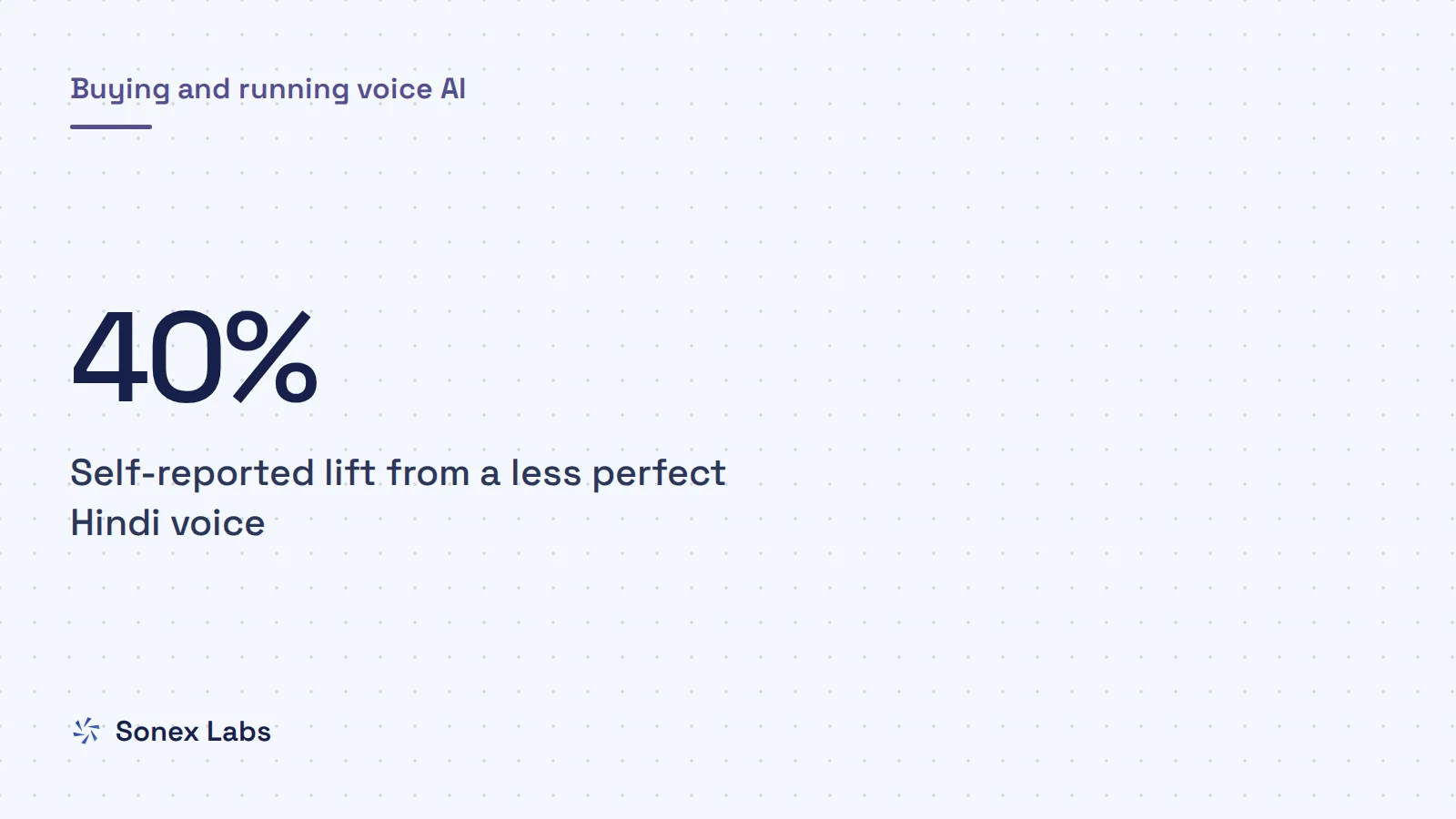
The team then added light background noise and pauses, and he reported that conversion went up 40%. That is the whole of the evidence. The post gives no sample size, no control group and no definition of conversion, and two things changed at once, so nobody can tell whether the noise or the pauses mattered. Read it as a hint worth testing, not as a result to plan around.
The hint is plausible for a simple reason. Doordarshan newsreaders, government announcements and IVR menus all use a formal, careful Hindi that almost nobody uses on a phone call with a stranger. When a call opens in that register, a listener files it with recorded announcements, and Indian phone users have learned to hang up on those. How quickly they do is the subject of the guide to whether customers hang up on AI calls in India.
Why formal Hindi sounds like a broadcast, not a person
Hindi has a wide gap between its written and spoken registers, and most AI scripts land on the written side. A register is the level of formality a speaker chooses for a setting, and written Hindi leans on Sanskrit-derived words that spoken Hindi replaces with everyday or English ones. Scripts are often translated from English by a model or an agency, and translation pulls towards formal vocabulary: सूचित, देय तिथि, भुगतान सुनिश्चित करें. Each word is correct, but together they sound like a bank notice read aloud.
A good TTS voice makes this worse, not better. It reads the formal script exactly as written, with even pacing and no hesitation, which is what a trained announcer does. So when a Hindi AI voice sounds robotic, the cause is usually the text: formal translated Hindi, long sentences, no punctuation for pauses and numbers read in the wrong form all sound mechanical, even in a good voice, and an 8 kHz phone line makes small problems louder.
Listen to the two reminders below. They carry the same information. The first is the register many voice bots ship with, and the second is how a collections agent in Delhi or Lucknow might say it.
नमस्कार। आपको सूचित किया जाता है कि आपकी मासिक किस्त की देय तिथि निकट है। कृपया समय पर भुगतान सुनिश्चित करें, ताकि आपकी सेवाएँ बिना रुकावट जारी रहें। धन्यवाद।
नमस्ते, आपकी EMI पाँच तारीख को है। आज पेमेंट कर लेंगे तो कोई लेट फीस नहीं लगेगी।
Writing spoken Hindi: one clause, everyday words
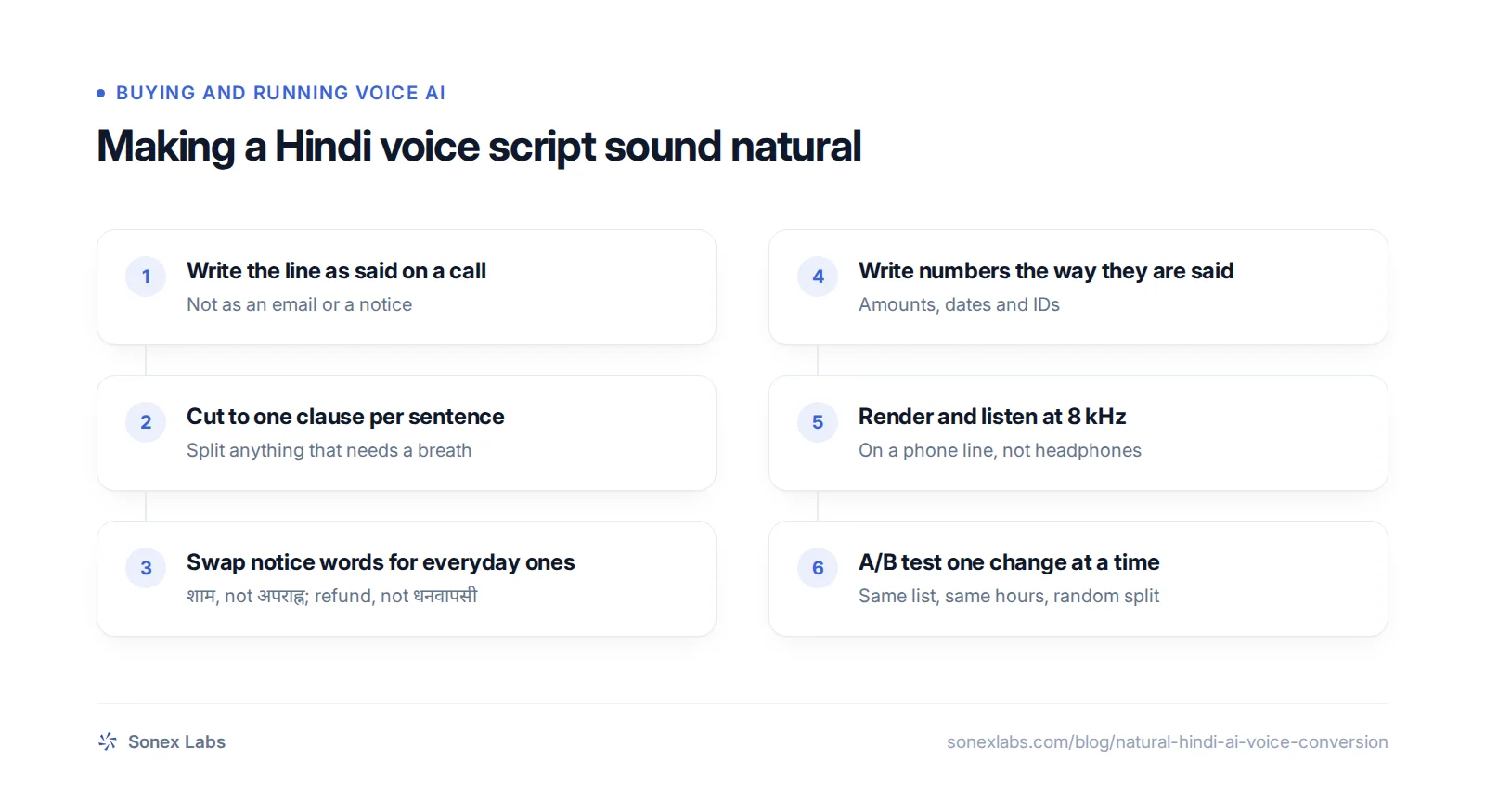
We apply one rule when we write the reference sentences our own voices are built and checked on: every sentence is short, one spoken clause, in the modern register people use out loud. The same rule works for agent scripts. It came from a plain observation about stiff customer-service Hindi: nobody talks like that any more.
Mixing in English is part of the spoken register for many callers. Urban callers usually say order, refund and EMI rather than their formal Hindi equivalents, and a script that keeps those nouns sounds closer to how they talk; the guide to Hinglish text to speech covers how a voice handles the mix. Older callers or callers in smaller towns may prefer more Hindi, and no public data settles the balance for every audience, so test both on your own calling list.
In practice the rule means avoiding a handful of patterns that mark a script as written rather than spoken:
- Formal requests such as कृपया and the दीजिए or कीजिए forms; ask a polite question instead ("आज कर लेंगे?").
- Bookish connectors and phrases: ताकि, जल्द से जल्द, बिना रुकावट, निर्धारित, उपस्थित हों.
- Stacking a greeting, the message, a reason clause and धन्यवाद into one sentence.
- Sanskrit-heavy words where an everyday one exists: अपराह्न for शाम, धनवापसी for refund.
- Long sentences; if you need a breath to read it, split it with a full stop.
आपका अपॉइंटमेंट कल अपराह्न चार बजे निर्धारित किया गया है। कृपया निर्धारित समय से पंद्रह मिनट पूर्व उपस्थित हों।
कल शाम चार बजे का अपॉइंटमेंट पक्का है। बस पंद्रह मिनट पहले आ जाइए।
Pauses, small words and background noise
Pauses and small spoken words are the cheapest way to sound less like a broadcast, and you control them in the text. A comma or full stop gives a pause. Words like जी, हाँ and अच्छा, used where a person would use them, make a line sound like part of a conversation. They do the job that filler sounds in voice agents do, but in the caller's language.
Background noise is a different matter, and vendors disagree about it. Some platforms offer it as a setting: Retell's agent API, for example, has an ambient_sound option with values such as call-center and coffee-shop, described as making the experience "more realistic" (Retell API reference). The founder above added it too. The case against is practical and ethical: noise makes speech harder to hear on an 8 kHz phone line, and it implies the caller is talking to someone in a busy office.
Our view is to be wary of any change whose effect depends on the caller not knowing they are talking to an AI. A natural script and well-placed pauses help a voice that is honest about what it is. Background noise mainly helps a voice pass for something it is not.
जी, एक सेकंड... हाँ, मिल गया। आपका अपॉइंटमेंट कल शाम चार बजे का है।
A natural voice should still say it is an AI
Sounding natural and claiming to be human are different things, and only the first is acceptable. The disclosure debate is real. On Quora, one answer argued that if an agent identifies itself upfront, many people will hang up at once, while another argued that saying it upfront keeps people from hanging up angry later (Quora). Both are opinions, not data.
The law is clearer than the debate. Since 20 February 2026, India's IT Rules have required platforms to block synthetic content that misrepresents a real person's identity or voice in a way likely to deceive, and to label lawful synthetic audio (G.S.R. 120(E); Business Today). Whether those rules bind a business placing its own AI calls is unsettled, but the ordinary laws on cheating and impersonation apply either way. The guide to AI voice labelling rules in India sets out what is mandatory and what is open.
For calls to people in the EU, Article 50 of the AI Act requires that people be told they are interacting with an AI system unless that is obvious, and it has applied since 2 August 2026 (EU AI Act Article 50). In practice, say early in the call that the caller is speaking to an AI assistant, answer truthfully if asked, and offer a person when the caller wants one. The AI disclosure scripts have opening lines in Hindi and other languages.
Getting the details right matters more than the voice
A natural register helps, but getting the facts of the call right helps more. One builder who had shipped Hindi-English support put it this way on r/TextToSpeech: "customers forgive a slightly synthetic voice, they do not forgive the agent butchering their order id" (r/TextToSpeech).
A fintech team made the same point in its postmortem. An amount read as a long English chunk inside Hindi, and a reference number read as one giant number, sank its first pilot, and clean number readback changed the results (r/AI_Agents, August 2026). So the order of work is numbers, names and IDs first, then the script's register, then the voice; the Hindi text-to-speech voices are worth comparing only once the script is settled.
Testing whether a natural script converts better
If you test whether a more natural script converts better, change one thing at a time. Run the old and new scripts on randomly split halves of the same calling list, at the same hours, and compare answered calls, completed calls and the outcome you care about. The X anecdote changed noise and pauses together, so it cannot say which one helped; your test can.
Before the live test, render both versions with the same voice and listen to them over a phone line at 8 kHz, not on headphones. Ask two or three people who did not write the script which one sounds like a person. The flow below shows the order we would follow.
Sources
- X: founder's post on AI call hang-ups and a "Flawless Hindi" voice, Apr 2026 (self-reported)Secondary
- Quora: Should AI voice agents always disclose that they're not human?Secondary
- r/TextToSpeech: Why do almost all TTS APIs butcher Hinglish?, Aug 2026Secondary
- r/AI_Agents: Shipped a Hindi-English voice agent for a fintech, Aug 2026Secondary
- Gazette of India: IT (Intermediary Guidelines and Digital Media Ethics Code) Amendment Rules, 2026, G.S.R. 120(E)Official
- Business Today: Govt tightens rules on AI-generated content, mandates labels, 10 Feb 2026Secondary
- EU AI Act Article 50: transparency obligations (AI Act Service Desk, European Commission)Official
- Retell AI API reference: create agent (ambient_sound)Official
Change log: 24 Oct 2026, First published. Later the same day, rewritten as one continuous guide: made the IT Rules statement precise (what platforms must block and label, and that coverage of a business's own calls is unsettled), added the EU Article 50 date, Retell's ambient-sound setting as the opposing practice, and a disclosure section; takeaways, steps, checklist and FAQs folded into the body. No Hindi text changed