On this page
Why Hinglish voiceovers sound wrong
Creators describe the same four problems again and again. The first is a voice that does not sound Indian at all: a creator looking for a free Hindi voice for YouTube found most free tools "too robotic" or with a very Western accent (r/aitubers). The second is accent drift inside one sentence. A developer who tried many open-source models found they sounded right in pure Hindi or pure English, but gave a "north east indian accent in hinglish text" (r/LocalLLaMA).
The third problem is numbers. A team that built a Hindi-English voice agent for a fintech wrote that its first agent read an amount due as "one thousand four hundred ninety nine rupees" in a jarring full-English chunk in the middle of a Hindi sentence, and read a reference number as one giant number instead of digit by digit (r/AI_Agents). A commenter elsewhere called number reading inside mixed-language text the hardest part, because the engine has to choose between Hindi words, English words and single digits from context, and most engines just guess (r/TextToSpeech).
The fourth is skipped or garbled words, reported mostly with open models run at home. One user of an open Indic model found it skipping many Hindi words, especially in long paragraphs (Hugging Face discussion).
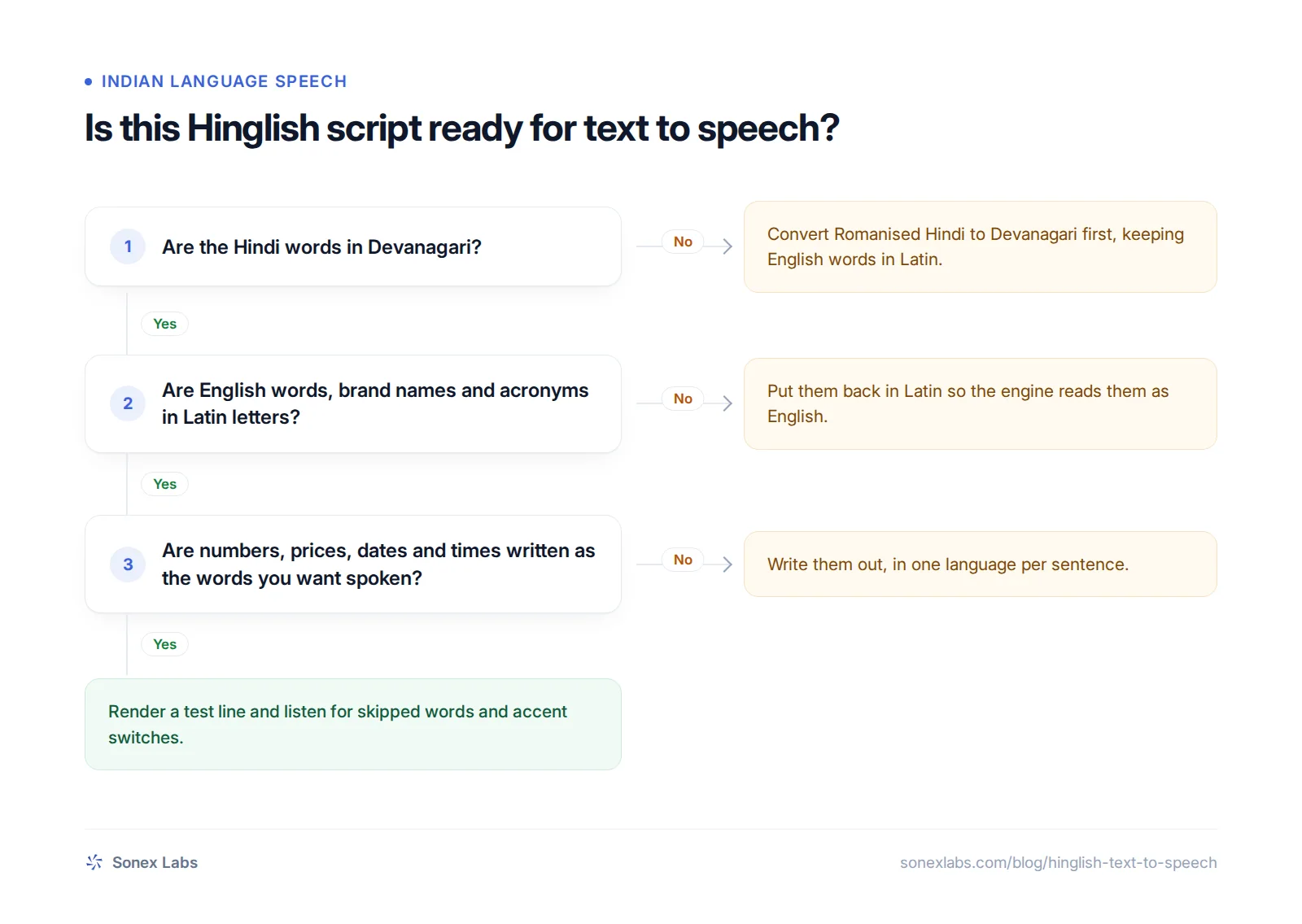
Three of the four are partly or wholly in your control. A TTS engine has to turn every digit, date, symbol and English word into sounds, and when the text leaves that choice open, the engine's default may not match what your audience says. The sections below take numbers, dates and English words in turn, each with a before-and-after pair read by the same voice, Shruti, the Hinglish voice on our site, so the only thing that changes is the text.
Write numbers and prices the way you want them said
Digits are the most common cause of a Hinglish line that sounds broken, because a number has several correct spoken forms and the engine must pick one. In Pāṇini, our text-to-speech engine, a text step turns digits into English number words before the voice speaks, whatever the language of the sentence. It does this on purpose, because many speakers and agents switch languages mid-sentence, but in a Hindi narration it produces exactly the English chunk the fintech team complained about: ₹1,49,900 becomes "one lakh forty nine thousand nine hundred rupees", and 1.5 लाख becomes "one point five लाख".
The fix is to decide how the number should sound and write that. For Hindi narration, write the amount in Hindi words: एक लाख उनचास हज़ार नौ सौ रुपये, and डेढ़ लाख for 1.5 lakh. If your audience says prices in English, as many urban viewers do ("sirf nine ninety-nine"), write the English words in Latin letters instead. Either way, keep one language for a number inside one sentence. Long digit strings are a different case: six or more digits with no currency, such as an OTP or a PIN code, are read digit by digit, and phone numbers are too.
The two lines below are the same sentence, first with digits and then with the amounts written as Hindi words. Our guide to how Hindi TTS should read rupees, lakh and crore covers amounts, OTPs and phone numbers rule by rule.
इस phone की कीमत ₹1,49,900 है, यानी लगभग 1.5 लाख।
इस phone की कीमत एक लाख उनचास हज़ार नौ सौ रुपये है, यानी लगभग डेढ़ लाख।
Dates and times: one language per sentence
Dates and clock times follow the same logic, with one extra twist: spoken Hindi has forms that digits can never produce. Written as 31/12/2026, a date comes out as "thirty first December two thousand twenty six", and 10:30 as "ten thirty", correct English dropped into a Hindi sentence. A Hindi speaker would say इकतीस दिसंबर and साढ़े दस बजे, and Hindi's quarter-hour words, सवा, साढ़े and पौने, exist only if you write them.
In practice, write dates and times in words in the language of the sentence around them. Leave out the year unless it matters, since a narrator rarely says it, and add सुबह, दोपहर or शाम rather than relying on a 24-hour clock.
ये offer 31/12/2026 तक है, और sale 10:30 बजे शुरू होगी।
ये offer इकतीस दिसंबर तक है, और sale सुबह साढ़े दस बजे शुरू होगी।
Brand names and English words stay in Latin letters
For the English inside Hinglish, the most reliable script choice is mixed script: Hindi words in Devanagari, and English words, brand names and acronyms in Latin letters, as in "आज के video में OnePlus Nord का camera test करेंगे". Each word then arrives in the script of its own language, which tells the engine, word by word, which set of sounds to use.
Spelling English words in Devanagari removes that signal. A word like वीडियो is common enough to be read well either way, but brand names and product names spelt in Devanagari are read as if they were Hindi words, and acronyms written as एसबीआई or केवाईसी leave the engine to guess. Writing everything in Roman letters, the way most people type Hinglish on a phone, is ambiguous in the other direction: "main" can be मैं or the English word main, and "nahi", "nahin" and "nhi" are the same word. Pāṇini reads Devanagari Hindi with English in Latin; it is not built to read Hindi typed in Roman letters. The playground on our Hinglish text to speech page converts Romanised Hindi to Devanagari with Vyas, our language model, before speaking, but the API speaks exactly what you send, so convert first if your script is in Roman letters.
The pair below is a typical YouTube intro, first written entirely in Devanagari and then in mixed script. The second line is also the test for accent drift described next.
Accent drift: the part that depends on the voice
Accent drift happens when a voice handles Hindi and English as separate sound systems and switches between them at every language boundary, so the English words come out in a different accent, or with a small stumble, from the Hindi around them. The fintech team above described TTS that visibly paused or changed accent at the Hindi-English boundary, and noted that on a call about money any oddity like that sounds like a scam robot.
Script choices reduce drift but cannot remove it; the voice decides. What helps is one voice that speaks both languages with an Indian accent, so English words keep the same speaker's sound. Pāṇini voices read mixed-language text such as Hinglish in one voice, and the mixed-script sample below puts a full English phrase, "welcome back to the channel", in the middle of Hindi narration. Listen for whether the English keeps the accent of the Hindi around it and whether there is a pause at either switch. Judge any voice, ours included, by listening to your own lines rather than by a vendor's description.
नमस्ते दोस्तों, वेलकम बैक टू द चैनल। आज के वीडियो में वनप्लस नॉर्ड का कैमरा टेस्ट करेंगे, लिंक डिस्क्रिप्शन में है।
नमस्ते दोस्तों, welcome back to the channel. आज के video में OnePlus Nord का camera test करेंगे, link description में है।
Check every render before you publish
Even with a clean script, listen to every render with the script in front of you before it goes into a video. You are listening for four things: a skipped or garbled word, a number or date read in the wrong language, an English word or brand name read with Hindi sounds, and a change of accent or a pause at a language switch. Skipped words are easiest to miss in long paragraphs, so render a long script in paragraph-sized pieces and keep sentences to one spoken clause each.
The lines below are a starting test script in the style of Hindi YouTube narration. They keep digits, dates and brand names on purpose, so you can hear how any text-to-speech engine handles them before you rewrite them. Run them through every voice you are considering, then rewrite the ones that fail using the rules above and render them again.
Sonex sells Pāṇini, so treat this test as a way to check us and every other option on your own lines, not as a ranking. Our article on timing AI narration explains why writing numbers out also makes a script's length easier to predict.
आज की video में बात करेंगे iPhone 17 के camera की।
इस course की fees सिर्फ़ ₹4,999 है, offer 15 नवंबर तक है।
Subscribe कर दो, और bell icon दबाना मत भूलना।
ये trick मैंने 2019 में Delhi में सीखी थी।
Amazon पे sale रात 12 बजे शुरू होगी।
UPI से payment करो तो 10% cashback मिलेगा।
मेरा Instagram handle description में है।
अगले part में बताऊँगा कि YouTube Shorts से पैसे कैसे कमाएँ।Questions people ask
Per character, not with Pāṇini: it charges $0.03125 per 1,000 characters for every language. Per minute, script choice matters a little. In our renders the same lines typed in Roman letters needed 14% more characters than in Devanagari, and cost about 6% more per finished minute with the same voice. Other providers price by plan, voice or language.
Sources
- r/aitubers: Looking for a free text-to-speech for Hindi with an Indian accent, 10 Nov 2025Secondary
- r/LocalLLaMA: Best open source Hinglish (Hindi+English) TTS, 8 Feb 2026Secondary
- r/AI_Agents: Shipped a Hindi-English voice agent for a fintech, 7 Aug 2026Secondary
- r/TextToSpeech: Why do almost all TTS APIs butcher Hinglish?, 5 Aug 2026Secondary
- Hugging Face, ai4bharat/IndicF5 discussion 39: Hindi TTS skipping words during generationSecondary