On this page
- Why India now requires labels on AI content
- Do India's AI-labelling rules apply to AI phone calls?
- When an AI voice counts as synthetic content
- What the IT Rules require for AI audio, and what they ban
- Who has to add the label: the platform or the business calling
- What an AI call disclosure should say
- Two other rulebooks: TRAI and ASCI
- Key dates
- Sources
Why India now requires labels on AI content
MeitY (the Ministry of Electronics and Information Technology) writes the IT Rules, the rulebook for online platforms. Explaining its 2026 amendment, it said advances in AI had made highly realistic synthetic audio and video, including deepfakes, much easier to make. It listed the harms it had in mind: misinformation, impersonation and identity fraud, non-consensual intimate imagery, and extortion (MeitY FAQ on the 2026 amendment, question 2).
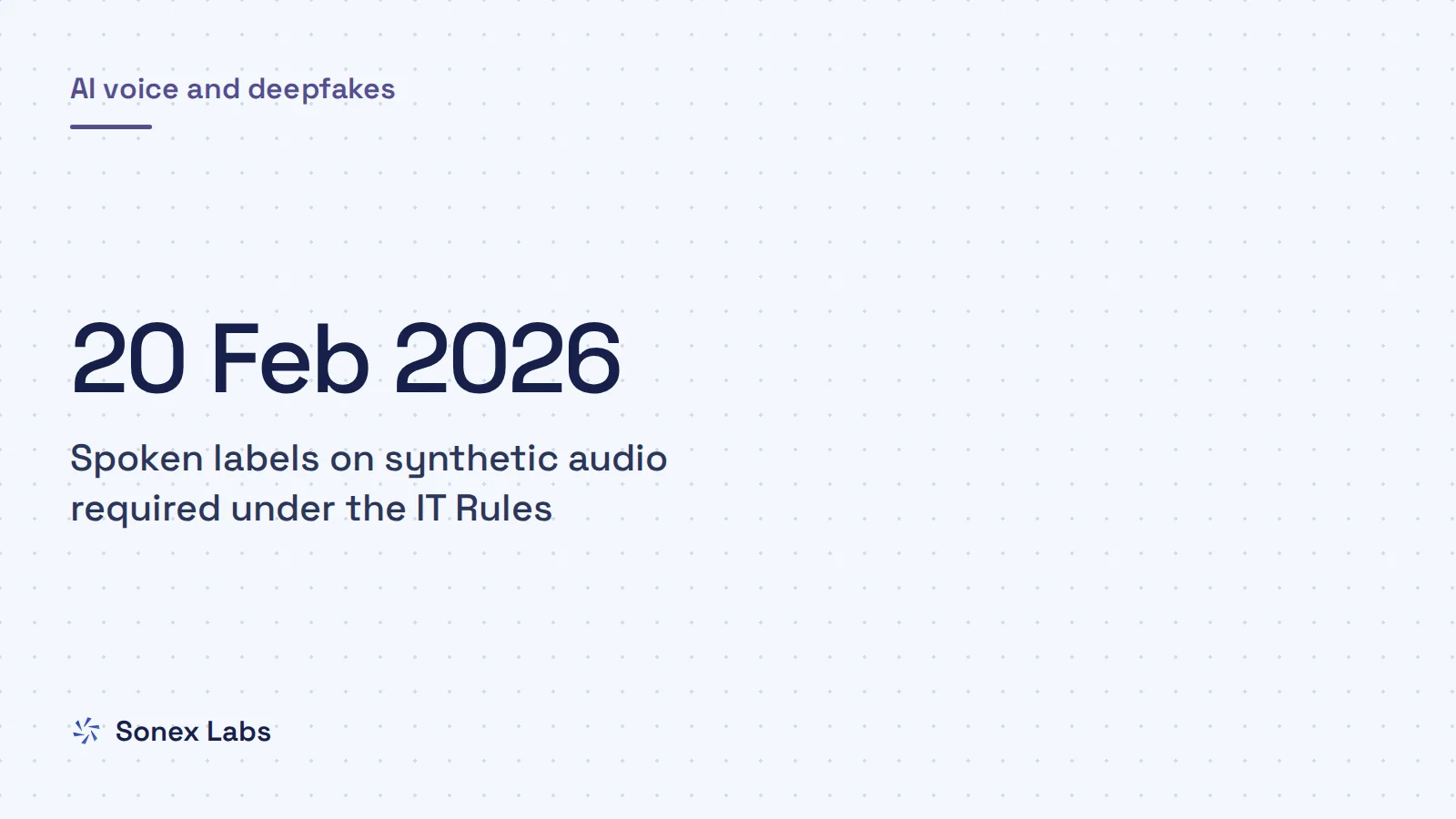
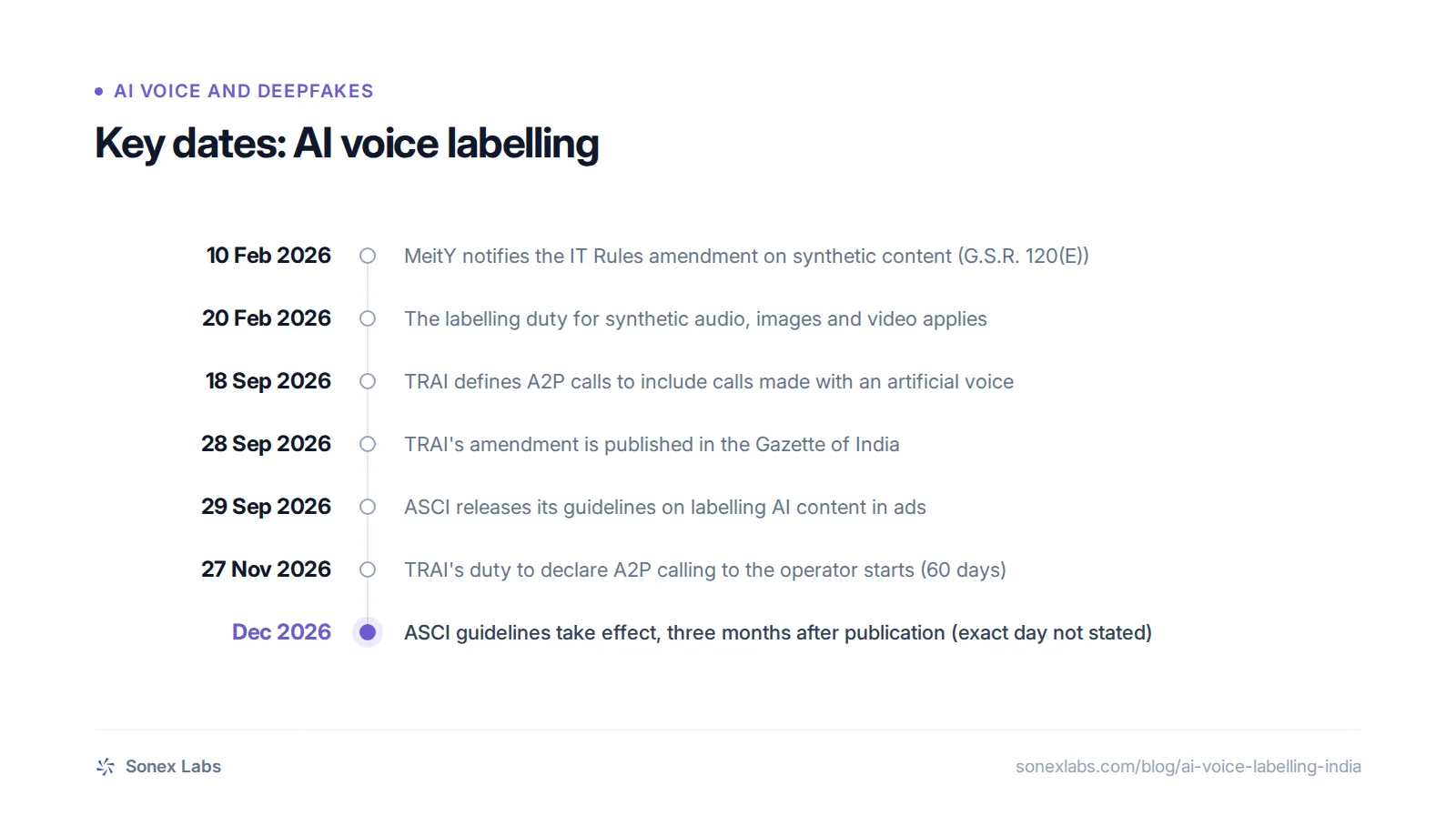
The final rule is lighter than first proposed. A draft published on 22 October 2025 proposed a label covering 10% of the screen, or the first 10% of an audio clip (MeitY explanatory note). The final text, the Information Technology (Intermediary Guidelines and Digital Media Ethics Code) Amendment Rules, 2026, dropped the percentage. MeitY notified it on 10 February 2026, and it has applied since 20 February 2026 (G.S.R. 120(E)).
The rules may change again. MeitY published further draft amendments on 30 March 2026, and on 21 April 2026 added a proposal that labels on visual content stay on screen throughout (MeitY notice, 21 April 2026). As of 24 October 2026 we found no notification making them final. MeitY also issued an advisory on 8 October 2026 asking platforms to label manipulated and synthetic content, as reported by MediaNama; we have not seen its text.
Do India's AI-labelling rules apply to AI phone calls?
Not clearly. The labelling duty falls on platforms that offer synthetic-audio tools, and the rules never mention phone calls or put the duty on the business placing a call (rule 3(3)). A bank whose AI agent rings a customer is not obviously the kind of service the rules were written for.
Three things are clear, though. A realistic AI voice can count as synthetically generated information, the rules' term for AI-made content that seems real. Using a cloned voice to deceive someone about who is speaking is banned outright. And TRAI, the telecom regulator, now treats calls made with an artificial voice as automated calls with their own rules.
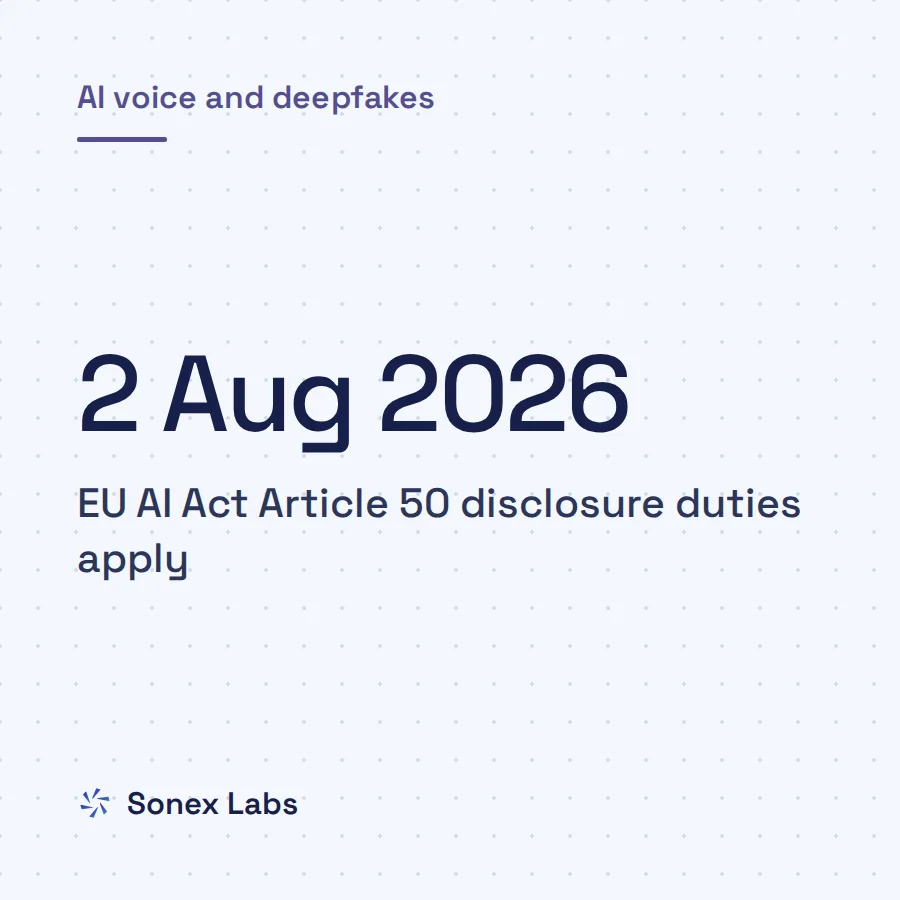
That leaves a simple low-risk course: say at the very start of each call that the caller is an AI voice. It takes a few seconds and matches what the rules ask for audio. India is also moving the same way as other markets. The EU AI Act's disclosure rule for AI voice agents, for example, has required since 2 August 2026 that an AI talking to people in the EU tells them so when the conversation starts.
When an AI voice counts as synthetic content
Synthetically generated information is audio, images or video that a computer has made or changed so that it seems real and could be taken for a real person or event (rule 2(1)(wa)). The test is whether a listener could mistake it for a natural person, and a human-sounding AI calling voice usually could.
MeitY's FAQ gives a direct example: a synthetic voice, made by text-to-speech or voice cloning, that reproduces a natural person's voice with realistic intonation and tone (question 28). Its labelling example is an audio announcement generated with text-to-speech, which it says should open with a line such as "This audio is synthetically generated" (question 22).
Some things are left out. Noise reduction, transcription and translation that keep the meaning are not synthetic content (proviso to rule 2(1)(wa)). Plain text is not covered either. MeitY's FAQ says a chatbot's written reply is outside the definition (question 8), but a voice agent that reads the same reply aloud in a human-sounding voice can fall within it. A clearly robotic voice that nobody would mistake for a person may also fall outside, though the rules do not say where that line sits.
What the IT Rules require for AI audio, and what they ban
Once audio counts as synthetic, the rules ask for a spoken label at the start, plus a technical mark where that is feasible. For audio, the label must be "a prominently prefixed audio disclosure" that lets the listener identify the content as synthetic straight away (IT Rules, 2021 as amended, rule 3(3)(a)(ii)). The content must also carry permanent metadata, meaning data embedded in the file, or another mark showing where it came from, to the extent technically feasible.
Some uses are banned however they are labelled, and deceptive impersonation heads the list. Platforms must block synthetic content that falsely portrays a real person by misrepresenting their identity or voice in a way likely to deceive (rule 3(3)(a)(i)(IV)). MeitY's FAQ gives two examples that could have been written for phones: voice-cloned emergency-scam calls, and cloned voices of senior officers giving false instructions.
A label does not cure this, because the deception itself is the problem. That covers an AI voice that poses as a named real person who did not agree, or one that tells a customer it is human. ASCI's advertising guidelines take the same line: deepfakes and a person's likeness used without consent are prohibited even with a label.
India has no single deepfake act. The 2026 amendment makes platforms block deceptive synthetic content, label lawful synthetic content and remove unlawful content quickly. The existing laws on cheating, impersonation and identity theft apply to anyone who misuses a cloned voice. A platform that breaks the rules loses its legal shield, meaning the protection the IT Act gives it for content its users post (IT Act section 79(1), applied by rule 7). The platform duties in brief:
- Audio label: a spoken disclosure at the start, not buried at the end.
- Provenance: permanent metadata with a unique identifier for the tool used, where technically feasible.
- No stripping: the platform must not let anyone change, hide or remove the label or metadata (rule 3(3)(b)).
- User warning: platforms offering synthetic-voice tools must warn users that misuse can attract penalties (rule 3(1)(ca)).
- Faster takedown: unlawful content must come down within 3 hours of an order from a court or an authorised government officer, down from 36 hours (rule 3(1)(d)).
Who has to add the label: the platform or the business calling
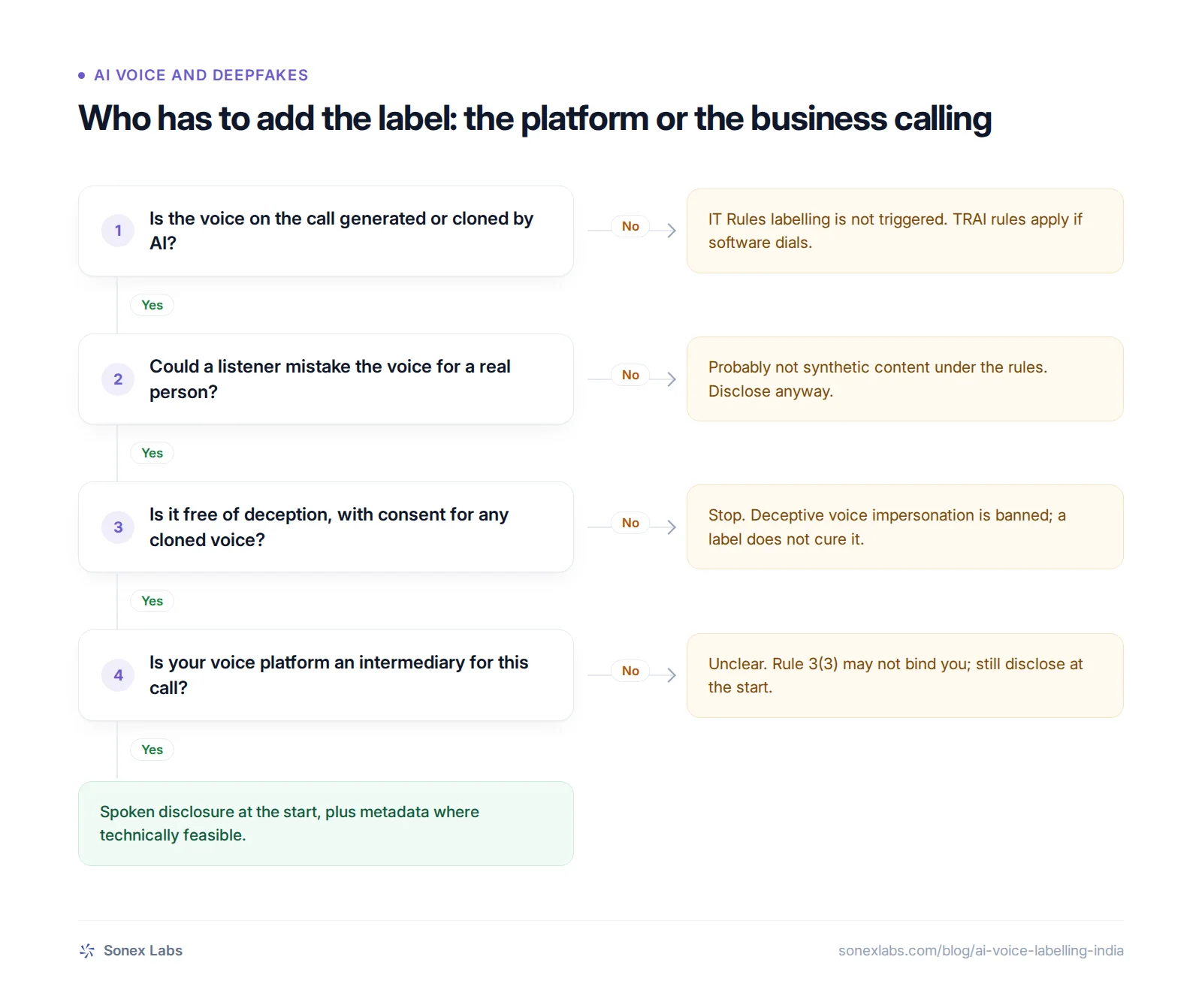
All of these duties sit with intermediaries, and nobody has yet said whether a voice-AI platform is one. An intermediary is anyone who receives, stores or sends electronic records for someone else, or provides a service for those records. Telecom operators are named in the definition (IT Act, section 2(1)(w)).
MeitY's FAQ says rule 3(3) covers intermediaries offering voice synthesis or voice cloning tools, and services that help publish or spread synthetic content (question 20). A platform that turns a client's script into a synthetic voice and plays it to the person on the line looks close to that. But the FAQ is not binding, and the rules were written for content platforms, not live phone calls. Attaching metadata to an ordinary phone call is also hard, which the technically-feasible wording may cover.
The largest platforms carry an extra duty. Significant social media intermediaries, meaning platforms with at least 50 lakh registered users in India, must ask uploaders whether content is synthetic, check the answer and show a label (rule 4(1A)). Separately, YouTube's own policy asks creators to disclose realistic AI-generated or altered content when they upload it.
The business placing the call, such as a bank or an insurer, is the one using the tool. It is not obviously an intermediary for its own calls, so rule 3(3) may not bind it directly. That does not make deception lawful, because the laws on cheating and impersonation still apply to it. The chart follows the rule text and these open questions; it is a working aid, not a legal ruling, and every path through it ends with a disclosure at the start of the call.
What an AI call disclosure should say
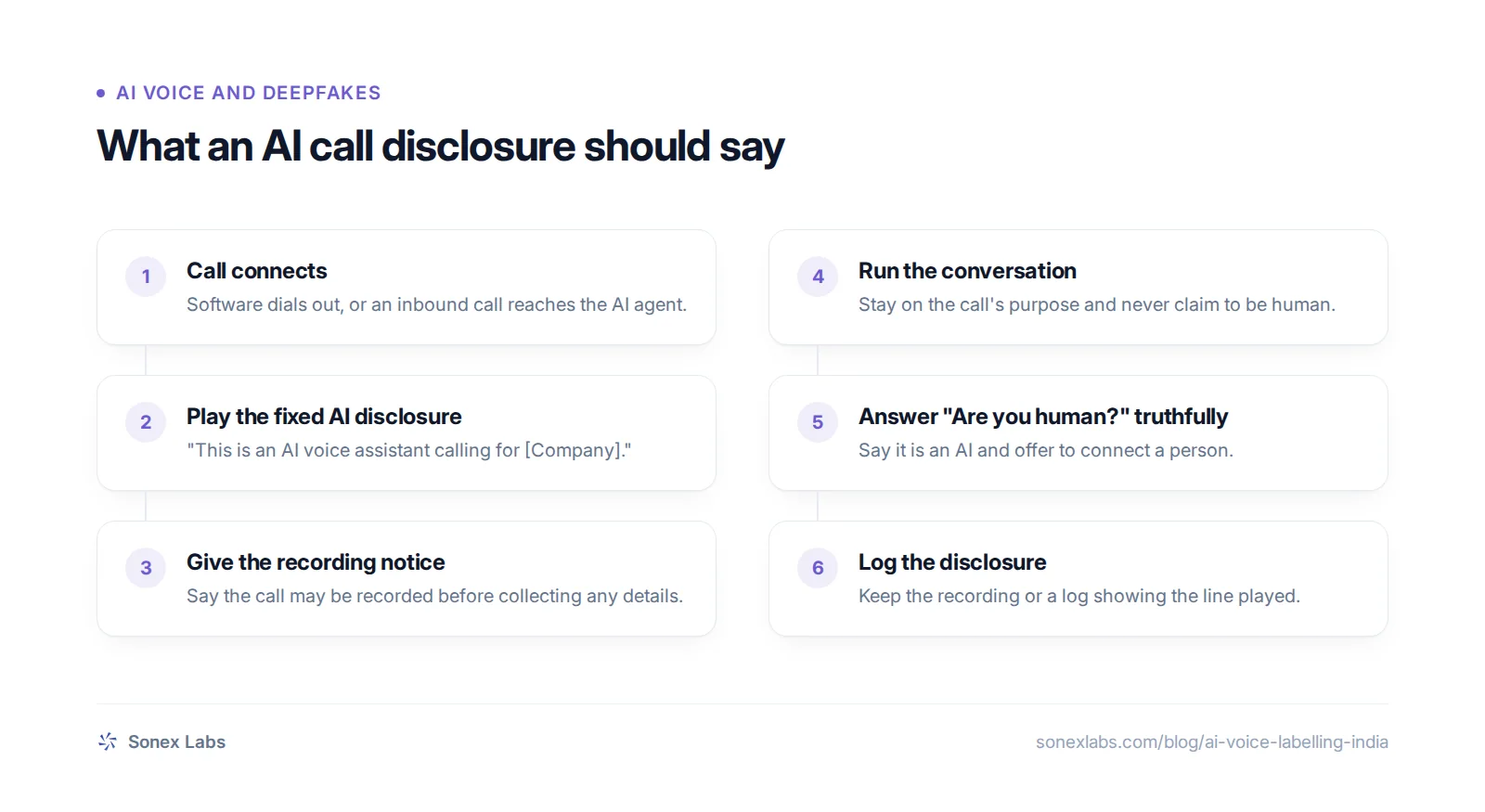
If you disclose, say it first, say it plainly and say who you are calling for. The rule asks for a prefixed audio disclosure, so it belongs in the opening line, before any sales or collection message. MeitY's own example is accurate but stiff for a live conversation, and a line that names the company does more to reassure a listener.
Two design choices make the disclosure hold up. It should be fixed text or a fixed recording that the model cannot rephrase or skip, in every language the agent speaks, so that no campaign setting or language switch can drop it. And there should be proof it played: on Sonex, for example, AI telecaller calls are kept as recordings and transcripts, which show what each caller heard.
If a caller asks whether they are talking to a person, the agent should answer truthfully every time and be able to hand over. On Sonex that is a live transfer to a human agent. A cloned voice of a real person needs that person's written consent before it is used, covering AI use, the purposes and the disclosure wording. The voice cloning law in India guide explains the personality-rights cases behind that. The lines below are a starting point, and the AI disclosure scripts have versions in several languages.
- Opening of any AI call: "Hello, this is an AI voice assistant calling on behalf of [Company]. This call may be recorded."
- Cloned voice of a real person, with consent: "This message uses an AI-generated version of [Name]'s voice, created with their permission, on behalf of [Company]."
- When asked "Am I talking to a human?": "No, I'm an AI assistant for [Company]. I can connect you to a person if you'd like."
- Pre-recorded synthetic announcement: "This is an automated, AI-generated message from [Company]."
Two other rulebooks: TRAI and ASCI
The IT Rules are not the only text that reaches an AI call. The telecom regulator governs how it is dialled, and the advertising self-regulator may govern what it says if it sells something.
TRAI's rules for calls made with an artificial voice
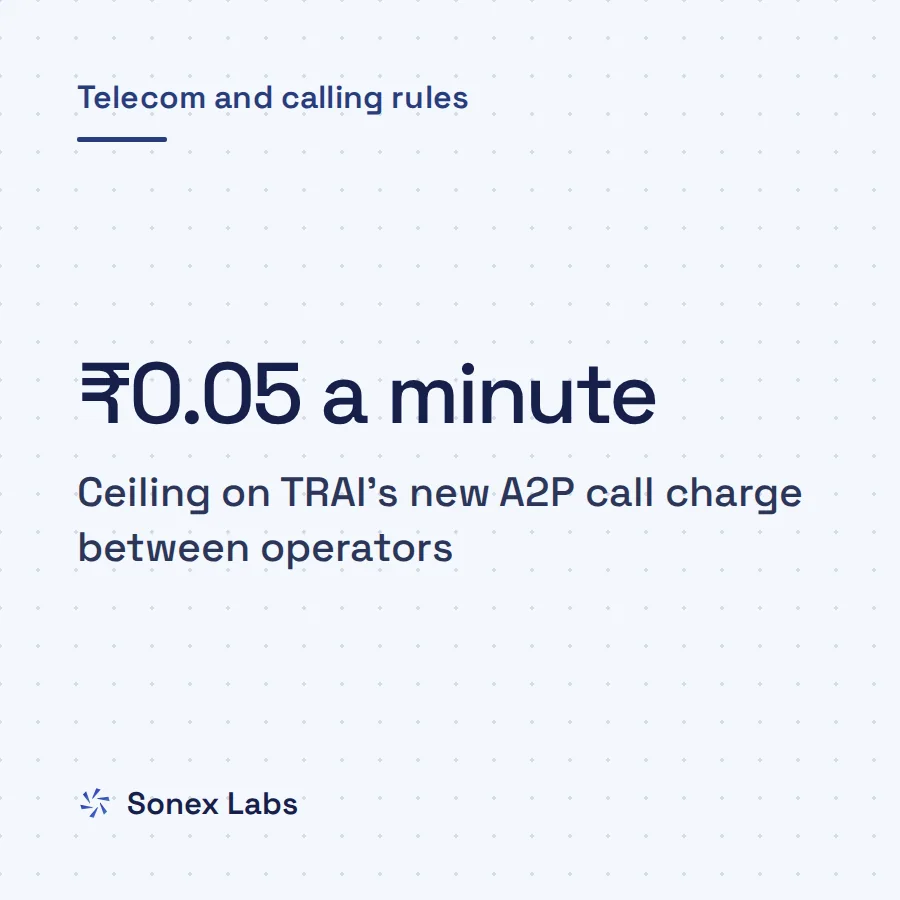
TRAI's Third Amendment to the TCCCPR, its regulations on commercial calls and messages, was notified on 18 September 2026. It defines an A2P (application-to-person) call as one started by software without direct human dialling, including "pre-recorded/ artificial voice technologies" (new regulation 2(ea), TCCCPR Third Amendment).
Every sender must declare its A2P calling and its calling number ranges to its telecom operator in advance, or the calls are treated as spam (new regulation 4). That duty starts on 27 November 2026, 60 days after the regulations were published in the Gazette on 28 September 2026 (Gazette of India, Extraordinary, Part III, Section 4, CG-DL-E-28092026-276548). It is a declaration to the operator, not a spoken notice to the person called, and the text we read does not require an on-call AI announcement. TRAI's 2026 rules for AI and automated calls cover the rest.
ASCI's AI-labelling guidelines and sales calls
The Advertising Standards Council of India (ASCI), the ad industry's self-regulator, released its Guidelines for Responsible Labelling of Synthetically Generated Content in Advertising on 29 September 2026 (ASCI guidelines). They take effect three months after publication. The guidelines are dated 17 September 2026 and do not say which date counts, so expect them to apply from mid to late December 2026.
A label is mandatory where synthetic content could materially influence a buying decision and leaving the label out would mislead. One listed case is replicating a real person's likeness or voice, even with consent, for personalised messaging (clause 2B). Synthetic influencers and brand ambassadors need a label too (clause 2A). Suggested labels include "Audio/Video created using AI", or your own accurate wording (clause 4).
The guidelines never mention phone calls or telemarketing. The ASCI Code defines an advertisement as a paid-for communication "addressed to the public or a section of it" that promotes goods or services (The ASCI Code). That wording does not settle whether a one-to-one call counts, so treating a sales call as an ad is the cautious reading. Sales calls also have to avoid the tricks covered in the guide to dark patterns in sales and service calls.
| Group | Examples in the guidelines | What it means for an AI sales call |
|---|---|---|
| Prohibited | Fake endorsements, deepfakes, a person's likeness without consent | Never clone a real person's voice without written consent |
| Label required | Synthetic influencers and ambassadors; a real person's voice replicated with consent for personalised messages | Disclose that the voice is AI, especially a cloned founder or celebrity voice |
| No label needed | Noise reduction, ambient music, accurate translations, ad copy written with AI | Cleaning up a human recording does not need a label |
Key dates
Sources
- Gazette of India: G.S.R. 120(E), 10 Feb 2026, IT Amendment Rules, 2026 (in force 20 Feb 2026)Official
- MeitY: IT (Intermediary Guidelines and Digital Media Ethics Code) Rules, 2021, consolidated as on 10.02.2026Official
- MeitY: FAQs on the IT Amendment Rules, 2026 (10 Feb 2026)Official
- MeitY: explanatory note on the draft amendment on synthetically generated information, 22 Oct 2025Official
- MeitY: draft IT (Intermediary Guidelines and Digital Media Ethics Code) Second Amendment Rules, March 2026Official
- MeitY: notice of 21 Apr 2026 extending consultation on the March 2026 draftOfficial
- MediaNama: YouTube Music AI labels and India's synthetic audio rules (mentions the 8 Oct 2026 MeitY advisory), Oct 2026Secondary
- MeitY: S.O. 942(E), 25 Feb 2021, threshold for significant social media intermediariesOfficial
- Information Technology Act, 2000, as amended (India Code)Official
- TRAI: TCCCPR (Third Amendment) Regulations, 2026, 18 Sep 2026Official
- Gazette of India: TCCCPR (Third Amendment) Regulations, 2026, published 28 Sep 2026 (CG-DL-E-28092026-276548)Official
- ASCI: Guidelines for Responsible Labelling of Synthetically Generated Content in Advertising, Sep 2026Official
- ASCI: press release on the labelling guidelines, 29 Sep 2026Official
- ASCI: Draft guidelines for labelling synthetically generated content in advertising, 8 May 2026Official
- ASCI: The ASCI Code (definition of advertisement)Official
- YouTube Help: Disclosing use of GenAI contentSecondary
- Fox Mandal: ASCI issues guidelines for labelling of AI content in advertisingSecondary
- Hogan Lovells: India introduces mandatory labelling for AI and 3-hour takedownSecondary
Change log: 24 Oct 2026, Dated the March 2026 draft amendments and the October 2026 advisory; hedged the ASCI and TRAI start dates; exact TRAI start dates from the Gazette (published 28 Sep 2026). Later the same day, rewritten as one continuous guide: added why MeitY made the change (its FAQ's stated reasons) and the EU comparison; the takeaways, steps, checklist and FAQs (deepfake law, YouTube, text chatbots) were folded into the body · 23 Oct 2026, First published