On this page
Is call recording legal in India?
Yes, if you are one of the people on the call. No Indian law makes it an offence to record your own call, whether you are a person using a phone app or a business recording its customer line. No law requires every person on the call to agree first either. What decides the answer is who does the recording, because the law treats recording a call you are on very differently from intercepting a call between other people.
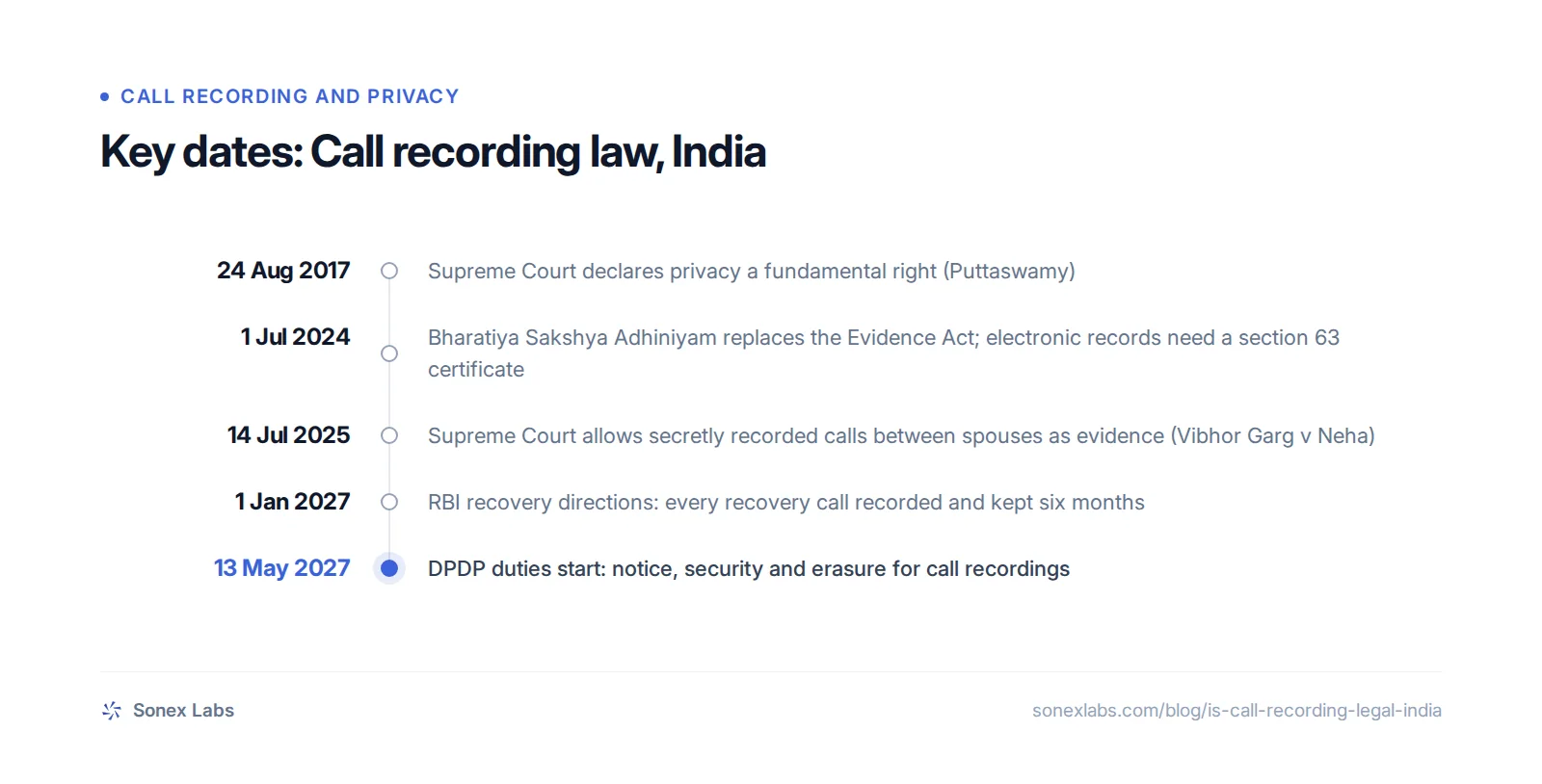
The reason the law looks like this is historical. India's telephone rules grew out of the Indian Telegraph Act, 1885, whose tapping provision dealt with the government's power to intercept messages. It said nothing about what callers could do with their own conversations. Privacy was confirmed as a fundamental right only in 2017, and India's general data protection law will apply its main duties only from 13 May 2027, so courts have answered the practical questions in between.
Being allowed to record does not make every use of a recording lawful. Four sets of rules limit how a recording is made, shared and stored. The first is the right to privacy under Article 21 of the Constitution, and the second is the Information Technology (IT) Act, 2000, which protects sensitive personal data.
The third is the Digital Personal Data Protection (DPDP) Act, 2023, once its duties start. The fourth is the rules of sector regulators, such as the Reserve Bank of India (RBI) and the Securities and Exchange Board of India (SEBI). Some of those regulators go further and require certain calls to be recorded.
For someone recording on their own phone, the practical risk comes later. Keeping a recording for your own records is generally lawful, but publishing it or misusing it can lead to privacy or defamation claims. For a business, the real question is not whether it may record. It is what it tells callers, how long it keeps the audio and who gets to hear it.
Why "one-party consent" is the wrong label for India
Many articles ask whether India is a "one-party consent" country, where one person on the call can agree to the recording for everyone, or an "all-party consent" country, where everyone must agree. Strictly, it is neither. Both terms come from United States wiretap laws, and no Indian law sets either rule for ordinary calls.
The closest Indian guide is a 1972 Supreme Court case. Police attached a tape recorder to a phone with the permission of the man making the call. The Court held that this did not breach the Telegraph Act, and it accepted the recording as evidence (R.M. Malkani v State of Maharashtra, Supreme Court, 22 September 1972).
The case turned on who made the recording. A recording made with the consent of someone on the call is treated very differently from interception by an outsider, so in practice the result looks much like a one-party rule. It rests on court rulings about privacy and evidence rather than on a consent statute, though, and those rulings, together with sector rules and the DPDP Act, are what a business should plan around.
Recording your own call versus intercepting someone else's
Interception is the other side of that line. It means listening to or recording a call you are not part of, and in India only the government can lawfully order it. The central or a state government, or an officer it specially authorises, may order messages to be intercepted, but only on a public emergency or in the interest of public safety. The order must be in writing, give reasons and follow prescribed safeguards (Telecommunications Act, 2023, section 20(2)).
Section 20(2) replaced section 5(2) of the Telegraph Act, so older cases and many articles still cite the Telegraph Act. The Supreme Court has called telephone tapping "a serious invasion of an individual's privacy" (PUCL v Union of India, Supreme Court, 18 December 1996). It also set safeguards, such as who may sign a tapping order and how long it lasts, and these later found their way into the interception rules.
No private party has this power. A business, a private investigator or a call-centre vendor cannot lawfully record calls it is not part of, whatever its reason. On our reading, an outsourced contact centre that records the calls its own agents handle for a client is on those calls, which is why recording a customer service line falls on the lawful side.
Secret recordings and the right to privacy
Being on the call settles whether you may record it, but not whether you may do so in secret. Recording a call without the other person's consent is not illegal as such in India, but courts treat it as a privacy question. A nine-judge bench of the Supreme Court has held that privacy is a fundamental right (K.S. Puttaswamy v Union of India, 24 August 2017), and since then the question in each case has been whether a particular secret recording breaches that right.
High Courts have split on the answer in cases between spouses. In one, a husband had recorded his wife's phone calls with her friends and parents, calls he was not on. The court held this breached her privacy and kept the tapes out of evidence (Rayala M. Bhuvaneswari v Nagaphanender Rayala, Andhra Pradesh High Court, 20 December 2007). In another, a High Court held that a husband's recordings of his own calls with his wife also breached her privacy (Neha v Vibhor Garg, Punjab and Haryana High Court, 12 November 2021).
The Supreme Court reversed that 2021 ruling and let the husband use the recordings in the divorce case (Vibhor Garg v Neha, 2025 INSC 829, 14 July 2025). It said the right of privacy between spouses "cannot be absolute" and that the phone that recorded the call "is no different from an eavesdropper". It found no breach of privacy in that case.
Read the ruling narrowly. It decides what one spouse may use as evidence against the other, and the two earlier High Court rulings show that judges weigh these recordings differently depending on who recorded whom. It is not a general licence to record anyone in secret, and it says nothing about how a business should treat its customers. For that, you have to look at the rules written for businesses.
What the law asks of a business that records calls
Which rules apply depends on your sector, but three layers cover most businesses: the IT Act today, the DPDP Act from 13 May 2027, and any recording rules your regulator sets. They answer different questions. The first two govern how you protect and handle a recording, while the third can oblige you to make one and keep it for a set period.
The IT Act, until 13 May 2027
Until the DPDP Act's duties start, the IT Act applies. A company that negligently fails to protect sensitive personal data, such as financial or health details given on a call, must pay compensation to the person harmed (section 43A). Disclosing personal information in breach of a lawful contract can be punished as a crime (section 72A).
Section 43A has an end date. On 13 May 2027 the DPDP Act deletes it from the IT Act (DPDP Act, section 44(2)(a)), and the new Act's duties take over.
The DPDP Act, from 13 May 2027
The DPDP Act covers digital personal data, meaning data about an individual who can be identified from it. A recording or transcript linked to a customer will usually fall within it, because the voice and the details discussed identify the caller. The Act itself does not mention calls, so that is our reading of the definition.
From 13 May 2027 a business that records calls will need a notice describing the data and the purpose whenever it asks for consent (section 5). It will also need reasonable security, breach reporting, and erasure once the purpose ends, unless a law requires the data to be kept (section 8; DPDP Rules, 2025, rules 3 and 6). The guide to what the DPDP Act means for voice AI and call recordings covers those duties in detail.
Where a regulator requires recording
Some regulators go further and make recording compulsory. Banks already have to record their recovery agents' calls under RBI's 2025 conduct directions (Commercial Banks Responsible Business Conduct Directions, 2025, para 442(4)), a rule that began in a 2008 circular. From 1 January 2027, RBI's recovery agent rules extend the duty to every type of RBI-regulated lender (NBFC direction, para 100P; para 454P for commercial banks).
Under those rules, every recovery call that staff or agents make to a borrower or guarantor must be recorded, and so must calls the borrower makes to the number the lender gave them. Each recording is kept for six months, or until a pending court case about it is disposed of. RBI also lists posting a borrower's videos or audio recordings on social media as a harsh recovery practice (NBFC direction, para 100Z(2)).
Stockbrokers must record orders that clients give by phone. They keep those recordings for as long as the exchange arbitration mechanism accepts complaints, currently three years, or until a dispute is resolved (SEBI Master Circular for Stock Brokers, 17 June 2025, paras 35.4 and 35.5). The guide to SEBI's call-recording rules for brokers covers the detail, and how long to keep call recordings in India compares these periods across regulators.
The table sets out the common situations side by side, from a person's own recording to government interception, with the source for each.
| Situation | Allowed? | Conditions |
|---|---|---|
| A person records a call they are on, for their own useSource: R.M. Malkani (SC, 1972); Vibhor Garg v Neha (SC, 2025) | Yes | No law bars it. Publishing or misusing it can lead to privacy or defamation claims. |
| A spouse secretly records calls with the other spouse, for a divorce caseSource: Vibhor Garg v Neha (SC, 14 Jul 2025) | Yes, as evidence | The court still tests relevance, the identity of the voice and accuracy. |
| Recording calls between other people (you are not on the call)Source: Telecommunications Act 2023, s.20(2); Rayala M. Bhuvaneswari (AP HC, 2007) | No, for private parties | That is interception. A High Court held that recording a wife's calls with others breached her privacy. |
| A business records customer service or sales callsSource: IT Act ss.43A, 72A; DPDP Act ss.5, 8; DPDP Rules 3, 6 | Yes | Tell callers and protect sensitive data. From 13 May 2027: DPDP notice, security and erasure. |
| A bank or NBFC (non-bank lender) makes or receives recovery callsSource: RBI recovery directions, para 100P (NBFCs) and 454P (banks), from 1 Jan 2027; until then, for banks, Commercial Banks RBC Directions 2025, para 442(4) | Required | Record staff and recovery agent calls, and borrower calls to the number you gave. Tell the borrower. Keep six months, longer while a court case is pending. |
| A stockbroker takes client orders by phoneSource: SEBI Master Circular for Stock Brokers, 17 Jun 2025, paras 35.4–35.5 | Required | Record phone orders. Keep them while arbitration accepts complaints (now three years) or until a dispute ends. |
| Posting a borrower's call recording on social mediaSource: RBI NBFC directions, para 100Z(2) | No, for lenders | RBI lists it as a harsh recovery practice. |
| Government intercepts callsSource: Telecommunications Act 2023, s.20(2) | Only by order | Public emergency or public safety, written reasons, prescribed safeguards. |
What to tell callers in a recording notice
All of these rules meet the caller in the first few seconds of the call. Telling the caller at the start, in their language, that the call is recorded and why is sound practice in any sector, and RBI already expects it of lenders on recovery calls. It asks them to take reasonable precautions "such as intimating the borrower / guarantor that the conversation is being recorded" (NBFC direction, para 100P).
From 13 May 2027 the notice that must come with any request for consent has to say more than "this call may be recorded". It must list the data and the purpose and link to your website or app. It must also explain how to withdraw consent, use data rights and complain to the Data Protection Board, the regulator the DPDP Act sets up (DPDP Rules, rule 3).
A customer may ask not to be recorded. Where no law requires the recording, a good notice offers a way to object or to carry on without it. Where a rule does require it, such as RBI's rule for recovery calls or SEBI's rule for phone orders, the business still has to record the call and keep the file for the required period.
A full DPDP notice is too long to read out at the start of every call. A short spoken line, plus a link to the full notice sent by SMS, is a practical way to cover both. A line such as "This call is recorded for quality and to keep a record of what we agree. You are speaking with [Company]'s virtual assistant" works for most service calls, and the recording-notice and AI disclosure scripts have versions in several languages. Whatever the wording, the spoken line should cover these points:
- Who is calling, and on whose behalf.
- That the call is recorded, and the main purpose: for example quality, records the regulator requires, or resolving disputes.
- That an AI voice agent is speaking, if one is.
- A way to object, or to continue without recording, where no law requires the recording.
- Where to find the full privacy notice.
Using a call recording as evidence in court
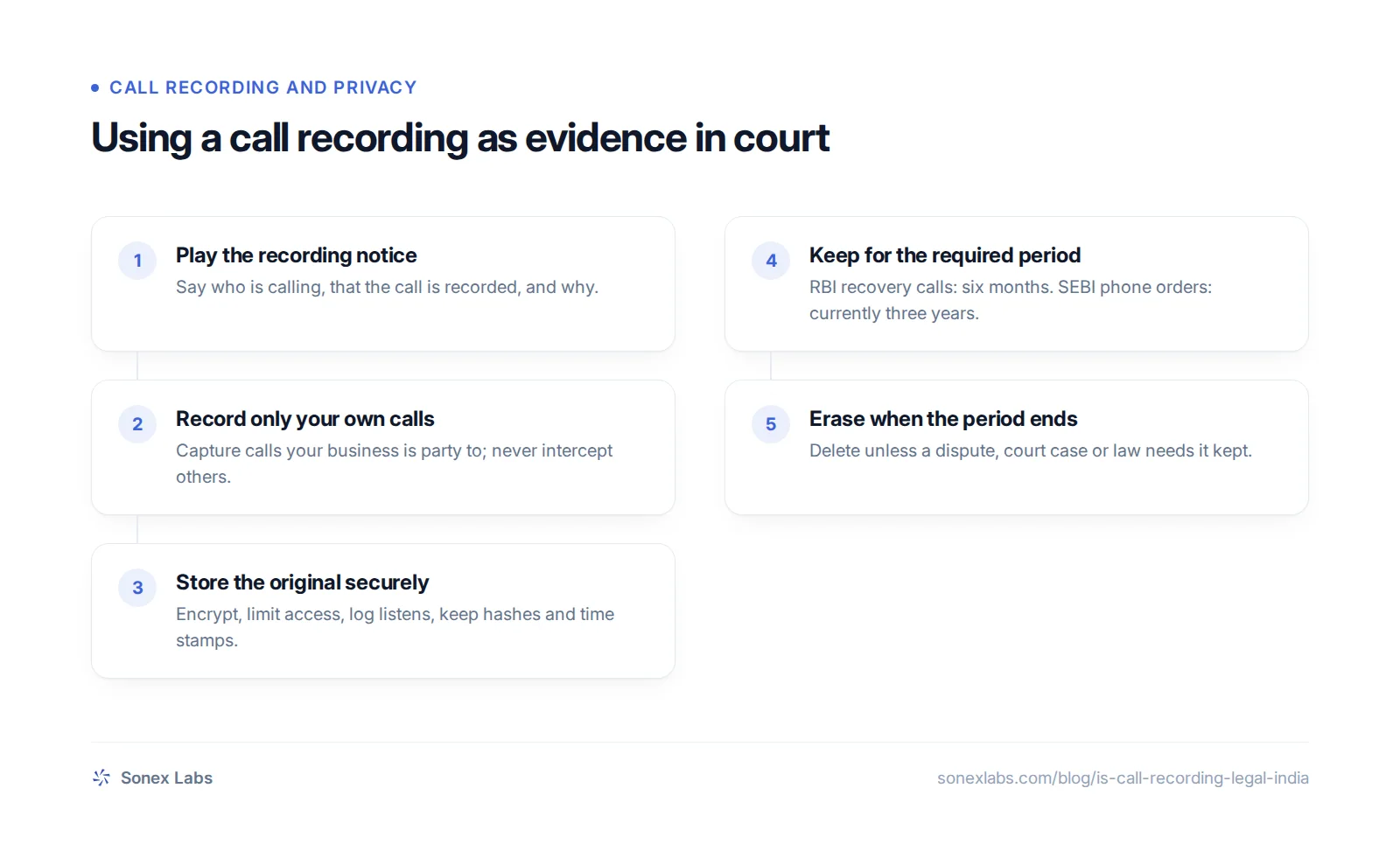
A recording's legal value is tested on the day it ends up in court. A call recording is admissible as evidence in India if it passes the tests for recorded evidence: the voice must be identified, the recording must be accurate and free from tampering, and the conversation must be relevant (R.M. Malkani, Supreme Court, 1972; Ram Singh v Col. Ram Singh, Supreme Court, 1985). Evidence is also not excluded only because it was obtained illegally (R.M. Malkani).
The paperwork changed in 2024. Since 1 July 2024 the Bharatiya Sakshya Adhiniyam, 2023 (BSA) has replaced the Indian Evidence Act, and a recording offered as an electronic record now needs a certificate under section 63. That certificate replaced the section 65B certificate that many pages still describe. It identifies the record and the device, and both the person in charge of the device and an expert sign it, using the format in the Act's Schedule.
For a business, this means storing recordings so they can be certified later, sometimes long after the call. Keep the original files, their time stamps, the phone numbers, a note of the system that captured them and a log of who listened to or exported them. A hash, a digital fingerprint that changes if the file is edited, makes tampering easy to rule out. The original file matters more than any transcript or compressed copy.
The same storage has an end point. Once the purpose and any required retention period have passed, the recording should be erased unless a dispute, court case or law needs it kept. AI voice agents on platforms such as Sonex produce both a call recording and a transcript, and both are personal data to be secured and erased on the same schedule.
Key dates
Sources
- RBI: NBFC Responsible Business Conduct (Third Amendment) Directions, 2026, paras 100P and 100ZOfficial
- RBI: Commercial Banks Responsible Business Conduct (Fourth Amendment) Directions, 2026 (RBI/2026-27/223), para 454POfficial
- RBI circular on bank recovery agents, 24 Apr 2008 (recording of calls; since withdrawn, text carried into the 2025 Directions)Official
- RBI (Commercial Banks – Responsible Business Conduct) Directions, 2025, para 442(4)Official
- SEBI Master Circular for Stock Brokers, 17 Jun 2025 (SEBI/HO/MIRSD/MIRSD-PoD/P/CIR/2025/90), para 35Official
- SEBI circular on prevention of unauthorised trading by stock brokers, 22 Mar 2018 (SEBI/HO/MIRSD/DOP1/CIR/P/2018/54)Official
- Digital Personal Data Protection Act, 2023Official
- DPDP Rules, 2025 (G.S.R. 846(E))Official
- MeitY: commencement of the DPDP Act (G.S.R. 843(E), Gazette, 13 Nov 2025)Official
- Telecommunications Act, 2023 (Gazette)Official
- Vibhor Garg v Neha, 2025 INSC 829 (judgment text, Indian Kanoon)Secondary
- Rayala M. Bhuvaneswari v Nagaphanender Rayala, AP High Court, 20 Dec 2007 (Indian Kanoon)Secondary
- R.M. Malkani v State of Maharashtra, 1973 AIR 157 (judgment text, Indian Kanoon)Secondary
- Ram Singh v Col. Ram Singh, 1986 AIR 3 (judgment text, Indian Kanoon)Secondary
- PUCL v Union of India, 18 Dec 1996 (judgment text, Indian Kanoon)Secondary
- K.S. Puttaswamy v Union of India, 24 Aug 2017 (judgment text, Indian Kanoon)Secondary
- Telecommunications Act 2023, section 20 (Indian Kanoon)Secondary
- IT Act 2000, section 43A (Indian Kanoon)Secondary
- IT Act 2000, section 72A (Indian Kanoon)Secondary
- Bharatiya Sakshya Adhiniyam 2023, section 63 (Indian Kanoon)Secondary
- LiveLaw: P&H High Court on recording a wife's calls (2021)Secondary
Change log: 24 Oct 2026, Narrowed RBI notice duty to recovery calls, tied the DPDP notice to consent requests, and updated the bank recording rule to the 2025 Directions. Later the same day, rewritten as one continuous guide: added why Indian law has no recording statute, the contact-centre point, the court-case exception to RBI's six-month period and the end of storage; the decision chart, takeaways, steps, checklist and FAQs were folded into the body · 23 Oct 2026, First published