On this page
Is voice considered biometric data?
Voice is biometric data only when it is processed to identify a person. The EU's General Data Protection Regulation (GDPR) defines biometric data narrowly (Article 4(14)). It is personal data that results from "specific technical processing" of a person's characteristics and that can "allow or confirm the unique identification" of that person. Illinois' Biometric Information Privacy Act (BIPA) takes a similar line: it lists a "voiceprint", not a voice recording, as a biometric identifier (740 ILCS 14/10).
BIPA does not define "voiceprint". In plain terms, and as we use the word here, it is a model of someone's voice that software can match against new audio. So the legal question is what a voice system does with the audio, not whether it records it. Storing a call is one thing; building something that can recognise the caller next time is another.
EU regulators frame it the same way. The European Data Protection Board (EDPB), the group of EU data regulators, says voice data is "inherently biometric". It becomes special-category data, the most protected kind under GDPR, when it is processed to uniquely identify someone. The EDPB applies the GDPR's photograph rule to voice: a photo is biometric only when it is processed by technical means that allow unique identification (Guidelines 02/2021, para 31 and footnote 31).
The table shows how that test plays out across common voice AI features. Recording and transcription usually stay on the ordinary side of the line, while speaker identification, voice login and cloning cross it. Diarisation, which only separates speakers within one call, sits between the two, and we found no regulator guidance on it specifically.
| Activity | What happens to the voice | Biometric data? |
|---|---|---|
| Call recording | Audio is stored as a file | Usually not by itself. Washington's law expressly excludes audio recordings (RCW 19.375.010(1)) |
| Transcription (speech-to-text) | Audio becomes words; the speaker is not identified | Usually not. The transcript is still personal data |
| Speaker separation (diarisation) | Labels "speaker 1" and "speaker 2" within one call | Grey area, in our view. Lower risk if no voice model is kept or matched across calls |
| Speaker identification or voice login | A voice model is made and matched to a known person | Yes. This is a voiceprint under BIPA and special-category data under GDPR Art. 9 |
| Voice cloning | A model of one person's voice is built to generate new speech | Treat as yes. The model is derived from and identifies one person's voice |
What Illinois BIPA requires before you create a voiceprint
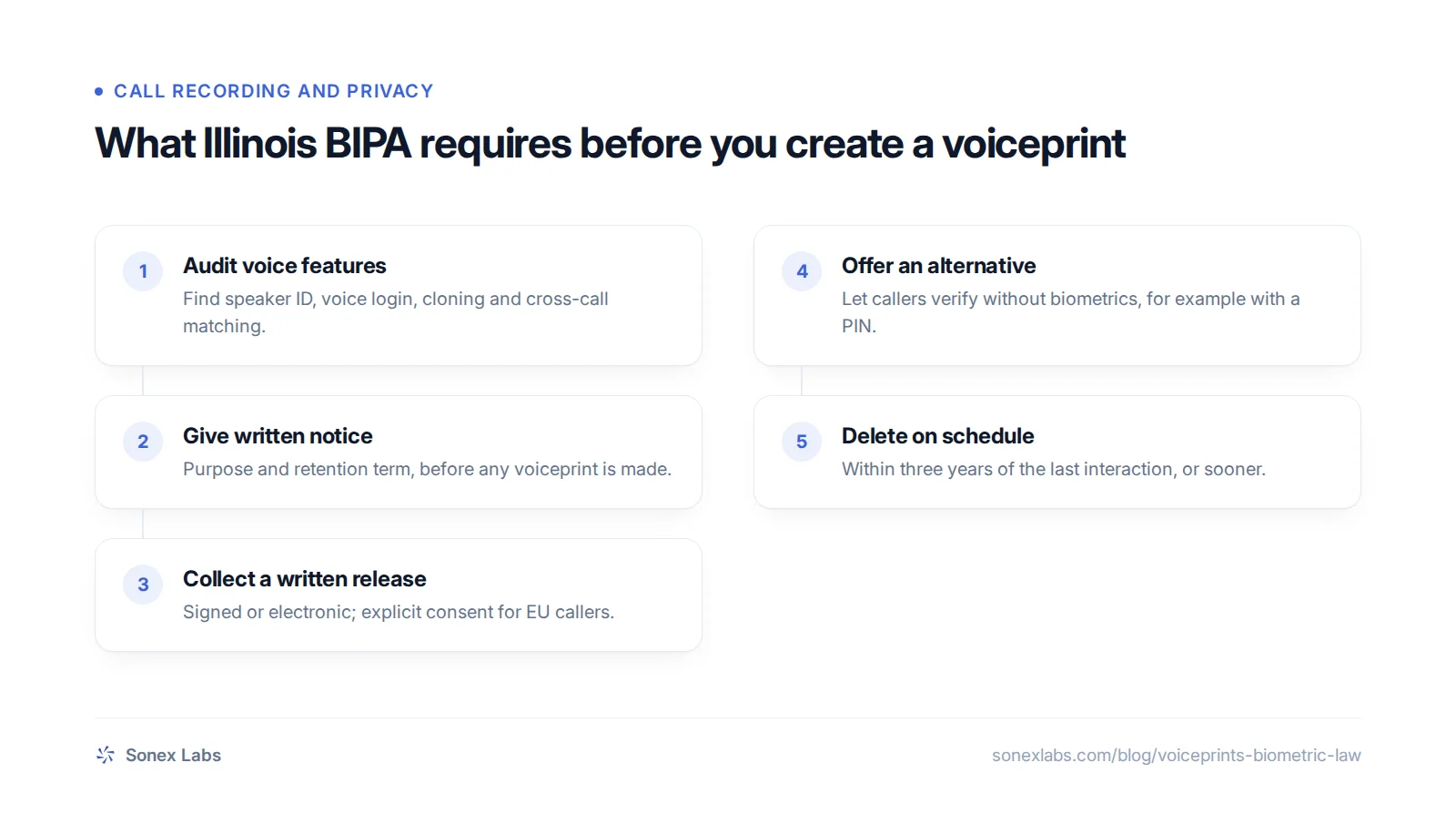
Illinois matters more than its size suggests because BIPA is the strictest of the US biometric laws and the only one of the three covered here that lets individuals sue. Its duties start before anything is collected, which is why the first practical step is an audit: find every component that builds or matches a voice model, including vendor features switched on by default.
Notice, a written release and a retention schedule
Before a voiceprint is created, the law asks for three things (section 15(b)). The person must be told in writing that the data is being collected. They must be told in writing the specific purpose and how long it will be collected, stored and used. And the collector must receive a "written release" signed by the person.
The duties continue after collection. A collector needs a public written retention policy that destroys the data when the purpose is met or within 3 years of the person's last interaction, whichever comes first (section 15(a)). It may not sell or otherwise profit from the data (section 15(c)), and section 15(d) limits disclosing it without consent, even to vendors.
That last point is where vendor contracts come in. A contract should bar a voice vendor from using call audio to train voice or speaker models, and limit what it may disclose; a vendor due-diligence questionnaire can capture the answers. Cross-call speaker matching that has no clear purpose and no consent behind it is simplest switched off.
Who can sue, and what the 2024 amendment changed
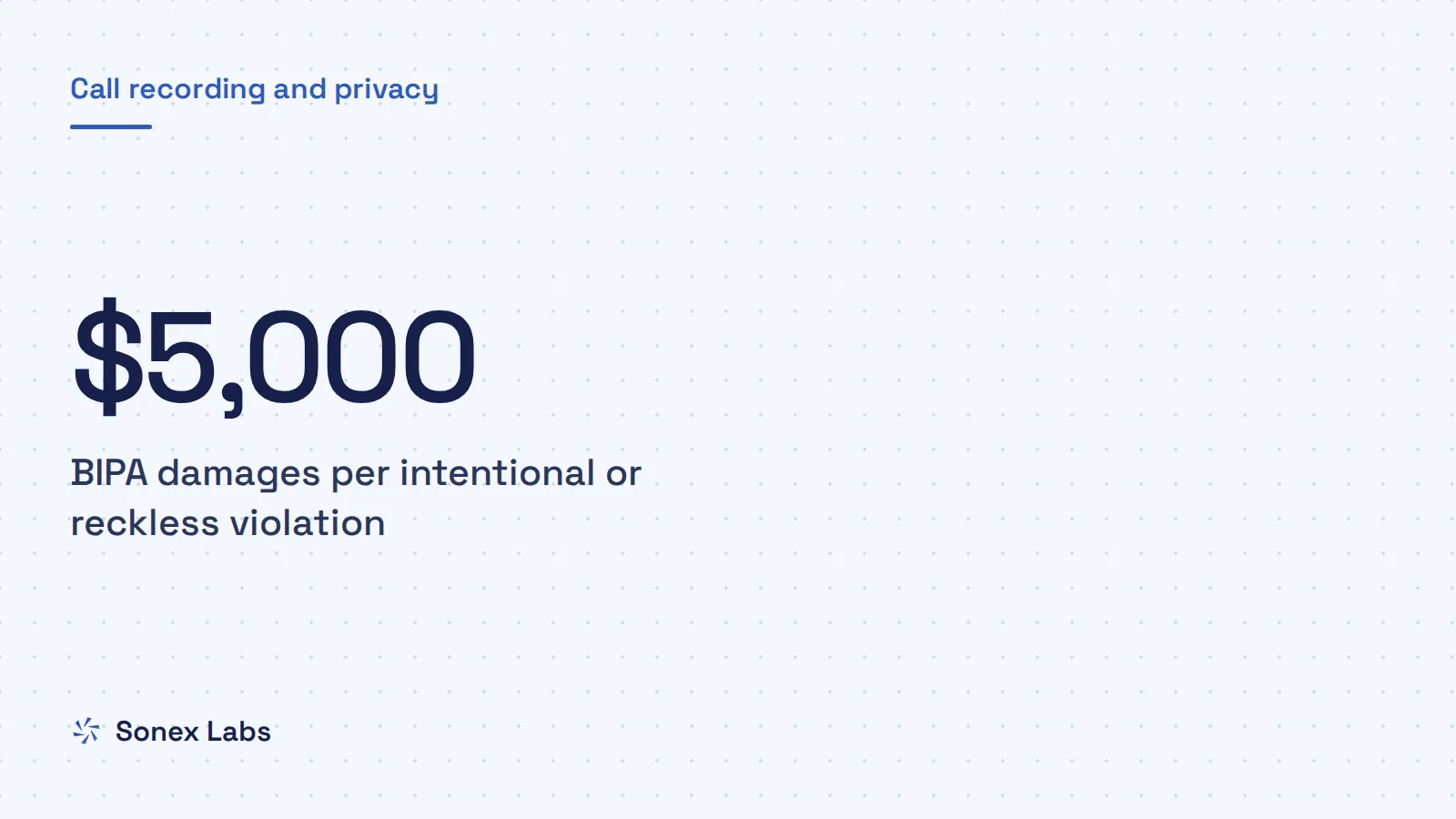
What makes BIPA especially risky is that anyone harmed can sue (section 20), which the Texas and Washington laws described below do not allow. Damages are $1,000 per negligent violation and $5,000 per intentional or reckless violation, or actual damages if higher, plus legal fees.
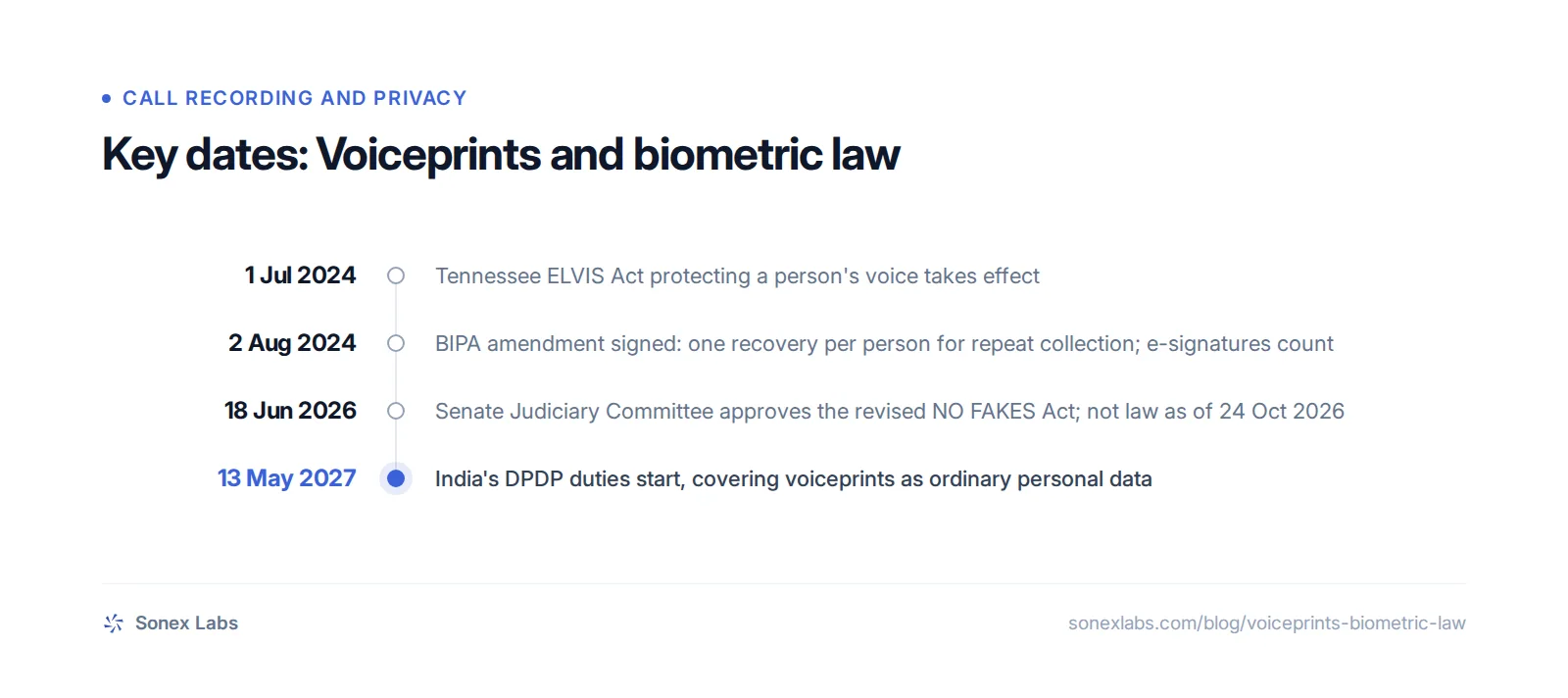
A 2024 amendment limits that exposure. Collecting the same identifier from the same person by the same method, again and again, is now one violation with one recovery. An electronic signature now also counts as a written release (Public Act 103-0769, signed 2 August 2024). A federal appeals court has applied the new limit to cases that were already pending (Clay v Union Pacific Railroad, Seventh Circuit, 1 April 2026).
Why a recording notice is not biometric consent, and the lawsuits testing it
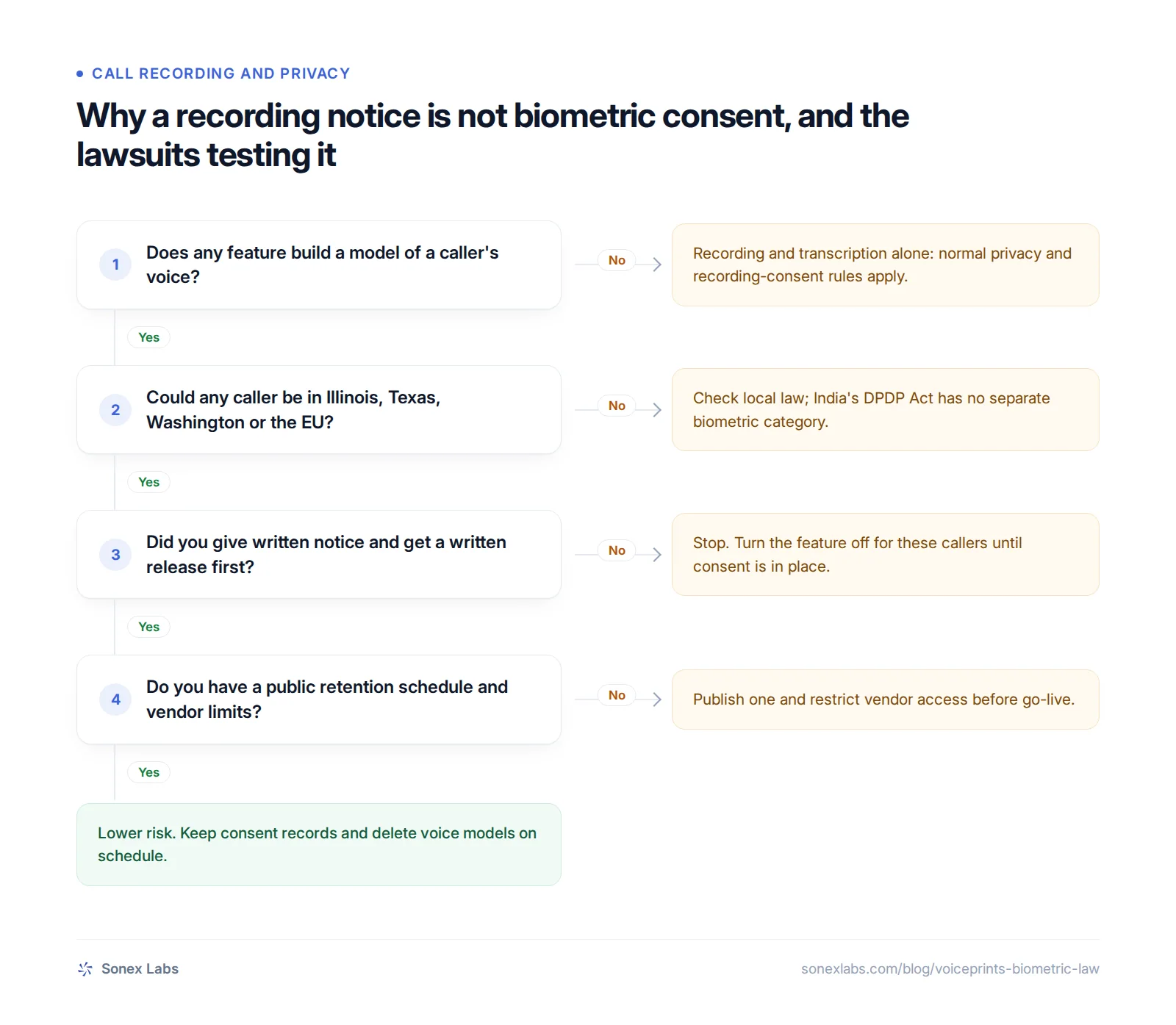
It is tempting to treat the usual call notice as enough, but a "this call may be recorded" line is probably not biometric consent if the system makes voiceprints. A recording notice tells callers that audio is captured. BIPA asks for something different: written notice that a biometric identifier is being collected, its specific purpose and retention term, and a signed written release (section 15(b)). A spoken line at the start of a call does none of those things.
AI meeting assistants
The first wave of suits alleged that the speaker-identification features of AI meeting-transcription services made voiceprints of people who never signed up or consented. One against Otter.ai was filed in August 2025 and now forms part of a consolidated case in federal court in California (In re Otter.AI Privacy Litigation). In August 2026 that court reportedly let the BIPA claims go forward past a motion to dismiss. Another was filed on 18 December 2025 (Cruz v Fireflies.AI Corp, Central District of Illinois).
Contact centres and customer-service lines
Contact centres are now targets too, and the Walmart case shows the recording-notice gap exactly. In a proposed class action filed in early August 2026, two Illinois callers allege that an AI system on Walmart's store phone lines built templates of their voices (Krupke v Walmart, Northern District of Illinois, No. 1:26-cv-09305, as reported by Biometric Update). Callers heard that the call and their voice "may be recorded for business purposes, including fraud prevention", which the plaintiffs say said nothing about voiceprints, retention or recipients.
A proposed class action filed in September 2026 makes similar claims about Lowe's customer-service calls (Perkins v Lowe's, Cook County Circuit Court, as reported by Courthouse News and CX Today). In May 2026 another wave of suits accused technology and AI voice companies of training voice models on recorded voices without BIPA consent, as reported by CX Today.
These are allegations, not findings. None of these cases had a final ruling that we could find as of 24 October 2026. The chart below is a quick way to tell whether a feature puts a business on the biometric side of the line, and which callers it affects.
Texas and Washington voiceprint laws
Outside Illinois, Texas and Washington have their own biometric laws, but neither lets individuals sue. Texas' Capture or Use of Biometric Identifier Act (CUBI) names a voiceprint as a biometric identifier. It bars capturing one for a commercial purpose without telling the person first and getting their consent (Business and Commerce Code 503.001). Only the Texas attorney general can enforce it, with a civil penalty of up to $25,000 per violation.
Texas also exempts voiceprint data kept by financial institutions, and biometric data used to train AI models unless the system is used to identify a specific person (503.001(e)). That second exemption matters for voice AI vendors, but it ends the moment the model is used to recognise a particular caller.
Washington also names voiceprints, but its definition excludes photographs and video or audio recordings (RCW 19.375.010(1)). It bars enrolling a biometric identifier in a database for a commercial purpose without notice, consent or a way to stop later commercial use (19.375.020(1)). Here too, only the attorney general can enforce it (19.375.030(2)).
Biometric consent under GDPR and India's DPDP Act
Europe and India sit at opposite ends. The EU treats voice identification as one of the most sensitive kinds of processing, while India's new law has no separate biometric category at all.
The EU: explicit consent and an alternative
In the EU, voice recording consent and biometric consent are not the same thing. Recording and transcribing calls needs a lawful basis under Article 6, such as a contract or legitimate interests, plus clear information for callers; consent is only one of the possible bases. Using a voice to identify a person is processing biometric data "for the purpose of uniquely identifying a natural person" (Article 9(1)), which is prohibited unless an Article 9(2) exception applies.
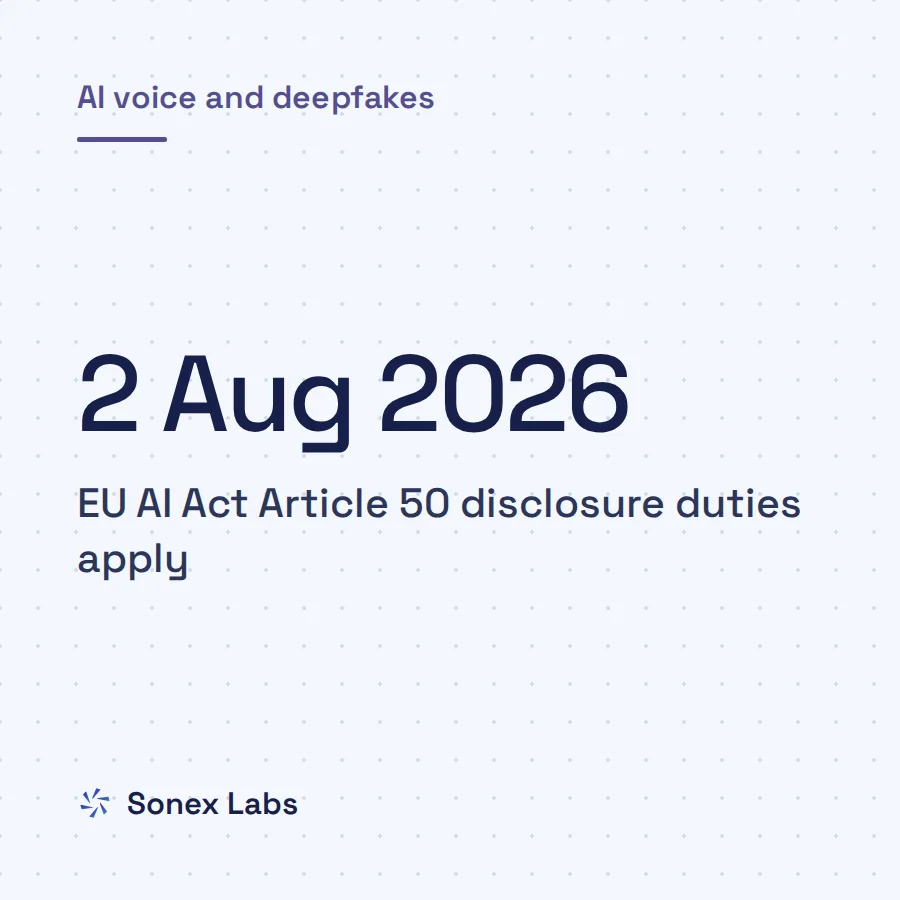
For voice identification, the EDPB says only the person's explicit consent seems to fit (Guidelines 02/2021, paras 81 to 82 and 128). Consent must be freely given, so it says controllers should offer an alternative to biometric identification, such as a PIN. The EDPB also recommends a separate opt-in for voice identification and for human review of recordings (para 90), and suggests keeping voice models on the user's own device where possible (para 133). AI systems that talk to people also carry transparency duties under a separate EU law, explained in the EU AI Act's Article 50 for voice.
India: personal data, with older rules until 2027
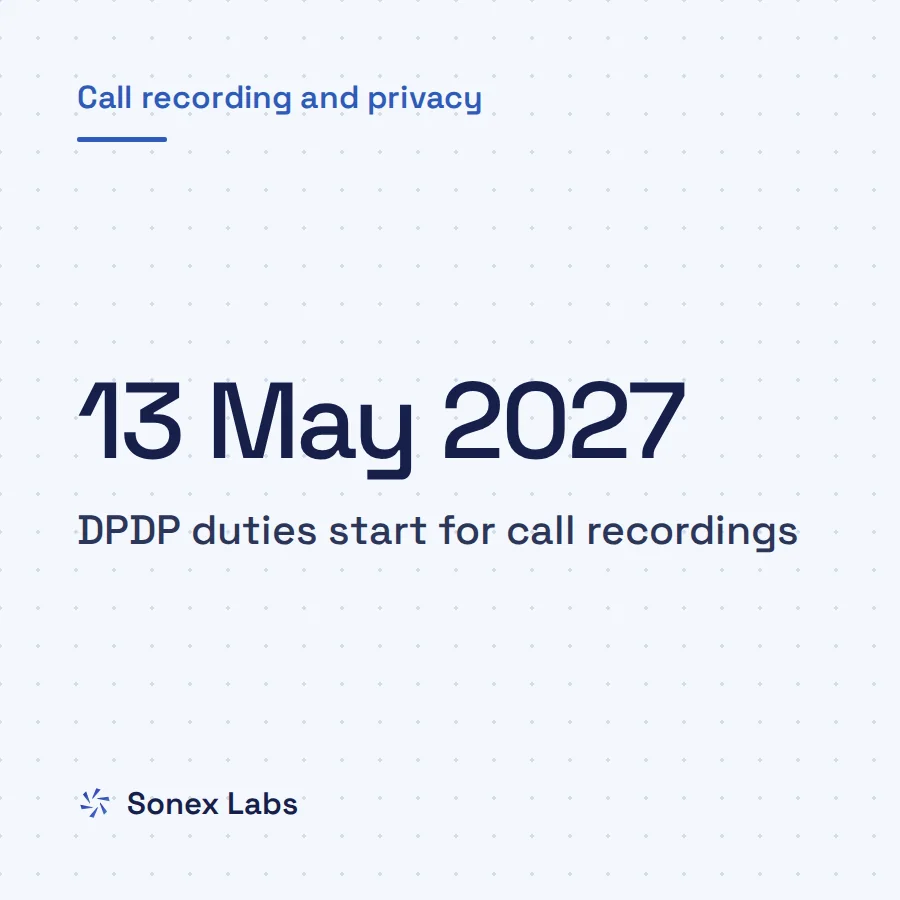
The Digital Personal Data Protection (DPDP) Act, 2023 has no special category for biometric or sensitive data. A voiceprint is personal data like any other, with the same notice and consent duties, which start on 13 May 2027; the guide to the DPDP Act for voice AI sets them out.
Until then, India's older IT rules on sensitive personal data apply. They list biometric information as sensitive, and their definition of biometrics includes voice patterns used for authentication (SPDI Rules, 2011, rules 2(1)(b) and 3). Sector rules can be stricter: RBI bars lenders and their lending service providers from collecting biometric data unless a law allows it, as the guide to RBI's digital lending rules explains. Indian vendors that build voiceprints for foreign clients also need to meet the client's law, such as BIPA or GDPR, through the contract.
Voice cloning laws in the US
Voice cloning raises a different question from voiceprints: not who is speaking, but whose voice may be copied. In the US no federal voice-likeness law is in force, so the rules come from states and from calling law. Tennessee's ELVIS Act (Ensuring Likeness, Voice, and Image Security Act), in force since 1 July 2024, adds a person's voice, real or simulated, to the state's right of publicity. It targets publishing or distributing someone's voice without permission, and making available a tool whose primary purpose is producing a particular person's voice without permission.
At the federal level, the NO FAKES Act would create a right to authorise digital replicas of a person's voice or likeness. The 2025 bill (S. 1367, introduced 9 April 2025) was followed by a revised version introduced on 20 May 2026 (S. 4591 in the Senate, H.R. 8915 in the House). The Senate Judiciary Committee approved it on 18 June 2026, unanimously according to press reports, and reported it to the full Senate on 24 June 2026. As of 24 October 2026 it had not passed either chamber and is not law (Congress.gov).
For phone calls, the FCC has already ruled that cloned and AI-generated voices are "artificial" voices under the Telephone Consumer Protection Act (FCC 24-17, February 2024). Outbound calls using them therefore need prior express consent, and US rules on AI collection calls show how that plays out. India's approach, built on court orders protecting personality rights, is covered in voice cloning law in India.
Cloning needs very little audio now. Pāṇini TTS, for example, can clone a voice from about 10 seconds of reference audio, which is less than most customer calls contain. That is the practical reason never to clone a voice taken from a customer call recording. Where a voice is cloned with permission, the consent should cover these terms:
- Written, signed consent from the voice owner before training audio is recorded.
- The purpose: which products, languages and channels the cloned voice will be used in.
- A term, and what happens to the voice model when it ends or consent is withdrawn.
- Whether the voice can say things the person never approved, and who reviews scripts.
- A ban on using the clone to impersonate the person to their family, bank or employer.
- Access control on the model and a log of every generation job.
- Payment or credit as agreed, and confirmation that no union or label contract restricts it.
Key dates
Sources
- Illinois BIPA, 740 ILCS 14 (Illinois General Assembly)Official
- Illinois Public Act 103-0769 (2024 BIPA amendment)Official
- BIPA statute text as compiled (pre-2024), via Akin GumpSecondary
- Greenberg Traurig: BIPA update on SB 2979 (Aug 2024)Secondary
- Clay v Union Pacific Railroad Co., No. 25-2185 (7th Cir., 1 Apr 2026), opinionOfficial
- Sidley Data Matters: Seventh Circuit applies the 2024 BIPA amendment retroactively (Apr 2026)Secondary
- Washington RCW 19.375 (biometric identifiers)Official
- Texas Business and Commerce Code ch. 503 (CUBI)Official
- Texas Legislative Council: Business and Commerce Code ch. 503 (current text)Official
- Texas Bus. & Com. Code 503.001 text (Public.Law copy)Secondary
- GDPR (Regulation (EU) 2016/679), Articles 4(14) and 9Official
- EDPB Guidelines 02/2021 on virtual voice assistants, v2.0 (7 Jul 2021)Official
- India: IT (Reasonable Security Practices and Procedures and Sensitive Personal Data or Information) Rules, 2011 (WIPO Lex copy)Secondary
- NO FAKES Act of 2025, S. 1367 (introduced text, GovInfo)Official
- Congress.gov: S. 4591, NO FAKES Act of 2026, all actionsOfficial
- Manatt: Congress reintroduces the NO FAKES Act (S. 4591, H.R. 8915), May 2026Secondary
- Digital Music News: Senate Judiciary Committee advances the NO FAKES Act, 18 Jun 2026Secondary
- Tennessee HB 2091 (ELVIS Act) bill pageOfficial
- Davis Wright Tremaine: Tennessee's ELVIS Act and AI voice replicas (Apr 2024)Secondary
- FCC Declaratory Ruling FCC 24-17 (AI voices under the TCPA)Official
- Bloomberg Law: Otter.ai hit with BIPA class suit over voice print collection (26 Aug 2025)Secondary
- CourtListener: In re Otter.AI Privacy Litigation, No. 5:25-cv-06911 (N.D. Cal.) docketSecondary
- IDTechWire: Otter.ai must face voiceprint claims under Illinois biometric law (Aug 2026)Secondary
- JD Supra: AI meeting assistants and the Fireflies.AI BIPA lawsuitSecondary
- Biometric Update: Walmart sued over alleged voiceprint collection from customer calls (6 Aug 2026)Secondary
- Courthouse News: Lowe's hit with class action over collection of consumers' voiceprints (Sep 2026)Secondary
- CX Today: voice AI lawsuits put contact centres on BIPA watchSecondary
- ABA: Voiceprints, AI and BIPA, new trends in biometric privacy litigationSecondary
Change log: 24 Oct 2026, Rewritten as one continuous guide: added the Walmart voiceprint suit (Krupke v Walmart, Aug 2026) as the clearest example of the recording-notice gap, split the BIPA, lawsuit and GDPR/India sections into subsections, and folded the takeaways, steps, checklist and FAQs (BIPA damages, diarisation, NO FAKES status) into the body. Earlier the same day: updated the NO FAKES Act and BIPA lawsuit status; added Texas exemptions; marked our own definitions as such · 23 Oct 2026, First published