On this page
- Why the AI Act makes voice agents say they are AI
- Providers, deployers and companies outside the EU
- What to say, and when: the first sentence of the call
- Why the obvious-use exception rarely helps on calls
- Machine-readable marking and cloned voices
- Emotion recognition in call centres
- Fines, and how Article 50 fits with the GDPR
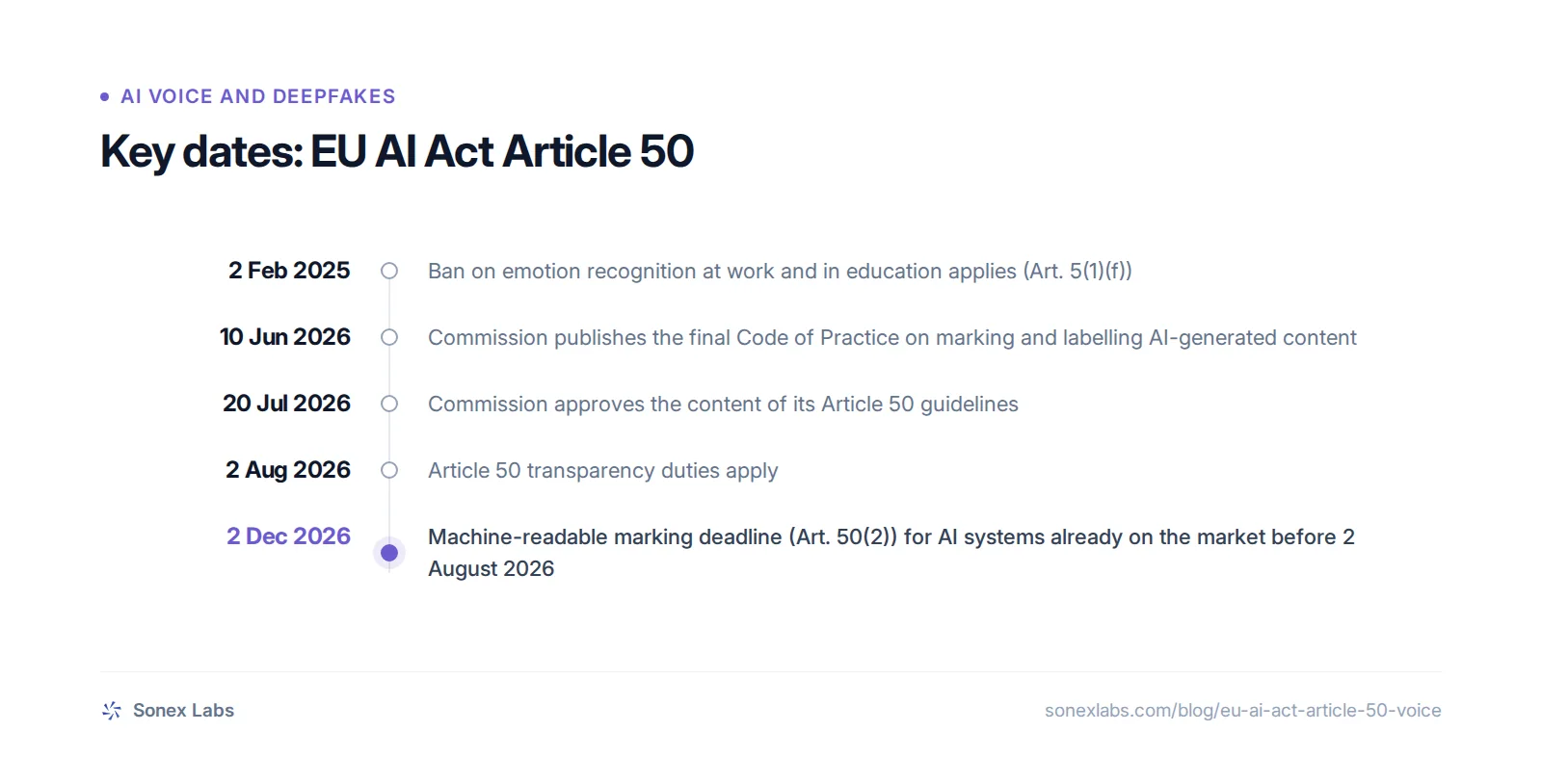
- Key dates
- Sources
Why the AI Act makes voice agents say they are AI
The EU AI Act (Regulation (EU) 2024/1689) sorts AI systems by risk. A few practices are banned, high-risk uses such as credit scoring carry heavy duties, and most systems carry few. Article 50, the transparency article, cuts across that scale. It applies to systems that interact with people or generate content, whether or not they are high-risk.
The reason is set out in the Act's recitals. Some AI systems can create risks of impersonation or deception even when they are not high-risk, so people "should be notified that they are interacting with an AI system, unless this is obvious" (recital 132). The same recital asks providers to take account of people who are vulnerable because of their age or disability, and to give notices in accessible formats. A voice agent that sounds human is close to the centre of that concern.
The core duty for a voice agent is Article 50(1): people must be told they are talking to an AI system, unless that is obvious. Three more duties can apply to a calling operation. Synthetic speech must carry a machine-readable mark (Art. 50(2)). People must be told when a system detects their emotions (Art. 50(3)). And a voice that imitates a real person must be disclosed as AI-generated (Art. 50(4)).
Article 50(5) then sets the manner for all of them: clear, distinguishable and accessible, at the latest at the first interaction. The duty is the same for a text chatbot and a voice agent; what differs is how the notice reaches the person. The timing has not moved either. The Digital Omnibus (Regulation (EU) 2026/1744) delayed the high-risk rules but not Article 50, and only machine-readable marking for systems already on the market got extra time.
| Paragraph | Who must comply | What it means on a call |
|---|---|---|
| 50(1) Interaction disclosure | Provider of the AI system | The caller is told they are speaking with an AI, unless that is obvious |
| 50(2) Machine-readable marking | Provider of the system that generates the audio | Synthetic speech is marked, for example with metadata or a watermark, so it can be detected as AI-made |
| 50(3) Emotion recognition notice | Deployer (the business using it) | People are told if the system infers their emotions from their voice |
| 50(4) Deepfake disclosure | Deployer | A voice that resembles a real person is disclosed as AI-generated |
| 50(5) Manner and timing | Both | Clear, distinguishable and accessible, at the latest at the first interaction |
Providers, deployers and companies outside the EU
Because the duties fall on different parties, the first practical step is to work out your role. The provider builds the AI system, or has it built, and offers it in the EU under its own name (Art. 3(3)). The deployer is the business that uses the system under its authority (Art. 3(4)). If a bank buys a ready-made calling agent and runs campaigns with it, the bank is the deployer and the company selling the agent is the provider.
The roles can merge. According to the Commission's guidelines on Article 50, a company that builds its own agent in-house and uses it under its own name is a provider. So is a company that modifies someone else's system and offers it under its own name.
The split matters because Article 50(1) puts the duty on the provider: the agent must be built so that callers are informed. In practice, though, the deployer writes the script and picks the voice, and a deployer who edits the greeting can remove the disclosure without the provider knowing. Both sides should agree in the contract who makes sure the disclosure is spoken on every call, and the deployer should check its live prompts and opening line itself, in every language it calls in.
Calling the EU from India, the UAE or Saudi Arabia
Being based outside the EU does not take you out of scope if the call's output is used in the EU. The AI Act covers providers and deployers based outside the EU when the output of their AI system is used in the Union (Art. 2(1)(c)). An Indian, US or UAE company whose AI agent calls people in the EU is in scope. The guidelines add one limit: incidental or unforeseeable use in the EU should not by itself trigger the rules for providers outside the EU. A campaign that deliberately dials EU numbers is not incidental.
For many of those companies, Article 50 is stricter than the rules at home. India's AI labelling rules put the duty on platforms that offer synthetic-audio tools, not on the business placing a call (IT Rules, rule 3(3)). The UAE telemarketing rules require the company name, the purpose and a recording notice, but no express "I am an AI" statement (Cabinet Resolution No. 56 of 2024, Articles 4(7) and 4(11)). In Saudi Arabia, AI disclosure is guidance from the national AI authority rather than a binding rule. A campaign into the EU therefore needs the AI line even where the home script did not.
What the Commission's guidelines are, and are not
Much of the practical detail in this guide comes from the Commission's guidelines on Article 50, published on 20 July 2026. They are not law. The Commission's communication of that date approved their content and said they apply once formally adopted in all language versions; as of 24 October 2026 we found no notice of that adoption.
Either way, the guidelines are non-binding, and only the Court of Justice of the EU can give a binding interpretation of the AI Act. They still matter, because they show how the Commission expects national market surveillance authorities to read the duty. The duty itself comes from Article 50, which has applied since 2 August 2026, so waiting for formal adoption is not an option.
What to say, and when: the first sentence of the call
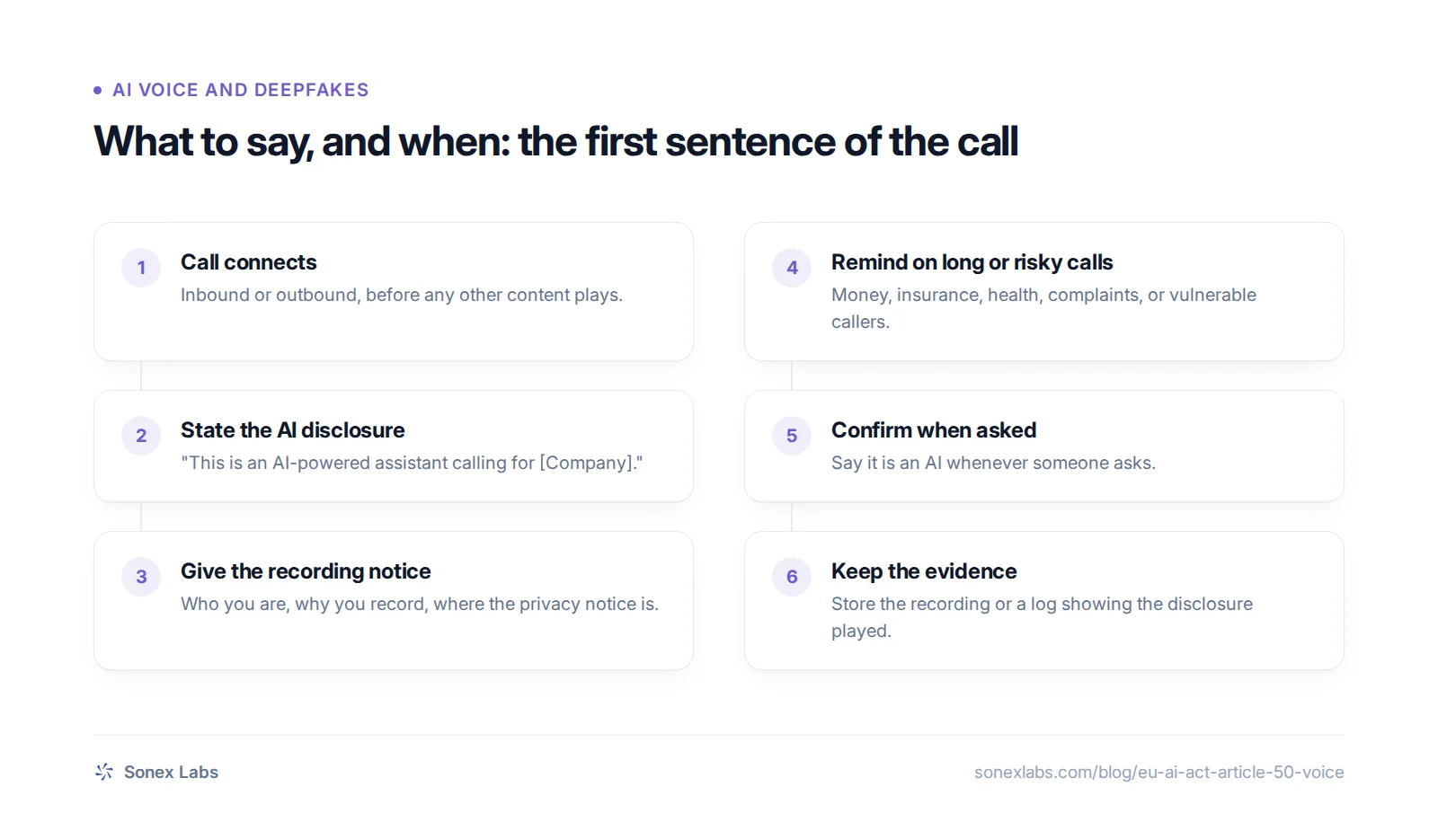
The timing is strict. An AI phone agent has to say it is an AI at the latest at the first interaction, which on a call means the opening line (Art. 50(5)). The guidelines give a telephony example: an explicit spoken statement at the start, such as "This is an AI-powered assistant". Tones or other audio cues may help, but they are not enough on their own.
The guidelines add three points for calls. A single clear notice at the start usually suffices. In riskier contexts, such as financial advice, insurance, health advice, complaints, or calls with older or vulnerable people, periodic reminders are likely to be needed. And the agent must disclose that it is an AI whenever someone asks about its nature. AI agents must also state on whose behalf they are acting, so the opening line should name the company, not just the fact that the caller is an AI.
Our advice on how to deliver it goes beyond the text. Play the disclosure as fixed, pre-written words rather than a line the language model generates, so it cannot be skipped or paraphrased away, and stop callers from talking over it. Developers building on open-source voice frameworks describe the same pattern. Write the line in each language you call in, in short, plain words, and test it with real listeners, including older callers, because Article 50(5) requires the notice to meet the applicable accessibility rules.
If you record the call, the same opening can carry the recording notice the GDPR requires, covered below. A line such as "Hello, this is an AI-powered assistant calling on behalf of [Company]. This call is recorded; you can find our privacy notice at [link]" does both jobs. The AI disclosure and recording-notice scripts have versions in several languages.
Finally, keep evidence that the disclosure played. On Sonex, for example, every call on an outbound calling campaign is kept as a recording and a transcript, which shows what was said in the first seconds if a regulator or customer asks.
Why the obvious-use exception rarely helps on calls
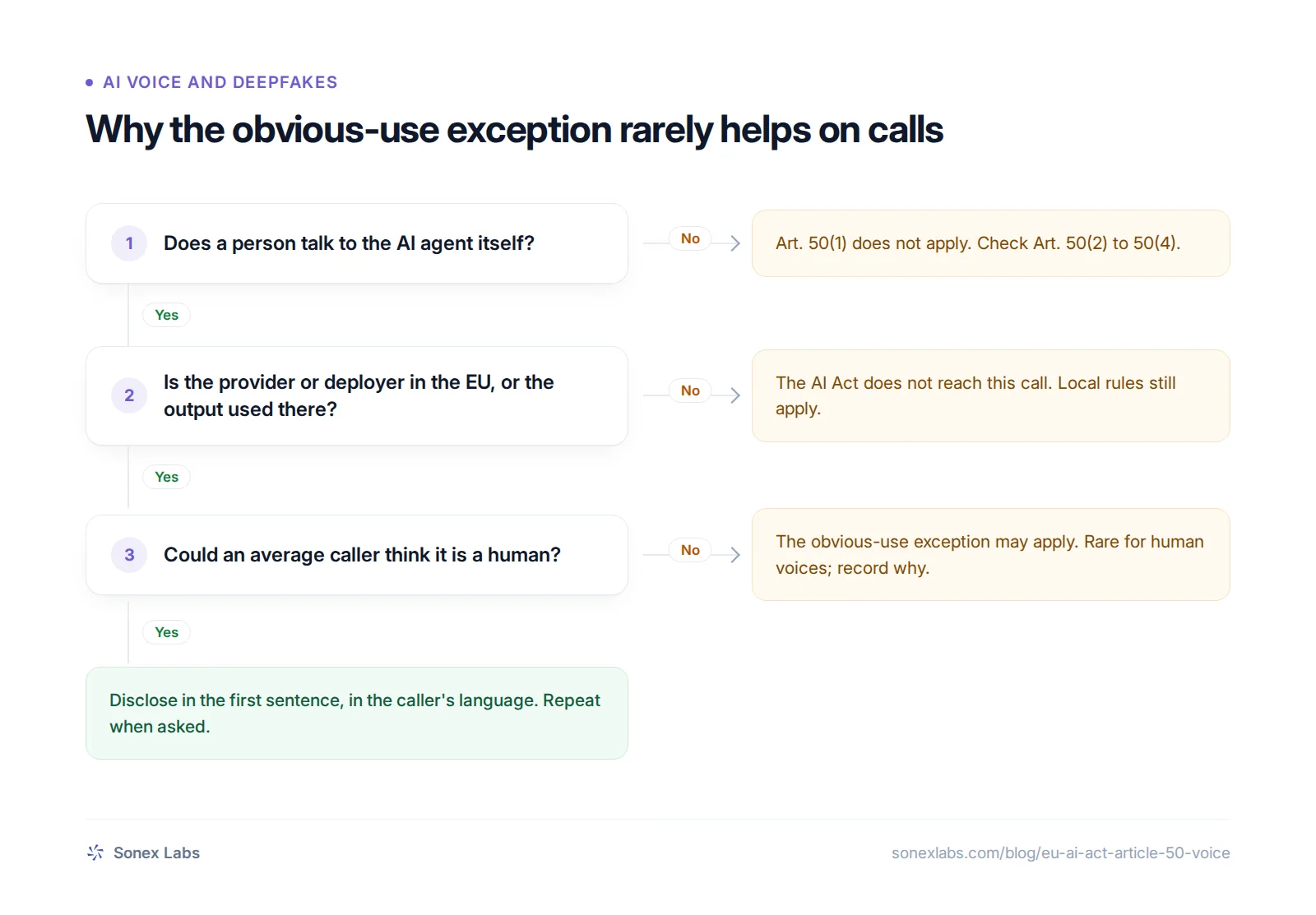
It is rarely obvious enough on a phone call that the caller is talking to an AI. Article 50(1) drops the duty only when AI use is obvious to a person who is reasonably well-informed, observant and circumspect, given the context. The guidelines say this exception must be read narrowly and kept to cases where almost no doubt is left.
Several factors work against relying on it. The guidelines list a human-sounding voice as something that makes AI use less obvious. If the general public can reach the system, including children, older people or people with disabilities, the exception cannot be relied on for them. Their examples of obvious cases are code assistants for developers or internal tools for trained staff, not customer calls.
Accessibility is part of the duty too. Article 50(5) requires the information to meet the applicable accessibility rules, and the guidelines point to the European Accessibility Act (Directive 2019/882). They do not add accessibility requirements of their own beyond those rules. Short, plain wording in the caller's own language is the safest way to meet them.
Machine-readable marking and cloned voices
The spoken disclosure is for the listener; Article 50(2) adds a technical duty for the audio itself, and it is the provider's job. Providers of AI systems that generate synthetic audio must make sure the output is marked in a machine-readable format and detectable as AI-generated (Art. 50(2)). The guidelines confirm that audio includes speech.
The Commission's Code of Practice on marking and labelling AI-generated content, published on 10 June 2026, describes how. Signatories commit to at least two layers of machine-readable marking, such as metadata and an imperceptible watermark, and to provide a way to detect the marks. On 8 July 2026 the Commission found the Code adequate for Articles 50(2), (4) and (5). Signing is voluntary, but it is one way to show compliance, so ask your voice provider how its output is marked and whether it has signed.
The deadline depends on when the system reached the market. Systems already on the market before 2 August 2026 must take the steps needed to comply with Article 50(2) by 2 December 2026 (Art. 111(4), added by the Digital Omnibus). Systems placed on the market from 2 August 2026 onwards have had to comply from the start.
A cloned or human-like voice brings in the deepfake rule as well. A voice counts as a deepfake when it resembles an existing person and would falsely appear authentic (Art. 3(60)). Cloning the voice of a real employee, founder or celebrity for a calling agent is the clear case. The deployer must then disclose that the audio is AI-generated (Art. 50(4)), and should hold the person's consent to use their voice.
The guidelines also treat realistic AI-generated personas and avatars as "persons" for this test (para 113). So, on our reading, it could be argued that a named, human-sounding agent that never says it is an AI falls in as well. A clear AI disclosure at the start of the call addresses both Article 50(1) and this risk.
Emotion recognition in call centres
Article 50(3) matters if your system reads emotion from people's voices, and here the AI Act draws a sharp line between customers and staff. AI systems that infer the emotions of people at work or in education have been banned since 2 February 2025, except for medical or safety reasons (Art. 5(1)(f)). The Commission's guidelines on prohibited practices give the exact example: a call centre using webcams and voice recognition to track its employees' emotions, such as anger, is prohibited.
Tracking customers' emotions, such as anger or impatience, is not banned by Article 5(1)(f), the same guidelines say. Their example is a system that helps employees cope with angry customers. But the deployer must tell the people exposed to it (Art. 50(3)), and emotion recognition is a high-risk use whose extra duties apply from 2 December 2027. Under the AI Act, emotion recognition by definition works on biometric data such as the voice (Art. 3(39)). Whether the same processing is special-category biometric data under the GDPR depends on whether it identifies the person, as explained in when a voice becomes biometric data.
- Your staff, from voice or other biometric data: banned since 2 February 2025, unless for medical or safety reasons.
- Customers, from voice or other biometric data: allowed, but tell them (Art. 50(3)); high-risk duties apply from 2 December 2027.
- Anyone, from the text transcript only: not emotion recognition under the AI Act, but the GDPR still applies, and labour law too for staff.
Fines, and how Article 50 fits with the GDPR
Breaching Article 50 can bring a fine of up to €15 million or 3% of worldwide annual turnover, whichever is higher (Art. 99(4)(g)). For small and medium-sized enterprises, including start-ups, the lower of the two applies (Art. 99(6)). The Digital Omnibus extended that rule to small mid-cap companies (Art. 99(6a)).
Breaching the Article 5 bans costs more. Using emotion recognition on your own staff, for example, can bring a fine of up to €35 million or 7% of worldwide annual turnover (Art. 99(3)).
Article 50 also sits alongside the GDPR rather than replacing it: they are separate duties, and you need both. Article 50 is about telling people they are dealing with an AI. The General Data Protection Regulation (GDPR) is about personal data, and a call recording is personal data. The AI Act says it does not affect the GDPR (Art. 2(7)).
Under Article 13 GDPR, you must tell people, when you collect their data, who you are, why you process it and on what legal basis. For a recorded AI call, the opening line usually covers both the AI and the recording, with a route to the full privacy notice. Some EU countries also have national rules on recording calls. We have not checked them country by country, so check each country you call; the calling rules by country tool is a starting point.
Key dates
Sources
- AI Act Article 50, consolidated text as amended (AI Act Service Desk, European Commission)Official
- AI Act Recital 132: why people must be told they are interacting with an AI systemOfficial
- AI Act Article 5: prohibited practices, incl. 5(1)(f) emotion recognitionOfficial
- AI Act Article 99: penalties, incl. 99(6a) for small mid-capsOfficial
- AI Act Article 2: scope, incl. 2(1)(c) non-EU providers and deployersOfficial
- AI Act Article 111(4): legacy systems and Article 50(2) by 2 December 2026Official
- AI Act Article 113: application datesOfficial
- Regulation (EU) 2024/1689 (AI Act), Official JournalOfficial
- Regulation (EU) 2026/1744 (Digital Omnibus on AI), Official JournalOfficial
- Commission guidelines on transparency obligations under Article 50, C(2026) 5054 (content approved 20 July 2026; apply once formally adopted)Official
- Communication C(2026) 5054 final approving the content of the Article 50 guidelines, 20 Jul 2026 (formal adoption to follow)Official
- Commission press release IP/26/1328: Code of Practice on marking and labelling AI-generated content, 10 June 2026Official
- Code of Practice on Transparency of AI-generated Content (Commission page)Official
- Commission opinion on the adequacy of the Code of Practice, 8 July 2026Official
- Commission guidelines on prohibited AI practices, C(2025) 5052, 29 July 2025 (call-centre emotion examples, para 254)Official
- General Data Protection Regulation (EU) 2016/679, Article 13Official
- Stephenson Harwood: European Commission adopts guidelines on Article 50 transparency obligations (non-binding status)Secondary
- Akin Gump: guidelines on transparency obligations under the EU AI ActSecondary
- Jones Walker: Yes, August 2 still mattersSecondary
- Future of Privacy Forum: the AI Act timeline under the AI OmnibusSecondary
- LiveKit community: how developers handle the Article 50 disclosure on voice agentsSecondary
- MeitY: IT (Intermediary Guidelines and Digital Media Ethics Code) Rules, 2021, consolidated as on 10.02.2026 (rule 3(3))Official
- UAE Legislation portal: Cabinet Resolution No. 56 of 2024 on telemarketingOfficial
Change log: 24 Oct 2026, Clarified the Article 50(2) deadline for systems placed on the market from 2 August 2026; dated the guidelines' adoption status. Added how Article 50 compares with India's and the UAE's disclosure rules for companies calling into the EU. Later the same day, rewritten as one continuous guide: added why the Act requires disclosure (recital 132), the guidelines' non-binding status, Saudi Arabia in the comparison, and practical delivery and evidence advice; takeaways, steps, checklist and FAQs folded into the body · 23 Oct 2026, First published