On this page
- Can you use an AI agent for US debt collection calls?
- Why offshore and Indian vendors are covered too
- How often and when you can call: the 7-in-7 rule and the 8 am to 9 pm window
- What an AI agent must say on the call and in a voicemail
- The TCPA and AI voices: consent, landlines and revocation
- Stricter state limits: Massachusetts and Washington
- Pending FCC changes on AI disclosure and consent
- Key dates
- Sources
Can you use an AI agent for US debt collection calls?
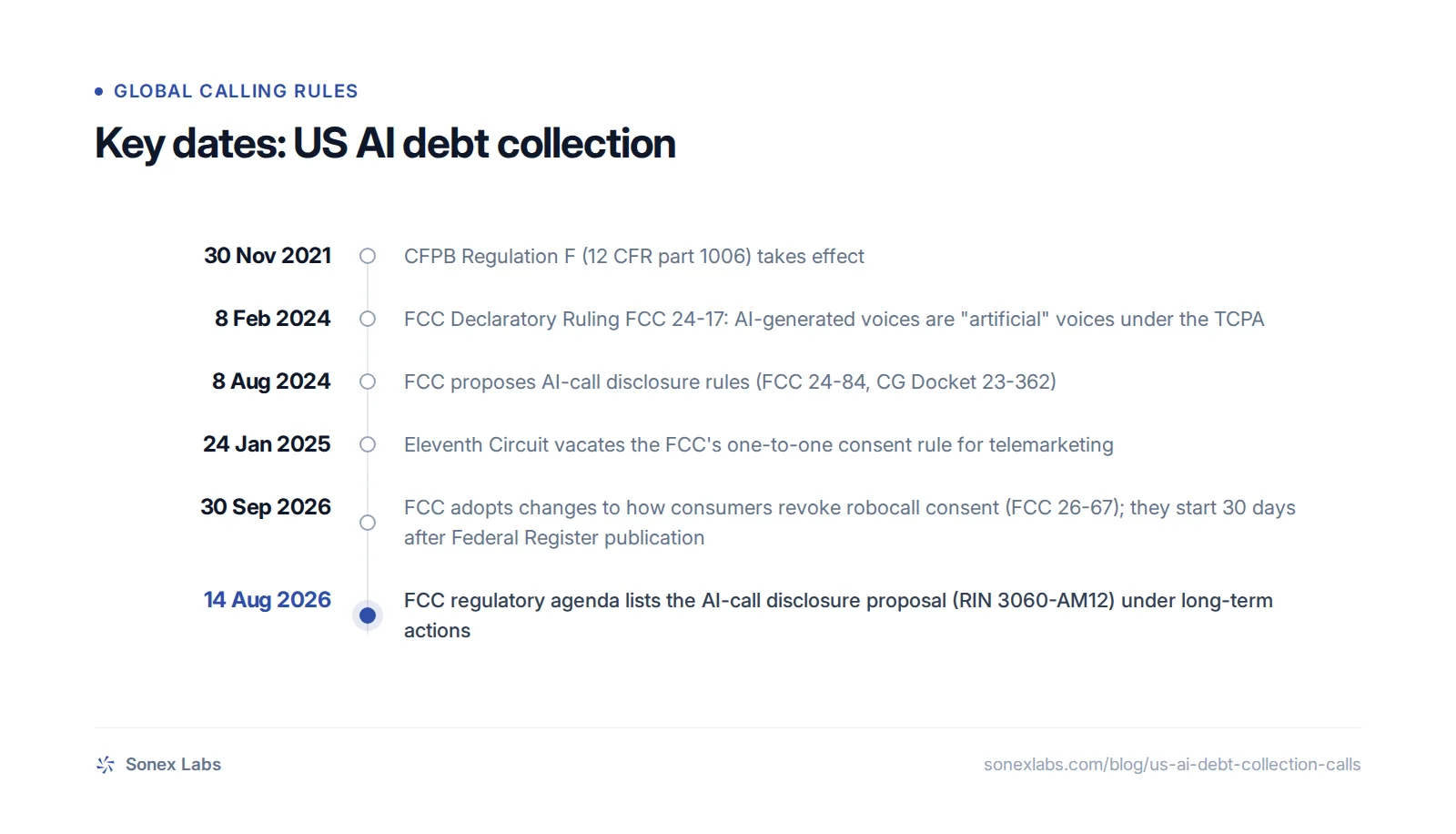
Yes, but the rules were written to stop abusive collection, and they apply to the collector whatever technology places the call. The Fair Debt Collection Practices Act (FDCPA) states its purpose as eliminating "abusive debt collection practices by debt collectors" (15 U.S.C. 1692). Regulation F, the CFPB's rule under that Act, took effect on 30 November 2021 and sets out in detail how a debt collector may communicate (12 CFR part 1006).
Regulation F does not mention AI. Its limits on frequency, timing, disclosures and stop requests therefore apply to an AI agent exactly as they do to a person, and the collector answers for both.
The TCPA is a separate law with a different target: calls made with an autodialler or an artificial or prerecorded voice (47 U.S.C. 227). The Federal Communications Commission (FCC) settled in February 2024 that an AI-generated voice is an artificial voice. Some states add stricter limits on top, so a single AI agent can be answering to three layers of rules on the same call.
Why offshore and Indian vendors are covered too
Teams outside the US sometimes assume these rules stop at the border. In practice they do not. The FDCPA defines a debt collector as anyone who uses interstate commerce, such as phone lines or the mail, in a business whose main purpose is collecting debts. It also covers anyone who regularly collects debts owed to another (15 U.S.C. 1692a(6)).
A business process outsourcing (BPO) firm in Pune dialling US consumers for a US lender is collecting debts owed to another. On our reading, where the vendor sits is not part of the test, so the same rules follow the calls whether they start in the US or in India.
A creditor's own staff collecting in the creditor's name are generally outside the FDCPA. But a creditor that collects under a different name, suggesting that a third party is collecting, becomes a debt collector (1692a(6)). An AI agent that introduces itself under a separate brand can create exactly this problem.
Liability also runs both ways. The FCC has ruled that a seller can be vicariously liable, under federal agency principles, for TCPA violations by third parties calling on its behalf (Declaratory Ruling FCC 13-54, 2013). That ruling was about sellers and telemarketing, but on our reading the same agency logic means outsourcing collections calls does not move the risk away from the US client.
FDCPA statutory damages are up to $1,000 per individual case. In a class action they can reach the lesser of $500,000 or 1% of the collector's net worth (15 U.S.C. 1692k(a)(2)). Because both sides are exposed, contracts should give the client audit rights over dialler logs, consent records and scripts. India's own collection rules are a different regime, covered in RBI's recovery agent rules, and Indian lenders using vendors have outsourcing duties of their own.
How often and when you can call: the 7-in-7 rule and the 8 am to 9 pm window
The two limits that shape an AI dialler most are frequency and timing. Both are built as presumptions rather than flat bans, which matters for how a dialler should be set.
The 7-in-7 rule
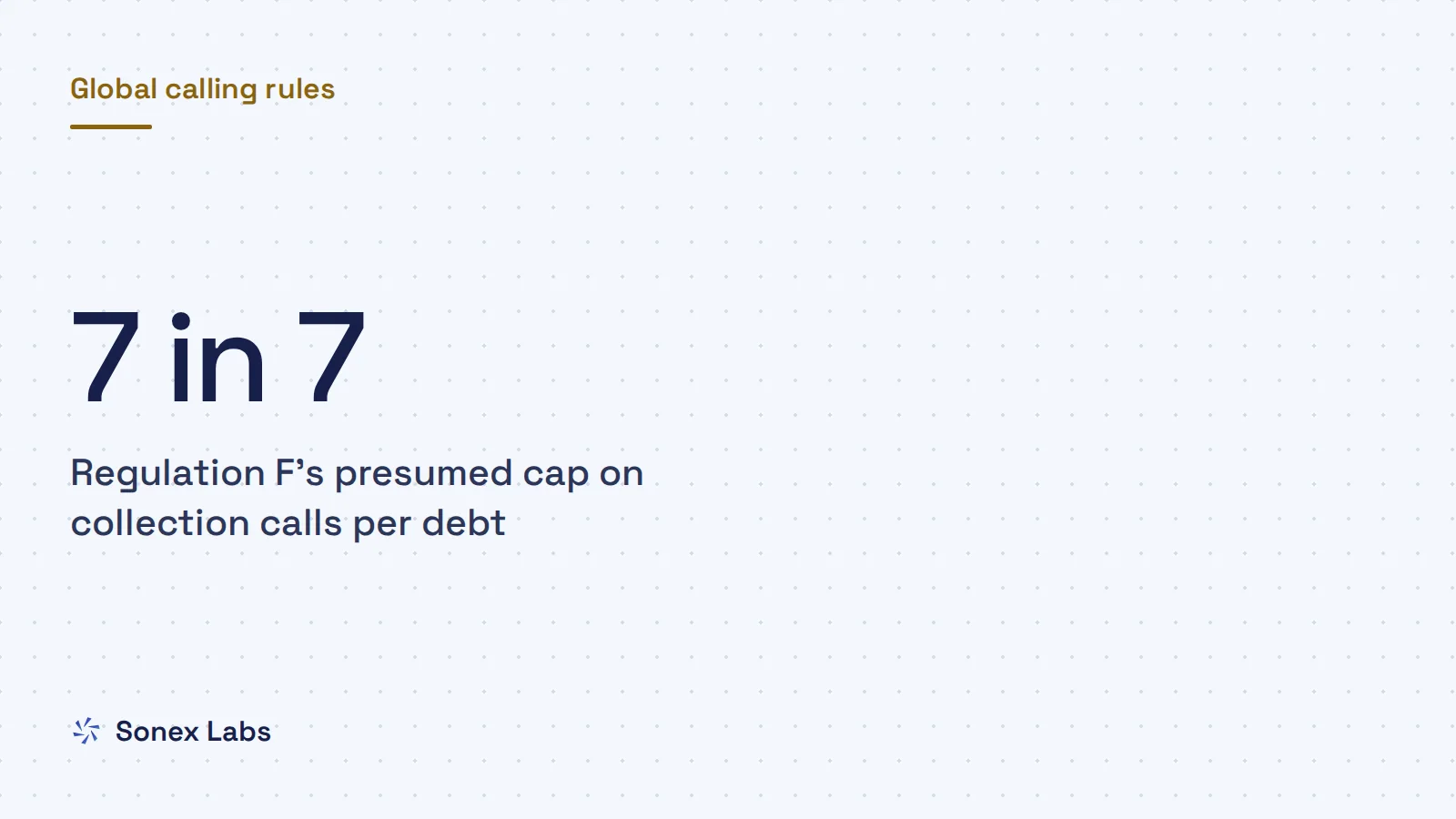
The Regulation F 7-in-7 rule is a presumption about call attempts. A collector is presumed to comply with the ban on harassing calls if it calls a particular person about a particular debt no more than seven times within seven consecutive days. It must also make no call within seven consecutive days after a telephone conversation with that person about the debt, counting the day of the conversation as day one (12 CFR 1006.14(b)(2)(i)). Going over either limit creates the opposite presumption, of a violation (1006.14(b)(2)(ii)).
The count is per debt, so a consumer with three debts in collection has three counters. Three kinds of call do not count (1006.14(b)(3)). The first is a call made with the person's prior consent given directly to the collector, within seven days of that consent. The others are calls that do not connect, and calls to certain third parties such as the consumer's attorney.
'Connected' has a wide meaning here. A call that rings unanswered or goes to voicemail still counts, because it connected. A busy signal or an 'out of service' message is an example of a call that did not connect (comment 14(b)(3)(ii)-1).
Staying under 7-in-7 is a presumption, not a safe harbour. The CFPB's official commentary says the pattern of calls, the number of voicemails, what the consumer has said and the collector's past conduct can all rebut it. An AI dialler that retries quickly within those limits can still look like harassment.
Calling hours follow the consumer's clock
Regulation F tells collectors to assume, unless they know otherwise, that the convenient time to communicate is after 8 am and before 9 pm local time at the consumer's location (12 CFR 1006.6(b)(1)(i)). In practice that is the default calling window. The clock that matters is the consumer's, not the contact centre's, and a consumer who says a time is inconvenient takes that time out of the window.
For a team in India, 8 am to 9 pm Eastern Time is 5:30 pm to 6:30 am India Standard Time (IST) during US daylight time. During US standard time it is 6:30 pm to 7:30 am IST, and Pacific Time runs three hours later still. In other words, most US calling happens during the Indian night shift.
If the collector's records point to more than one time zone, it may call only at times that are convenient in all of them. The CFPB's own example is a mobile number with an Eastern area code and a home address in the Pacific time zone. The convenient times are then after 11 am and before 9 pm Eastern (comment 6(b)(1)(i)-2).
Calling windows, time zones and retry limits are standard settings on outbound platforms; on Sonex, outbound campaigns carry all three, which is the approach behind AI collections calls for lenders. A campaign-level retry limit is not the same thing as a per-debt, per-person counter with a seven-day quiet period, so the collector still has to check how its platform counts.
What an AI agent must say on the call and in a voicemail
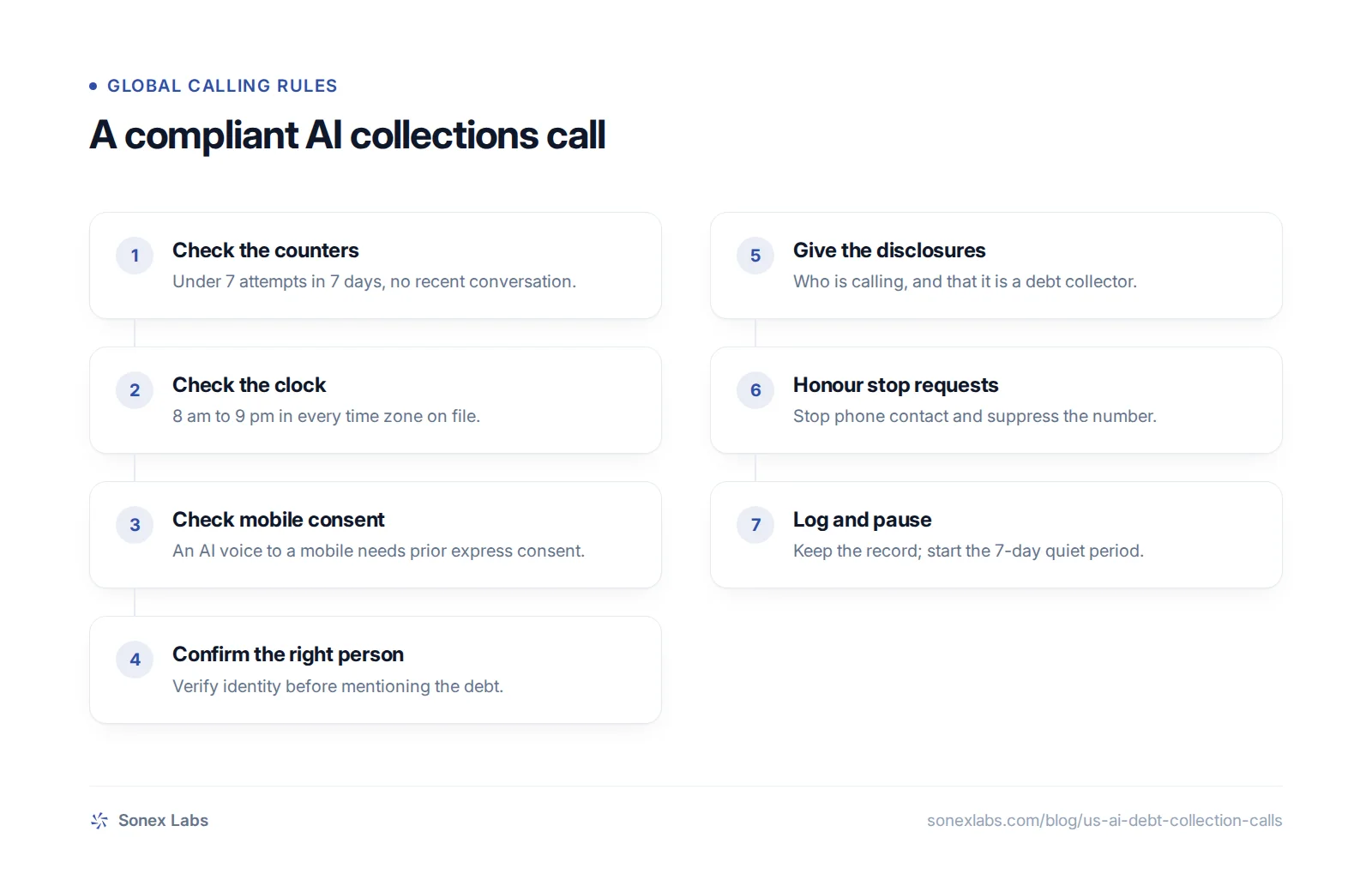
Once the dialler has cleared a call, the agent's first job is to confirm it is speaking to the consumer. Telling a relative or colleague about the debt is a third-party disclosure problem (12 CFR 1006.6(d)).
In the first communication, the collector must say it is a debt collector attempting to collect a debt and that any information obtained will be used for that purpose (1006.18(e)(1)). Every later communication must say it is from a debt collector (1006.18(e)(2)). This is often called the 'mini-Miranda', after the warning US police give on arrest.
A first-call opening that covers it might run: "This is [Collector], a debt collector. This is an attempt to collect a debt, and any information obtained will be used for that purpose." Calls must also meaningfully disclose the caller's identity (1006.14(g)). Versions of the opening for other markets are in the recording-notice and AI disclosure scripts.
The agent should also give, or trigger, the validation information within five days of the first communication (1006.34(a)(1)). That is the notice telling the consumer about the debt and their right to dispute it.
Regulation F has no rule that the caller must say it is an AI. Under the TCPA rules, every artificial or prerecorded voice message must state the identity of the business responsible at the start and give its telephone number (47 CFR 64.1200(b)). Saying the call uses an automated assistant is the safer practice, and the FCC has proposed making that a rule.
Voicemail is where these duties most easily collide, because a message that says too much becomes a full communication. The note below sets out what a safe message may contain, and the flowchart shows where the disclosures sit in a complete call.
The TCPA and AI voices: consent, landlines and revocation
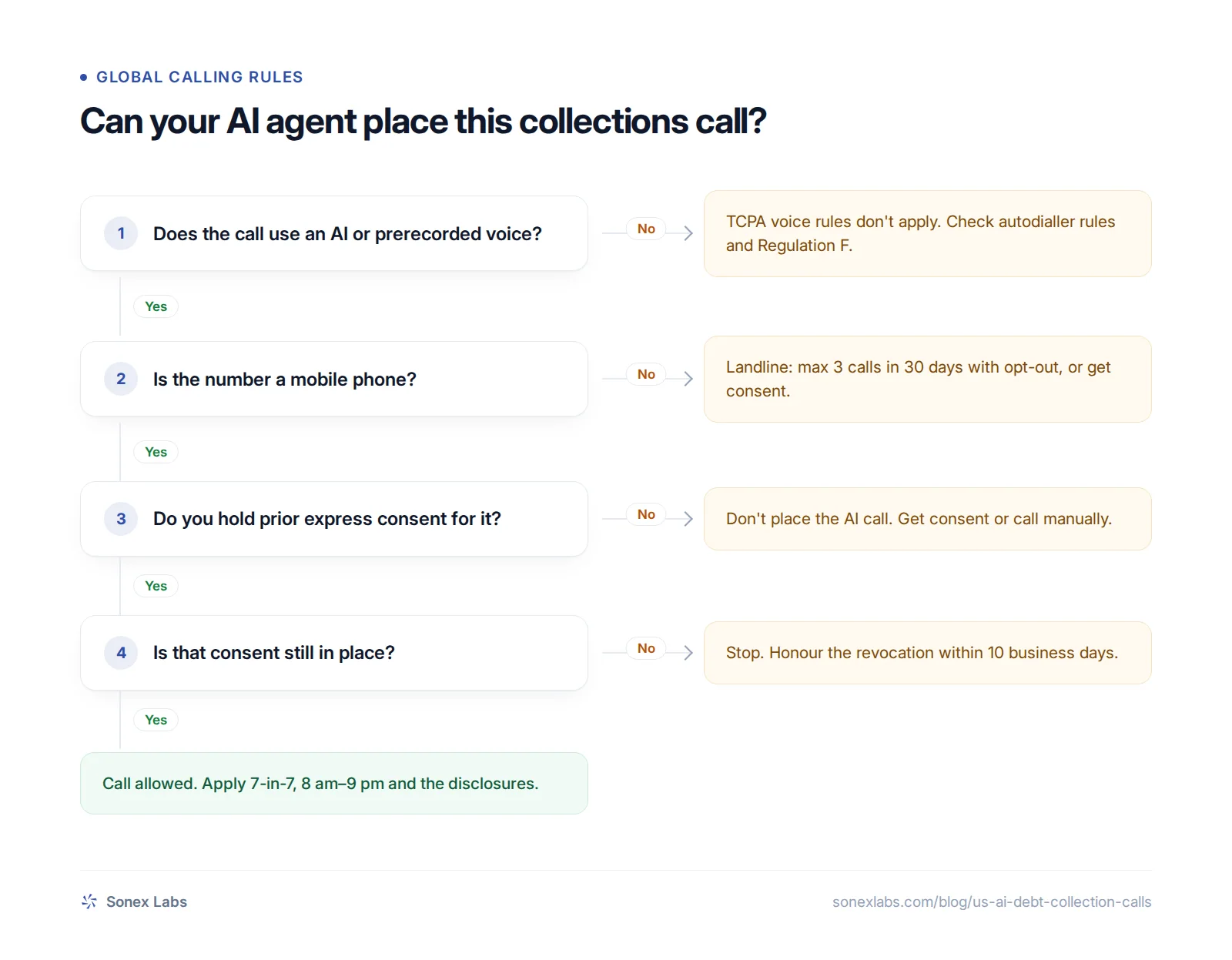
Regulation F governs what a collector says and when; the TCPA decides whether an AI voice may be used on that line at all. Its answer depends on the kind of line and on consent.
AI voices are artificial voices
The FCC settled this in a declaratory ruling adopted on 2 February and released on 8 February 2024 (FCC 24-17). The TCPA's limits on an 'artificial or prerecorded voice' cover current AI technologies that generate human voices, including voice cloning (paragraph 5). The ruling adds that the TCPA allows no carve-out for technologies that claim to be the equivalent of a live agent (paragraph 6).
For collections, that means an AI-voiced call to a mobile phone needs prior express consent, meaning permission from the called party given before the call. Emergency calls are the exception (47 U.S.C. 227(b)(1)(A)(iii)). Debt collection is not telemarketing, so plain prior express consent is the standard, not the written consent required for marketing (FCC 24-17, footnote 13).
The statute also used to exempt calls made solely to collect a debt owed to or guaranteed by the United States. The Supreme Court struck that exemption down on 6 July 2020 and severed it from the rest of the law (Barr v. American Association of Political Consultants, No. 19-631).
Residential landlines
Residential landlines work differently. A non-marketing commercial call with an artificial voice needs no consent if the caller stays within two limits (47 CFR 64.1200(a)(3)(iii)). It may make no more than three such calls to that line in any 30 days, and it must honour every opt-out. These limits have applied since 20 July 2023. That collection calls fall into this category is our reading of the rule text.
Stop requests, revocation and records
Both laws give the consumer a way to end the calls, on different terms. Under Regulation F, once a person asks the collector not to use the phone to contact them, the collector must stop communicating by phone (1006.14(h)(1)). Under the TCPA, consumers can revoke consent in any reasonable way, such as saying 'stop', and the caller must honour it within ten business days (47 CFR 64.1200(a)(10)). An AI agent should treat 'stop' as final and suppress the number at once, which satisfies both.
Consumers can sue under the TCPA for $500 per violation, or up to $1,500 if the violation was wilful or knowing (47 U.S.C. 227(b)(3)). The defence is the record. Regulation F requires a collector to keep records that evidence compliance from the start of collection on a debt until three years after its last collection activity on it. Any call recording it makes must be kept for three years after the date of that call (12 CFR 1006.100).
Stricter state limits: Massachusetts and Washington
The federal rules are a floor, not a ceiling: they do not override stricter state rules. The table compares Regulation F with two states whose limits are tighter. Other states have their own licensing and conduct rules, so every state a collector calls into needs mapping before go-live; the calling rules tool is one starting point.
Massachusetts splits its rules by who is calling. The Attorney General's rules cover creditors and their agents and employees, while licensed debt collectors follow Division of Banks rules (209 CMR 18.00). Those were amended with effect from 26 September 2025, and we could not confirm the current text of their call limit, so licensed collectors should check it directly.
| Rule and who it covers | How often | What hours |
|---|---|---|
| Regulation F (federal): debt collectors under the FDCPASource: 12 CFR 1006.14(b)(2)(i); 12 CFR 1006.6(b)(1)(i) | Presumed compliant at up to 7 calls in 7 days per debt, with a 7-day pause after a conversation | 8 am to 9 pm in the consumer's local time |
| Massachusetts: creditors and their agents and employees, under the Attorney General's rules. Licensed debt collectors follow Division of Banks rules (209 CMR 18.00)Source: 940 CMR 7.04(1)(f), (g) | At most 2 telephone communications in each 7 days per debt, to the debtor's home, mobile or other personal number | The debtor's normal waking hours; if unknown, only 8 am to 9 pm Eastern time |
| Washington: licensed collection agencies and their employeesSource: RCW 19.16.250(13)(a), (c), (18) | More than 3 communications in a week presumed to be harassment. Calls or texts to a mobile at most twice a day | Calls to the home between 9 pm and 7:30 am presumed to be harassment |
Pending FCC changes on AI disclosure and consent
Two parts of this picture are still moving at the FCC. In August 2024 the FCC proposed rules that would define AI-generated calls and require callers to disclose that they use AI-generated voices (FCC 24-84, CG Docket 23-362). No final rule had been adopted as of 24 October 2026. The FCC's regulatory agenda of 14 August 2026 lists the proposal under long-term actions, so it is pending rather than imminent.
The consent-revocation rules are changing too. On 30 September 2026 the FCC adopted an order that lets callers name one or more exclusive ways to opt out, if they disclose them clearly on the call or text (FCC 26-67). The permitted methods are an automated key-press or voice opt-out, a reply using standard opt-out words, or a designated website or phone number.
Under the same order, a revocation made in response to an informational call can be treated as covering only that category of calls. One made in response to telemarketing covers all of the caller's telemarketing robocalls. The order does not say whether collection calls form a single informational category. The ten-business-day deadline to honour a revocation stays for now, although the FCC has asked for comment on changing it.
These changes start 30 days after the order is published in the Federal Register, which had not happened as of 24 October 2026. The FCC says it will announce the exact date in a Public Notice. They replace a wider 'revoke-all' rule that never took effect; the FCC had delayed it to 31 January 2027 (DA 26-12).
Separately, on 24 January 2025 the Eleventh Circuit vacated the FCC's 'one-to-one' consent rule, which would have required marketing consent to name a single seller (Insurance Marketing Coalition v. FCC). That rule concerned telemarketing, so it matters little for pure debt collection calls. It does matter if an AI agent mixes collections with offers such as refinancing. Taking card payments on the call brings in a further standard, explained in PCI DSS rules for card payments on AI calls.
Key dates
Sources
- CFPB: Regulation F, 12 CFR 1006.14 (harassing calls, 7-in-7, identity, media)Official
- CFPB: official interpretation of 12 CFR 1006.14 (comment 14(b)(3)(ii)-1, connected calls)Official
- CFPB: Regulation F, 12 CFR 1006.6 (inconvenient times, third parties)Official
- CFPB: official interpretation of 12 CFR 1006.6 (comment 6(b)(1)(i)-2, conflicting time zones)Official
- CFPB: Regulation F, 12 CFR 1006.18 (required disclosures)Official
- CFPB: Regulation F, 12 CFR 1006.2 (limited-content message)Official
- CFPB: Regulation F, 12 CFR 1006.34 (validation information)Official
- CFPB: Regulation F, 12 CFR 1006.100 (record retention)Official
- Federal Register: Debt Collection Practices (Regulation F) final rule, 85 FR 76734, effective 30 Nov 2021Official
- FCC Declaratory Ruling FCC 24-17 on AI voices under the TCPA (8 Feb 2024)Official
- FCC NPRM FCC 24-84 on AI-generated calls, Federal Register 10 Sep 2024Official
- Federal Register: FCC regulatory agenda, 14 Aug 2026 (RIN 3060-AM12, AI robocalls, long-term actions)Official
- FCC Report and Order FCC 26-67 on consent revocation (adopted 30 Sep 2026)Official
- FCC Order DA 26-12 extending the revoke-all effective date to 31 Jan 2027 (6 Jan 2026)Official
- Federal Register: TCPA exemption limits for residential lines effective 20 Jul 2023 (88 FR 3668)Official
- FCC Declaratory Ruling FCC 13-54 (DISH Network) on sellers' vicarious TCPA liability (2013)Official
- Eleventh Circuit: Insurance Marketing Coalition v. FCC, No. 24-10277 (24 Jan 2025)Official
- 47 U.S.C. 227 (TCPA)Official
- US Supreme Court: Barr v. American Association of Political Consultants, No. 19-631 (6 Jul 2020), striking the government-debt exceptionOfficial
- 47 CFR 64.1200 (FCC TCPA rules)Official
- 15 U.S.C. 1692 (FDCPA findings and purpose)Official
- 15 U.S.C. 1692a (FDCPA definitions)Official
- 15 U.S.C. 1692k (FDCPA civil liability)Official
- Massachusetts 940 CMR 7.04 (debt collection regulations)Official
- Washington RCW 19.16.250 (collection agency prohibited practices)Official
- Reed Smith: Eleventh Circuit vacates FCC one-to-one consent ruleSecondary
Change log: 24 Oct 2026, Rewritten as one continuous guide: dropped the opening rules list, takeaways, steps, checklist and FAQs (AI robocall ban, AI disclosure, lawsuits), whose content now sits in the body; added the FDCPA's purpose, the presumption of violation in 1006.14(b)(2)(ii), 'to a particular person' in the 7-in-7 test and the exact record-retention periods in 1006.100. Earlier the same day: FCC 26-67 allows one or more exclusive opt-out methods, recording retention runs from each call, Massachusetts rule covers creditors' agents, status dates refreshed · 23 Oct 2026, First published