On this page
- Is AI voice cloning legal in India?
- How Indian courts came to protect the voice
- The Arijit Singh order and AI voice models
- Copyright, performer's rights and the training data
- The 2026 deepfake rules and the criminal law
- What a voice cloning consent form should cover
- Running a cloned voice once it is live
- Key dates
- Sources
Is AI voice cloning legal in India?
AI voice cloning can be legal in India if you have the speaker's consent, but no statute says so either way. No Indian law bans voice cloning as such, and none gives anyone a general right to clone another person's voice. The answer has to be pieced together from court orders on personality rights, from copyright law, and from the criminal and IT laws.
Put together, those sources give a fairly simple working rule. Cloning a person's voice with their clear, written consent, for a use they agreed to, is low risk. Cloning a recognisable person's voice for commercial use without consent is exactly what the courts have stopped, again and again, since 2022. Using any cloned voice to deceive someone into handing over money or information can be a criminal offence.
A sound-alike is not a safe way round the rule. The courts have restrained tools that imitate a celebrity's voice, vocal style and singing technique, not only exact copies, so using a famous voice in any recognisable form needs a written licence. The rest of this guide explains where each part of the rule comes from, and it is a starting point, not legal advice.
How Indian courts came to protect the voice
Most of that working rule comes from judges, not from Parliament. Their tool is personality rights, which protect the parts of a person's identity that others could exploit, such as their name, image and likeness. No Indian statute sets them out. Judges have built them from privacy, from passing off (the rule that stops one business presenting its goods as someone else's) and from publicity principles.
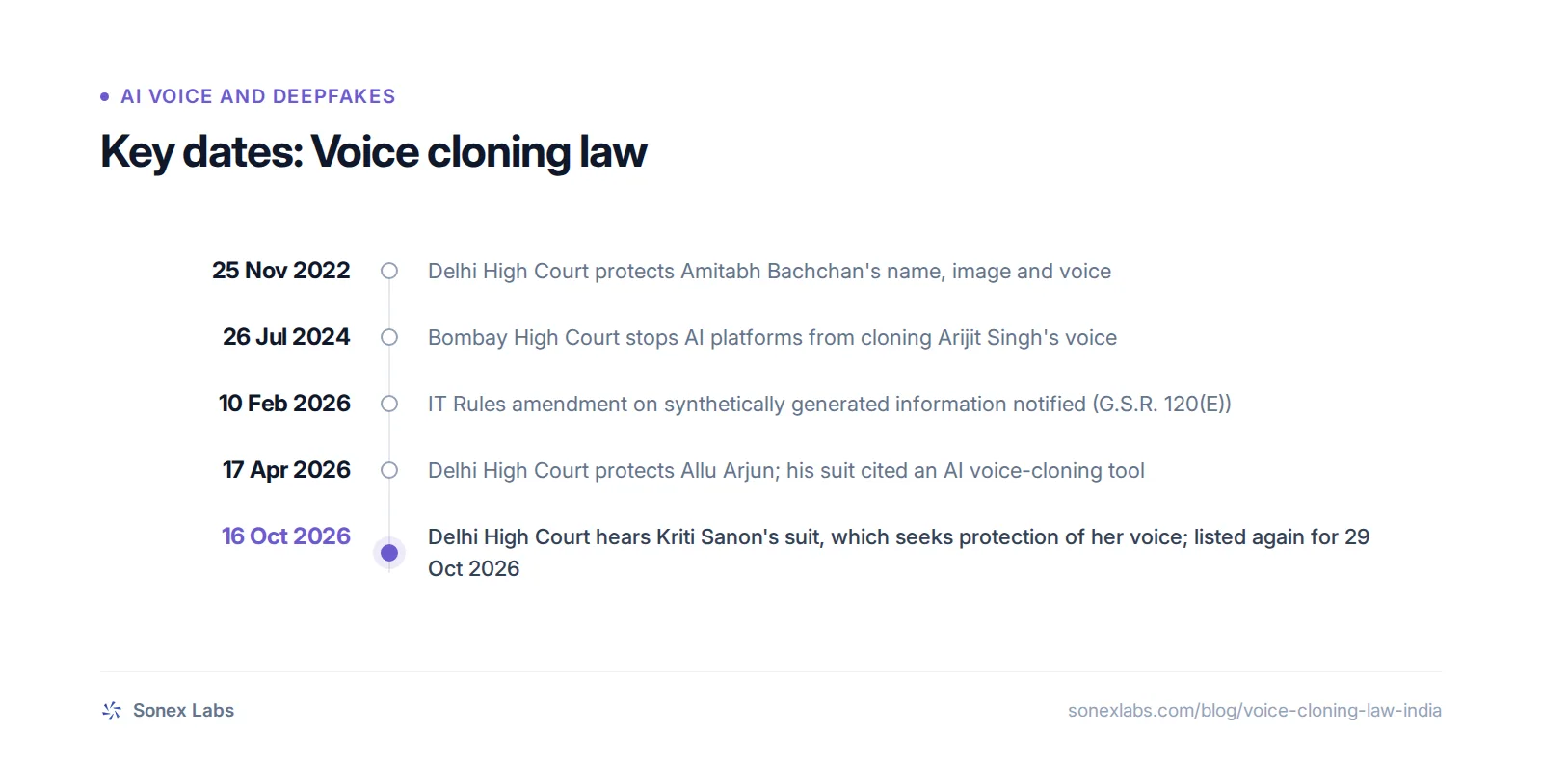
Since 2022 the High Courts have repeatedly named the voice as one of the attributes these rights protect, so a voice is covered in the same way as a face or a name. Read in date order, the orders show how quickly the issue has moved. The 2022 Amitabh Bachchan order dealt with fake lottery and WhatsApp scams. By 2024 courts were restraining AI chatbots and AI voice models, and the 2026 Sonakshi Sinha order, as reported, expressly covers "voice-cloned audio".
Why the protection mostly covers famous people
The orders protect well-known people for a reason built into the test the courts apply. In the Arijit Singh case, the Bombay High Court said that establishing "the celebrity status of the plaintiff is only the primary ingredient". The plaintiff must also show they are identifiable from the unauthorised use, and that the use is for commercial gain (Arijit Singh order, para 18).
So personality rights, as courts have used them so far, protect voices that have commercial value, such as those of actors and singers. Someone who is not famous still has the criminal law on impersonation, described below. On our reading, a recording that identifies a person is also personal data under India's data protection law, which covers any data about a person who can be identified from it (DPDP Act, 2023, section 2(t)). Whether a private person could win a personality-rights injunction over a cloned voice is untested.
The orders so far, and how much weight they carry
The table lists the orders we could confirm, plus one pending suit. For four of them we read the court's own order; the others are known from law-reporting and news sites, and the table says which. All the orders are interim, and most were passed ex parte, meaning before the other side was heard.
That limits what they prove. They show how judges are thinking, but none is a final judgment on whether voice cloning breaks the law, and we found no appeal-court ruling setting the limits as of 24 October 2026.
| Case | What was protected | What the court ordered |
|---|---|---|
| Amitabh Bachchan v Rajat NagiSource: Delhi High Court, Justice Navin Chawla, 25 Nov 2022 (reported by SCC Online and LiveLaw) | Name, image, voice and other attributes, misused in fake lottery and WhatsApp scams | Interim injunction against named and unknown defendants. Telecom and IT ministries told to have infringing links and sites taken down |
| Anil Kapoor v Simply Life IndiaSource: Delhi High Court, Justice Prathiba M. Singh, 20 Sep 2023 (reported by LiveLaw) | Name, voice, image, likeness, the catchphrase 'Jhakaas' and nicknames, including through AI and deepfakes | Interim injunction; listed links taken down; domain names using his name blocked and transferred |
| Jackie Shroff v The Peppy StoreSource: Delhi High Court, Justice Sanjeev Narula, 15 May 2024 (reported by Bar & Bench) | Name, voice, image and 'Bhidu', including AI chatbots that replied in his voice | Social media accounts, AI chatbots and online shops barred from commercial use without consent |
| Arijit Singh v Codible Ventures LLPSource: Bombay High Court, Justice R.I. Chagla, 26 Jul 2024 (order text) | Name, voice, vocal style and technique, mannerisms, image and signature | AI platforms offering his voice models restrained. Covers voice models, voice conversion, synthesised voices and deepfakes |
| Aishwarya Rai Bachchan v Aishwaryaworld.comSource: Delhi High Court, Justice Tejas Karia, 9 Sep 2025 (order text) | Name, image and likeness, including AI and deepfake content | Interim injunction; infringing websites, platforms and YouTube channels blocked. Misuse also breaches privacy, the court said |
| Abhishek BachchanSource: Delhi High Court, Justice Tejas Karia, 10 Sep 2025 (reported by LiveLaw and DT Next) | Name, image, voice and persona, including AI-generated content | Interim injunction against use for commercial gain without consent |
| Karan Johar v Ashok KumarSource: Delhi High Court, Justice Manmeet Pritam Singh Arora, 17 Sep 2025 (reported by SCC Online) | Name, 'KJo', likeness, image, voice and personality | Commercial use barred, including via AI, machine learning, deepfakes and face morphing; infringing sites and accounts blocked |
| Asha Bhosle v Mayk Inc (reported by SCC Online as 'Mayc Inc')Source: Bombay High Court, Justice Arif S. Doctor, 29 Sep 2025 (reported by SCC Online and Verdictum) | Name, voice, manner of singing, vocal style, images and signature. The suit also relied on her moral rights under Copyright Act s.38B | AI platform letting anyone 'sing' in her voice restrained, including from breaching her moral rights; content taken down; Amazon and Flipkart told to delist merchandise |
| Kumar Sanu Bhattacharjee v Jammable LtdSource: Delhi High Court, 15 Oct 2025 (as reported by BananaIP) | Name, voice, image and likeness, including AI voice imitations | Interim injunction covering use through AI tools; platforms to act on future takedown requests, as reported |
| Sonakshi Sinha v Character TechnologiesSource: Delhi High Court, Justice Jyoti Singh, 20 Mar 2026 (reported by SCC Online) | Name, voice, image, likeness and speaking style, including AI chatbots imitating her | Restraint covers 'AI-generated content, deepfake videos, voice-cloned audio'; listed URLs taken down |
| Allu Arjun v Frankly Retail Pvt LtdSource: Delhi High Court, Justice Tushar Rao Gedela, 17 Apr 2026 (order text) | Name, image, likeness and other attributes. The suit cited an AI tool that cloned his voice and a 'fake call' app | Interim injunction against commercial use, including via AI tools and deepfakes. Listed links to be taken down within 72 hours |
| Sanjiv Goenka v Google LLCSource: Delhi High Court, Justice Tushar Rao Gedela, 15 Apr 2026 (order text) | Name, image, likeness and other attributes, against morphed and AI-generated posts and videos. The suit listed his voice among his attributes | Interim injunction, including against AI and deepfake misuse; listed links taken down. The court noted that parody and caricature may not infringe |
| TabuSource: Delhi High Court, Justice Jyoti Singh, 6 Aug 2026 (reported by LiveLaw and Outlook) | Personality rights against derogatory and obscene content, reportedly including AI misuse (Outlook) | Interim takedown of listed posts and links |
| Kriti SanonSource: Delhi High Court, Justice Purushaindra Kumar Kaurav, heard 16 Oct 2026 (reported by LiveLaw) | Seeks protection of name, image, likeness and voice | No order reported as of 24 Oct 2026. On 16 Oct 2026 the court asked for research on the scope of personality rights and listed the suit for 29 Oct 2026 |
The Arijit Singh order and AI voice models
One order in that list deals most directly with the tools businesses now use. On 26 July 2024 the Bombay High Court stopped AI platforms from letting users turn any audio into singer Arijit Singh's voice. The order records that one platform ran 'AI Voice Models' using his name and photograph, where users could paste in any YouTube link or audio file and get it back in his AI voice.
The court treated his voice, vocal style and singing technique as part of his personality, alongside his name and image. It said that "making AI tools available that enable the conversion of any voice into that of a celebrity without his/her permission constitutes a violation of the celebrity's personality rights" (para 18). The restraint covers voice models, voice conversion tools, synthesised voices, deepfakes and similar technology.
This was an ex parte ad-interim order, a temporary order made before the platforms were heard. It was also the earliest order we found aimed squarely at AI voice-model and voice-conversion tools, and trade-mark and IP commentators have described it as the first AI voice-cloning decision in India. The 2023 Anil Kapoor and May 2024 Jackie Shroff orders had already covered AI misuse of a voice, though, so "first" depends on how narrowly you define the tool. The Asha Bhosle order of 29 September 2025 followed the same path, against an AI platform offering songs 'in her voice'.
Copyright, performer's rights and the training data
Personality rights protect a voice as part of someone's identity. Copyright law works differently, and it does not protect a voice from cloning directly, because it protects works and performances, not the sound of a voice itself. But a singer or voice artist holds a performer's right in each performance they give, and that right lasts 50 years (Copyright Act, 1957, section 38).
The performer has the exclusive right to record, reproduce, copy and communicate the performance (section 38A). They also have moral rights. These are the right to be named as the performer, and the right to stop any "distortion, mutilation or other modification" of the performance that would harm their reputation (section 38B).
This is why the training data matters as much as the voice. Training a clone on someone's recorded performances, or remixing those recordings, can engage these rights even where the voice itself is not protected. The Asha Bhosle suit relied on her section 38B moral rights, and the interim order, as reported, restrains breaches of them. The practical rule is to train only on recordings the speaker made for you, never on commercial songs, films or adverts, which carry other people's performer's rights.
The 2026 deepfake rules and the criminal law
There is no standalone deepfake act in India. Two sets of statutes sit alongside the court orders instead: a 2026 amendment to the IT Rules that reaches online platforms, and criminal offences that reach anyone.
IT Rules on synthetic audio
The IT Rules amendment of 10 February 2026 regulates "synthetically generated information" (G.S.R. 120(E); IT Rules as updated on 10 February 2026). That term includes audio a computer has created or altered so that it seems real and may be taken for a real person, so it does cover cloned voices. The duties, though, fall only on intermediaries, meaning platforms that handle content for others.
If they offer tools that make synthetic content, they must label what those tools produce. For audio, the label is "a prominently prefixed audio disclosure", in other words a spoken notice at the start. The rules also ban synthetic content that falsely depicts a real person by misrepresenting their "identity, voice, conduct" in a way likely to deceive.
What is not settled is whether a business that uses a cloned voice on its own phone calls counts as an intermediary. The guide to AI voice labelling rules in India looks at that question in detail.
Crimes of impersonation
Using a cloned voice becomes a crime when it is used to cheat. Cheating by personation, meaning pretending to be someone else in order to cheat, carries up to five years in prison, a fine, or both. It applies whether the person impersonated is real or imaginary (Bharatiya Nyaya Sanhita, 2023, section 319).
The IT Act adds an offence for doing this with technology. Cheating by personation using a computer or a phone carries up to three years in prison and a fine of up to ₹1 lakh (IT Act, 2000, section 66D). Fraudulent use of another person's "unique identification feature" carries the same maximum (section 66C), although whether a voice or voiceprint counts as such a feature is not settled.
A cloned voice that phones a relative or a bank, pretending to be someone else, fits these offences squarely. The offence lies in the deception: cloning a voice is not, by itself, a named crime. The guide to voiceprints and biometric law covers the related question of voice as an identifier.
What a voice cloning consent form should cover
All of this comes back to consent. If you clone an employee's, a founder's or a voice artist's voice, a written release is your main protection. Every court order above turns on the lack of consent, so the release should leave no doubt about what the person agreed to, and it should be signed before any training audio is recorded.
Data protection law points the same way. On our reading, a voice recording that identifies a person is personal data under the Digital Personal Data Protection Act, 2023 (DPDP Act), which expects consent to be free, specific, informed, unconditional and unambiguous (section 6(1)). For an employee that matters most at the exit: the release should say what happens to the model when they leave. The guide to what the DPDP Act means for voice AI covers the notice and erasure duties that start on 13 May 2027.
Some details depend on the tool. On Pāṇini TTS, for example, a voice can be cloned from a 10-second recording, and a cloned voice carries across languages, so a release for a business clone should name the languages as well as the purposes. A release that covers the points below meets both the courts' focus on consent and the DPDP standard:
- Who and what: the speaker's full name, the legal entity that may use the voice, the recordings used for training, and that a synthetic voice model will be built from them.
- Use: the purposes allowed (for example, outbound service calls in named languages) and those excluded (adverts, political content, endorsements).
- Disclosure: whether listeners will be told the voice is AI-generated, and the exact wording.
- Term, territory and pay: how long and where the model may be used, and any fees or royalties, especially for professional voice artists with performer's rights.
- Withdrawal and exit: how the person can withdraw consent, and what happens to the model and data when they do or when they leave the company.
- Security and deletion: who can access the model, a promise not to share or sell it, and deletion of the training audio and model at the end of the term.
- Moral rights: no use that distorts the person's performance or harms their reputation.
Running a cloned voice once it is live
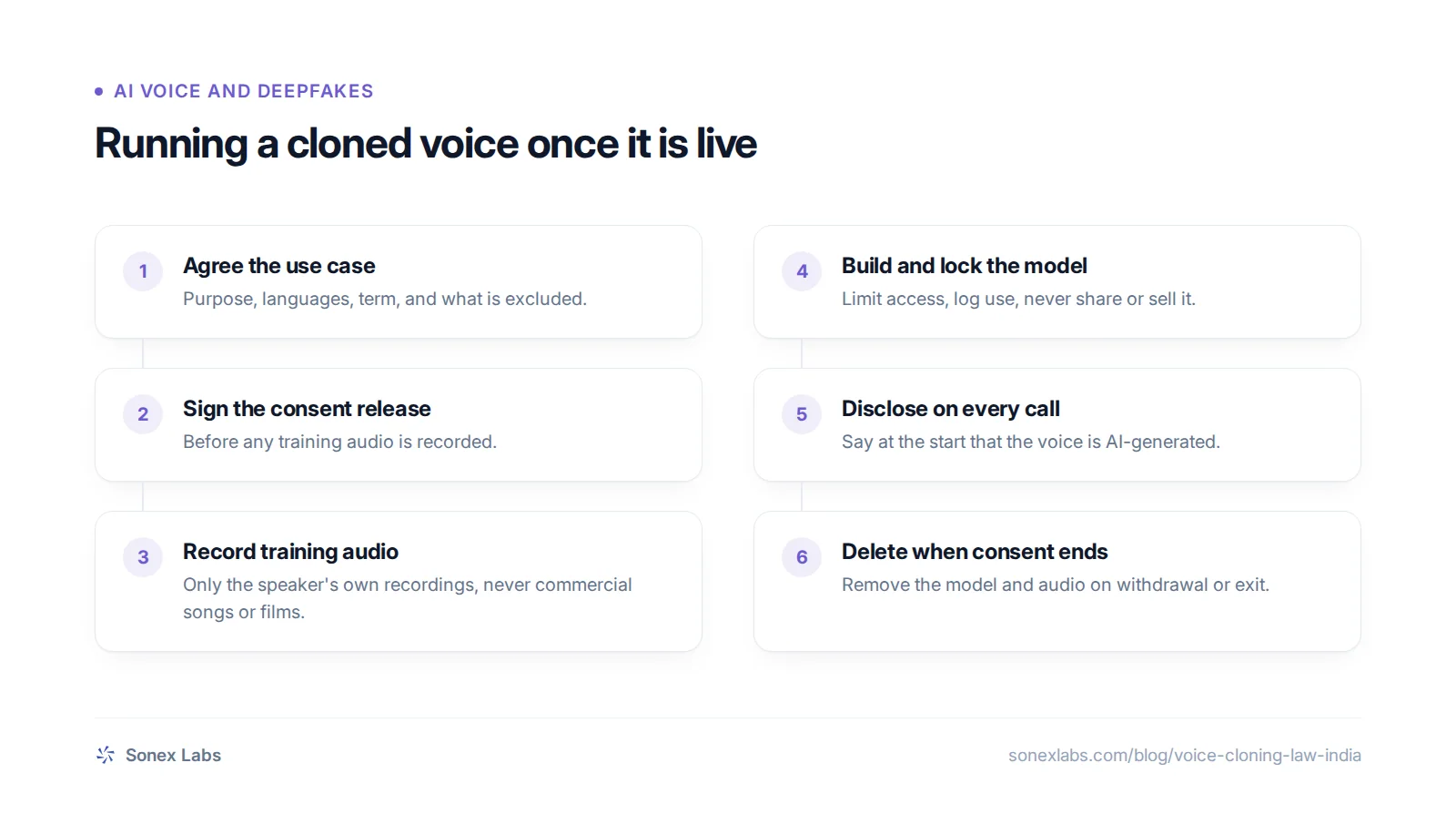
Consent is the start, not the end. Telling listeners at the start of each call that they are hearing an AI-generated voice is the habit that keeps a lawful clone from becoming a deceptive one. A line such as "This message uses an AI-generated version of [Name]'s voice, created with their permission, on behalf of [Company]" does the job, and the AI disclosure scripts have versions in several languages.
The model itself needs protecting, because a leaked clone can be used to impersonate the speaker in scam calls. Limit who can use it, log every use, and never share or sell it. Keep the release, the training recordings and each model version on file while the voice is in use. When the speaker withdraws consent, leaves the company or the term ends, delete the model and training audio and record the date.
A published contact for reports of a misused cloned voice, with quick takedowns and a record of each complaint, rounds this off. The chart shows the whole sequence, from agreeing the use to deleting the model.
Key dates
Sources
- Bombay High Court order, Arijit Singh v Codible Ventures LLP, 26 Jul 2024 (copy hosted by Columbia Global Freedom of Expression)Official
- Delhi High Court order, Aishwarya Rai Bachchan v Aishwaryaworld.com, CS(COMM) 956/2025, 9 Sep 2025 (copy hosted by LiveLaw)Official
- Delhi High Court order, Allu Arjun v Frankly Retail Pvt Ltd, CS(COMM) 403/2026, 17 Apr 2026 (copy hosted by MediaNama)Official
- Delhi High Court order, Sanjiv Goenka v Google LLC, CS(COMM) 395/2026, 15 Apr 2026Official
- Digital Personal Data Protection Act, 2023 (Gazette text)Official
- Copyright Act, 1957, Chapter VIII (sections 38, 38A, 38B)Official
- Information Technology Act, 2000, as amended, incl. sections 66C and 66D (India Code)Official
- MeitY: IT (Intermediary Guidelines and Digital Media Ethics Code) Rules, updated as on 10.02.2026Official
- SCC Online: Amitabh Bachchan interim injunction, Nov 2022Secondary
- LiveLaw: Amitabh Bachchan order, Nov 2022 (DoT, MeitY and telecom directions)Secondary
- LiveLaw: Anil Kapoor personality rights order, Sep 2023Secondary
- Bar & Bench: Jackie Shroff order, May 2024Secondary
- SpicyIP: Arijit Singh order analysisSecondary
- LiveLaw: Aishwarya Rai Bachchan order, Sep 2025Secondary
- LiveLaw: Abhishek Bachchan order, Sep 2025Secondary
- DT Next: Abhishek Bachchan order, Sep 2025Secondary
- SCC Online: Karan Johar order, Sep 2025Secondary
- SCC Online: Asha Bhosle order, Sep 2025Secondary
- Verdictum: Asha Bhosle v Mayk Inc, Oct 2025Secondary
- BananaIP: Kumar Sanu order review, Oct 2025Secondary
- SCC Online: Sonakshi Sinha order, Mar 2026Secondary
- MediaNama: Allu Arjun order, Apr 2026Secondary
- Hollywood Reporter India: Sanjiv Goenka order, Apr 2026Secondary
- LiveLaw: Tabu order, Aug 2026Secondary
- Outlook: Delhi HC protects Tabu's personality rights from AI misuse, Aug 2026Secondary
- LiveLaw: Kriti Sanon suit, Oct 2026Secondary
- BNS section 319 text (Devgan)Secondary
Change log: 24 Oct 2026, Rewritten as one continuous guide: added the Arijit Singh order's three-part test (celebrity status, identifiability, commercial gain) to explain why protection mostly covers famous people; marked each table row as read from the order or as reported; added the competing 'first AI voice-cloning decision' description; split the deepfake rules and the criminal law into subsections; added a section on running a live clone. The decision chart, takeaways, steps, checklist and FAQs were folded into the body · 24 Oct 2026, Corrected the Goenka, Allu Arjun, Abhishek Bachchan and Asha Bhosle rows against the orders and reports; dated the Kriti Sanon listing; AI-voice orders date from 2023 · 23 Oct 2026, First published