On this page
- Why India is putting caller names on screen
- How CNAP works, and how it differs from Truecaller
- Which name customers will see when a business calls
- Setting a preferred display name for business calls
- AI voice calls, SIP trunks and designated number series
- Hiding a caller name and switching CNAP off
- Key dates
- Sources
Why India is putting caller names on screen
CNAP supplies that name from the network's own records: the details a subscriber gave in KYC (know-your-customer) checks when taking the connection. It is meant to help people judge a call before they answer, which matters most to businesses, whose calls usually arrive from numbers customers have not saved.
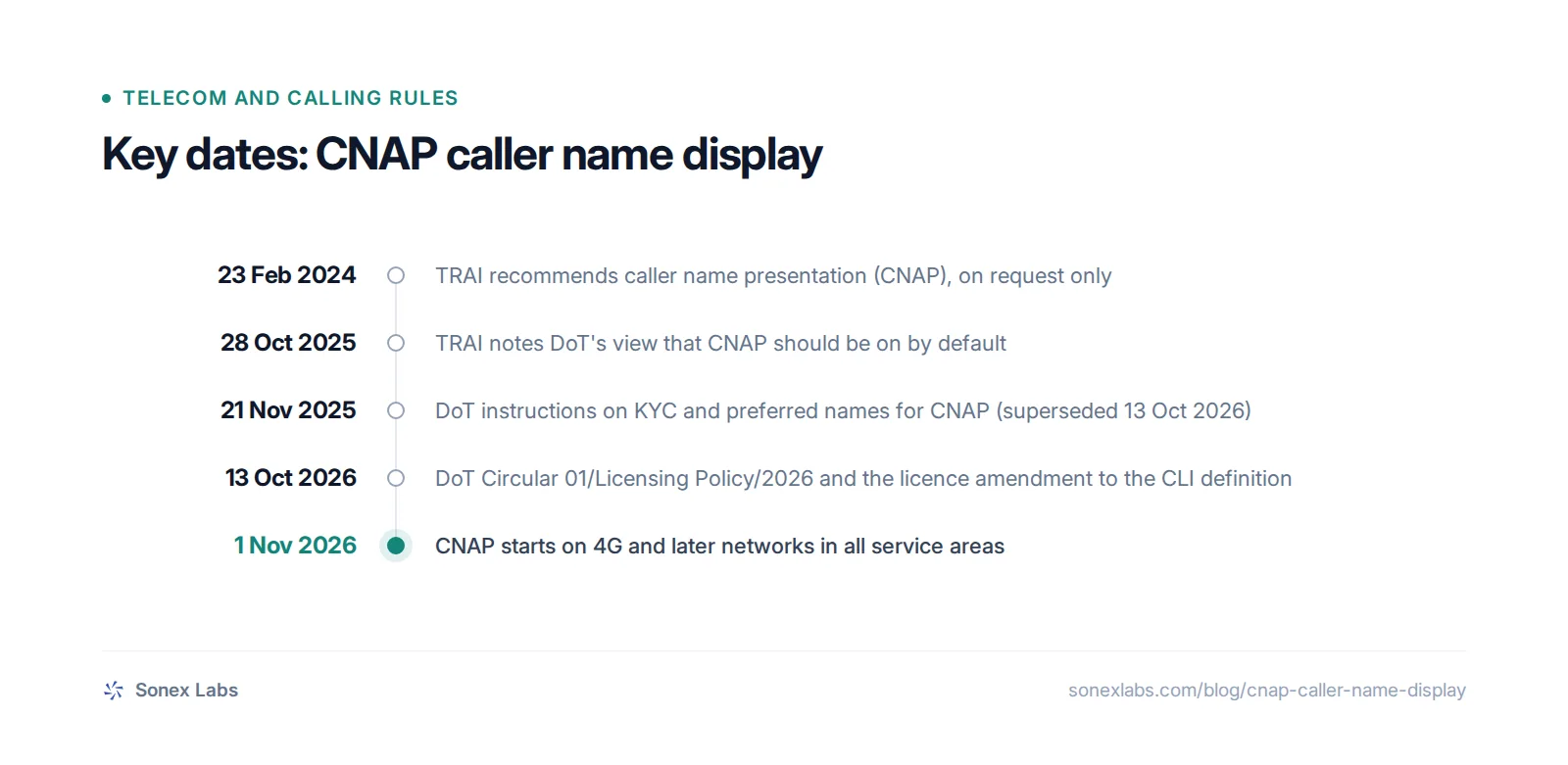
The idea took more than two years to settle. The Telecom Regulatory Authority of India (TRAI) recommended CNAP on 23 February 2024, but only for customers who asked for it (TRAI recommendations on CNAP, recommendation 3.1(b)). The Department of Telecommunications (DoT) preferred it on by default, a view TRAI recorded in its response of 28 October 2025. DoT then issued interim instructions on KYC and preferred names on 21 November 2025.
The final rules came on 13 October 2026. DoT Circular 01/Licensing Policy/2026 tells every mobile operator to switch CNAP on from 1 November 2026, in all service areas (DoT CNAP circular, para 2). It expressly supersedes the November 2025 instructions (para 9).
What starts on 1 November 2026
The service covers wireless networks built on 4G and later technologies. Operators must provide it "without the requirement of any separate request", so nobody has to opt in (para 4(a)). CNAP on 2G, 3G and fixed-line networks will be considered separately, and no date has been set for them.
On the same day DoT amended the Unified Licence that operators hold. CLI (calling line identification) is the caller identity a network passes on with each call. From 1 November 2026 it can mean the caller's number or the user's name as recorded in the subscriber data record (Unified Licence Amendment No. 01/Licensing Policy/2026). The name becomes part of the call's identity in law, not just a feature on some phones.
How CNAP works, and how it differs from Truecaller
CNAP is not a government caller-ID app, or an app of any kind. It is a service run by the telecom networks. The caller's operator keeps a database of names against numbers, and the receiving operator looks the name up and shows it during the call (para 4(c)). To protect privacy, the lookup must not keep the caller's name once the call ends (para 5(a)).
Whether a handset shows the name is a separate question. TRAI recommended that all phones sold in India support CNAP after a cut-off date. DoT said it would take the handset question up with MeitY, the IT ministry (TRAI's response of 28 October 2025). As of 24 October 2026 we found no published handset deadline.
Third-party caller-ID and spam apps such as Truecaller carry on alongside CNAP, and DoT's circular does not mention them. They use their own crowd-sourced data, so a customer may see one name from the network and a different name or a spam label from an app. Truecaller's chief executive, Rishit Jhunjhunwala, has argued that the two do different jobs: "Knowing a name doesn't solve the rise of spam and fraud calls" (Business Today, 16 October 2026).
TRAI's rules already limit what those apps can do with business numbers. TRAI rewrote regulation 34A in its September 2026 amendment, published in the Gazette on 28 September 2026 (CG-DL-E-28092026-276548), with effect from 28 October 2026. Under it, apps may not tag, block or filter calls from 140, 1600 or 1601 numbers for everyone. Each user can still block numbers on their own phone. The guide to the 140, 1600 and 1601 number series explains which calls belong on which series.
Which name customers will see when a business calls
For a business, the practical question is which name appears. The screen shows two fields: the number, as today, and a name. For a business call to someone who has not saved your number, the name is whatever your operator has on your subscriber record, usually the company name on your connection paperwork.
For many firms that will be a legal-entity name, such as a private limited company's registered name, rather than the brand customers know. The preferred-name route in the next section is how a business closes that gap.
If the name is plainly wrong, the operator that holds the number is the place to complain. DoT's circular requires every operator to run a grievance process for CNAP complaints, such as a wrong name (para 7). Written replies from the operator about the name it holds on each number are useful evidence if the problem persists.
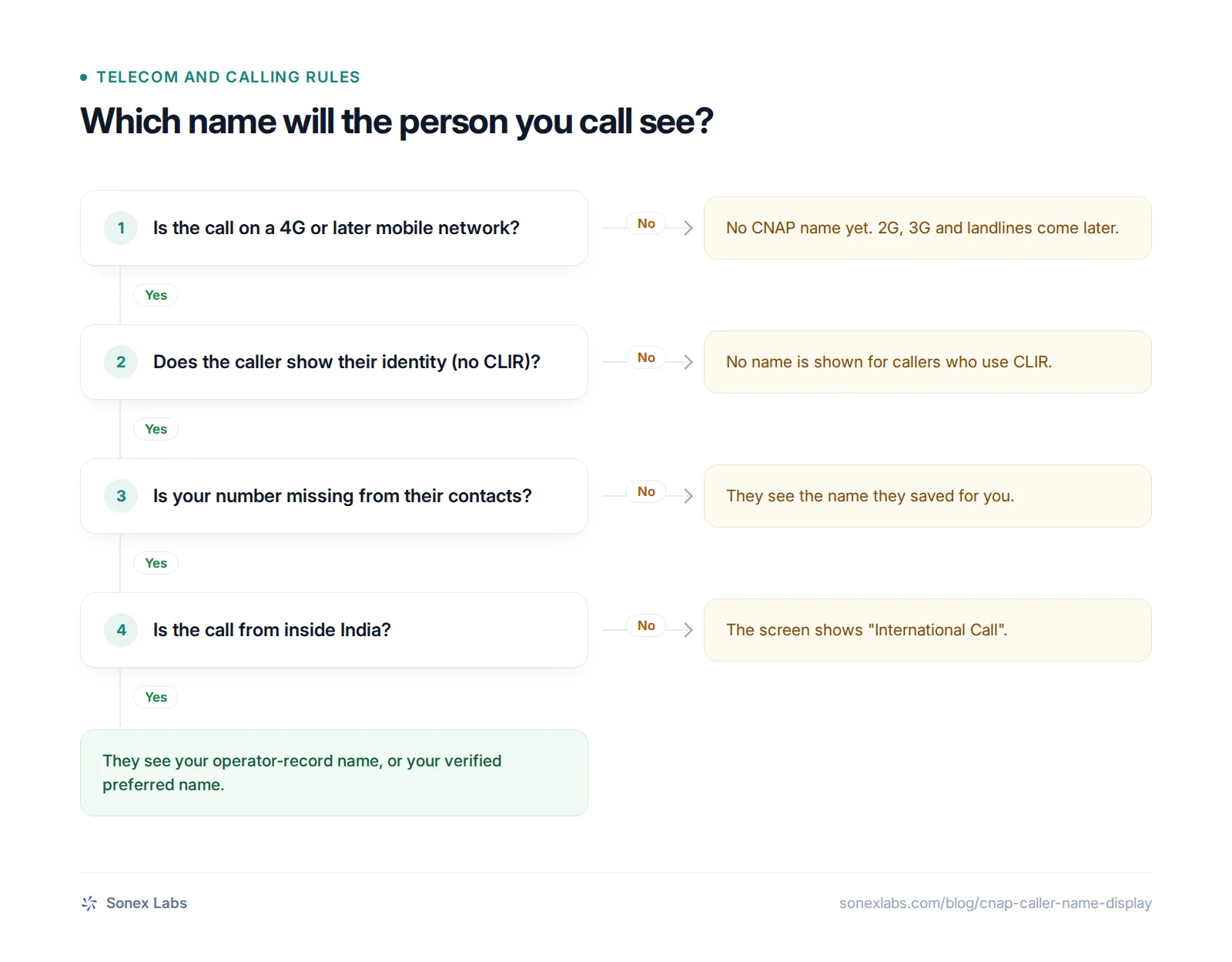
In full, the circular sets this order for choosing the name (para 4(b)):
- If the person has saved your number, they see the name in their own contacts.
- If not, and the call is domestic, they see your name from the originating operator's subscriber records.
- If the call comes from abroad, they see the words "International Call".
Setting a preferred display name for business calls
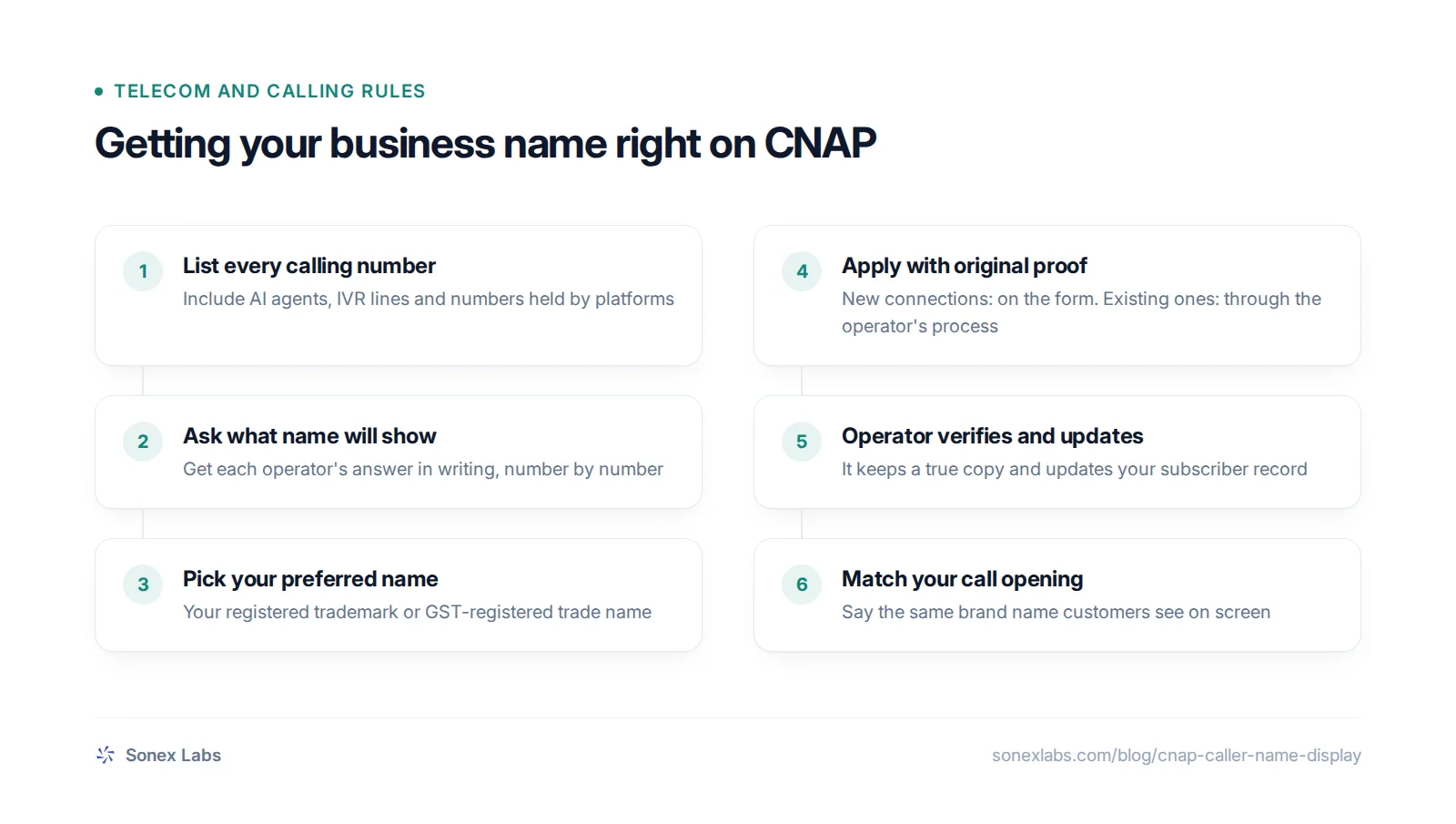
If you hold business or bulk connections, your operator may let you show a preferred name instead of your registered name (para 6). It must be a trademark registered in your name with the Trade Marks Registry, or your trade name as registered on the GST portal. The operator must verify it before switching it on. The circular describes the option only for business and bulk connections, so on other connections people see the name on the subscriber record.
For a new connection, you give the preferred name on the application form and show original proof, and the operator keeps a true copy. For an existing connection, the operator must set up a way to apply, and updates the record after checking your documents. The circular permits operators to offer the option rather than requiring it, so ask yours how and when.
The options have narrowed since 2024. TRAI's recommendation and DoT's November 2025 instructions also allowed other government-registered names. The October 2026 circular accepts only a registered trademark or GST trade name, as the table shows. The flowchart sets out the whole process, from listing your numbers to matching your call scripts.
| Document | What it allows | Status |
|---|---|---|
| TRAI recommendations, 23 Feb 2024 | Trademark name, GST trade name, or any other unique name registered with the government | Recommendation only |
| DoT instructions 800-18/2025-LPU, 21 Nov 2025 | Registered trademark, GST trade name, or any other officially recognised name registered with a government authority | Superseded by the October 2026 circular |
| DoT Circular 01/Licensing Policy/2026, 13 Oct 2026 | Only a trademark registered in your name with the Trade Marks Registry, or your GST-registered trade name | Applies from 1 Nov 2026 |
AI voice calls, SIP trunks and designated number series
Getting the name right matters most for businesses that call at scale, including with AI. CNAP shows who holds the number, not who or what is speaking. A call placed by an AI voice agent from your numbers shows your registered or preferred name, the same as a call from a human agent on those numbers.
That makes the subscriber record part of your caller identity. A customer who sees an unfamiliar legal-entity name, or a platform's name, may not pick up, and a greeting that uses a different name gives them a reason to doubt the call. So the name needs to be right on every number your agents call from, and the opening line should match it. The recording-notice and AI disclosure scripts include openings that name the business first.
Business lines and designated series: an open question
Whether the name will show on the lines businesses use for bulk calling is not settled. DoT's circular applies to 4G and later wireless networks and leaves fixed-line networks for later. It does not mention virtual numbers, TRAI's 140, 1600 and 1601 series, or SIP trunks and PRI lines, the digital lines businesses use for bulk calling.
TRAI did recommend in 2024 that calls from 140 numbers, and from any series for service or transactional calls, should invariably show the business's name (recommendation 3.6). DoT's October 2026 circular does not take this up. We found no DoT text that settles it, so the safest course is to ask each operator you call through, in writing, what name will display on each of your numbers. The number series lookup tool shows which series a given call should use in the first place.
Numbers held by a platform or reseller
Who holds the number matters too. The name comes from the subscriber record of the operator where the call starts, so if your numbers are held in a reseller's or platform's name, that name may be the one shown. TRAI's 1601 series is allotted directly to the business, not to an aggregator, which avoids the problem for those numbers.
Calling from numbers in your own name is the simplest fix. On Sonex, for example, outbound AI calling can run on telephony you bring from your own operator, in which case the name shown is the one on your own subscriber record. Calls from those numbers also fall under TRAI's 2026 rules for AI and automated calls, including the A2P declaration.
Hiding a caller name and switching CNAP off
The last open point is how much control callers and the people they call have. Callers who use CLIR (calling line identification restriction), which withholds the caller's identity under existing rules, will not have their name shown either (para 8). The circular gives callers no other way to opt out.
For people receiving calls, the 13 October 2026 circular has no option to switch CNAP off. Some news reports say users can opt out through their operator. That idea traces to DoT's 2025 view, recorded by TRAI, that a called user who does not want CNAP could "request to disable it as per procedure" (TRAI response, 28 October 2025). The wording does not appear in the circular, so whether an opt-out will be offered later is unclear.
Key dates
Sources
- DoT Circular 01/Licensing Policy/2026: Introduction of calling name presentation service, 13 October 2026Official
- DoT: Unified License Amendment No. 01/Licensing Policy/2026 (CLI definition), 13 October 2026Official
- DoT instructions 800-18/2025-LPU on CNAP KYC issues, 21 November 2025 (superseded 13 October 2026)Official
- TRAI: response to DoT back-reference on CNAP, 28 October 2025Official
- TRAI: recommendations on calling name presentation, 23 February 2024Official
- TRAI Press Release 08/2024: CNAP recommendations, 23 February 2024Official
- TRAI: TCCCPR (Third Amendment) Regulations, 2026 (regulation 34A)Official
- Gazette of India: TCCCPR (Third Amendment) Regulations, 2026, published 28 Sep 2026 (CG-DL-E-28092026-276548)Official
- Inc42: Centre directs telcos to display caller names from 1 NovemberSecondary
- Business Today: Truecaller says CNAP won't replace its caller ID in India, 16 October 2026Secondary
Change log: 23 Oct 2026, First published · 24 Oct 2026, Confirmed the circular supersedes DoT's November 2025 instructions; scope now reads 4G and later networks throughout; exact TRAI start dates from the Gazette (published 28 Sep 2026). Later the same day, rewritten as one continuous guide: added why CNAP was introduced and how the default-on decision was reached, Truecaller's response, and where opt-out reports come from; the takeaways, steps, checklist and FAQs were folded into the body