On this page
- Why the UAE regulates marketing calls, and who the rules cover
- Can an AI voice agent make sales calls in the UAE?
- Who you may call: the Do Not Call Register and your own opt-in list
- Calling hours, weekends and how often you can call back
- Fines, suspensions and how the rules are enforced
- Stricter Central Bank rules for banks and insurers
- Key dates
- Sources
Why the UAE regulates marketing calls, and who the rules cover
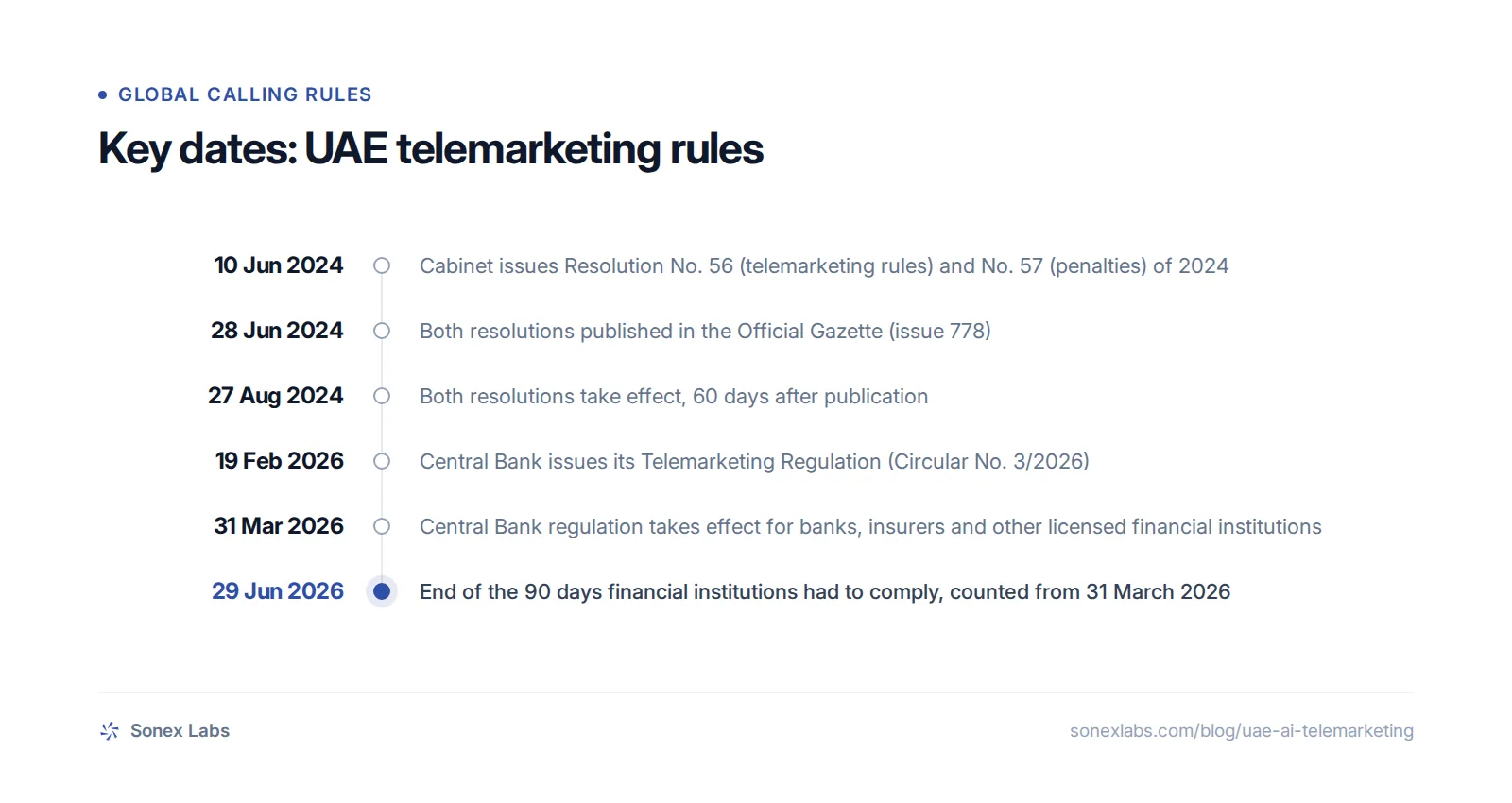
The UAE Cabinet issued two linked decisions on 10 June 2024, and both took effect on 27 August 2024, 60 days after they appeared in the Official Gazette. Cabinet Resolution No. 56 of 2024 sets the rules for marketing by phone. Its stated aims are to organise telemarketing, make companies keep to permitted channels and times, and reduce unwanted calls so that consumers are not disturbed and their privacy is respected (Article 2). Cabinet Resolution No. 57 of 2024 puts a price on breaking each of those rules.
The rules apply to every company licensed in the UAE that markets products or services by phone, including companies in free zones (Resolution 56, Article 3(1)). Telemarketing is defined broadly. It covers calls from a landline or mobile number made to market, advertise or promote a product or service, and it includes marketing text messages and marketing messages sent through social media apps (Article 1). A follow-up text or chat message from an AI agent that promotes a product is therefore covered as well as the call itself.
One definition matters more than it first appears. An unwanted marketing call is one made in breach of the resolution, and the definition expressly excludes calls made at the consumer's request (Article 1). A callback that someone asked for, such as a reply to a web enquiry, is in a different position from a cold call. The duties on hours, recording and disclosure are still written for every marketing call, though, so the safe course is to apply them to requested calls too.
What the resolution bans outright is selling from a personal line. An individual may not make marketing calls for products or services from a landline or mobile number registered in their own name (Article 3(2)). This is the cold calling ban that UAE residents talk about. Telemarketing itself is not banned, but a personal SIM card can no longer serve as a sales tool, and the penalty for using one falls on the individual.
Who enforces the rules
Enforcement is split by sector (Resolution 56, Article 9). The Central Bank of the UAE (CBUAE) handles marketing calls by the banks, insurers and other financial firms it licenses, and the Securities and Commodities Authority handles calls that market securities and commodities trading. For every other company, the competent authority is the licensing body in its emirate. The Ministry of Economy has general oversight, and the Telecommunications and Digital Government Regulatory Authority (TDRA), the telecom regulator, supervises the Do Not Call Register and acts against individuals.
Dubai shows how this works. The Dubai Corporation for Consumer Protection and Fair Trade, part of the Department of Economy and Tourism, warned 174 companies and then fined 159 of them AED 50,000 each in the first months of the rules, Gulf Today reported on 25 February 2025. Each authority may also add controls of its own, provided they do not cancel or soften the resolution's duties (Article 5(9)). Check your own licensing authority's requirements as well as the federal text, for instance on how long it wants your call register kept.
Can an AI voice agent make sales calls in the UAE?
Yes. Resolution 56 says companies may use automated communication systems to market, advertise and promote their products and services "in accordance with the provisions of this resolution" (Article 5(6)). The wording cuts both ways. Automation is allowed, but it buys no exemption. Using automated calling in breach of the rules is a fine of its own: AED 10,000 for a first violation, rising to AED 50,000 for a third (Resolution 57, Table 1, item 16).
An AI agent therefore carries every duty a human telemarketer does, and several are easier to meet in software than with a room of callers. A dialler can refuse to place a call outside permitted hours, count retries for each number and block a number for good after a refusal. On Sonex, for example, each outbound calling campaign has its own calling window, time zone and retry limit, and every call is kept as a recording and a transcript.
What the rules do not settle is whether the caller must say it is an AI. Neither Resolution 56 nor the Central Bank's telemarketing regulation requires an "I am an AI" statement. The regulation says only that the use of AI is subject to applicable laws and regulations (Article 16.2). For banks and insurers, the Central Bank's AI guidance note of 11 February 2026 goes further: firms "should be transparent" when customers are interacting with an AI application, with disclosures in Arabic and English (paragraph 4). That is guidance rather than a binding rule, and nothing equivalent exists for other sectors.
Our recommendation, which goes beyond what the UAE text requires, is to say it plainly in the opening line anyway. The rules already demand a scripted opening, so one more sentence costs little, and it removes any later argument that a person was misled about who was calling. Companies that also call Europe will need it regardless, because the EU AI Act's transparency rule for AI voice agents makes disclosure a legal duty there.
What to say in the first few seconds
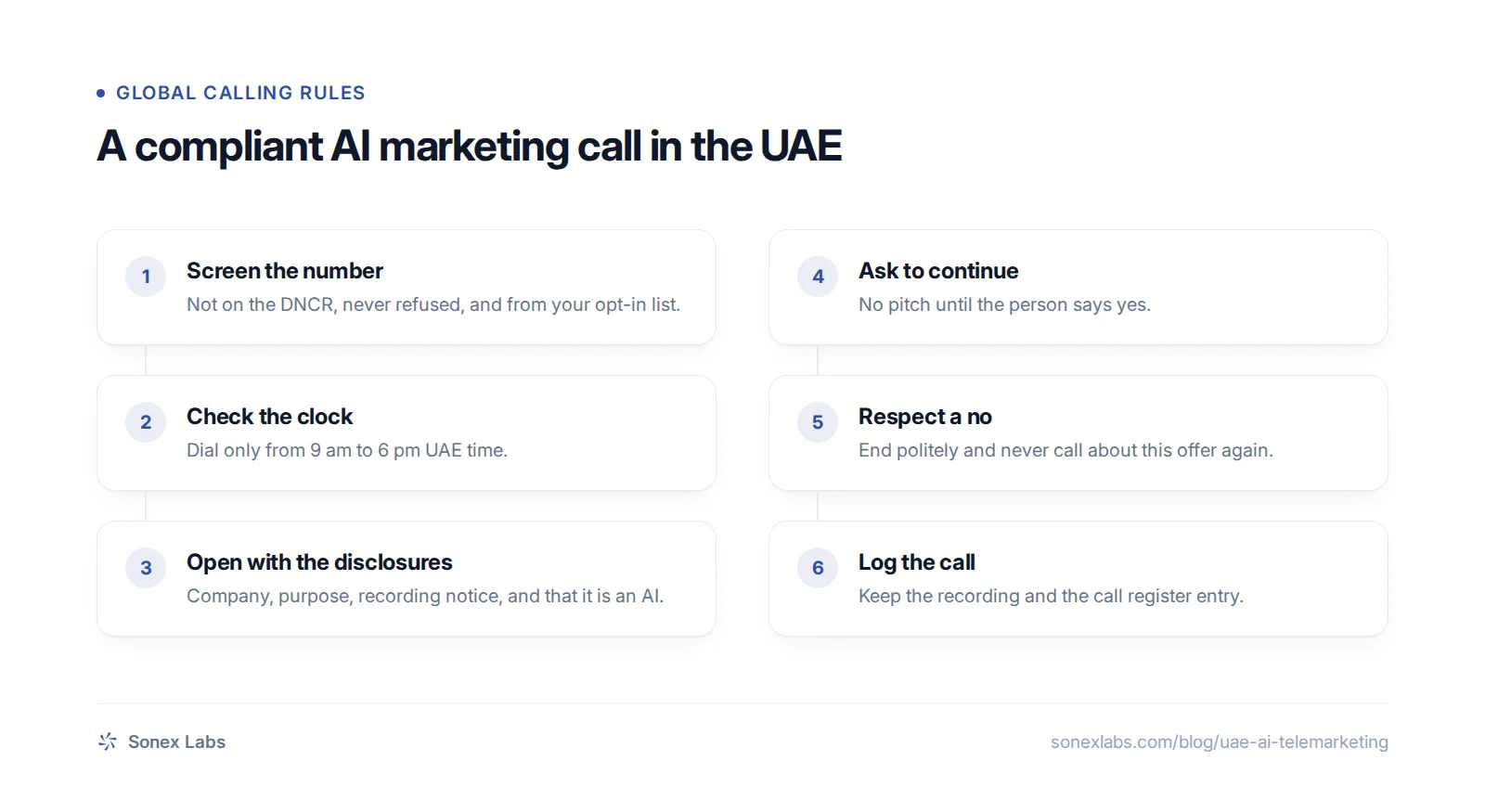
Three things must happen at the start of every marketing call, and missing any of them is a separate fine. The caller must identify the company and the purpose of the call (Article 4(11)), say that the call is recorded (Article 4(7)), and ask whether the person wants to continue before marketing anything (Article 5(7)). Firms licensed by the Central Bank must also state the right to complain and the right to join the Do Not Call Register (CBUAE Article 13.1.1).
Offer the opening in Arabic and English and let the person choose; an agent can speak Gulf Arabic or Modern Standard Arabic, and Gulf Arabic text to speech is one way to hear how that sounds. The lines below are examples we wrote, not official wording. Change them to suit your brand, but keep every element, and see the AI disclosure and recording-notice scripts for more versions.
- English: "Hello, this is the virtual assistant for [Company]. You are speaking with an AI assistant, not a person. I'm calling about [purpose]. This call is recorded. Is it OK to continue?"
- Arabic: "مرحباً، معك المساعد الافتراضي لشركة [اسم الشركة]. أنا مساعد يعمل بالذكاء الاصطناعي ولست موظفاً بشرياً. أتصل بك بخصوص [الغرض]، وهذه المكالمة مسجلة. هل يناسبك أن نكمل؟"
- If the person says no: end the call politely, mark the number as refused, and never call it again about that product.
Who you may call: the Do Not Call Register and your own opt-in list
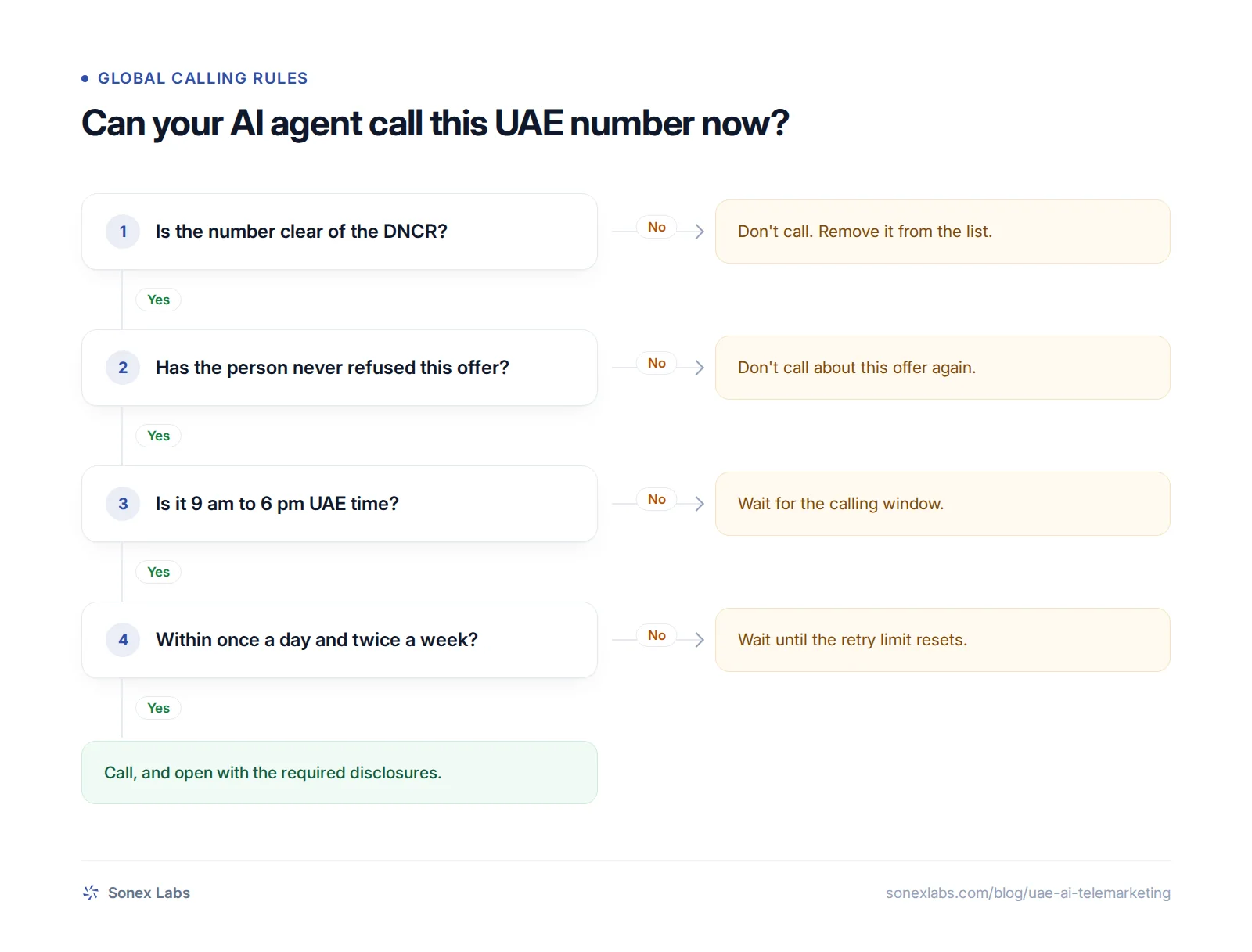
Before the clock or the script matters, a company has to know whether it may call a number at all. The first filter is the Do Not Call Register (DNCR), a national list of people who do not want marketing calls, supervised by TDRA. People add their number to stop marketing calls (Resolution 56, Article 6(5)), and TDRA says they can do it by texting "DNCR" to 2211 or 1012.
Calling a listed number is one of the most expensive mistakes in the rules: AED 50,000 for a first violation, AED 75,000 for a second and AED 150,000 for a third (Resolution 57, Table 1, item 4). Because people can join the register at any time, a list that was clean last month may not be clean today. Check every number before it enters a calling list, and again before each campaign. Callers must also be trained in how to use the register, and skipping that training is a separate fine (Article 4(2)).
The register is only the first filter. Article 4(4) asks companies to set up a channel for people who want marketing information and to market only to them, which in practice means an opt-in list you built, not a bought database. The authority can also demand to know where you got each number and each person's data, and failing to say is a fine of AED 25,000 to AED 75,000 (Article 4(12)). A bought list makes both duties hard to meet.
A number that is not on the register can still be off limits. If the person refused on an earlier call, or you cannot show they came through your opt-in channel, calling them is a breach even though the DNCR check passed. Keep a refusal list alongside the register check, and screen against both.
Where the data protection law fits
The telemarketing rules sit alongside the UAE's Personal Data Protection Law (PDPL), Federal Decree-Law No. 45 of 2021, in force since 2 January 2022 and overseen by the UAE Data Office. Resolution 56 cites it, and one of its own duties is about personal data. A consumer's personal data may not be disclosed without their consent, or traded so that other companies can market to them by phone (Article 6(4)). That breach carries the same top fines as calling a DNCR number: AED 50,000, AED 75,000 and AED 150,000.
An AI calling programme creates personal data on every call: the recording, the transcript and the log entry. Keep a record of where each number came from, what the person agreed to, and how long you keep recordings and transcripts.
Calling hours, weekends and how often you can call back
Once a number is cleared, the clock decides. Marketing calls are allowed only between 9:00 am and 6:00 pm (Resolution 56, Article 5(3)). The resolution names no time zone, but the Central Bank's version of the rule says "the State's time" (CBUAE Article 15.1). The safe reading for everyone is UAE time, which is Gulf Standard Time (GST), or UTC+4. The UAE has no daylight saving, so the window is the same all year.
Neither text limits calls to weekdays or rules out public holidays, so the same window applies on Saturdays, Sundays and holidays. Some guides still describe weekend hours of 12 pm to 5 pm and a public-holiday ban. Those were in the Central Bank's draft, as reported by the law firm Al Tamimi, but they are not in the final Article 15.
Apply the window wherever your contact centre or servers are. A team in India, an hour and a half ahead of the UAE, would dial UAE numbers only between 10:30 am and 7:30 pm India time. Setting the dialler to the called person's time zone, rather than the server's, avoids that kind of conversion error.
How often you call is limited too. If the person rejects the product or service on the first call, you may not call them back about it (Article 5(4)). If they do not answer or they end the call, you may try again at most once a day and twice a week (Article 5(5)). For an AI dialler, the hours and retry rules become three hard settings: a 09:00 to 18:00 GST window, a per-number counter for daily and weekly retries, and a permanent stop after a refusal. The calling rules by country tool sets these out next to other markets.
Fines, suspensions and how the rules are enforced
Resolution 57 gives authorities a ladder of penalties for companies (Article 3, First). It starts with a warning, then a fine from Table 1, then suspension of all or part of the company's activity for 7 to 90 days. At the top is cancellation of the licence, with deletion from the commercial register, cut communication services and loss of the phone number. Authorities are meant to climb the ladder in order. If a company repeats a violation within six months of being penalised for it, they may skip straight to the most severe penalty.
Each duty has its own fine, and the amounts rise for a second and third violation. Resolution 57 does not say whether every call counts as a separate violation. Even counted once per type of breach, a campaign that calls listed numbers after 6 pm without a recording notice commits three violations, which at first-violation rates comes to AED 70,000 (our arithmetic: 50,000 plus 10,000 plus 10,000).
Banks, insurers and other Central Bank-licensed firms are handled differently. Resolution 57 leaves their penalties to a regulation the Central Bank makes with Cabinet approval (Article 3, Third). The Central Bank's telemarketing regulation says breaches may lead to supervisory action, administrative action or financial sanctions as it sees fit (CBUAE Article 20.1).
Individuals who sell from a personal number pay AED 5,000, and every number in their name is cut until they pay. A repeat within 30 days costs AED 20,000 and a three-month cut, and a third costs AED 50,000 and a 12-month ban from all UAE telecom services (Resolution 57, Table 2).
The penalties are being used. Between August 2024 and June 2026, TDRA issued 3,301 violations against individuals, worth about AED 19.19 million in fines, and cut 9,433 numbers after public reports. The figures come from Khaleej Times on 5 August 2026 and The National a day later; we did not find TDRA's own release. A penalised company or person can appeal within 15 days of being notified. The authority has 30 days to decide, and silence counts as a rejection (Resolution 57, Article 6).
| What you must do | Fine (AED) |
|---|---|
| Get prior approval for telemarketing from your licensing authoritySource: Resolution 56, Art. 4(1) | 75,000 / 100,000 / 150,000 |
| Train callers on professional conduct and how to use the DNCRSource: Resolution 56, Art. 4(2) | 10,000 / 25,000 / 50,000 |
| Call only from local numbers registered under your commercial licenceSource: Resolution 56, Art. 4(3), 4(13) | 25,000 / 50,000 / 75,000 |
| Market only to people who asked for marketing through your channelSource: Resolution 56, Art. 4(4) | No separate fine listed |
| Do not call numbers on the Do Not Call Register (DNCR)Source: Resolution 56, Art. 4(5) | 50,000 / 75,000 / 150,000 |
| Keep a register of all marketing calls in the authority's formSource: Resolution 56, Art. 4(6) | 10,000 / 25,000 / 50,000 |
| Record marketing callsSource: Resolution 56, Art. 4(7) | 10,000 / 25,000 / 50,000 |
| Tell the person at the start that the call is recordedSource: Resolution 56, Art. 4(7) | 10,000 / 20,000 / 30,000 |
| Send periodic reports within one month of the due dateSource: Resolution 56, Art. 4(8) | 10,000 / 20,000 / 30,000 |
| Name the company and the purpose at the start of the callSource: Resolution 56, Art. 4(11) | 10,000 / 20,000 / 30,000 |
| Say where you got the person's number, if the authority asksSource: Resolution 56, Art. 4(12) | 25,000 / 50,000 / 75,000 |
| Put no unjustified pressure on the person to buySource: Resolution 56, Art. 5(1) | 10,000 / 25,000 / 50,000 |
| Make no deceptive or misleading claimsSource: Resolution 56, Art. 5(2) | 25,000 / 50,000 / 75,000 |
| Call only between 9:00 am and 6:00 pmSource: Resolution 56, Art. 5(3) | 10,000 / 25,000 / 50,000 |
| Do not call back after the person says no on the first callSource: Resolution 56, Art. 5(4) | 10,000 / 25,000 / 50,000 |
| After no answer or a hang-up, call back at most once a day and twice a weekSource: Resolution 56, Art. 5(5) | 10,000 / 25,000 / 50,000 |
| Use automated systems only within these rulesSource: Resolution 56, Art. 5(6) | 10,000 / 25,000 / 50,000 |
| Ask whether the person wants to continue before you start sellingSource: Resolution 56, Art. 5(7) | 10,000 / 20,000 / 30,000 |
| Do not disclose or trade a consumer's data without consentSource: Resolution 56, Art. 6(4) | 50,000 / 75,000 / 150,000 |
Stricter Central Bank rules for banks and insurers
Banks, insurers and other firms licensed by the Central Bank sit under a second, stricter layer: the CBUAE Telemarketing Regulation, Circular No. 3/2026, issued on 19 February 2026. It took effect on publication in the Official Gazette on 31 March 2026 (Article 24.1), and firms had 90 days from then to comply (Article 24.2). Resolution 56 gives the Central Bank this role (Article 9(2)), and where the regulation conflicts with another regulator's requirements, the regulation prevails (Article 21.1).
Its reach is wider than the general rules in three ways. It applies to a firm and its whole group, including subsidiaries and foreign branches. It also applies when calling is outsourced, and any third-party provider must comply in full (Scope, Article 19.2). Telemarketing means any communication that promotes a financial product, by call, text, chat box, email, website or social media (Article 1.30). A telemarketer may include automated systems and artificial intelligence (Article 1.29), so an AI agent is squarely inside the rules.
For a bank or insurer, the AI vendor is therefore part of the compliance perimeter, not outside it. That is the context for AI calling for banks and lenders: the institution keeps every duty, and the vendor must be able to show it follows them.
Consent that names AI agents
The biggest change from the general rules is that firms need a customer's prior express consent before any telemarketing (Article 7.1). The consent must record the customer's preferred language, the channels they accept, their preferred method of contact, and the products they want to hear about. The regulation lists the methods of contact as "natural agents, artificial intelligence-based agents or robocalls" (Article 7.2), meaning people, AI agents or automated recorded calls.
That makes AI consent a pre-dial check rather than a formality. Before an AI agent calls a customer, look up the consent record. If it lists only human agents, an AI call falls outside what the customer agreed to, and a person should make it instead.
The regulation also says how consent may be collected (Article 8). Online sign-ups need explicit written consent, such as a ticked box or a keyword sent by text. Consent given during a phone call needs explicit spoken agreement, the recording must be kept, and the terms must be confirmed in writing straight after (Articles 8.1.3 and 8.2.1). Customers must be told that consent can be withdrawn at any time, without cost, and that agreeing is not a condition of buying (Articles 8.2.6 and 8.2.7). Once they withdraw, contact must stop at once and their details must leave the calling list (Article 8.3).
The Central Bank's AI guidance note adds that customers should be able to ask for human review of AI decisions, and that firms should consider letting customers opt out of AI altogether (paragraphs 4 and 7). The note uses "should" throughout, so read it as the regulator's expectations rather than hard rules.
Retries and the follow-up exception
The retry rules are where the regulation is hardest to read. Article 14.2 says telemarketing must not be directed at customers who rejected the product before, or who have not answered a telemarketing attempt about the same product. Article 15.3 then allows contact at most once a day and twice a week, "except in the event of follow-up communication". Article 15.4 allows a follow-up only when the customer has explicitly expressed interest in a product and asked to be contacted again.
Read together, our interpretation is that an unanswered call about a product ends the attempts for that product, unless the customer has asked for a follow-up. The once-a-day, twice-a-week cap then works as an outer limit. We have not seen the Central Bank explain how the two articles fit, so confirm your retry policy before relying on any reading. The regulation names the Central Bank's Regulatory Development Department as the reference for interpreting it (Article 23.1), so that is the place to ask.
Two further timing rules apply. A customer who names a preferred time must be called only then, provided it falls inside 9 am to 6 pm (Article 15.2). Any request to stop, spoken or written, ends the contact immediately (Article 14.1).
Dialler timing and what each call must cover
The customer must be connected to a telemarketer within two seconds of answering (Article 16.1.2). Because a telemarketer can be an AI system, an agent that greets the caller at once may meet this, while a long silence while a model starts up does not. In practice that means having the agent ready before the dialler places the call.
The rule on unanswered calls is worded differently in the two languages. The English text says diallers must disconnect an unanswered call "within fifteen (15) seconds or after four (4) rings" (Article 16.1.1). The Arabic text reads as letting 15 seconds or four rings pass before disconnecting, which is a minimum ring time rather than a maximum. A ring timeout of about 15 seconds, or four rings, satisfies both readings.
On the call itself, the agent must ask whether it is a convenient time and offer to call back if not. It must say how long the call is likely to take, let the customer end it once that time is exceeded, and ask whether to continue before selling (Article 13.1.2). It must state the product's features, risks, charges and full terms, and must not make untrue statements (Article 13.2). Scripts must be in the relevant languages, simple and accurate, and the Central Bank may demand to see and change them (Articles 5.1 and 5.2).
Logs, records and reports
Every telemarketing contact, on any channel, goes into a log that records at least the date and time, the duration, who initiated it, the customer's name and the purpose (Article 10.2). For an automated or AI call, the initiator is the system's name or unique identifier (Article 10.2.3). Firms must check the log randomly and regularly (Article 10.3), keep records for at least five years (Article 10.4) and tell the customer that the call is recorded (Article 10.5).
Around the calls sit the governance duties. Telemarketing needs written approval from the firm's board before it starts (Article 2.1), and staff need at least 15 hours of training before they call, plus yearly refreshers (Articles 3.2.2 and 3.3). Firms must send the Central Bank an annual telemarketing report within 30 days of the year's end (Article 11.1) and audit their own compliance every year (Article 19.3). Customer personal data may not be shared with a third-party provider without the customer's explicit consent (Article 18.2), which matters for any vendor that receives call lists.
Key dates
Sources
- Cabinet Resolution No. (56) of 2024 on the Telemarketing Regulations (English, Ministry of Economy)Official
- Cabinet Resolution No. (57) of 2024 on administrative violations and penalties (English, Ministry of Economy)Official
- UAE Legislation portal: Cabinet Resolution No. 56 of 2024 (Official Gazette No. 778, 28 Jun 2024; effective 27 Aug 2024)Official
- UAE Legislation portal: Cabinet Resolution No. 57 of 2024Official
- Ministry of Economy and TDRA press release on the telemarketing rules, 29 Aug 2024Official
- TDRA: Telemarketing and voice spam (how to join the DNCR)Official
- CBUAE Rulebook: Telemarketing Regulation (C 3/2026)Official
- CBUAE Circular No. 3/2026 (Telemarketing Regulation), 19 Feb 2026, bilingual Arabic and English PDFOfficial
- CBUAE Rulebook: Guidance Note on the Consumer Protection and Responsible Adoption and Use of AI and ML by Licensed Financial Institutions, issued 11 Feb 2026Official
- UAE Government portal: data protection lawsOfficial
- UAE Legislation portal: Federal Decree-Law No. 45 of 2021 (PDPL)Official
- Khaleej Times: Dh19 million in fines issued, 9,433 numbers cut, 5 Aug 2026Secondary
- The National: Dh19 million in fines and 9,400 numbers disconnected for cold-calling violations, 6 Aug 2026Secondary
- Gulf Today: 159 companies fined for unwanted telemarketing calls in Dubai, 25 Feb 2025Secondary
- Al Tamimi & Co: Draft Telemarketing Regulation from CBUAE (draft weekend and holiday limits)Secondary
- CMS: What the CBUAE's telemarketing regulation means for licensed financial institutionsSecondary
- Pinsent Masons: Telemarketing rules set for UAE financial institutions (Gazette publication 31 Mar 2026)Secondary
Change log: 23 Oct 2026, First published · 24 Oct 2026, Fact-checked against the official texts: enforcement figures dated and attributed, no weekday or holiday limit noted, PDPL status re-dated. Spelled out the Central Bank AI-consent check (Article 7.2) and added the Central Bank's AI guidance note of 11 February 2026. Later the same day, rewritten as one continuous guide after re-reading both resolutions and the full Central Bank regulation: added the purpose of the rules, the exclusion of requested calls, who enforces them in each emirate, Dubai enforcement figures, the penalty ladder and Central Bank penalties, the follow-up exception (Article 15.4), the English and Arabic wording of the ring-time rule, consent withdrawal, group-wide scope, annual reports and audits, and the limit on sharing customer data with vendors; takeaways, steps, checklist and FAQs folded into the body