On this page
- What India's 2023 dark patterns guidelines ban
- Do the dark patterns guidelines apply to phone calls?
- The 13 dark patterns, and how they sound on a call
- Drip pricing and add-ons, the patterns calls fall into most easily
- RBI's dark-pattern ban for banks and NBFCs
- Self-audits, fines and penalties
- The unsolicited business communication draft
- Key dates
- Sources
What India's 2023 dark patterns guidelines ban
A dark pattern is a design trick that pushes people into doing something they did not intend or want to do. Think of a countdown timer that never runs out, an insurance add-on ticked in advance, a fee that appears only at the last step. The CCPA defines it as a deceptive practice using user interface or user experience interactions on any platform. To count, it must amount to a misleading advertisement, an unfair trade practice or a breach of consumer rights (clause 2(1)(e)).
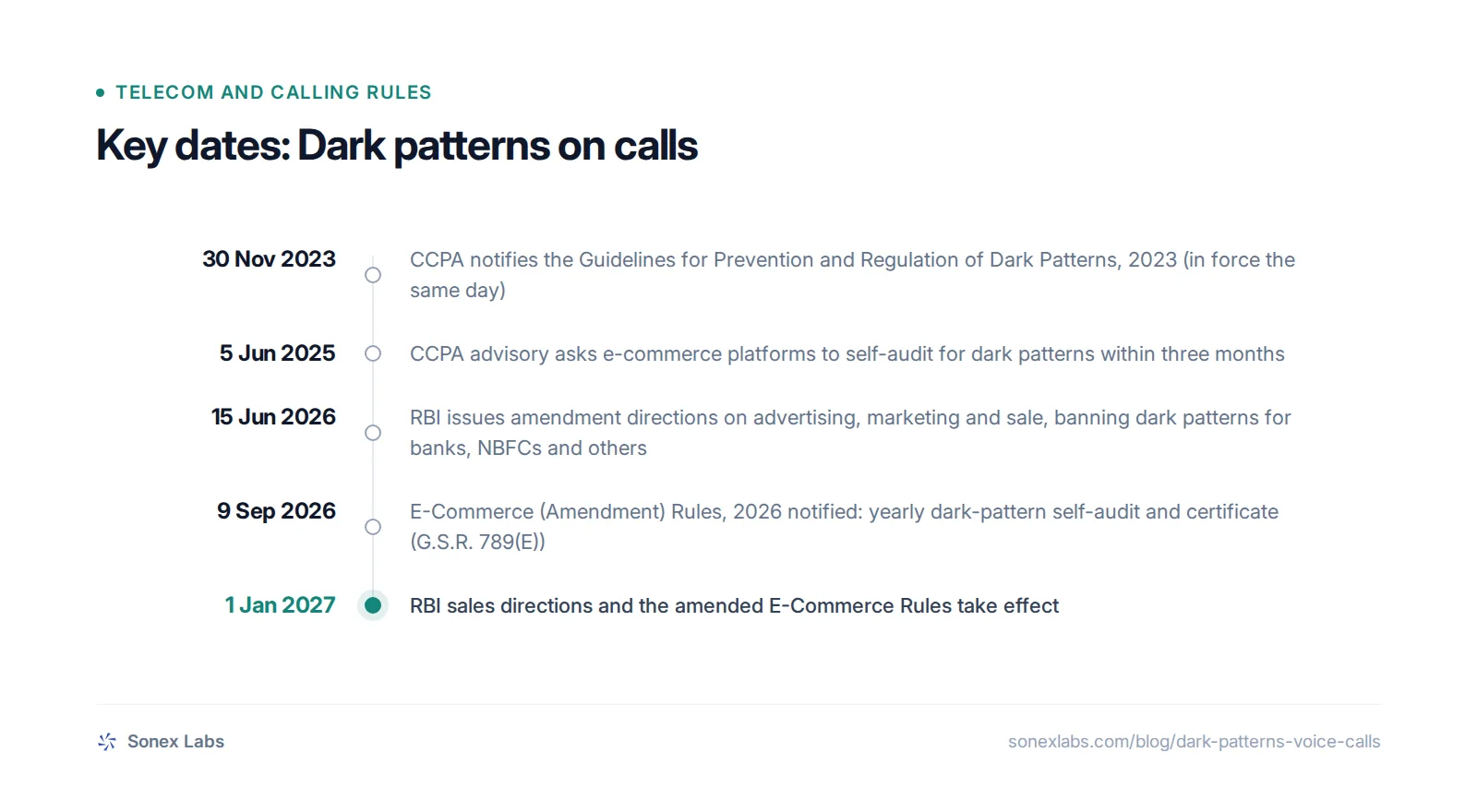
The CCPA notified the Guidelines for Prevention and Regulation of Dark Patterns, 2023 on 30 November 2023, and they took effect that day (CCPA dark patterns guidelines). It issued them under section 18 of the Consumer Protection Act, 2019, which lets it issue guidelines to prevent unfair trade practices (section 18(2)(l)). The list builds on earlier industry work: Khaitan & Co notes that the patterns are similar to those in a December 2022 report by the Advertising Standards Council of India (Khaitan & Co summary).
The guidelines apply to platforms that systematically offer goods or services in India, and to advertisers and sellers (clause 3). The core rule is short: no one may engage in any dark pattern (clause 4), and doing anything listed in Annexure 1 counts as one (clause 5). Annexure 1 lists 13 specified patterns, and the CCPA can add more. The Annexure adds that its illustrations are guidance only, so a trick need not match an example to be caught.
Do the dark patterns guidelines apply to phone calls?
Not clearly. The guidelines borrow the meaning of "platform" from the Consumer Protection (E-Commerce) Rules, 2020, and talk about user interfaces and user experience. None of the illustrations in Annexure 1 is a phone call, and no text we found applies the guidelines to calls by name. Whether an AI voice agent run by an online business counts as a user interface on a platform has not been decided by the CCPA or a court.
The law underneath the guidelines does reach calls, though. The Consumer Protection Act, 2019 treats a deceptive practice used to promote a sale as an unfair trade practice. Its list of examples covers statements made "whether orally or in writing" (Consumer Protection Act, 2019, section 2(47)). The CCPA's definition of confirm shaming also covers fear or guilt applied through "a phrase, video, audio or any other means", which suggests the authority was not thinking only of screens.
So a sales pitch that hides a fee or invents a deadline is likely unfair under the Act whether or not the 2023 guidelines formally apply. That is the reasoning behind treating a trick in a voice the same as a trick on a screen. For banks and NBFCs (non-banking financial companies) the question is settled another way: from 1 January 2027, RBI's sales directions bar dark patterns and set a code of conduct for sales calls, covered below.
The 13 dark patterns, and how they sound on a call
Most of the 13 patterns were described with screens in mind, but each has an obvious spoken version. Hearing them as a caller would is the quickest way to find them in a script.
The first column of the table follows Annexure 1 of the CCPA guidelines. The call examples and fairer lines are our own illustrations of how each pattern could sound in a sales or service call; they are not taken from the guidelines.
| Dark pattern: what the guidelines target | How it can sound on a call | A fairer line |
|---|---|---|
| 1. False urgency: false urgency or scarcity, or false popularity, to rush a decision | "Only two slots left today and the rate goes up tonight" when that is not true | "This rate is valid until 30 November. Take your time to compare." |
| 2. Basket sneaking: adding items or charges at checkout without consent (free samples and necessary fees disclosed at purchase are excluded) | "I've added card protection for ₹99 a month" without asking | "Card protection is optional and costs ₹99 a month. Would you like it?" |
| 3. Confirm shaming: fear, shame, guilt or ridicule, by phrase, video, audio or other means, to push a purchase | "So you're okay leaving your family unprotected?" | "No problem, I won't add it." |
| 4. Forced action: making people buy something else, sign up for something unrelated or share personal data to get what they wanted | "I need your Aadhaar number and your contacts list to book this" when neither is needed | Ask only for what the task needs, and say why |
| 5. Subscription trap: making cancellation impossible, hidden, long or confusing; demanding auto-debit for a free trial | Looping retention offers, repeated transfers, or "you have to visit a branch to cancel" | "I've cancelled it. Your reference number is 4471." |
| 6. Interface interference: highlighting some information and obscuring other relevant information to misdirect | Reading "yes" slowly and "no" fast, or burying "cancel" at the end of a long menu | Give every option the same weight and pace |
| 7. Bait and switch: advertising one outcome and serving another | Offering a loan at 10.5% and switching to 14% at application | State eligibility and conditions with the headline rate |
| 8. Drip pricing: hiding price elements, charging more than quoted, calling something free when it is not | Quoting the monthly EMI, then adding processing fee, GST and insurance after the OTP | Say the total cost, fees included, before asking for consent |
| 9. Disguised advertisement: ads posing as other content | A call that opens as an "important account update" and turns into a sales pitch | "This is a sales call about a new credit card. Is now a good time?" |
| 10. Nagging: repeated, persistent requests or interruptions the user has not agreed to | Calling back again and again after the customer has said no | Record the refusal and stop calling about that offer |
| 11. Trick question: confusing wording or double negatives to steer an answer | "You don't want me to not renew the cover, right?" | "Do you want to renew the cover? Yes or no." |
| 12. SaaS billing: collecting recurring payments as quietly as possible, such as silent renewals or unannounced trial-to-paid switches | "It's free" with no mention that billing starts after 30 days | "It's free for 30 days, then ₹299 a month from 1 December unless you cancel." |
| 13. Rogue malware: scareware or ransomware that frightens people into paying for fake fixes | "Your phone has a virus; install this app so I can fix it" | Never ask a customer to install remote-access or "cleaning" apps |
Drip pricing and add-ons, the patterns calls fall into most easily
Two patterns deserve particular attention on calls, because speech works against the listener. Drip pricing means revealing parts of the price late, or charging more than the amount stated at checkout. The guidelines also cover calling something free without saying that continued use costs money, and blocking a paid service until something extra is bought (Annexure 1, item 8).
On a screen, a customer can scroll back to the price. On a call they hear it in pieces and cannot, so the fix is to give the full cost before asking for a yes. RBI's directions for banks require the same: fees, charges, interest rate, risks and exit terms must be disclosed prominently when consent is taken (para 85H). Where a financial regulator prescribes a format, such as the Key Facts Statement (KFS) or Most Important Terms and Conditions (MITC), that format must be used.
A pre-selected add-on is usually basket sneaking: adding an item or charge without the customer's consent, unless it is a free sample or a necessary fee disclosed at purchase. RBI gives adding loan protection insurance by default as a banking example. On a call, that means naming each optional add-on separately and asking about each one. If a trial becomes paid, the agent should say the date and amount of the first charge, and the same figures should follow in writing after the call.
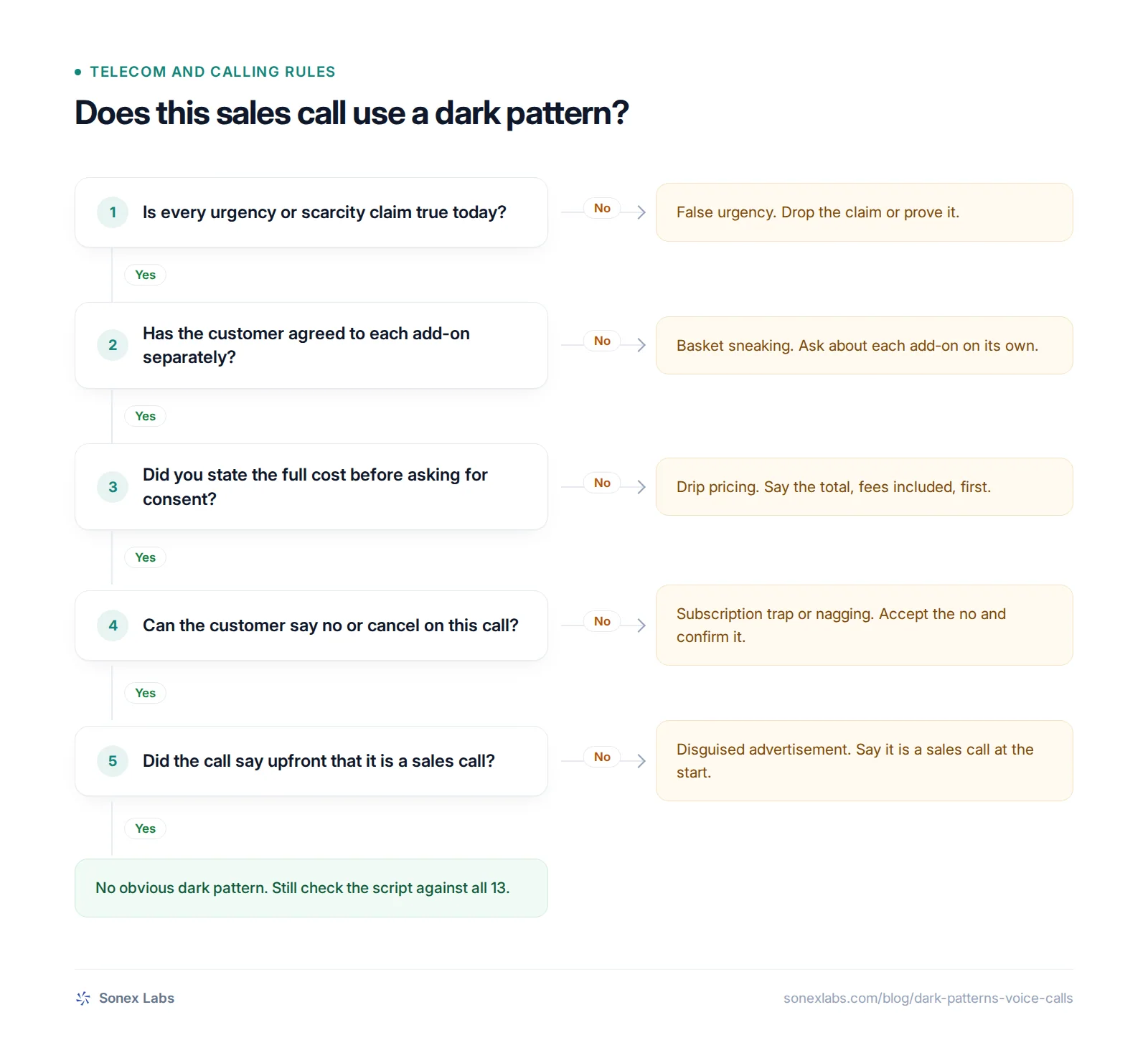
The same discipline works for a whole script. Read it line by line and ask the five questions in the chart. A "no" to any of them points to a specific pattern from the table. Check voice-agent prompts the same way: an AI agent follows its prompt on every call, so one bad line repeats at scale.
RBI's dark-pattern ban for banks and NBFCs
Financial firms face the most specific rules. On 15 June 2026, RBI issued amendment directions on advertising, marketing and sale of financial products, which take effect on 1 January 2027 (RBI press release, 15 June 2026). They cover commercial banks, small finance banks, payments banks, regional rural banks, co-operative banks, NBFCs, housing finance companies and others.
A bank and its direct selling or marketing agents must not use any dark pattern in their user interfaces. They must test and periodically audit those interfaces and follow the CCPA's 2023 guidelines (Commercial Banks RBC Second Amendment Directions, 2026, para 85X, RBI/2026-27/115). RBI's Annex IIA gives banking examples, such as adding loan protection insurance by default, or advertising a low rate and charging a higher one. The NBFC directions carry the same rules, numbered from para 101 (RBI/2026-27/123; for example paras 101N and 101X).
The code for sales calls
The same directions set a code for sales calls. Staff and selling agents must disclose fees and interest up front, call normally between 09:00 and 19:00 unless the customer asks otherwise, and must not mislead or coerce (para 85N). Promotional communication needs explicit consent, consent choices must default to No, and unsubscribing must be easy and simple (paras 85L, 85I and 85M).
One point is unclear. Para 85N lists employees, direct selling and marketing agents and their sub-agents, and representatives of third-party product providers deployed for sale or marketing activities in the bank's premises. The text does not settle whether "in the bank's premises" limits the whole list, and so whether the 09:00 to 19:00 window binds remote telecalling teams and vendors. The safe course is to apply it to every sales call.
These are sales rules, separate from RBI's recovery rules, which set an 08:00 to 19:00 window for collection calls from the same date. The RBI recovery agent rules from 1 January 2027 cover those. On Sonex, each outbound campaign carries its own calling window, so a lender using AI calling for banks and lenders can keep sales and collection campaigns on their separate hours.
Mis-selling and refunds
The directions also widen what counts as mis-selling. Selling without explicit consent, with incomplete or misleading information, or through compulsory bundling now counts, and so does selling an unsuitable product even with consent (para 4(20A)). Where mis-selling is established, the bank must refund the full amount and compensate the customer under its policy (para 85Z).
Where insurers stand
Insurers sit outside RBI's reach. For them, IRDAI's Master Circular on Protection of Policyholders' Interests, 2024 makes insurers and their distribution channels responsible for the solicitation process. It calls for action against unhealthy solicitation practices but does not use the term dark patterns (para 7). Insurers' sales calls meet another IRDAI duty at the point of sale, explained in the guide to IRDAI pre-issuance verification calls.
Self-audits, fines and penalties
Outside finance, the pressure comes from audits and enforcement. The Consumer Protection (E-Commerce) (Amendment) Rules, 2026, notified on 9 September 2026, require every e-commerce entity to follow the 2023 guidelines from 1 January 2027. Each must also do a self-audit every year and display a certificate of compliance prominently (G.S.R. 789(E), new rule 4(15)).
The rule formalises something the CCPA had already asked for. In an advisory of 5 June 2025, it told e-commerce platforms and online service providers to audit themselves within three months and remove any dark patterns. By 20 November 2025, 26 platforms had sent self-declarations saying they were free of dark patterns, according to the Ministry of Consumer Affairs.
The CCPA is also penalising breaches. In orders announced on 3 June 2026, it fined an ed-tech company ₹5 lakh for basket sneaking, confirm shaming and forced action (PIB, 3 June 2026). It fined a software company ₹1 lakh for a subscription-renewal screen that used confirm shaming, interface interference, trick questions and forced action, treating both as unfair trade practices.
The Act gives the CCPA wider powers than those fines suggest. It can order an unfair practice discontinued (section 20). It can also fine a manufacturer or endorser up to ₹10 lakh for a false or misleading advertisement, or up to ₹50 lakh for later contraventions (section 21). A false or misleading advertisement can also be a criminal offence, with up to two years' imprisonment and a fine of up to ₹10 lakh for a first offence (section 89).
An audit that covers calls
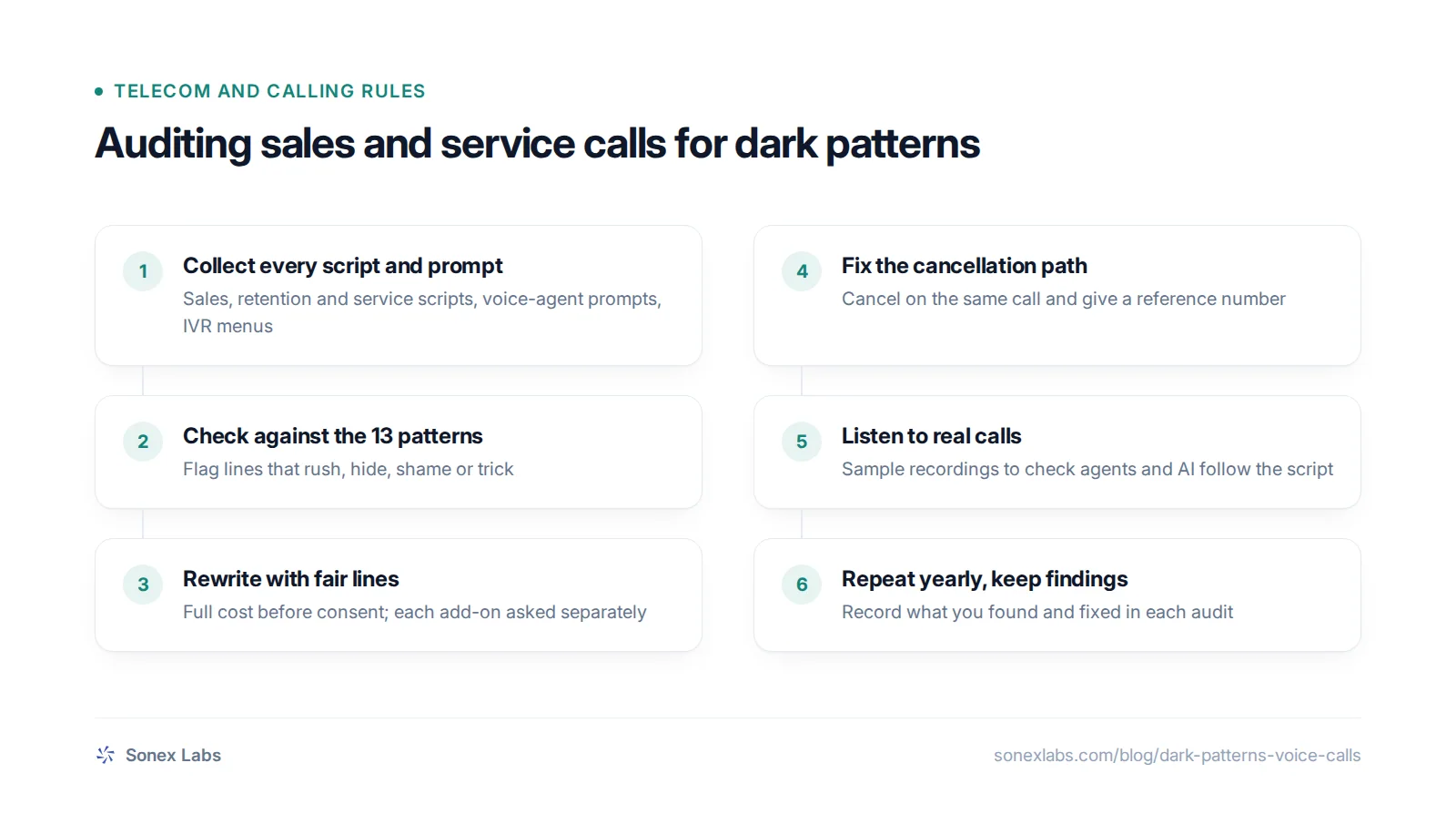
Both 2026 cases concerned screens, and the most common gap is an audit that stops at the app and website. If sales or service also happens on calls, the same audit belongs on call scripts, voice-agent prompts, IVR (interactive voice response) menus and cancellation calls. That includes the scripts vendors use when they call for you.
Reading scripts is only half of it, because people and AI agents drift from what is written. Listening to a sample of real calls closes that gap. On Sonex, for example, AI telecaller calls are kept as recordings and transcripts, so an auditor can check what was actually said. The diagram shows a yearly audit that covers calls as well as screens.
The unsolicited business communication draft
One rule that would speak to calls directly is still not in force. As of 24 October 2026, the Guidelines for Prevention and Regulation of Unsolicited and Unwarranted Business Communication, 2024 are still a draft as far as we can find. The Department of Consumer Affairs published the draft on 20 June 2024 (PIB, 20 June 2024). Comments were due by 21 July 2024, and the deadline was later extended to 5 August 2024.
The draft treats a business call or message as unsolicited if it follows neither the customer's consent nor their registered preferences. It would apply not only to whoever makes the call but also to the business that hires them or benefits from it. Reports say it covered voice calls, SMS and messaging apps.
We found no final version in our searches, and the Department of Consumer Affairs website would not load when we checked on 24 October 2026. Until one appears, telemarketing calls fall under the commercial communication rules of TRAI, the telecom regulator, which TRAI's 2026 rules for AI and automated calls explain. Promotional calls come from the 140 series, and service calls from 1600, 1601 or regular numbers depending on the sector, as the guide to the 140, 1600 and 1601 number series sets out.
Key dates
Sources
- CCPA: Guidelines for Prevention and Regulation of Dark Patterns, 2023 (Gazette, 30 Nov 2023)Official
- CCPA: guidelines and advisories page (incl. self-audit advisory, 5 Jun 2025)Official
- PIB: 26 e-commerce platforms declare dark-pattern self-audit compliance, 20 Nov 2025Official
- PIB: CCPA acts against dark patterns on digital platforms, 3 Jun 2026Official
- Gazette: Consumer Protection (E-Commerce) (Amendment) Rules, 2026, G.S.R. 789(E), 9 Sep 2026Official
- PIB: Government amends E-Commerce Rules, in force 1 Jan 2027, 10 Sep 2026Official
- RBI press release: amendment directions on advertising, marketing and sale, 15 Jun 2026Official
- RBI (Commercial Banks – Responsible Business Conduct) Second Amendment Directions, 2026 (RBI/2026-27/115)Official
- RBI (NBFC – Responsible Business Conduct) Second Amendment Directions, 2026 (RBI/2026-27/123)Official
- Consumer Protection Act, 2019 (Gazette text): sections 2(47), 18, 20, 21 and 89Official
- IRDAI: Master Circular on Protection of Policyholders' Interests, 2024Official
- PIB: draft guidelines on unsolicited and unwarranted business communication, 20 Jun 2024Official
- PIB: comment deadline on the draft extended to 5 Aug 2024, 25 Jul 2024Official
- Khaitan & Co (Mondaq): CCPA issues Guidelines for Prevention and Regulation of Dark Patterns, 2023, 4 Dec 2023Secondary
Change log: 24 Oct 2026, Dated the CCPA fines as announced on 3 June 2026 and the draft's status as of 24 October 2026; added the NBFC paragraph numbers and the Act's source. Later the same day, rewritten as one continuous guide: added the Act's penalties (sections 20, 21 and 89), the link to ASCI's 2022 report and why calls are riskier for drip pricing; the takeaways, steps, checklist and FAQs were folded into the body · 23 Oct 2026, First published