On this page
What YouTube changed on 15 July 2025
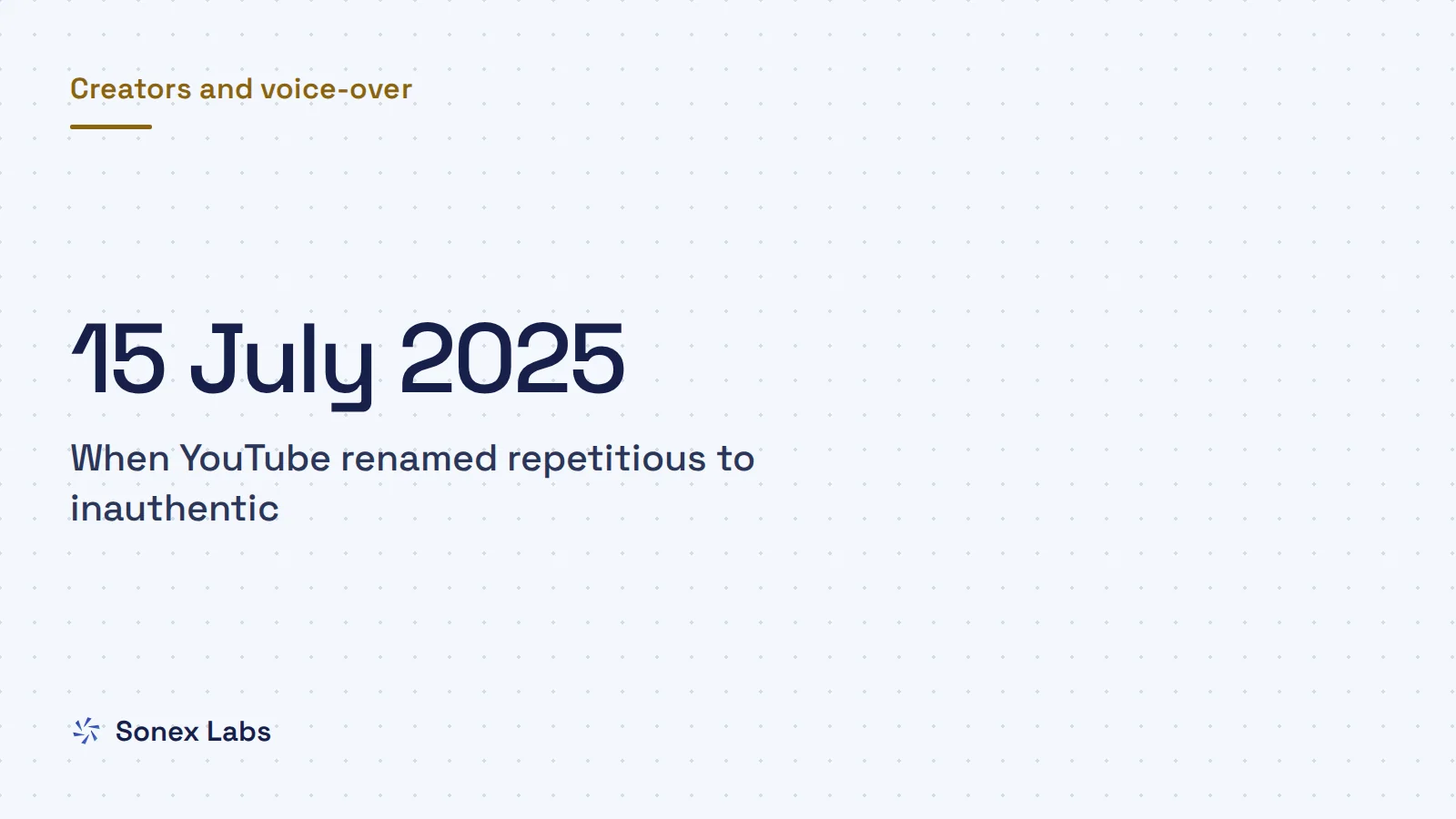
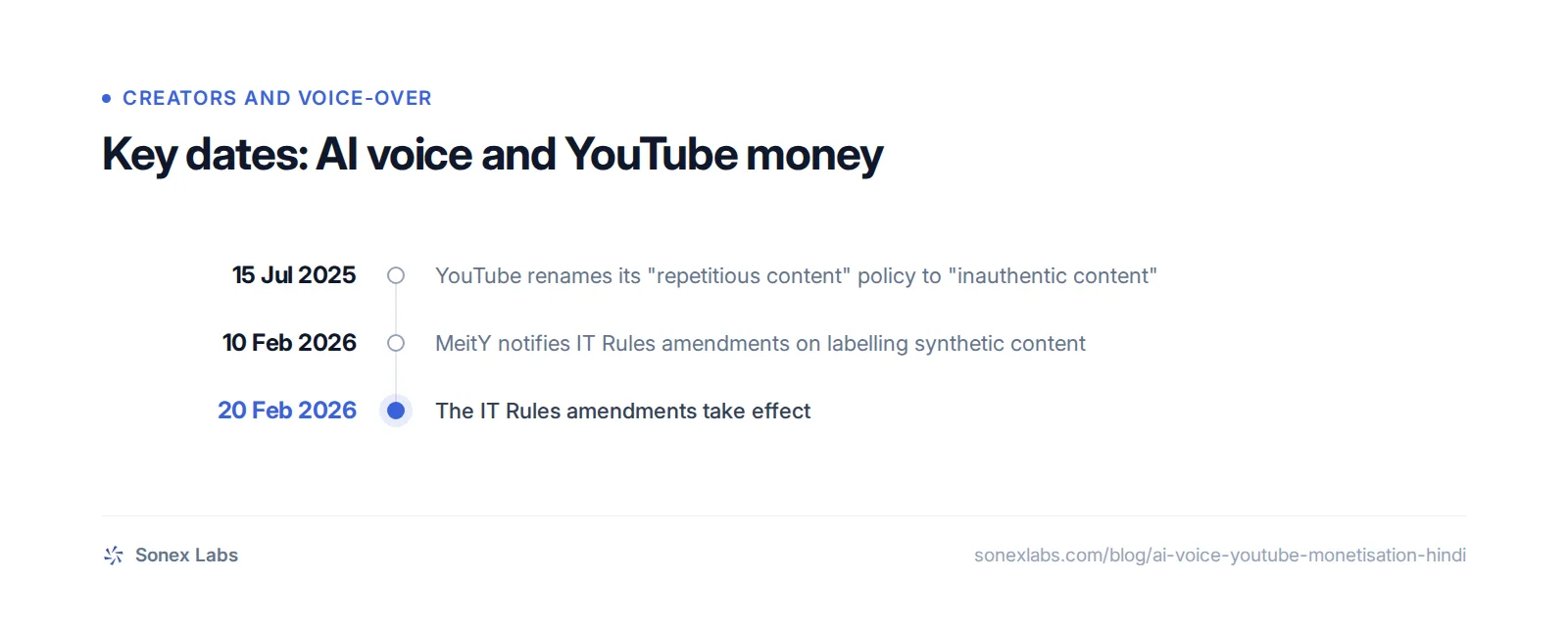
YouTube's 15 July 2025 update renamed a policy and clarified its scope; it did not add a rule about AI voices. The entry in the changelog of the YouTube channel monetization policies calls it a minor update: the "repetitious content" policy was renamed "inauthentic content" and clarified to cover content that is repetitive or mass-produced. YouTube adds that such content had always been ineligible for monetisation, and that its separate reused content policy did not change.
News coverage read the same entry in two ways, and both readings are still repeated in Hindi creator videos. Social Samosa reported on 14 July 2025 that YouTube said the change did not specifically target AI-generated videos, and that channels using AI tools could still earn if they added significant original commentary or value. Four days earlier, The Week had listed channels using AI voiceovers and basic slideshow visuals among those that could be affected.
Both readings fit the policy, because the test is not the voice. The test is whether a channel looks like a production line, and a synthetic voice over stock visuals is the most common way a channel comes to look like one.
One detail trips up people searching for the policy by name. On 24 October 2026 the monetisation page no longer has a section called "inauthentic content": the name survives in the changelog, while the rules themselves sit under headings such as "Generic or Repetitive Content", "Reused content" and "Unsatisfying or Off-putting Content". The flag in the case below was still called "Inauthentic Content", by the creator's account, so searching the policy page for that phrase finds only the changelog.
What the monetisation policies say about AI
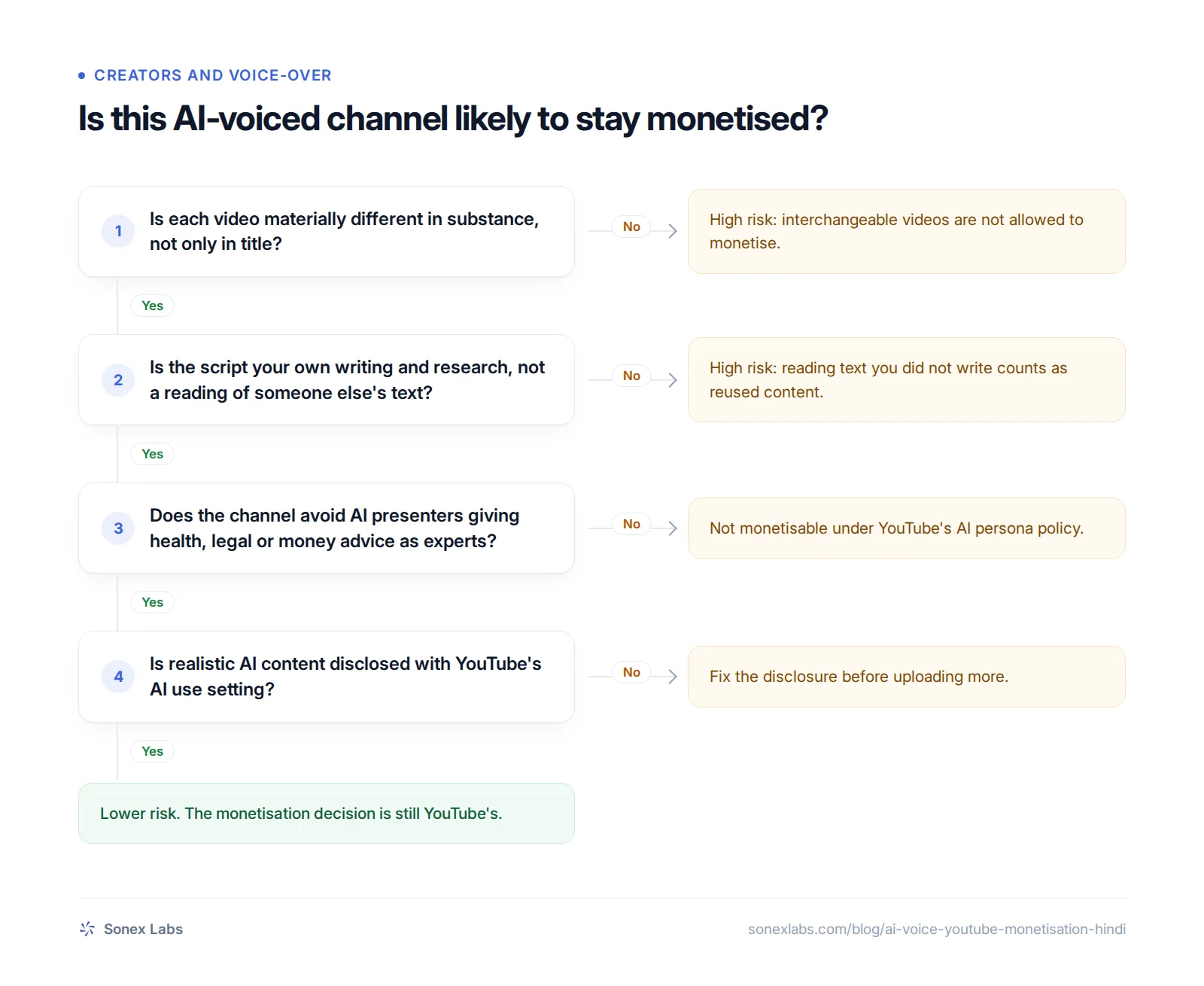
The policy text mentions AI in a few specific places, and each one is about how the content is made and what it offers, not about the voice. Read together, they describe the channels YouTube does not want to pay: interchangeable videos, scripts copied from elsewhere, and synthetic presenters posing as experts.
Generic or repetitive content
This is the section most AI-voiced channels run into. YouTube describes generic content as videos that look made with a template or feel repetitive when you watch several in a row from one channel. Its examples of what may not earn include image slideshows or scrolling text with little narrative or commentary, and "AI-generated content made with generic or unoriginal templates giving the impression of mass production" without the creator's own insight or perspective.
The same section says what is allowed: a series can share an intro and outro, or follow the same characters, as long as each video has a distinct storyline, focus or concept. Format is fine; interchangeable substance is not.
Reused content: reading what someone else wrote
Reused content is a separate policy, and it catches a pattern common in faceless channels. Among YouTube's examples of content that may not earn is a video that only reads out material you did not write, such as text from websites or news feeds. An AI voice reading a translated Wikipedia article is exactly that, however good the voice sounds.
The policy also shows what changes the verdict. Its examples of reused material that may earn include a movie scene where you have rewritten the dialogue and changed the voiceover. New writing and commentary are what count, whoever or whatever speaks them.
Automated tools and AI presenters
Under "Unsatisfying or Off-putting Content", YouTube says that if you use automated tools or templates, the final video must still show your creative vision and give viewers educational or entertainment value. It lists using AI to edit your scripts, or to generate a background visual for an original story, as acceptable.
A newer section closes off one popular format entirely. Channels that use AI-generated personas presenting themselves as human experts on health, law, money or politics are not allowed to monetise. YouTube's examples include an AI "doctor" giving health advice and AI podcast hosts giving investment tips, which matters for the many Hindi finance and health channels built around a synthetic narrator.
How reviewers judge a channel
YouTube's reviewers do not check every video. The policy says they may focus on a channel's main theme, its most viewed and newest videos, the videos with the most watch time, its titles, thumbnails and descriptions, and its About section. A few strong videos therefore do not protect a channel whose bulk looks templated, and thumbnails count as much as scripts.
The 507K-subscriber Hindi channel that was flagged
The case behind much of the worry is one creator's own account, so it is evidence of how a flag felt from the inside, not of how YouTube decided. In May 2026 a creator posted on r/PartneredYoutube that his channel of 25-minute Hindi documentaries, with 507K subscribers, had received the "Inauthentic Content" flag the month before. He had used a third-party AI voice and AI visuals for two years without trouble, and reported 1 to 5 million views a video.
He first blamed the voice, then changed his mind, because channels using the same AI voice were still earning. Comparing his channel with theirs, he found his thumbnails all came from one template: the same yellow Hindi lettering, the same red arrow, the same tag and badge placement. His scripts never said "I" and read, in his words, like translations of an encyclopedia. His editing was identical from video to video, he never showed sources on screen, and he relied on phrases like "historians say" instead of naming sources and years.
The replies did not all agree with him. The most upvoted one argued that neither the voice nor the thumbnails was the problem: the problem was content that appears low-effort or mass-produced. Another said thumbnail and branding templates are fine on their own. In later comments the creator said a team of five spent 11 days editing each video, which is the uncomfortable point of the story: effort that viewers and reviewers cannot see does not count.
YouTube has not commented on the case, and we cannot confirm his diagnosis. What can be checked is that everything he listed matches the policy text above. The two lines below show the script difference he described, read in Hindi by the same voice.
इतिहासकारों के अनुसार इस किले का निर्माण सोलहवीं शताब्दी में किया गया था।
मैंने इस किले पे तीन किताबें पढ़ीं, और तीनों में यही लिखा है कि ये सोलहवीं सदी में बना था।
When YouTube's AI label applies, and India's rules
Disclosure is a separate question from monetisation, and getting it right does not cost you earnings. YouTube's page on disclosing use of GenAI content requires creators to use the "AI use" setting in YouTube Studio for AI-generated or altered content that seems realistic. Its examples are making a real person appear to say or do something they did not, altering footage of a real event or place, generating a realistic scene that never happened, and AI music that is the focus of a video. YouTube says disclosing does not by itself limit a video's audience or its eligibility to earn.
Several things an AI-voiced channel does are on YouTube's list of uses that need no disclosure: using AI to help with a script, outline, thumbnail or title, and cloning your own voice to create voiceovers or dubs. A synthetic narrator reading your own script is not among the listed examples either way, and YouTube says its lists are not complete. Two further points matter in practice. YouTube may apply a label itself when its systems detect AI content or a file carries C2PA provenance data, and creators who consistently fail to disclose can face penalties up to suspension from the YouTube Partner Program.
For non-music AI audio, the label appears in the expanded description rather than on the player, so many viewers will never see it. A short spoken line at the start of the video settles the question for them in two seconds.
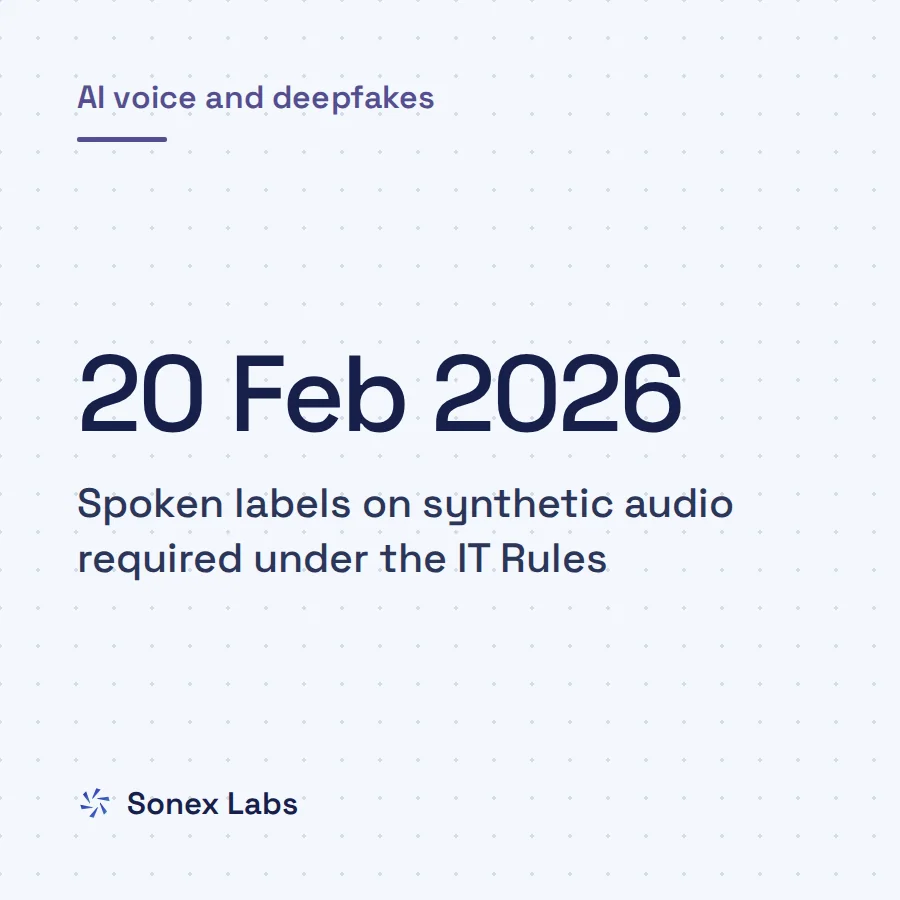
India added its own layer in 2026. MeitY notified amendments to the IT Rules on 10 February 2026, in force from 20 February, that require platforms to label synthetic content prominently and require social media platforms to ask users to declare AI-generated content before publishing (Business Today). The duties sit with platforms, and YouTube's AI use setting is how it collects that declaration. Our guide to AI content labelling in India covers what the rules ask of synthetic audio, and the guide to voice cloning law in India explains why a sound-alike of a film star is a takedown risk whatever label it carries.
इस वीडियो की आवाज़ AI से बनी है, पर रिसर्च और स्क्रिप्ट मेरी अपनी है।
How to put this into practice
Write each script yourself, in the first person
Say what you read, watched or checked, and name sources with their year instead of "experts say". A script that only reads out text from a website or a translated article counts as reused content, however good the voice.
Show the research on screen
Put documents, maps, screenshots and your own notes into the edit. Keep drafts and source lists for every video, so you have something concrete to point to if you ask for a review.
Vary the packaging, not just the titles
Change thumbnail layouts, video length, structure and editing from one video to the next. A shared intro and outro is fine; a channel where every video is interchangeable is not.
Use one consistent channel voice, ideally your own
Cloning your own voice for voiceovers is on YouTube's list of uses that need no disclosure, and it gives the channel a voice that other channels do not share. Pāṇini's free tier includes one voice clone, no card required. Never clone someone else's voice without their clear permission.
Disclose when YouTube's label applies
Tick "AI use" in YouTube Studio for realistic synthetic content, such as a real person saying something they did not or a realistic scene that never happened. Add a short spoken line at the start of AI-narrated videos as well.
Key dates
Before you upload an AI-voiced video
- Script written by you, in the first person, with named sources.
- Sources and research visible on screen; drafts and notes saved.
- Thumbnail, length and structure differ from your last few videos.
- Narration in your channel's own voice, or a clone of your own voice.
- AI use setting ticked if any content is realistic and synthetic; spoken label added.
Sources
- YouTube Help: YouTube channel monetization policies (changelog of 15 July 2025; generic, reused and AI persona sections), read 24 Oct 2026Official
- YouTube Help: Disclosing use of GenAI content, read 24 Oct 2026Official
- Social Samosa: YouTube clarifies monetisation policy update targeting inauthentic content, 14 Jul 2025Secondary
- The Week: YouTube rolls out new rules to curb AI content, 10 Jul 2025Secondary
- r/PartneredYoutube: I think my thumbnails killed my 507K channel (not my AI voice), 8 May 2026Secondary
- Business Today: Govt tightens rules on AI-generated content, mandates labels, 10 Feb 2026Secondary