On this page
- What an Urdu voice agent for Pakistani callers has to get right
- Urdu script or Roman Urdu: what to send the voice
- Reading rupees, lakh and times the Pakistani way
- Urdu text to speech options in 2026
- Urdu speech recognition is usually the weak link
- Pakistani phone numbers and calling rules
- What an Urdu voice agent costs in rupees
- Sources
What an Urdu voice agent for Pakistani callers has to get right
A voice agent handles each turn of a call in four hops. Speech to text turns the caller's words into text, a language model writes a reply, text to speech reads it aloud, and the phone line carries both directions. Each hop has its own Pakistani trap, and builders usually discover them in the wrong order.
One builder in Pakistan described a typical first attempt on r/n8n in June 2026: a telemedicine agent with a general-purpose transcriber, a general-purpose language model and a multilingual cloud voice (r/n8n). The agent misheard names, and the transcript came back as what the poster called "a messy mix of random words, English and Hindi". The most useful reply said the bottleneck was Urdu speech recognition, not the workflow tool or the voice, and suggested testing 20 to 30 real calls before changing anything else.
A vendor case study tells the same story from the other side. Telnyx, a telephony company, described a sales team calling Pakistan in an August 2026 case study. It wrote that speech models "trained on Hindi data regularly confused Urdu transcription", and that "a Hindi-trained TTS voice on a Pakistan caller ID sounds foreign" (Telnyx). Pakistani callers say amounts, times and greetings differently from Indian Hindi speakers, so an agent built from Indian templates sounds wrong even when every word is technically Urdu.
Urdu script or Roman Urdu: what to send the voice
Roman Urdu, meaning Urdu typed in Latin letters, is how most Pakistanis text. A study of 346,455 messages from 116 users found it "the most widely adopted style" of texting in Pakistan (Bilal and others, MobileHCI 2017). The sample came from one university, so treat it as a strong signal rather than a national figure.
The problem for a voice is that Roman Urdu has no fixed spelling. The same word arrives as "pohanch", "pahunch" or "puhanch", and every writer guesses the short vowels differently. A text-to-speech engine reading Latin letters has to decide first whether a word is Urdu or English, then how to say it. Urdu script removes the first decision, although it brings its own: short vowels are not written, so the engine still has to know the word.
The practical rule follows from that. Send Urdu script to the voice whenever pronunciation matters, and treat Roman Urdu as something to accept from customers rather than something to generate. Let the language model write its replies in Urdu script, and say so in the prompt. Customers can still type Roman Urdu into WhatsApp or a web chat, and the agent can read it; what you control is the text you hand to the voice.
The same delivery message is below in both scripts, read by Pāṇini TTS. Both are read by Alok, a platform voice recorded in Hindi, because Sonex Labs has no Urdu-recorded voice yet. They therefore sound Indian rather than Pakistani, which is exactly the problem the Telnyx study describes and the reason the options section below covers cloning. No listening test has measured which script Pakistani listeners prefer, so play both and judge for yourself.
السلام علیکم، آپ کا آرڈر کل شام تک پہنچ جائے گا۔ کیا آپ اُس وقت گھر پر ہوں گے؟
Assalam o alaikum, aap ka order kal shaam tak pohanch jayega. Kya aap us waqt ghar par honge?
Reading rupees, lakh and times the Pakistani way
Digits leave the reading to the engine, and the engine cannot know local habits. Pakistanis write prices as "Rs2,500" or "PKR 2,500" but often say twenty-five hundred, پچیس سو روپے, rather than two thousand five hundred. Write amounts and times in Urdu words, in the form a Pakistani would say them, and the voice will say them that way.
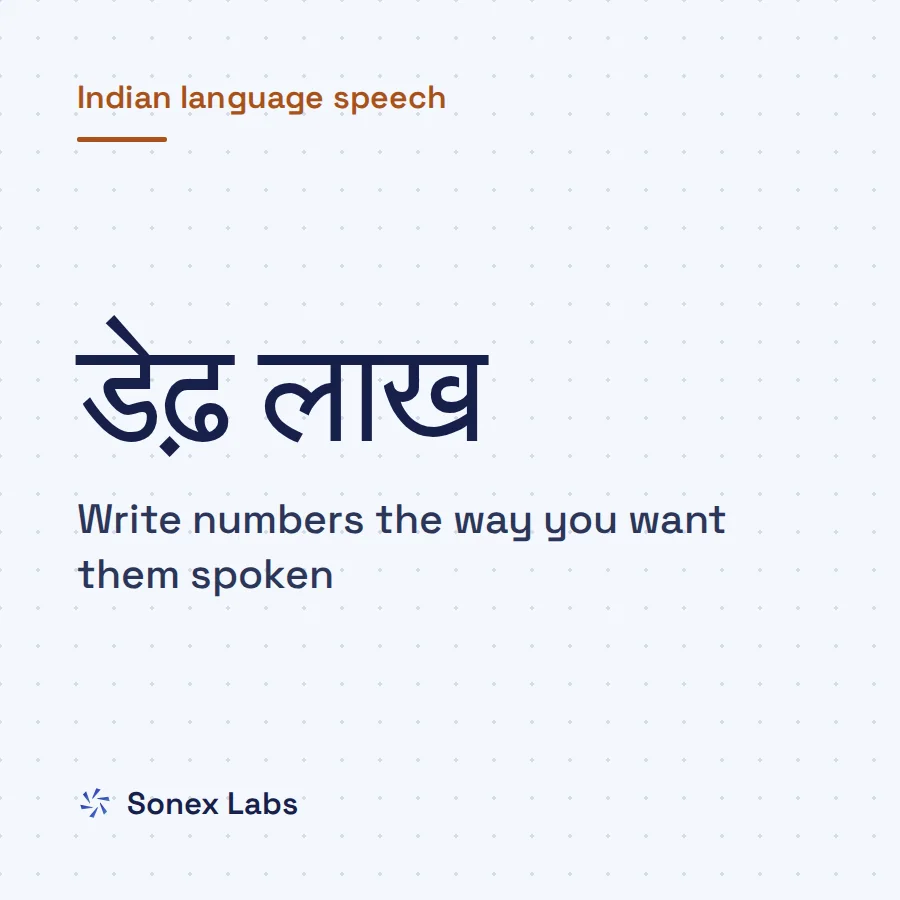
Large amounts follow the South Asian lakh (100,000) and crore (10 million) system in speech. Pakistani newspapers write figures in Western groups such as Rs500,000, yet they use lakh and crore in prose. Dawn has reported "a fine of one lakh rupees" (Dawn, July 2023), and a Dawn columnist wrote of about two crore rupees spent on an election. A loan reminder that reads 150,000 as one hundred and fifty thousand is correct but sounds like a translation, while ڈیڑھ لاکھ روپے (one and a half lakh rupees) sounds like a person.
The pairs below show the same bill written as digits and as words. The point is not that one reading is wrong but that only the second is under your control. Times work the same way: write "گیارہ بجے" (eleven o'clock) or "ساڑھے دس بجے" (half past ten) instead of 10:30. The cheapest fix is one line in the agent's prompt telling the model to write every amount, date and time in Urdu words, as a Pakistani caller would say it.
آپ کا بجلی کا بل Rs 2,500 ہے، جو جمعے تک جمع کروانا ہے۔
آپ کا بجلی کا بل پچیس سو روپے ہے، جو جمعے تک جمع کروانا ہے۔
آپ کی اگلی قسط ڈیڑھ لاکھ روپے ہے، اور آخری تاریخ دس نومبر ہے۔
Urdu text to speech options in 2026
There are now a few real Urdu voices to choose from, but almost none combine a Pakistani accent with the speed a live call needs. The right choice depends on whether you need offline use, a Pakistani accent or low latency.
Offline and open-source voices
For offline and home-assistant use, the complaint that "Piper has no Urdu voice", a January 2026 thread title on r/homeassistant, is out of date. Piper's voice repository added two Pakistani Urdu voices in 2026: ur_PK-fasih-medium (male, April) and ur_PK-aegis_female-medium (female, July) (Piper voices). The Fasih voice was fine-tuned from a Hindi Piper voice, and its model card warns that "quality may vary" on mixed Urdu and English text (model card).
For streaming voice agents, open-source Urdu is harder. A builder on r/PakistaniDevs in March 2026 tested nine Urdu models from Hugging Face and reported unrealistic voices, background hum and slow output. One run took about 25.8 seconds to produce its first audio, far too slow for a call (r/PakistaniDevs). Replies pointed to commercial Urdu voices instead. In July 2026 another poster on r/PakistaniTech, looking for a self-hosted model, was told there was none worth using yet.
Cloud voices
Among the large cloud platforms, Microsoft Azure lists two Pakistani Urdu voices, ur-PK-UzmaNeural (female) and ur-PK-AsadNeural (male), alongside two Indian Urdu ones (Azure). Google Cloud Text-to-Speech offers Urdu only as ur-IN (Urdu, India), with 34 voices and no ur-PK locale (Google Cloud). That difference matters if your callers are in Lahore rather than Lucknow, and it answers the common search for a female Urdu voice: Piper's Aegis and Azure's Uzma are both Pakistani and female.
Cloning a Pakistani voice
Sonex Labs sells one of the options, so weigh this paragraph with that in mind. Pāṇini TTS reads Urdu script, but its platform voices were recorded in other languages and none is Pakistani. For a Pakistani accent you clone a voice from a 10-second sample of a native speaker, with their consent, and the clone carries that speaker's accent into every call. The Urdu text to speech page has samples, and our guide to accent in cross-language voice cloning explains why the accent follows the recording.
| Option | Pakistani Urdu voice |
|---|---|
| Piper (offline, open source)Source: rhasspy/piper-voices on Hugging Face | Yes: ur_PK fasih (male) and aegis (female), medium quality |
| Microsoft Azure SpeechSource: Azure language support page | Yes: ur-PK Uzma (female) and Asad (male) |
| Google Cloud Text-to-SpeechSource: Google Cloud voice list | No: Urdu (India) voices only |
| Pāṇini TTS (Sonex Labs, our product)Source: Sonex Labs | No platform voice; clone a native speaker from 10 seconds |
Urdu speech recognition is usually the weak link
Speech recognition fails before the voice does, so test it first and on real calls. Pakistani callers mix Urdu with English nouns (order, bill, appointment), say names the model has never seen, and call from noisy streets on narrowband phone audio. A transcriber that drifts into Hindi spellings or English guesses hands the language model nonsense, and no prompt can repair that.
The test the r/n8n reply suggested is the right one. Take 20 to 30 recorded calls from your own customers, with their consent, have a person write down exactly what was said, and compare each transcriber's output with it. Count wrong words, and separately count wrong names, amounts and dates, because those are what break a booking or a payment. Our guide to testing a multilingual voice agent sets out the method in more detail.
Decide early what script you want back. Some transcribers return Urdu script while others drift into Devanagari or Roman letters, and your language model and logs work best with one consistent form. Valmiki STT, the Sonex Urdu speech-to-text model, includes Urdu and detects the spoken language automatically, including callers who switch to English for a sentence or two, as many do in banking and tech support. No Urdu accuracy figures have been published for it, so run the same test on it as on anything else.
Pakistani phone numbers and calling rules
The phone route is the part to settle before you build anything. Twilio, the platform many voice-agent tutorials assume, says on its Pakistan page that "we don't have voice enabled numbers in this locale" (Twilio). Pakistani callers would have to dial a foreign number, which few will do, and builders have reported Pakistani mobile calls to US numbers dropping at zero seconds through one voice-agent platform (Retell community, September 2026).
Not every carrier is in the same position. Telnyx's case study says it provisioned local Pakistani numbers through its carrier network, and adds that calls from unattested numbers "get flagged as spam on Pakistani mobile networks" (Telnyx). Those are a vendor's claims about its own service, so ask any provider to show how its Pakistani numbers are licensed and how its calls are presented to the mobile networks.
The reason routes are scarce is regulation. The Pakistan Telecommunication Authority (PTA) restricts the carrying of international VoIP calls to licensed operators, and blocks common VoIP signalling ports for everyone else to stop grey traffic, meaning calls routed around licensed gateways (PTA). The number your customers dial should therefore come from a PTA-licensed operator, or a licensed service provider working with one, connected to your agent's platform.
Outbound calling has its own rules. PTA's 2009 regulations against spam and unsolicited calls made operators set up a Do Not Call Register for subscribers who do not want telemarketing calls (PTA, August 2009). We could not read the regulation's full text, so check with your operator what your campaigns must do before an AI agent dials anyone. Opening the call by saying it is an AI assistant, as in the sample below, is a sensible courtesy whatever the rules require.
السلام علیکم، میں سونیکس کلینک کا AI اسسٹنٹ بول رہا ہوں۔ آپ کی کل کی اپوائنٹمنٹ کے بارے میں فون کیا ہے، دو منٹ بات ہو سکتی ہے؟
What an Urdu voice agent costs in rupees
The running cost of an agent is the sum of its parts: the voice, the transcriber, the language model and the phone line. The voice and transcriber are the easiest to price, because they are metered by characters and seconds.
As one data point, converted at 276.73 Pakistani rupees per US dollar (open.er-api.com, 24 October 2026), Pāṇini TTS lists $0.03125 per 1,000 characters, about Rs 8.65. In our own test on 24 October 2026, three Urdu paragraphs read by Alok came out at about 927 characters per finished minute of audio, so a minute of Urdu speech costs about Rs 8.02. Valmiki STT lists $0.00525 per minute, billed by the second, about Rs 1.45 a minute; the pricing page has current rates for every part.
The phone line is usually the largest item, and it depends on the route. Sonex's own numbers are Indian and US numbers, so a Pakistani agent on Sonex voice agents runs on telephony you bring, and Sonex adds no minute charge for it; your carrier bills you directly. For scale, Twilio lists outbound calls to Pakistani mobiles at $0.18 a minute, about Rs 49.81 (Twilio voice pricing), several times the cost of the voice itself.
Sources
- r/n8n: multilingual voice agent build for Urdu callers in Pakistan (24 June 2026, read via PullPush)Secondary
- Telnyx customer story: Alibaba.com voice AI in Pakistan, English and Urdu (18 August 2026)Secondary
- r/PakistaniDevs: best open-source Urdu TTS for naturalness and real-time streaming (31 March 2026)Secondary
- r/homeassistant: human-sounding offline Urdu TTS, "Piper has no Urdu voice" (10 January 2026)Secondary
- r/PakistaniTech: are there any good Urdu TTS models available? (25 July 2026)Secondary
- Piper voices on Hugging Face: voices.json with ur_PK fasih and aegis_femaleOfficial
- Piper ur_PK fasih medium model cardOfficial
- Microsoft Azure Speech: language and voice support (text to speech)Official
- Google Cloud Text-to-Speech: supported voices and languagesOfficial
- Twilio: SIP trunking pricing for Pakistan (no voice-enabled numbers)Official
- Twilio: voice pricing for PakistanOfficial
- Retell community: inbound calls from Pakistan disconnect immediately (3 September 2026)Secondary
- PTA: VoIP signalling ports blocked for unlicensed operatorsOfficial
- PTA: regulations for unsolicited and obnoxious communications (26 August 2009)Official
- Bilal and others, Roman-txt: forms and functions of Roman Urdu texting, MobileHCI 2017Official
- Dawn: "a fine of one lakh rupees" (13 July 2023)Secondary
- Dawn: Mohammed Hanif on election spending in crore (14 October 2015)Secondary
- Sonex Labs API quickstart: /v1/speech fields and output formatsOfficial
- ExchangeRate-API open endpoint, USD rates updated 24 October 2026Official
Change log: 24 Oct 2026, Rewritten as one continuous guide: added the Telnyx case study (Hindi-trained models, local numbers, spam flagging) and a separate cost section; removed the per-minute agent price pending a billing decision; takeaways, FAQs, the callout and the call-flow chart folded into the body; cover fact changed from our price to the Pakistani number gap