On this page
- Why AI voice calls are an election problem
- What are the ECI AI guidelines for election campaigns?
- Labelling AI calls: the ECI advisories and the IT Rules
- Cloning a leader's or candidate's voice
- Campaign calls during the 48-hour silence period
- How TRAI's calling rules apply to political campaigns
- Checking an AI campaign call and keeping records
- Key dates
- Sources
Why AI voice calls are an election problem
A phone call carries a voice straight into a voter's ear, with no profile page or caption to check. That is what makes cloned voices dangerous in an election. In January 2024, voters in the US state of New Hampshire received a call in what sounded like President Biden's voice telling them to skip the primary. The US Federal Communications Commission cited the case weeks later. Its ruling confirmed that US robocall restrictions on artificial voices "encompass current AI technologies that generate human voices" (FCC Declaratory Ruling FCC 24-17, 8 February 2024).
We found no equivalent consent rule for political calls in India. Its regulators have instead worked through the Model Code of Conduct (MCC), the ECI's code for parties and candidates during campaigns, together with the election law, the telecom rules and the IT Rules. Automated campaign calls are not new. In May 2019, the Congress complained to the ECI that AAP was placing IVR (interactive voice response) calls to Delhi voters during the silence period (ETV Bharat, 11 May 2019). What AI adds is a voice that can pass for a real person.
What are the ECI AI guidelines for election campaigns?
The ECI has set out its approach to AI in a letter and a series of advisories. Together they tell parties to avoid deepfakes, to label AI-generated content and to act fast when misleading content appears. They are issued under the MCC and existing law, not as a new statute.
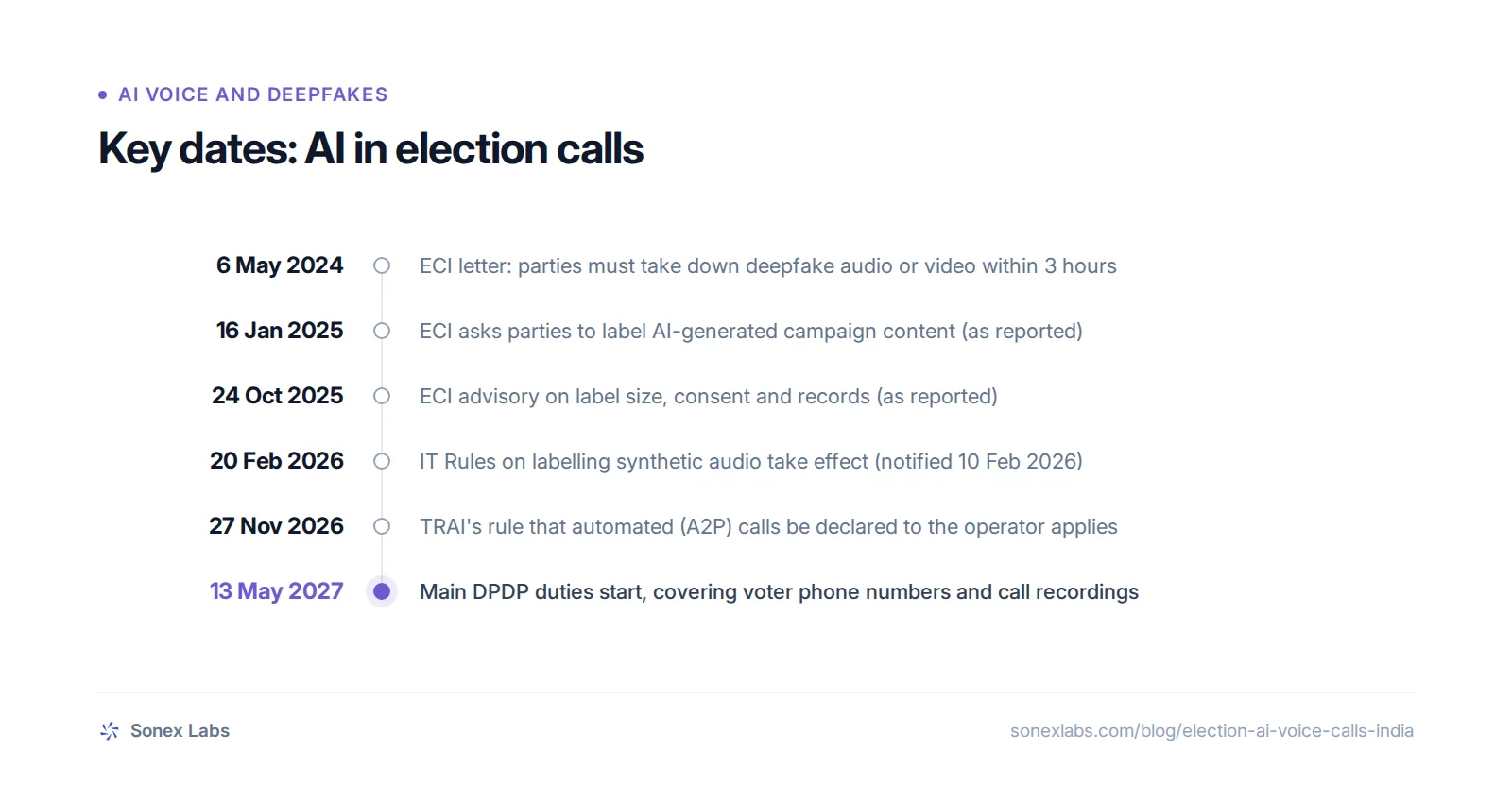
The first was a letter to all recognised parties on 6 May 2024, during the general election. It told them not to let their social media handles publish deepfake audio or video. Any such post, it said, must come down "maximum within a period of 3 hours" of it coming to their notice (ECI letter No. 491/SM_SOP/2024/Communication).
On 16 January 2025, according to news reports, the ECI asked parties to label AI-generated and synthetic content. It repeated this for the Bihar election on 9 October 2025, naming parties, their leaders, candidates and star campaigners (PIB, 9 October 2025). A further advisory, reported as dated 24 October 2025, set detailed rules on labels, consent and records.
The ECI restated the labelling rule on 19 April 2026, during the Assam, Kerala, Tamil Nadu, Puducherry and West Bengal elections. Labels should come "along with disclosure of the originating entity", meaning who is behind the content, and unlawful content reported to social media platforms is to be acted on within three hours (ECI/PN/072/2026).
Not every one of these texts is publicly available, which matters if you plan to rely on exact wording. The table sets out the main rules that touch an AI campaign call and whether we found each official text.
| Rule | Who it binds | What it says |
|---|---|---|
| ECI letter, 6 May 2024Source: Official text found | Recognised national and state parties | No deepfake audio or video; take down within 3 hours; no impersonation |
| ECI advisory, 16 Jan 2025Source: Original not found; an ECI release of 9 Oct 2025 repeats it | Parties, leaders, candidates and star campaigners | Label AI content "AI-Generated", "Digitally Enhanced" or "Synthetic Content" |
| ECI advisory, 24 Oct 2025Source: Official text not found; news reports, partly confirmed by an ECI note of 19 Apr 2026 | Parties, candidates and campaign representatives | Label size and timing, name the creator, no voice imitation without consent, keep records |
| RP Act 1951, s.126Source: Official text found, quoted in an ECI press note | Any person | No election matter by TV or similar apparatus in a polling area in the last 48 hours |
| TRAI rules, 2026 amendmentSource: Official text found | Anyone making automated calls | Declare A2P calls and number ranges to the operator in advance |
| IT Rules, 2026 amendmentSource: Official text found | Intermediaries (platforms) | Prefixed audio disclosure on synthetic audio |
Labelling AI calls: the ECI advisories and the IT Rules
The first practical question is whether these labelling rules reach a phone call at all. The ECI texts we read talk about social media, online advertisements and party handles. None of them names phone calls, so it is not settled that the labelling advisories reach an outbound AI voice call.
The reported 24 October 2025 advisory does deal with audio. According to news reports, a visual label must cover at least 10% of the display area, and an audio label must play during the first 10% of the clip (Storyboard18). A recorded or AI-voiced call is, in substance, an audio clip delivered over the phone. A campaign that wants to stay safe therefore treats it as audio content and says it is AI-generated near the start. The full text of that advisory was not on eci.gov.in when we checked. The 10% rules, the consent rule and the record-keeping rule therefore rest on reports, and a state Chief Electoral Officer can confirm the wording.
The ECI's AI texts also have a limited audience. They address parties, leaders, candidates, star campaigners and, in the reported October 2025 advisory, campaign representatives. They do not name independent supporters or the agencies that run campaigns, although the other rules in this guide reach further.
The IT Rules' audio disclosure
The IT Rules add a labelling duty of their own for synthetic voice. They were amended on 10 February 2026, with effect from 20 February 2026 (G.S.R. 120(E)). Under new rule 3(3), an intermediary whose tools can create synthetic content must label it. For audio that means "a prominently prefixed audio disclosure" so listeners can tell at once, plus embedded metadata where technically feasible (IT Rules, 2021 as amended).
MeitY's FAQ gives an example of such a disclosure: "This audio is synthetically generated" (MeitY FAQ on synthetic content). It also counts a cloned voice call recording as synthetic content. These duties fall on intermediaries, meaning platforms, not on every party or campaign that uses AI. The amendment also cut the time to remove unlawful content after a government or court order from 36 hours to 3 hours.
No source we found says whether a calling platform that places AI campaign calls is an intermediary for this rule. The ECI's labelling advisory applies to the party in any case, so the two point the same way. An opening such as "This is an AI-generated message from" the named party or candidate uses the ECI's wording and names the originating entity in one line. The guide to AI voice labelling in India covers the IT Rules in more depth, and the AI disclosure scripts have opening lines in several languages.
Cloning a leader's or candidate's voice
A label tells listeners the voice is synthetic, but it does not make every synthetic voice acceptable. The reported 24 October 2025 advisory asks parties to avoid material that misrepresents a person's identity, appearance or voice without consent, with intent to mislead voters. The ECI's 6 May 2024 letter had already told parties not to use social media to impersonate anyone, including with synthetic content that reasonably appears to be authentic.
Other laws apply too. The 2024 letter lists sections 66C and 66D of the IT Act, on identity theft and cheating by impersonation using a computer. It also cites section 123(4) of the Representation of the People (RP) Act, 1951, which makes false statements about a candidate's character a corrupt practice.
A government note on deepfakes adds sections 319, 336 and 353 of the Bharatiya Nyaya Sanhita, the criminal code that replaced the Indian Penal Code in July 2024. They cover cheating by personation, forgery and statements that cause public mischief (PIB, 6 August 2026). The IT Rules also bar synthetic content that deceptively misrepresents a real person's identity or voice.
A leader recording or approving an AI version of their own voice for their own campaign is a different case, because the problem these rules target is deception without consent. It still needs the AI label, and the consent should be written down and kept. The voice cloning law in India guide covers the personality-rights cases that protect a voice outside elections.
Campaign calls during the 48-hour silence period
Timing is the next constraint, and here the rule on calls is clearer. Bulk campaign calls cannot go out into a polling area during the 48-hour silence period. The ECI says "use of bulk SMS/voice messages" in a polling area in the last 48 hours before the close of poll is also prohibited (ECI/PN/38/2024, para 4). It repeated the same line for the Bihar election in October 2025 (ECI/PN/327/2025).
The ban sits alongside section 126(1)(b) of the RP Act, which bars displaying election matter by cinematograph, television or similar apparatus in that period. Election matter means anything intended or calculated to influence the result. The section itself does not name phones, so the clearest statement on calls is the ECI's press note rather than the Act.
The ban is tied to the polling area. In a multi-phase election, the ECI's notes allow content about later phases if it does not refer to an area in silence, so call lists need to be filtered by polling area and phase. For the 2026 state elections we found no ECI note repeating the bulk SMS and voice line. News reports from Assam said canvassing by bulk SMS and phone calls was barred in the silence period (WION, 7 April 2026). The rules at a glance:
- How long: the 48 hours ending with the hour fixed for the close of poll.
- Where: the polling area that is going to the poll.
- What is barred: election matter on TV or similar apparatus; political ads on TV, radio, cable and in cinemas; bulk SMS and voice messages.
- Penalty under section 126(2): up to two years' imprisonment, a fine, or both.
How TRAI's calling rules apply to political campaigns
Outside the silence period, the telecom rules decide how campaign calls may be placed. The rules of TRAI, the telecom regulator, on business calls and messages (the TCCCPR) do not say directly whether political calls are commercial communication. They exempt government calls made in the public interest on the directions of the Central or State Government or a body set up under the Constitution. A political party is none of these, so on our reading the exemption does not cover party campaigns (2025 amendment, regulations 2(za) and 2(bw)(iii)).
In practice, party campaigns already run through the operators' registration and template system. TRAI said in September 2025 that approving or rejecting a party's SMS templates is done by telecom operators "in accordance with the framework prescribed under TCCCPR, 2018" (TRAI Press Release 88/2025).
For AI calls the commercial question matters less now. TRAI's 2026 amendment defines an A2P (application-to-person) call as one made by software without direct human dialling, including calls in artificial voices, and applies its rules to all A2P calls, commercial or not. The duty to declare A2P calling and number ranges in advance falls on every sender (regulation 4), and TRAI's memorandum says "the bulk callers must pre-declare" (TCCCPR Third Amendment).
The rules do not say in so many words that a party calling voters is a sender, so declaring is the safe course, because undeclared A2P calls count as spam. That applies from 27 November 2026, 60 days after the amendment was published in the Gazette on 28 September 2026 (Gazette of India, Extraordinary, Part III, Section 4, CG-DL-E-28092026-276548). TRAI's 2026 rules for AI and automated calls explain the declaration, spam flags and the A2P charge.
Checking an AI campaign call and keeping records
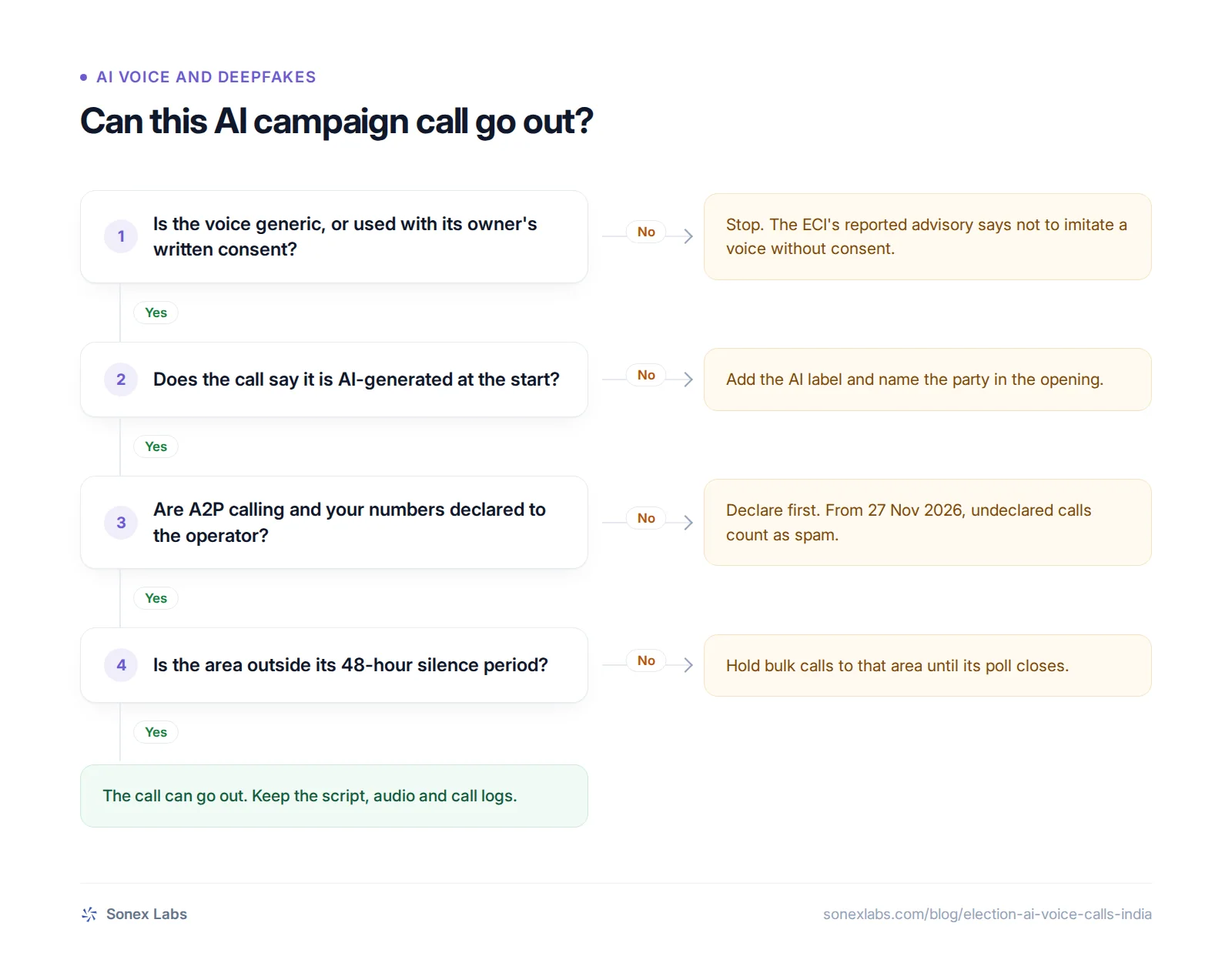
Put together, these rules give four checks before any AI-voiced campaign call goes out: consent for the voice, an AI label at the start, the declaration to the operator, and the silence period in the area being called. The chart takes them in order. Scheduling is the part software handles best. On Sonex, for example, each outbound calling campaign carries its own calling window, so each polling area can run as a separate campaign that ends before its silence period begins.
A yes to all four does not end the campaign's duties. On records, the reported 24 October 2025 advisory asks parties to keep internal records of all AI-generated campaign material, including who made it and when, and the ECI can ask to check them. For a call campaign, that means the script, the audio, the voice used, any consent from the person whose voice it is, and the call lists with dates and times. Because a flagged deepfake must come down within three hours, someone also needs the authority to stop a call campaign that fast.
Candidates must also keep an account of all election expenses under section 77(1) of the RP Act. The ECI has said this covers all campaign spending, including social media advertising, so on our reading paid call campaigns belong in it too.
Those records carry their own obligations. Phone numbers and call recordings are personal data, and the main duties under the Digital Personal Data Protection (DPDP) Act, such as notice, security and breach reporting, start on 13 May 2027. The DPDP Act guide for voice AI sets out what applies to call recordings.
Key dates
Sources
- ECI letter No. 491/SM_SOP/2024/Communication, 6 May 2024 (responsible use of social media, deepfakes)Official
- ECI press note ECI/PN/72/2024, 6 May 2024Official
- ECI press note ECI/PN/38/2024, 2 April 2024: media coverage during the section 126 period (via PIB)Official
- ECI press note ECI/PN/327/2025, 9 October 2025: Bihar elections, including the silence-period ban on bulk SMS and voice messages (copy on CEO Lakshadweep site)Official
- PIB: ECI directs parties to label AI-generated content (Bihar elections), 9 Oct 2025Official
- PIB: ECI action on unlawful social media content (ECI/PN/072/2026), 19 Apr 2026Official
- TRAI TCCCPR (Third Amendment) Regulations, 2026, 18 Sep 2026Official
- Gazette of India: TCCCPR (Third Amendment) Regulations, 2026, published 28 Sep 2026 (CG-DL-E-28092026-276548)Official
- TRAI TCCCPR (Second Amendment) Regulations, 2025, 12 Feb 2025Official
- TRAI press note on a party's SMS campaign, 8 Sep 2025Official
- MeitY: IT Rules 2021 as amended up to 10 Feb 2026Official
- MeitY: FAQs on synthetically generated information (in force 20 Feb 2026)Official
- PIB: Government framework on AI-generated deepfakes, 6 Aug 2026Official
- FCC Declaratory Ruling FCC 24-17: AI-generated voices under the TCPA, released 8 Feb 2024Official
- News On AIR: ECI asks parties to label AI-generated content, 16 Jan 2025Secondary
- News On AIR: EC issues fresh guidelines on AI and synthetic content use in Bihar poll campaigns, 25 Oct 2025Secondary
- WION: Assam enters 48-hour silent period, 7 Apr 2026Secondary
- Storyboard18: report of the ECI advisory of 24 Oct 2025Secondary
- ETV Bharat: Congress complains of AAP automated calls on poll eve, 11 May 2019Secondary
Change log: 23 Oct 2026, First published · 24 Oct 2026, Narrowed the ECI voice-imitation and 2024 letter wording to what the texts say; hedged party A2P duty; added 2026 silence-period report; exact TRAI start dates from the Gazette (published 28 Sep 2026). Later the same day, rewritten as one continuous guide: added why AI calls are an election problem (the 2024 New Hampshire call and the FCC ruling; a 2019 Delhi IVR complaint) and who the ECI texts bind; the takeaways, steps, checklist and FAQs were folded into the body