On this page
- Why Arabic text to speech has to choose a variety
- The text decides the dialect, the voice decides the accent
- One sentence in MSA and the eastern dialects
- The same sentence in North Africa and Sudan
- The letter ق shows why one Arabic voice cannot fit every caller
- How vendors describe Arabic dialect support, and what to ask them
- Choosing an Arabic variety for your callers
- Sources
Why Arabic text to speech has to choose a variety
Arabic is diglossic, meaning it has two layers used for different purposes. Modern Standard Arabic (MSA, الفصحى) is the written standard of news, contracts and school, and it is understood from Morocco to Oman. At home, in shops and on the phone, people speak a dialect: Gulf, Najdi, Egyptian, Levantine, Iraqi, Moroccan and many others. The dialects differ in everyday words, verb forms and sounds, not just in accent.
That gap shapes what a voice agent should say. MSA on a delivery or appointment call sounds like a news bulletin reading out your order, correct but distant. The caller's own dialect sounds like a person, but only to callers who share it, and Arabic dialects are not equally easy for each other's speakers to follow.
Speech technology has mostly been built on the standard. A February 2026 paper on Egyptian text to speech notes that Arabic resources are concentrated on MSA and Gulf dialects, leaving Egyptian severely under-resourced (Khamis and Ali, 2026). The authors built 38 hours of Egyptian speech from two speakers to train their own model. Most other dialects have even less, which is why vendors' dialect claims deserve close reading.
The text decides the dialect, the voice decides the accent
In text to speech the dialect starts with the words you send. If the text is MSA, you hear MSA. If you send "طلبك بيوصلك باكر", you hear the Gulf words for "your order will reach you tomorrow", because those words exist only in Gulf speech. No setting can turn an MSA sentence into Egyptian; someone has to write it in Egyptian first.
Sonex Labs' Arabic text-to-speech model, Pāṇini, works this way. Its API documentation says a language value other than auto is accepted but has no effect on pronunciation (Sonex quickstart), so the language and dialect come from the text itself. Pāṇini's language list includes MSA and twelve dialect codes, from Gulf and Najdi to Libyan, Omani and Chadian, and each code is a label for text written that way rather than a separate voice.
The accent comes from the voice's reference speaker. The samples below are read by Nour and Tariq, two voices recorded in Modern Standard Arabic, so you hear each dialect's words with a pronunciation that stays closer to the standard. Sonex has no voice recorded by a native speaker of any of these nine dialects. For a Kuwaiti or Cairene accent you would clone a local speaker's voice, with their consent, from a 10-second sample, and the guide to cloned voices and accent across languages explains what carries over.
Real customer speech also mixes languages, and the script should too. Gulf customers say "الـ order", and Algerian and Tunisian messages often use French words such as commande or livraison. Pāṇini reads mixed-language text in one voice, so write the foreign words the way your customers write them, in Latin or Arabic script, and keep the spelling consistent.
One sentence in MSA and the eastern dialects
The test sentence is a delivery confirmation: "Your order will reach you tomorrow before four o'clock. Does that time suit you?" It is the kind of line a voice agent says every day, and it changes in almost every word from one variety to the next.
Listen for three things. The word for tomorrow moves from غدًا in MSA to باكر in the Gulf, بكرة in Najdi and Egyptian, باچر in Iraqi and بكرا in Levantine. The future marker changes too: the Gulf and Najdi بـ, Iraqi راح, Levantine رح and Egyptian هـ. Egyptian also swaps the possessive for بتاعك and the word for the appointment time for الميعاد.
Gulf and Najdi are easy to confuse. Khaleeji, or Gulf Arabic, is spoken in Kuwait, Bahrain, Qatar, the UAE and Saudi Arabia's Eastern Province. Riyadh and central Saudi Arabia speak Najdi, which shares the Gulf's hard g for ق but has its own words, such as وش for "what". A Saudi campaign therefore needs to know which part of the country it is calling.
سيصلك طلبك غدًا قبل الساعة الرابعة، هل يناسبك هذا الوقت؟
طلبك بيوصلك باكر قبل الساعة أربع، يناسبك الوقت؟
ترى طلبك بيوصلك بكرة قبل الساعة أربع، يناسبك الوقت؟
طلبك راح يوصلك باچر قبل الساعة أربعة، يناسبك هالوقت؟
طلبك رح يوصلك بكرا قبل الساعة أربعة، بيناسبك هالوقت؟
الطلب بتاعك هيوصلك بكرة قبل الساعة أربعة، الميعاد ده يناسبك؟
The same sentence in North Africa and Sudan
West of Egypt the vocabulary changes again. Moroccan says غدا for tomorrow and غادي for the future, Algerian and Tunisian say غدوة, and each has its own possessive: ديالك in Morocco, تاعك in Algeria and متاعك in Tunisia. The order itself becomes الطلبية.
These dialects are hard for eastern Arabs to follow. Wikipedia's overview of Arabic varieties says understanding between the western (Maghrebi) and eastern (Mashriqi) groups is asymmetric: North Africans are more likely to follow eastern dialects than the reverse, which it credits to exposure to Egyptian and Levantine film, television and music (Varieties of Arabic). Part of that passage is marked as needing a citation, but it matches why a Cairo or Dubai team cannot simply reuse its scripts in Casablanca.
Sudanese, though spoken in Africa, falls in the eastern group under that division, which puts the line at Libya's eastern border. Its sample is grouped here only because of geography.
الطلبية ديالك غادي توصلك غدا قبل الربعة، واش الوقت مناسب ليك؟
الطلبية تاعك راح توصلك غدوة قبل الربعة، الوقت يناسبك؟
الطلبية متاعك باش توصلك غدوة قبل الأربعة، الوقت يناسبك؟
الطلب حقّك بيصلك بكرة قبل الساعة أربعة، الوقت ده بناسبك؟
The letter ق shows why one Arabic voice cannot fit every caller
Every sample keeps the word قبل (before), because its first letter, qaf, is said differently across the Arab world. MSA has a deep q at the back of the throat. Most of the Arabian Peninsula, including Gulf and Najdi speakers, says a hard g, so قبل sounds like gabl. Lower Egypt, including Cairo, and most of the Levant turn it into a glottal stop, the catch in "uh-oh", so it sounds like ʔabl. Most of the Maghreb keeps q (Wikipedia: Qāf).
Spelling does not show any of this. A dialect sentence written in Arabic script still says ق, and only the voice decides how it comes out. That is why the sound of ق is one of the first things a native listener notices, and why a native speaker should check it in every sample before a script reaches callers.
Even one region is not one accent. Wikipedia's article on Gulf Arabic notes that Kuwaiti speech differs from Qatari and Emirati speech, "especially in pronunciation", enough that it may hinder mutual intelligibility (Gulf Arabic). A single "Gulf" voice will sound local in some Gulf cities and foreign in others.
| Variety | "Tomorrow" in the sample | How ق is usually said |
|---|---|---|
| Modern Standard Arabic | غدًا | q |
| Gulf | باكر | g |
| Najdi | بكرة | g |
| Iraqi | باچر | g in the south, q in the north |
| Levantine | بكرا | Glottal stop in most of the Levant |
| Egyptian | بكرة | Glottal stop in Lower Egypt, g in Upper Egypt |
| Sudanese | بكرة | A voiced uvular stop, close to g |
| Moroccan | غدا | q in most of Morocco, glottal stop in Fez |
| Algerian | غدوة | q in most of Algeria, glottal stop in Tlemcen |
| Tunisian | غدوة | q in most of Tunisia, g in some areas |
How vendors describe Arabic dialect support, and what to ask them
Sonex Labs sells Arabic text to speech, so read this section as a vendor's view. Dialect claims in this market are hard to compare. NEVOX advertises 15+ Arabic dialects, Munsit lists 25+ dialects understood, and Lahajati claims 192+ dialects and 600+ voices. Several publish headline accuracy figures, such as NEVOX's 95% and Lahajati's 99%, without a test set or method we could find.
The large platforms say less. Amazon Polly added Zayd, a male Gulf Arabic voice, in August 2023, joining its female Gulf voice Hala, and AWS describes it as speaking both Gulf Arabic and MSA (AWS announcement). Munsit, an Arabic-first competitor, writes that ElevenLabs' public documentation does not detail its dialect coverage (Munsit). That is a rival's description rather than a test, and it has not been checked independently here.
The useful question for any vendor, Sonex included, is what stands behind a dialect name. It can mean a voice recorded by a native speaker of that dialect, or a standard voice reading dialect text, which is what Sonex offers today. The two sound different, and a demo in MSA tells you nothing about either. These four questions separate them:
- Was this voice recorded by a native speaker of this dialect, or does a standard voice read dialect text?
- Can I hear one sentence of my own in every dialect you list?
- How does the voice say ق, prices and dates in this dialect?
- Is there a published test for your accuracy figure: which audio, how many speakers, which metric?
Choosing an Arabic variety for your callers
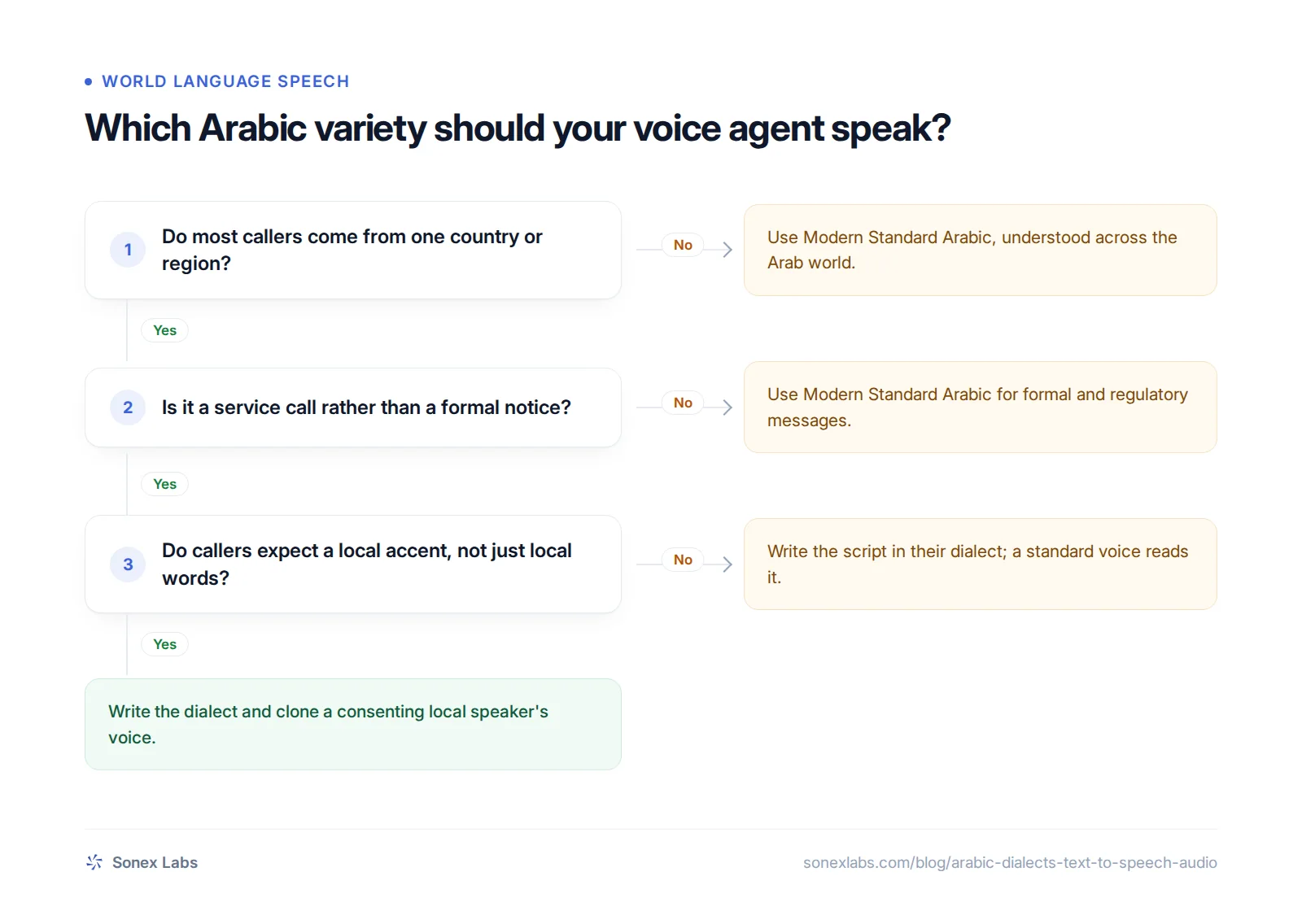
The choice comes down to who is calling and what the call is for. MSA is the safe default when callers come from several countries, and for anything formal, such as account statements, regulatory notices and IVR menus. A service call, such as a delivery or an appointment, sounds friendlier in the caller's own dialect.
Egyptian and Levantine are often suggested as compromises because so many Arabs have heard them on screen. That reach is real, but it does not make them neutral: a Gulf or Moroccan caller still hears them as someone else's dialect. For a mixed audience, MSA remains the safer choice.
Then decide how local the voice must sound. Local words in a standard voice already sound closer to home than MSA. If your callers expect a voice from their own city, clone a consenting native speaker and keep the scripts in that speaker's dialect. Whichever you choose, try your own sentence before you commit; the dialect pages for Gulf Arabic, Egyptian Arabic and Najdi Arabic carry more samples.
Two other things decide whether a dialect script sounds right. Short vowels, which Arabic usually leaves unwritten, change how a voice reads ambiguous words, as the guide to Arabic TTS without tashkeel shows. Numbers, prices and dates need writing out the way callers say them, covered in how Arabic TTS reads prices, dates and phone numbers.
Sources
- Sonex Labs API quickstart: the language field and auto-detectionOfficial
- Khamis and Ali: LLM-to-Speech, a synthetic data pipeline for dialectal TTS (Egyptian Arabic), arXiv, February 2026Secondary
- Wikipedia: Varieties of Arabic (Maghrebi and Mashriqi intelligibility)Secondary
- Wikipedia: Qāf (pronunciation by region)Secondary
- Wikipedia: Gulf ArabicSecondary
- AWS: Amazon Polly launches Zayd, a Gulf Arabic male neural voice (16 August 2023)Official
- NEVOX: Arabic voice agents (vendor site)Secondary
- Lahajati: Arabic voice platform (vendor site)Secondary
- Munsit (an Arabic voice vendor): best Arabic TTS comparisonSecondary
Change log: 24 Oct 2026, First published. Later the same day, rewritten as one continuous guide: added why Arabic TTS must choose a variety (diglossia, scarce dialect data), separated what the text decides from what the voice decides, explained Gulf versus Najdi, and folded the takeaways and three FAQs into the body. Audio samples unchanged