On this page
- Why short Arabic answers are hard for speech recognition
- What Azure and Whisper users report
- Code-switching and dialect spelling make Arabic error rates look worse than they are
- Let a one-word answer count as a turn
- Accept every dialect's yes and no, and treat the rest as unclear
- Re-ask instead of guessing
- Test yes/no recognition on your own callers before launch
- Sources
Why short Arabic answers are hard for speech recognition
A yes/no confirmation is the turn a voice agent's work hangs on: confirm the appointment, approve the payment, agree to the transfer. In Arabic the answer is often a single syllable, such as لا, إيه or إي, said quickly while the caller is already thinking about something else. A speech recogniser then has a fraction of a second of audio and no sentence around it to tell it which language, or which word, it heard.
Language matters more for Arabic than for most languages because Arabic callers switch so freely. A Gulf caller may answer "ok" one minute and "تمام" the next, and many recognisers decide the language of a clip before they decide its words. With so little audio, that first guess is easy to get wrong.
Three different failures follow. The recogniser can decide the audio was English and return an English word. It can recognise the Arabic but write it in Latin letters. Or the word never reaches the recogniser, because the agent's turn-taking rules, the logic that decides when the caller has started or finished speaking, discarded it as too short. Each needs a different fix, and the last is the easiest to miss.
What Azure and Whisper users report
The evidence for these failures is public, scattered across developer forums and issue trackers, and mostly unresolved. Three reports describe the patterns clearly.
Azure: English transcripts with the locale set to ar-AE
The best-documented case is a Microsoft Q&A thread from 13 March 2025 (Microsoft Q&A). A developer set Azure Speech to Arabic (UAE), ar-AE, with no automatic language detection, and still got English words, and later whole sentences, back as English. They reproduced it in Speech Studio in three regions: Sweden Central, Europe and UAE North. A moderator suggested a custom speech model or post-processing, and no answer was accepted.
Other users added the same report for Arabic in September 2025, and for French (fr-FR) in November 2025. The thread was still open when it was checked on 24 October 2026.
Azure's documentation explains why turning on language identification cannot rescue this. When you give it candidate languages, the service returns one of them even if none was spoken. Its continuous language identification "doesn't support changing languages within the same sentence", so an Arabic sentence with one English word in it is labelled as one language or the other (Microsoft Learn). For Gulf callers who mix "okay" and "booking" into Arabic, that is the normal case, not an edge case.
Whisper: نعم written as "Naah", and Arabic in Latin letters
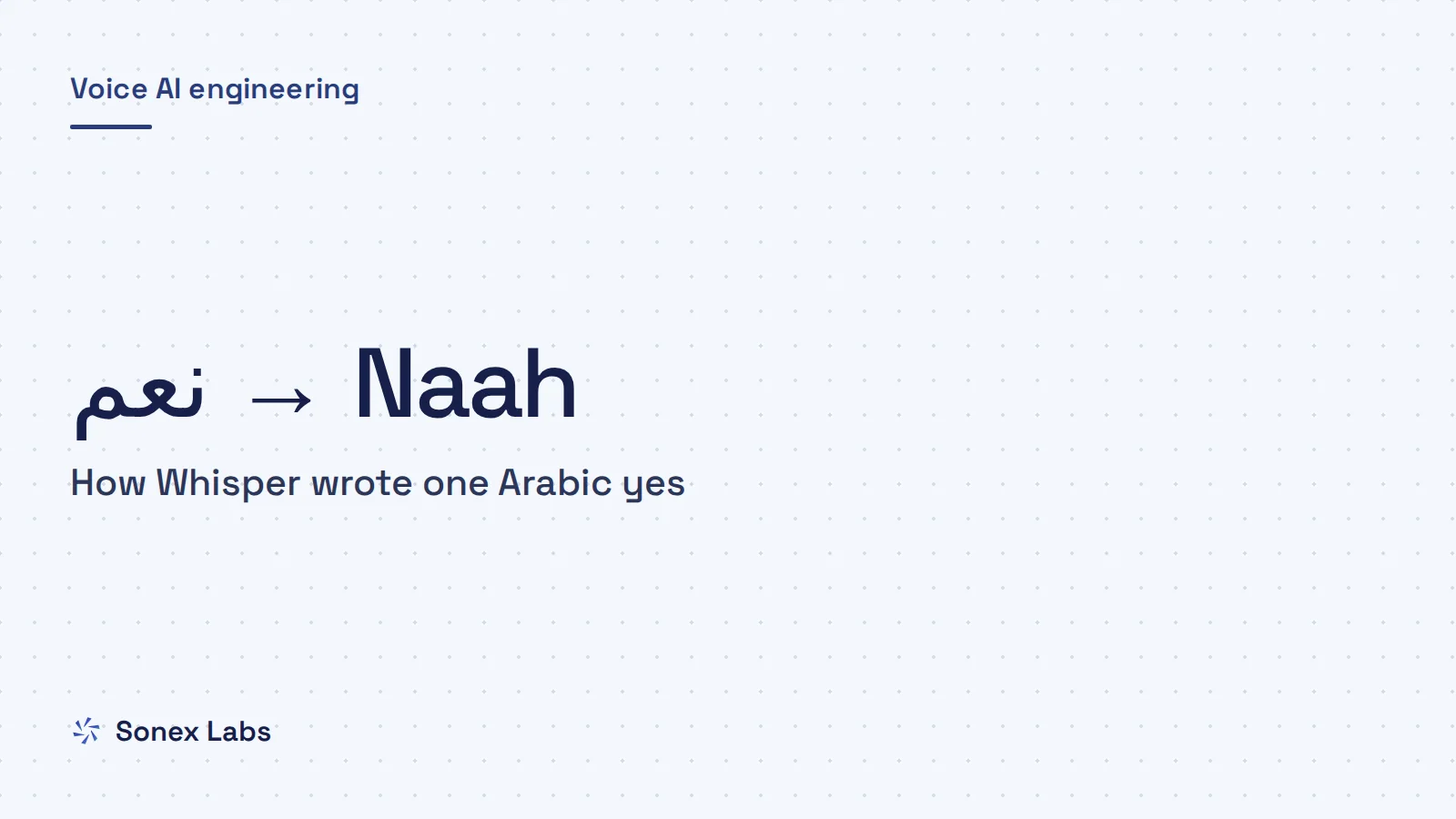
On the OpenAI developer forum, a user of whisper-large-v3-turbo reported in June 2025 that the Arabic word نعم (yes) came back as "Naah" or "Naahe" (OpenAI forum). One reply noted that single-word clips perform poorly across models. In September 2025 another user said tuning voice activity detection (VAD), the step that decides which audio contains speech, and chunk sizes fixed it for them, and that a temperature of about 0.1 made it rarer. That is one person's report, not a benchmark, and the original poster never confirmed a fix.
A related complaint is Arabic returned in Latin script. In an AnythingLLM issue from January 2025, a user set the Whisper language to Arabic and still got "marhaban" instead of مرحبا (AnythingLLM issue #2928). The maintainer explained that the language setting describes the input audio, not the output script, and pointed to post-processing with an LLM as the usual workaround.
The "Naah" case has a trap of its own. In English, "nah" means no. A voice agent that maps the Latin string to an answer by spelling can turn a caller's yes into a no. No report of this happening was found, but the collision is there in the strings, which is why the code later in this article treats these forms as unclear.
Whisper on silence: an Arabic sentence nobody said
The opposite failure matters too. When a caller says nothing, Whisper can return text anyway: one user reported that complete silence is always transcribed as "ترجمة نانسي قنقر" ("translation by Nancy Qunqar"), a subtitle credit Whisper appears to have learned from video subtitles (Kieran Healy, July 2025). An agent waiting for yes or no then receives a sentence that is neither. The guide to gating Whisper hallucinations on silent phone lines covers the fix, and the guide to Whisper picking the wrong language on short clips covers the language guess.
Code-switching and dialect spelling make Arabic error rates look worse than they are
Gulf and Egyptian callers mix English into Arabic constantly, and benchmarks have started to measure it. A May 2026 study tested five commercial speech recognition services on code-switched speech, with 300 samples each of Egyptian Arabic with English, Saudi Arabic with English, Persian with English and German with English (Abdoli and others, 2026). The best system overall, ElevenLabs Scribe v2, had a word error rate (WER), the share of words wrongly transcribed, of 13.2%.
The authors' more useful point is about the metric. They say WER overstates the gaps between systems by about three times, because it counts a valid transliteration as an error. An English word written in Arabic script, or the reverse, is marked wrong even when a person would accept it.
Dialect spelling has the same effect. The author of gulf-whisper-srt, a Saudi subtitling tool, found Whisper writes Gulf speech in standard spelling, such as ثاني for the spoken تاني, and calls these "only spelling" errors that a person would accept (gulf-whisper-srt). Their figures come from one episode of one Saudi show, which they say tells you nothing about other dialects. For a yes/no turn the lesson is direct: judge the meaning of the reply, never an exact string match.
Let a one-word answer count as a turn
Start with turn-taking, because a word that is thrown away cannot be recognised. Voice agent frameworks filter short sounds so that a cough or a "hmm" does not interrupt the bot, and an Arabic "لا" can look exactly like one of those sounds.
In Pipecat, the MinWordsUserTurnStartStrategy requires a set number of words before a reply counts while the bot is speaking, and drops to one word once the bot has stopped (Pipecat source). Set it to two words, and a caller who says "لا" over the end of the bot's question is ignored. LiveKit Agents counts speech as an interruption only after 0.5 seconds by default, its min_duration setting (LiveKit turn handling options).
The practical rule is to end the question cleanly, stop speaking, and let one word be enough. If callers often answer before the question ends, shorten the question rather than lowering the threshold for everything else. The same tension, between ignoring backchannel noises and hearing real answers, is worked through for Hindi in why voice bots get interrupted by haan or hmm.
Accept every dialect's yes and no, and treat the rest as unclear
Once the reply reaches the recogniser, accept it in every form your callers use. Yes and no differ by dialect, like most everyday words, as the same sentence in ten Arabic varieties shows. The sharpest example is إيه: it means yes in the Gulf and the Levant but usually means "what?" in Egypt. Callers also answer in English, or in a mix ("ok تمام"), and phrases such as مو مشكلة (no problem) contain a negative word but mean yes.
Normalise the transcript before matching, so that small spelling differences do not decide the outcome. That means stripping tashkeel (the short-vowel marks) and tatweel (the stretching stroke), writing every alef form as plain ا, and lowercasing Latin text. Anything that is empty, contradictory or romanised should come back as unclear, never as a guess.
The table is a starting list, and the Python function below applies it. Both are illustrations written for this article, not lists measured on real calls, and a native speaker of each dialect you serve should correct them before they reach callers.
| Dialect | Yes | No |
|---|---|---|
| Gulf and Najdi | إيه، إي نعم، أكيد، تمام | لا، لا والله |
| Egyptian | أيوه، آه، ماشي، تمام (إيه usually means "what?") | لأ، لا |
| Levantine | إيه، إي، أكيد، تمام | لا، لأ |
| Iraqi | إي، زين، تمام | لا |
| Moroccan | إيه، واخا | لا |
| Algerian and Tunisian | إيه، واه، باهي | لا، لالا |
| Mixed with English | yes، ok، okay | no |
import re
import unicodedata

YES = {"نعم", "ايوه", "ايوا", "اه", "اي", "ايه", "اكيد", "تمام", "طيب", "ماشي", "صح", "بلى",
       "زين", "واخا", "باهي", "واه", "yes", "yeah", "yep", "ok", "okay", "sure", "aywa", "aiwa", "naam", "tamam"}
NO = {"لا", "لاء", "مو", "مش", "ابدا", "no", "nope", "la", "laa"}
# Phrases that contain a negative word but mean yes ("no problem").
YES_PHRASES = ("مو مشكلة", "مش مشكلة", "ما في مشكلة", "ولا يهمك")
# Tokens that mean different things to different callers: never act on them alone.
AMBIGUOUS = {"nah", "naah", "naahe"}  # Whisper's spelling of نعم, and English "nah" (no)


def normalise(text: str) -> str:
    text = unicodedata.normalize("NFKC", text).lower()
    text = "".join(ch for ch in text if unicodedata.category(ch) != "Mn")  # strip tashkeel
    text = text.replace("ـ", "")  # tatweel
    text = re.sub("[أإآ]", "ا", text).replace("ى", "ي")
    return " ".join(re.findall(r"[\w']+", text))


def yes_or_no(transcript: str, dialect: str = "gulf") -> str:
    """Return "yes", "no" or "unclear" for a caller's reply to a yes/no question."""
    yes_words = set(YES)
    if dialect == "egyptian":
        yes_words.discard("ايه")  # in Egyptian, ايه usually means "what?"
    text = normalise(transcript)
    said_yes = any(phrase in text for phrase in YES_PHRASES)
    for phrase in YES_PHRASES:
        text = text.replace(phrase, " ")
    tokens = text.split()
    if any(t in AMBIGUOUS for t in tokens):
        return "unclear"
    said_yes = said_yes or any(t in yes_words for t in tokens)
    said_no = any(t in NO for t in tokens)
    if said_yes == said_no:  # neither, or both ("لا لا، تمام")
        return "unclear"
    return "yes" if said_yes else "no"


for reply, dialect in [("نَعَم", "gulf"), ("إيه أكيد", "gulf"), ("إيه؟", "egyptian"),
                       ("أيوه", "egyptian"), ("لأ شكراً", "levantine"), ("Naah", "gulf"),
                       ("ok تمام", "najdi"), ("مو مشكلة", "gulf"), ("واخا", "moroccan"), ("لا لا، تمام", "gulf")]:
print(f"{reply:12} {dialect:10} -> {yes_or_no(reply, dialect)}")Re-ask instead of guessing
An unclear answer is not a failure if the agent handles it well. Ask again with a different shape: restate the one fact being confirmed ("يوم الخميس الساعة أربع، صح؟"), so the caller can answer with a single word or correct the detail. A second unclear reply is the moment to offer a keypress ("اضغط واحد للتأكيد واثنين للإلغاء"), a good fallback even though callers expect to answer by voice first.
For steps where a wrong answer is costly, such as approving a payment, some teams require both a spoken yes and a keypress. That doubles the effort for the caller, so keep it to the few confirmations that justify it.
Pass the full transcript to the language model as well, so it can read longer answers such as "إيه بس خلها الساعة خمس" (yes, but make it five). Give the model the question being answered and ask it to return yes, no or unclear, rather than a rewritten sentence, so its output can be checked by code in the same way as the word lists.
Test yes/no recognition on your own callers before launch
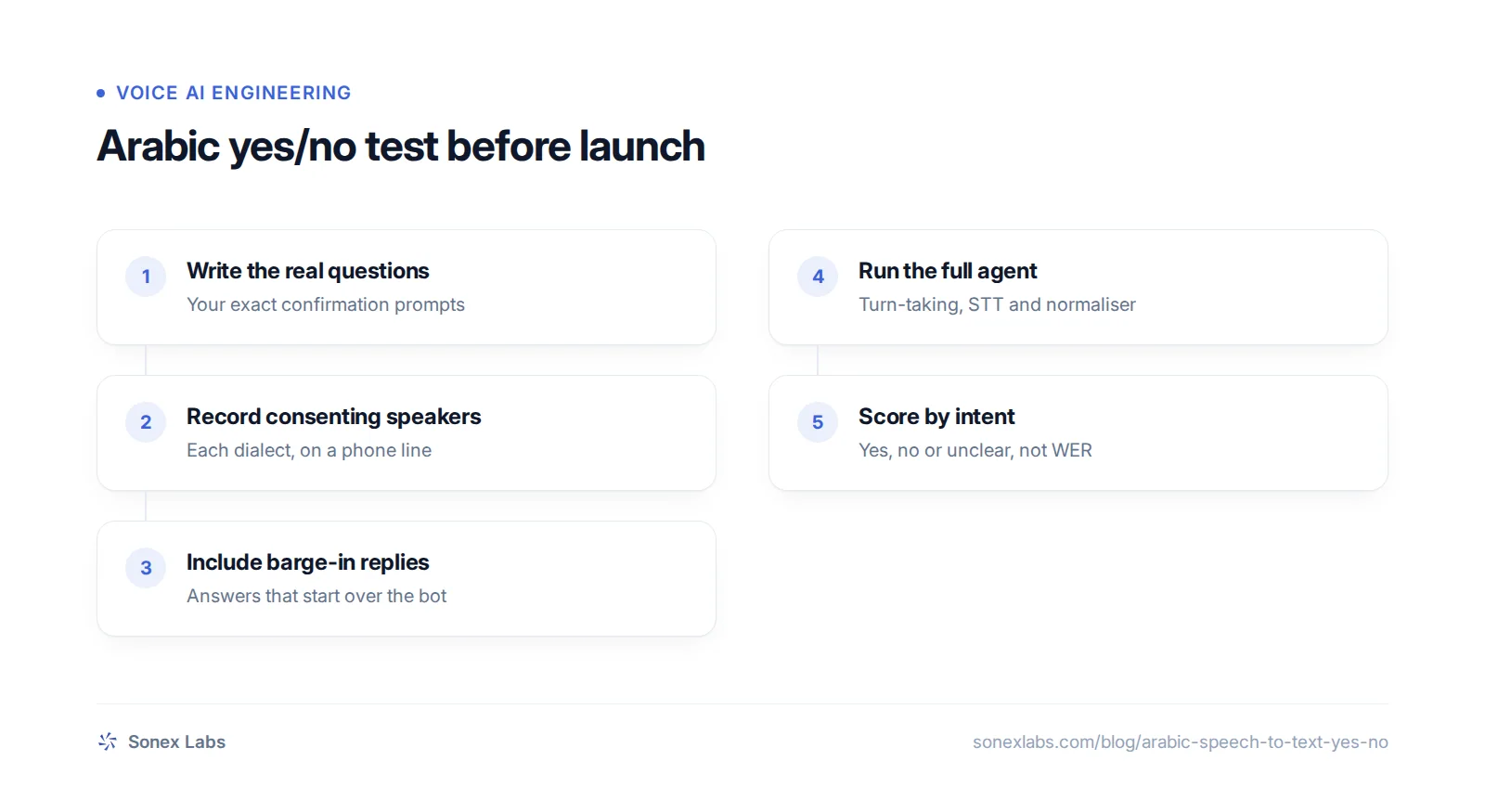
Published numbers will not tell you how your agent handles your callers, so build a small test of your own. Record consenting speakers from each dialect you serve answering your real confirmation questions, over a real phone line, with short replies, long ones and replies that start while the bot is still talking. Run them through the whole agent, turn-taking included, and score each reply by intent, yes, no or unclear, not by word error rate.
Repeat the test whenever you change the speech-to-text provider or the turn-taking settings, because either can move results more than any prompt change. The checklist for testing a multilingual voice agent covers the rest of the agent.
Sonex Labs has not published Arabic accuracy figures for Valmiki, its speech-to-text model, so this article describes a method, not a result. Valmiki's Arabic speech to text detects the spoken language automatically and takes Arabic as one language, with no dialect setting. That makes a per-dialect test like this one the only way to know how it, or any other recogniser, handles your callers.
Sources
- Microsoft Q&A: Azure Speech keeps recognising English with ar-AE set (March 2025)Secondary
- Microsoft Learn: Implement language identification (Speech service)Official
- OpenAI developer forum: Arabic transcription in whisper-large-v3-turbo returns "Naah" (June 2025)Secondary
- AnythingLLM issue #2928: specify Whisper transcription language (January 2025)Official
- Kieran Healy: The Sound of Silence, on Whisper's stock phrases for silent audio (22 July 2025)Secondary
- Abdoli et al., Benchmarking Commercial ASR Systems on Code-Switching Speech: Arabic, Persian, and German (arXiv 2605.19069)Official
- gulf-whisper-srt: Gulf dialect subtitling with Whisper (GitHub)Secondary
- Pipecat: MinWordsUserTurnStartStrategy sourceOfficial
- LiveKit Agents: turn handling options (interruption min_duration and min_words)Official
Change log: 24 Oct 2026, First published. Later the same day, rewritten as one continuous guide: the reports are grouped by system with a new note on Whisper's phantom Arabic sentence on silence; the handling advice is split into turn-taking, dialect word lists and re-asking; the takeaways, steps, checklist and three FAQs were folded into the body. Code and word table unchanged