On this page
Why a per-minute price rarely matches the invoice
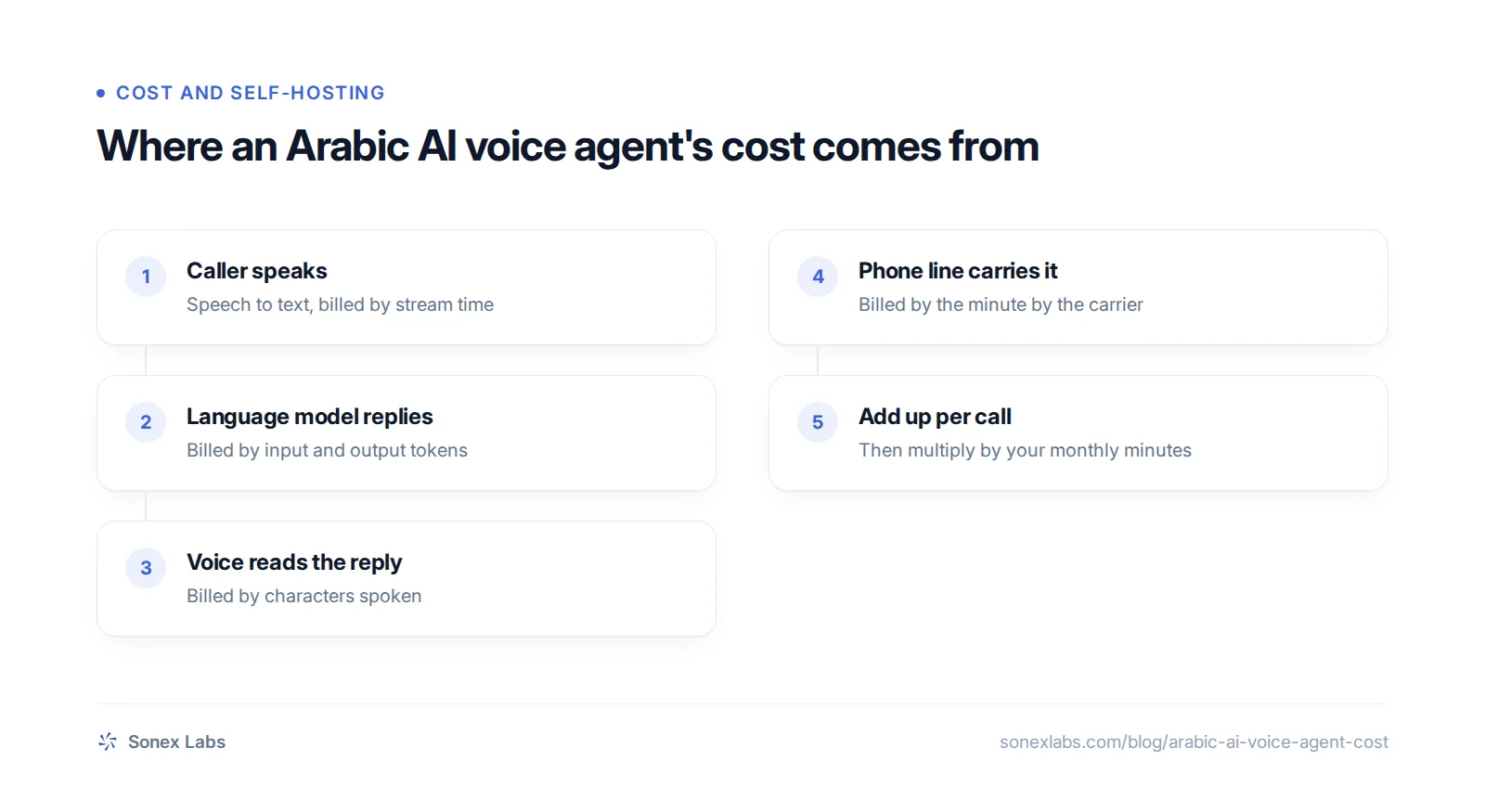
Most AI phone agents today are cascaded, meaning three models run one after another on every turn. A speech-to-text model turns the caller's Arabic into text, a large language model (LLM) writes the reply, and a text-to-speech model speaks it. Underneath all three sits the phone line that carries the call. Each of these four parts has its own cost, and each grows with something different.
A vendor's headline rate is a decision about which of those parts to bundle. One vendor folds the language model into its minute and leaves the phone line to you. Another includes the phone side but bills the model separately, and a third quotes a rate that excludes setup and platform fees. Two rates that look close can therefore produce invoices that are far apart, and a low rate can be low because it covers less.
Currency is the one part that stays still. The UAE dirham is pegged at AED 3.6725 to the US dollar and the Saudi riyal at SAR 3.75 (ExchangeRate-API, 24 October 2026), and most voice AI vendors price in dollars. A dirham or riyal budget therefore moves only when a vendor changes its dollar price, unlike in India, where the rupee floats. Every conversion in this guide uses those two rates, and all prices are before VAT, which both countries charge.
The four meters on every call, and what drives each
Before comparing vendors, it helps to see what each part is billed on, because that tells you which of your own numbers to collect. Minutes matter for two of the four parts. The other two depend on how long your prompt is and how much the agent says.
Speech recognition: billed by the time the line is open
Speech to text is usually billed per second or per minute of audio streamed, whether or not anyone is speaking. On a phone call the stream stays open for the whole call, so the pauses while a caller looks for a booking number cost the same as speech. This is why STT cost tracks call length closely and is easy to predict. The effect of per-second STT billing on silence is worth reading if your callers often wait on hold.
The language model: billed by tokens, not minutes
The language model is billed by tokens, the chunks of text it reads and writes. On every turn it reads the whole system prompt plus the conversation so far, so a long prompt is paid for again on each reply. A two-minute call with a short prompt can cost less in model fees than a one-minute call with a long prompt and several tool calls, such as checking a calendar or a CRM.
Arabic adds a second variable. Tokenizers, the part of a model that splits text into tokens, can need very different numbers of tokens for the same sentence in different languages, up to 15 times as many in extreme cases (Petrov and others, NeurIPS 2023). How Arabic compares with English depends on the model you choose, so the way to know is to count tokens on an Arabic pilot call and an English one, not to assume.
The voice: billed by characters spoken
Text to speech is billed by the characters the agent says, so a talkative script costs more than a terse one. Arabic is cheaper here than people expect. Arabic script leaves out most short vowels, so the same minute of speech needs fewer written characters than Hindi or English.
In a measurement on 24 October 2026, spoken Gulf Arabic read by Pāṇini, Sonex Labs' text-to-speech model, came to about 626 characters per minute of finished audio, against 937 for Hindi. The figure depends on the voice and the script as well as the language. Treat it as a rough guide to how far a per-character price stretches for Arabic, not as a constant.
The phone line: billed by your carrier, often rounded up
Telephony is billed per minute by whoever owns the number, and many carriers round each call up to a whole minute. A Gulf business usually wants a local UAE or Saudi caller ID, which in practice means connecting its own carrier account to the agent platform. That carrier then bills you directly at its own rates, so get its per-minute price in writing before you build a budget. Outbound calls also have to follow local rules on hours, consent and numbers, set out for the UAE's AI telemarketing rules and Saudi Arabia's rules for AI calls.
What vendors publish, and what each rate leaves out
Self-serve agent bundles now publish prices, and their pricing pages say plainly what is inside. Deepgram's Voice Agent API lists $0.075 a minute on its Standard pay-as-you-go tier and says the rate covers speech to text, LLM processing and text to speech, billed on WebSocket connection time (Deepgram pricing). With your own language model the rate drops to $0.065. The page does not mention telephony.
ElevenLabs lists $0.08 per agent call minute, and says LLM usage is billed separately on top, based on the model you choose (ElevenLabs Agents pricing). It adds no telephony fee of its own, but if you connect an external provider such as Twilio or a SIP trunk, that provider bills you directly for the carrier side.
Gulf-focused platforms publish less. ZIWO, which markets an Arabic-first agent with data hosted in Saudi Arabia, shows $0.25 a minute in a calculator on its Saudi page (ZIWO). It says that figure leaves out one-time setup fees, platform access and monthly channel fees. Most other Arabic-first vendors found while researching this guide quote only after a sales call, so your own pilot numbers are often the only comparison available.
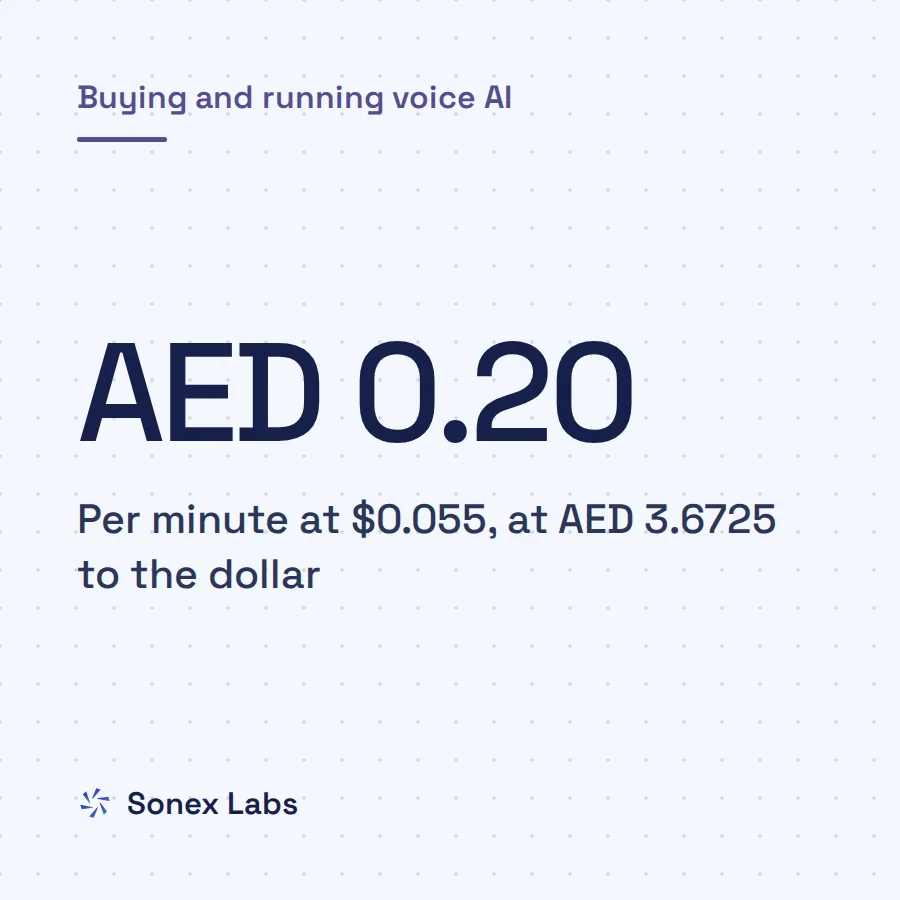
Sonex Labs, which publishes this guide, lists a voice-agent price of $0.055 a minute, the same in every language. The language model is billed per token on top, and so is telephony on Sonex numbers; calls on your own carrier carry no Sonex minute charge. Sonex has a stake in this comparison, so ask every vendor, including Sonex, for a real call's invoice broken into its parts.
| Vendor | Published rate per minute | What the vendor says is billed on top or excluded |
|---|---|---|
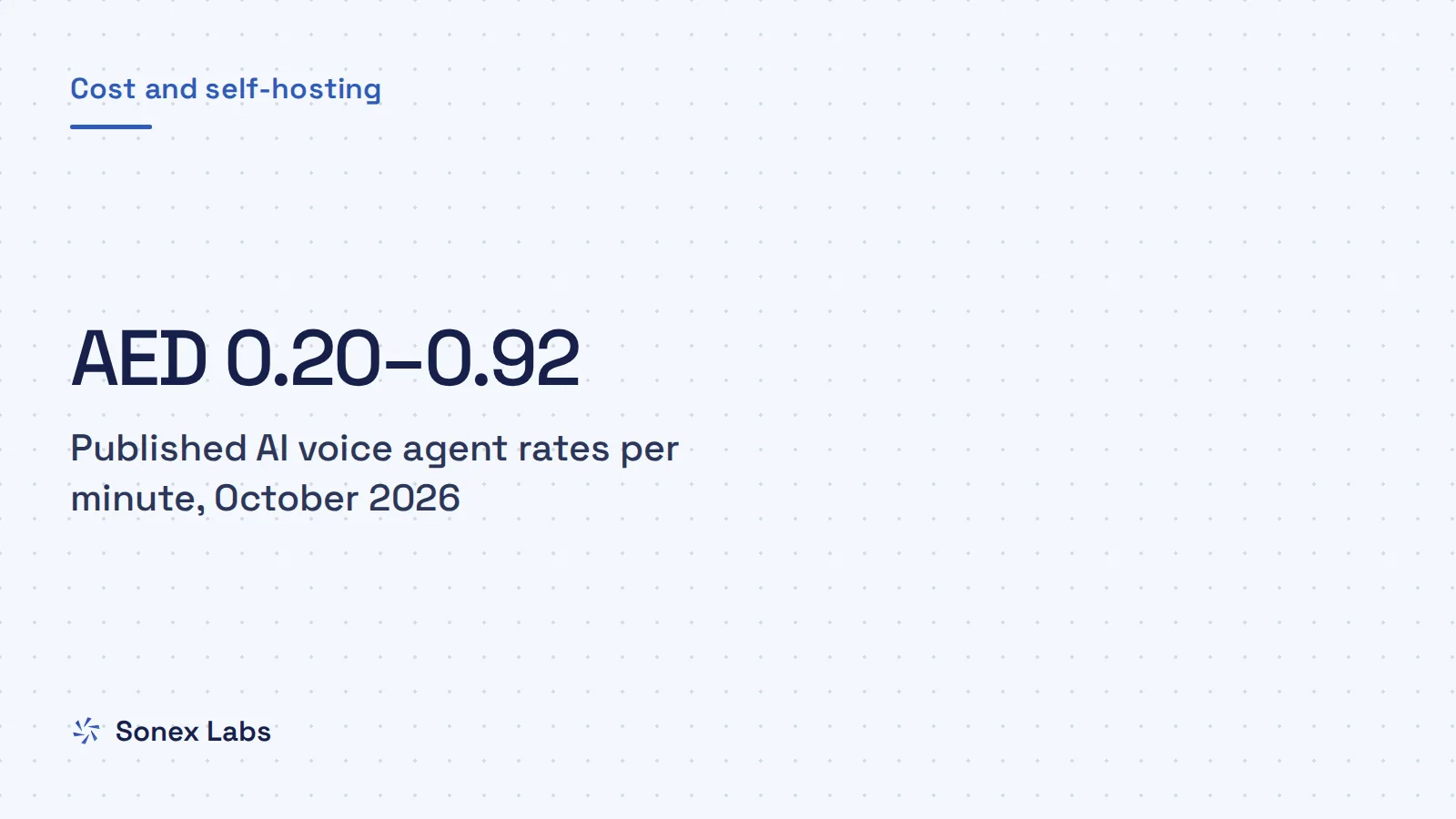
| Deepgram Voice Agent API (Standard, pay as you go) | $0.075 (AED 0.28, SAR 0.28) | Telephony not mentioned; $0.065 if you bring your own LLM |
| ElevenLabs Agents | $0.08 (AED 0.29, SAR 0.30) | LLM usage; an external carrier bills its own charges |
| ZIWO AI voice agent (Saudi page) | $0.25 (AED 0.92, SAR 0.94) | Setup fees, platform access and monthly channel fees |
| Sonex Labs voice agent | $0.055 (AED 0.20, SAR 0.21) | LLM tokens; telephony on Sonex numbers |
A worked monthly example in dirhams and riyals
Take a Riyadh clinic group or a Dubai service desk whose agent handles 5,000 connected minutes a month. That volume is an assumption for illustration, so replace it with your own. At Sonex's published $0.055 a minute, the agent minutes come to $275 a month, which is AED 1,009.94 or SAR 1,031.25.
The language model comes on top, and its cost depends on your prompt. Suppose, again for illustration, that each minute of conversation has four agent turns, and each turn reads 3,000 input tokens (the system prompt plus the history) and writes 60 output tokens. At the Vyas LLM list price of $0.30 per million input tokens and $0.60 per million output tokens, one minute uses 12,000 input tokens ($0.0036) and 240 output tokens ($0.000144). Over 5,000 minutes that adds about $18.72, or AED 68.75 and SAR 70.20.
The example therefore lands at about $293.72 a month before telephony and VAT: AED 1,078.69 or SAR 1,101.45. Real calls spread much wider than one tidy assumption. Across calls Sonex billed between 1 and 24 October 2026, the median language-model charge was about $0.0097 a minute, over twice the illustration, and the most expensive calls were those with long prompts and many tool calls.
The same 5,000 minutes on Deepgram's pay-as-you-go rate would be $375 (AED 1,377.19 or SAR 1,406.25) with the language model included, and on ElevenLabs $400 before its separate model charge. Neither figure includes the carrier, and none of these totals says anything about whether the agent handled the calls well. That is the point of the comparison: the arithmetic is easy once you know which lines each vendor leaves out, and impossible until you do.
Telephony is the line you will price yourself. Sonex's own numbers are Indian landlines and a US number, billed at $0.008 and $0.014 a minute, so a Gulf caller ID means bringing your own carrier, which Sonex does not charge a minute fee for. The voice agent cost calculator runs the same sums with your own minutes, and the AI calling agent cost guide for India works through the rupee version.
Test cost and call quality together
Price is not the only headline that needs reading closely. A UAE guide to ElevenLabs agents notes that the 75 ms figure quoted for its Flash model refers to model inference only and excludes application and network latency (MajLeads, updated 7 October 2026). It also finds no Middle East serving region, so UAE requests are served from Amsterdam or Singapore. The wait a caller actually hears is the sum of every hop, not the fastest one.
The same guide says the slower Multilingual v2 model handles number normalisation better, and that text normalisation is off by default on Flash v2.5 to protect latency. Normalisation means turning "AED 1,250" or "15/11" into the words a person would say. For an Arabic booking or collections call that trade-off matters, because prices, dates and phone numbers are what the call exists to get right. A cheaper minute that misreads an amount is not cheaper once the customer calls back to complain.
So run the same script through each shortlisted vendor on a real Gulf phone line, with dirham or riyal amounts, dates, times and names in it. Record the full cost of each call next to whether the agent read every number correctly and how long callers waited for replies. The guide to how Arabic TTS should read prices, dates and phone numbers lists what to put in that script.
After a pilot of a week or two, rebuild the monthly sum from the calls themselves rather than from any vendor's example, including the ones above. In the Sonex dashboard, call history can be filtered by agent and each call shows its cost broken down by part. There is no total per agent yet, so add one agent's calls up yourself.
Sources
- ExchangeRate-API: USD rates (open.er-api.com), 24 October 2026Official
- Deepgram pricing: Voice Agent APIOfficial
- ElevenLabs Agents pricingOfficial
- ZIWO: AI voice agent hosted in KSA (pricing calculator)Official
- Petrov, La Malfa, Torr and Bibi: Language Model Tokenizers Introduce Unfairness Between Languages (NeurIPS 2023)Secondary
- MajLeads: ElevenLabs voice agents in the UAE (updated 7 October 2026)Secondary
Change log: 24 Oct 2026, First published. Later the same day, rewritten as one continuous guide: the introduction now gives the market range rather than our own price; added ZIWO's published Saudi rate (correcting the earlier statement that no Gulf vendor published one), Deepgram's bring-your-own-LLM rate, ElevenLabs' telephony terms, tokenizer differences for Arabic and a like-for-like monthly comparison; takeaways and FAQs folded into the body