On this page
Why Hebrew text to speech has to guess
Hebrew is written mostly in consonants. The vowel points, niqqud (ניקוד), exist, but modern Israeli writing uses them mainly in "specialised texts such as dictionaries, poetry, or texts for children or new immigrants" (Wikipedia: Niqqud). News, websites and text messages all go without them.
Instead, everyday text uses full spelling, ktiv male (כתיב מלא), which adds the letters ו and י as hints for some vowels but still leaves most of them out. Its opposite, defective spelling or ktiv haser, drops those extra letters and relies on niqqud, as pointed children's books and poetry do. A TTS engine usually sees ktiv male, so text that mixes the two systems confuses it further.
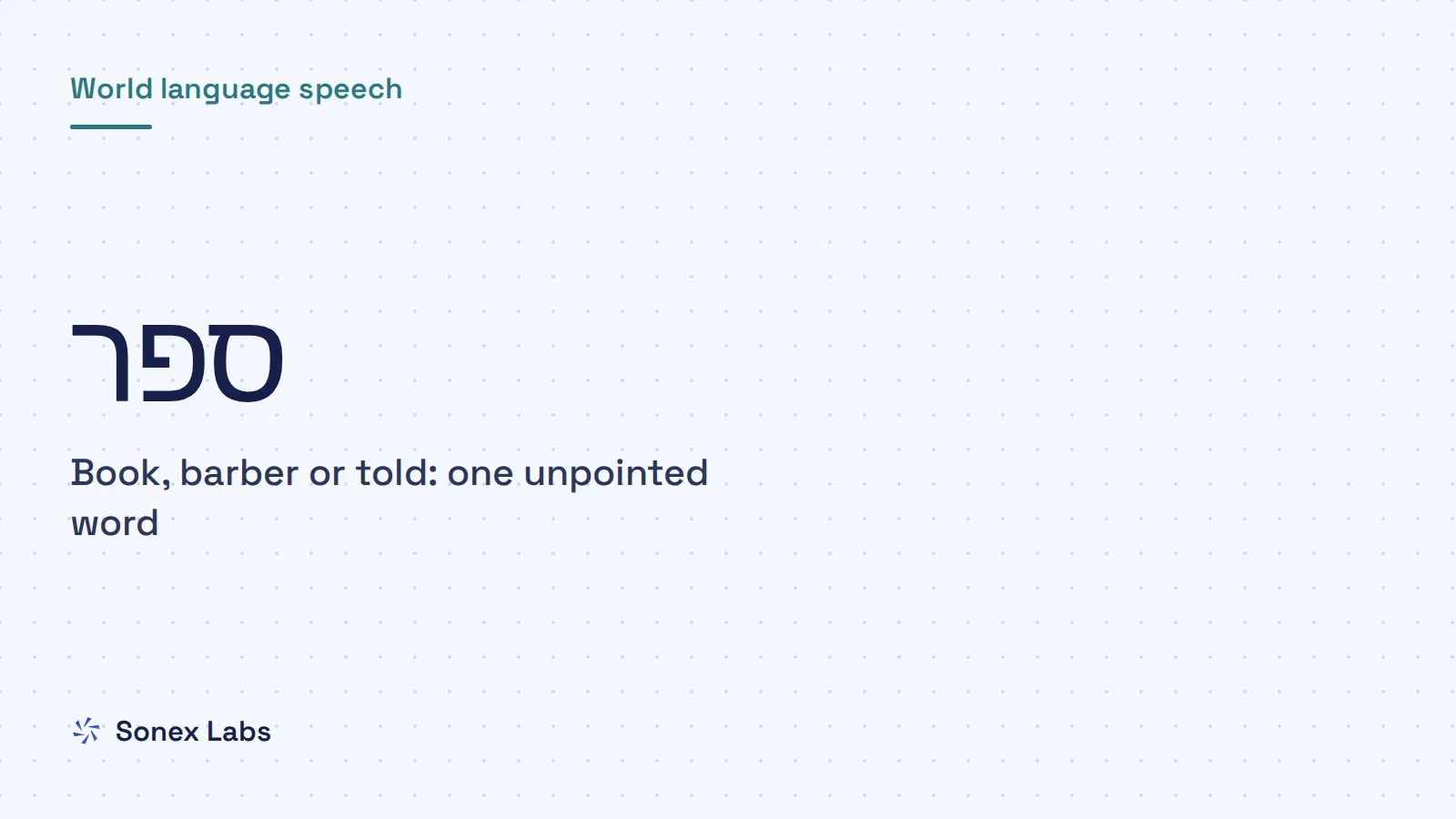
A reader fills the gaps from context. The letters ספר can be sefer (book), sapar (barber) or siper (told), and nobody reading a sentence about a library hesitates. A TTS engine has to commit to one reading before it produces any sound, and when it picks wrong the listener hears a different word, or a word that does not exist.
That last case is documented. In a Microsoft Q&A thread from November 2022, an Azure TTS user reported unpointed words read with vowel patterns that Hebrew does not have. One example was חדשנות (innovation) said with an o where the word has a u (Microsoft Q&A). In January 2023 Microsoft replied that "these errors are from model prediction" and that it would not fix sentences case by case. The thread has no accepted answer.
Gender, homographs and stress: the three guesses a Hebrew voice makes
Not all wrong guesses are equally bad. Some produce a slightly odd word that listeners forgive, while others change the meaning or offend the caller. Three kinds account for most of the errors that matter.
The gender of "you"
The guess that matters most on a call is gender. Hebrew marks it even in "you": לך is lekha (לְךָ) to a man and lakh (לָךְ) to a woman, and unpointed text shows no difference. A voice agent that reads every לך as lekha addresses half its callers as men, and callers notice at once.
Gender also appears in verbs and adjectives, including in the first person in some tenses, so the problem is not limited to one word. It is a writing problem as much as a pronunciation one, because the text itself has to choose a form before the voice can say it.
Homographs
Homographs are words spelled alike but pronounced differently. אוכל is okhel (food, or eating) and ukhal (I will be able), and דבר is davar (thing) or diber (spoke). In a reply such as "לא אוכל לאשר" (I won't be able to confirm), the wrong reading turns the sentence into nonsense, and a short reply gives the engine little context to choose from.
Names and loanwords are a related trap. Words the model rarely saw in training, such as a new brand or an unusual surname, have no context to resolve them at all.
Stress and the vocal shva
Stress is the guess that niqqud does not even solve. The Phonikud project, an open Hebrew pronunciation tool, adds its own marks for stress and for the vocal shva, because standard niqqud cannot tell some words apart (Phonikud). The shva is a vowel sign that is sometimes pronounced as a short e and sometimes silent. Phonikud's example is אורז, which is either rice or packing depending on which syllable is stressed.
This also explains why some Hebrew voices sound formal or old-fashioned. Phonikud's documentation notes that the spoken modern shva differs from the shva taught in grammar books, and a voice that follows every textbook rule can sound like a reading lesson on a phone call.
The same sentences with and without niqqud
Each set below sends one sentence to Pāṇini, Sonex Labs' TTS model, three ways: unpointed, with a single word pointed, and rephrased so nothing needs pointing. The first set is about gender: "I've just sent you a message with the payment link", addressed to a woman. The second is about אוכל: "Without an ID number I won't be able to confirm the change."
Sonex Labs has no voice recorded by a native Hebrew speaker. These samples are read by Liz, a platform voice recorded in English, so the accent is not Israeli: listen for the vowels and the gender of "you", not the accent. For an Israeli accent, a voice is cloned from a 10-second sample of a consenting native speaker, and the clone keeps that speaker's accent, as our guide to cross-language voice cloning and accent explains. The Hebrew text to speech page has further samples.
שלחתי לך עכשיו הודעה עם הקישור לתשלום.
שלחתי לָךְ עכשיו הודעה עם הקישור לתשלום.
הקישור לתשלום נשלח עכשיו בהודעה.
בלי מספר תעודת זהות לא אוכל לאשר את השינוי.
בלי מספר תעודת זהות לא אוּכַל לאשר את השינוי.
בלי מספר תעודת זהות אין לי אפשרות לאשר את השינוי.
What research offers: diacritic-free models and explicit pronunciation
Researchers are attacking the problem from two opposite directions. One teaches the model to read unpointed text the way people do, and the other spells out the pronunciation so the model has nothing left to guess.
Models that learn readings from context
Roth, Turetzky and Adi (Interspeech 2024) trained a Hebrew TTS model as a language model over speech units, fed with ordinary word pieces and trained on "in-the-wild weakly supervised data" (arXiv 2407.12206). They report that it beat the diacritic-based baselines they tested on both content and naturalness. The model learns readings from context, much as a human reader does, so it never needs niqqud at all.
Phonikud: spelling out the sounds
Phonikud converts Hebrew text to phonetic symbols in the International Phonetic Alphabet (IPA) for TTS, adding niqqud, stress and vocal shva on the way. Its paper, accepted to Interspeech 2026, reports that it predicts Hebrew phonemes more accurately than earlier methods, and that small local TTS models using it approach large proprietary systems (Kolani and others). The code is released under CC BY 4.0.
Both are research results, not tested phone-call products. Phonikud's own documentation lists formal-sounding niqqud, inconsistent stress and wrong predictions for names and non-Hebrew words as known limits. Its public roadmap from June 2025 asks for a better TTS model and much more hand-corrected data (issue 111). Treat these tools as components to evaluate, not as a guarantee.
Fixing Hebrew text written by an LLM
In a voice agent, a large language model (LLM) writes each reply and the TTS engine reads it aloud. The cheapest fix sits in the prompt, before any text reaches the voice. If your system knows the caller's gender, pass it to the model and ask for the matching forms. If it does not, ask the model to phrase around "you" with impersonal or passive forms, as in "הקישור נשלח" (the link was sent), which removes the most noticeable error without any niqqud.
For the words that remain ambiguous, ask the model to point that one word only, not the whole sentence. Fully pointed text tends to push a voice towards the formal register described above. Keep a short list in your own code of names and terms with the pointing or spelling you want, and apply it before the text goes to TTS.
Numbers and dates deserve the same care. Israel writes dates day first, so spell dates and amounts out in words rather than leaving 03/04 for the engine to interpret. Keep English brand names in Latin script, where a Hebrew reader expects them.
Testing before launch
Test the sentences callers will actually hear, not sample text. Export the 50 or so replies your agent says most often, including names, amounts and dates, and have a native speaker flag every gendered "you" and every word that could be read two ways. For each one, decide whether to rephrase it or point the word.
Then render the flagged sentences and have a native Israeli speaker listen on a real phone line, checking vowels, stress and gender. Repeat after any change to the prompt or the voice, since a new model version can resolve the same word differently. Our guide to testing a multilingual voice agent covers the wider process.
Hebrew and Arabic share the problem
Builders serving both Israel and Arab markets meet the same problem twice. Arabic is also written without most short vowels, and the same rules apply: rephrase, mark sparingly and test with native listeners, as our guide to Arabic TTS and tashkeel explains. Hebrew adds unmarked stress even in pointed text, while Arabic adds dialects that change the words themselves, and its numbers and dates have their own traps (Arabic numbers, prices and dates in TTS). Persian has a version of the same issue too (Farsi text to speech).
Sources
- Wikipedia: Niqqud (use in modern Israeli orthography, ktiv male)Secondary
- Microsoft Q&A: Text-to-Speech in Hebrew pronounces words that don't exist (November 2022)Secondary
- Roth, Turetzky and Adi, A Language Modeling Approach to Diacritic-Free Hebrew TTS (arXiv 2407.12206, Interspeech 2024)Official
- Phonikud repository: Hebrew text to IPA for TTS (GitHub)Official
- Kolani and others, Phonikud: Overcoming Phonetic Underspecification for Hebrew Text-To-Speech (arXiv 2506.12311, accepted to Interspeech 2026)Official
- Phonikud issue #111: next steps for high quality Hebrew TTS (June 2025)Official
Change log: 24 Oct 2026, Rewritten as one continuous guide: ktiv male and ktiv haser, the shva and formal-sounding voices explained in the body; the steps, checklist, FAQs, bullet list and flowchart folded into the sections they repeated